Trump Tariffs Shake Markets — Discover the Best Altcoins to Weather the Tariff Storm

bitcoinistPublié le 2025-07-08Dernière mise à jour le 2025-07-08

Résumé

If there’s one constant in crypto, it’s that Donald Trump will either pump the market to the moon or smash...

Trusted Editorial content, reviewed by leading industry experts and seasoned editors. Ad Disclosure

If there’s one constant in crypto, it’s that Donald Trump will either pump the market to the moon or smash it into the floor. This time, it’s the latter.

Trump’s latest round of tariffs – 25% on Japan and South Korea, plus vague threats to BRICS-aligned countries – have spooked investors.

The crypto market dipped 3.5%, Bitcoin flirted with dropping below $108K, and leveraged traders got flushed for $177M in liquidations.

But if you’ve been in this space long enough, you know this dip won’t last. The question is: where do you park your crypto bags when the storm clouds roll in?

We’ve rounded up the best altcoins for safety amidst Trump tariffs.

Trump’s Market Madness: Tariffs, Tweets, and Temporary Turbulence

Trump’s tariff tantrum came in the form of Truth Social posts and a flurry of letters to foreign leaders.

He’s hitting Japan and South Korea with 25% tariffs starting August 1, threatening 10% on BRICS countries, and trying to spin it all as a deficit-fixing genius.
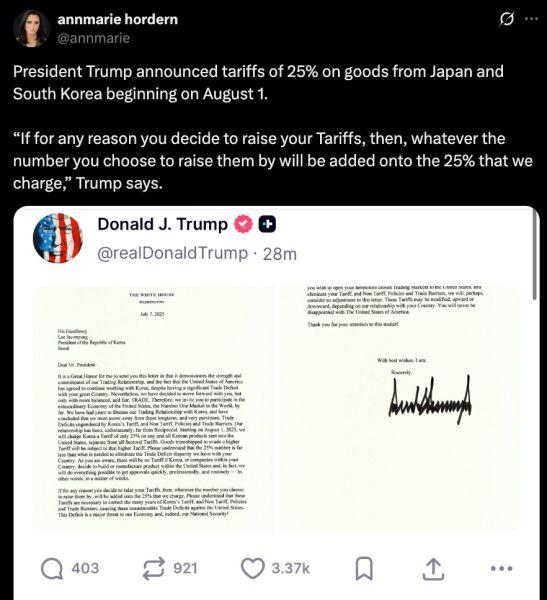
President Trump announced tariffs of 25% on goods from Japan and South Korea post on X.

Traders aren’t buying it.

Historically, Trump talks big, then backpedals – remember the last tariff showdown in April?

So the correct narrative would be: Bitcoin dipped to around $76K in April, then recovered to hit a new all-time high (ATH) just shy of $112 K in May.

The same pattern is likely here. But until the smoke clears, savvy investors are rotating into crypto presales and new crypto projects with utility, strong narratives, and room to grow.

1. Bitcoin Hyper ($HYPER) – The High-Speed Escape Hatch for Bitcoin Purists

With Trump rattling markets again through a new wave of tariffs, many investors are searching for assets that can thrive amid chaos – not just survive it.

That’s where Bitcoin Hyper ($HYPER) steps in. More than a token, Bitcoin Hyper is the first true Layer 2 built for Bitcoin, unlocking fast, cheap, and scalable transactions on top of the slow, legacy Bitcoin base layer.

Bitcoin Hyper presale.

Built on the Solana Virtual Machine (SVM), it gives devs, builders, and degens everything they love – blazing speed, near-zero gas fees, and full compatibility with Bitcoin and Solana.

In short: Bitcoin Hyper is where the action happens. Meme coins, payments, dApps, DeFi – it’s all finally possible on Bitcoin.

And at the core of it all? $HYPER, the native token fueling the ecosystem. It powers transactions, staking, governance, and access to future launches.

Right now you can buy $HYPER in the presale phase for just $0.012175, and it just passed the $2M raised milestone, signaling strong early momentum.

In a world where political noise keeps disrupting the markets, Bitcoin Hyper offers what Bitcoin was always meant to be – fast, useful, and unstoppable.

2. Best Wallet Token ($BEST) – The Smart Investor’s Shelter in a Storm

In moments like this, with Trump’s tariff threats rattling global markets and Bitcoin dipping, smart investors look for real utility.

Best Wallet Token ($BEST) offers exactly that. It’s the fuel behind Best Wallet, a sleek, secure, and highly functional multi-chain wallet built for both crypto newcomers and seasoned pros.

Unlike clunky legacy wallets like MetaMask, Best Wallet is part of a new generation. It combines fast token swaps, bridging, buying, and portfolio management – all inside a clean interface backed by Fireblocks’ MPC-CMP security tech.

There’s also a major advantage for early adopters: the $BEST presale is live exclusively inside the app, rewarding people with early access and lower costs.

The token is currently priced at $0.025295 and has already raised $13.7M, backed by a growing 70K+ user community and 50% monthly growth.

Best Wallet Upcoming Tokens feature

With powerful features like iGaming bonuses, staking perks, and exclusive presale access via Upcoming Tokens, it’s built to thrive even in shaky markets.

Analysts predict $BEST could hit $0.072 in 2025 and $0.62 by 2026 – not bad for a ‘safe’ play during tariff season.

3. Bitcoin Solaris ($BTC‑S) – Mining From Your Pocket While Markets Tremble

With Trump’s tariffs rattling crypto sentiment, Bitcoin Solaris ($BTC-S) is another altcoin that offers a compelling alternative – real utility built on Bitcoin’s legacy.

This Layer‑1 hybrid blockchain combines Proof‑of‑Work security with a Delegated Proof‑of‑Stake layer, giving people 10K TPS and sub‑2‑second transaction finality – versus Bitcoin’s sluggish 7 TPS and 60‑minute block times.

It cuts energy use by over 99%, making it both fast and green. But the real star is mobile mining. Through the upcoming Solaris Nova app, anyone can earn BTC‑S tokens on their phone, no ASICs required.

You just tap ‘start,’ and the app runs lightweight mining in the background, offering passive earnings and governance rights.

$BTC‑S is currently in Phase 11 of its presale at $5, with a launch set for $20. Over 13,650 participants have raised nearly $6M.

Bitcoin Solaris in presale.

In a nerve‑wracking market driven by Trump’s political noise, Bitcoin Solaris gives investors real issuing power – not just meme hype. It represents bitcoin’s evolution: scalable, accessible, and ready for action.

Don’t Let the Trump Dump Fool You

Tariffs come and go. Market jitters fade. But smart crypto plays. The ones with real use cases, clear narratives, and solid tokenomics stick around.

Whether you’re betting on hyper-deflation with Bitcoin Hyper, better wallets with Best Wallet Token, or sharper tools with Bitcoin Solaris, these three altcoins could help you ride out the Trump storm in style.

As always, remember this isn’t financial advice. Do your own research (DYOR) before investing in crypto.

Editorial Process for bitcoinist is centered on delivering thoroughly researched, accurate, and unbiased content. We uphold strict sourcing standards, and each page undergoes diligent review by our team of top technology experts and seasoned editors. This process ensures the integrity, relevance, and value of our content for our readers.

As a crypto writer, Bogdan’s responsibilities are split between researching and writing articles and entertaining the team with his humor bordering on the politically incorrect, an aspiring Bill Burr, if you will. Thanks to his 12+ years of writing experience in just as many fields, including tech, cybersecurity, modelling, fitness, crypto, and other topics-that-shall-not-be-named, he's become a genuine asset to the team. While his position as a senior writer at PrivacyAffairs thought him valuable lessons about the power of self-management, his entire writing career was and is an exercise in self-improvement. Now, he's ready to sink his teeth into crypto and teach people how to take control of their own money on the blockchain. With fiat as an eternally devaluing currency, Bitcoin and altcoins seem like the best-fitting alternative for Bogdan. Bogdan’s biggest professional accomplishment, aside from securing a position as a main writer for Bitcoinist, was his 5-year run as a writing manager at Blackwood Productions, where he coordinated a team of four writers. During that time, he learned the value of teamwork and that of creating a working environment that breeds efficiency, positivity, and friendship.

Lectures associées

Q-Day : Le compte à rebours avant que l'informatique quantique ne mette fin aux cryptomonnaies ?

**Q-Day et la Cryptographie : La Menace Quantique sur les Cryptomonnaies** L'avènement de l'ordinateur quantique tolérant aux fautes (CRQC) représente une menace existentielle pour les cryptomonnaies en raison de sa capacité à casser les algorithmes de chiffrement asymétrique actuels (comme ECDSA) via l'algorithme de Shor. Le "Q-Day", point critique où cette capacité devient pratique, est estimé entre 2035 et 2045. Les blockchains, par leur nature immuable et décentralisée, sont particulièrement vulnérables. Le risque est immédiat pour les actifs dont la clé publique est déjà exposée sur la chaîne (ex : certaines anciennes adresses Bitcoin). La migration vers la cryptographie post-quantique (PQC), comme les algorithmes basés sur les réseaux (ML-KEM/DSA) ou les hachages (SLH-DSA), est donc urgente. Cependant, cette transition est extrêmement complexe : * **Pour Bitcoin** : Le défi principal est la gouvernance et la gestion sociale des UTXO historiques à risque. Une mise à jour progressive par soft fork est privilégiée, mais elle se heurte à l'inflation de la taille des signatures PQC et à un dilemme éthique sur le gel éventuel des actifs non migrés. * **Pour Ethereum** : La migration nécessite une refonte à plusieurs niveaux (comptes, consensus, couche de données). La stratégie repose sur l'agilité cryptographique, l'abstraction de compte pour les utilisateurs et des solutions techniques comme leanXMSS couplé à un zkVM pour compresser les grandes signatures. La fenêtre d'action confortable est estimée à 5-8 ans. L'industrie doit se coordonner à l'échelle de l'écosystème (protocoles, portefeuilles, bourses). La menace quantique n'anéantira pas la blockchain, mais force une reconfiguration fondamentale de ses bases cryptographiques, testant sa résilience technique et sociale.

marsbitIl y a 6 h

Q-Day : Le compte à rebours avant que l'informatique quantique ne mette fin aux cryptomonnaies ?

marsbitIl y a 6 h

Compte à rebours pour Q-Day : L'informatique quantique va-t-elle mettre fin aux cryptomonnaies ?

La cryptographie moderne est vulnérable face aux ordinateurs quantiques, en particulier l'algorithme de Shor, menaçant les systèmes actuels comme RSA et ECC. Le « Q-Day », moment où les ordinateurs quantiques pourront casser ces cryptosystèmes, est estimé entre 2035 et 2045. La cryptographie post-quantique (PQC) se développe, avec des algorithmes comme ML-KEM, ML-DSA et SLH-DSA normalisés par le NIST, pour garantir une sécurité durable. Dans le domaine de la blockchain, le Bitcoin et l'Ethereum sont particulièrement exposés. Pour Bitcoin, le risque principal concerne les UTXO dont la clé publique est déjà exposée sur la chaîne. La migration vers des algorithmes PQC se heurte à des défis techniques (signatures plus volumineuses) et à un dilemme de gouvernance concernant les fonds dormants. Ethereum, grâce à son agilité cryptographique et à l'abstraction de compte, pourrait adopter une approche plus graduelle, notamment via ses L2. La transition ne sera pas uniquement technique, mais nécessitera un large consensus social et une coordination à l'échelle de l'écosystème. Le véritable enjeu n'est pas l'absence de solutions, mais la capacité de l'écosystème à migrer de manière coordonnée avant que les risques quantiques ne deviennent une réalité économique. La fenêtre d'action confortable est estimée à 5-8 ans.

链捕手Il y a 6 h

Compte à rebours pour Q-Day : L'informatique quantique va-t-elle mettre fin aux cryptomonnaies ?

链捕手Il y a 6 h

Trading

Spot
活动图片