UK Crackdowns On Crypto Tax Evasion: Investors To Face Fines Starting 2026

bitcoinistPublié le 2025-07-08Dernière mise à jour le 2025-07-08

Résumé

Ahead of the upcoming regulatory overhaul, UK authorities have introduced a new set of reporting rules to ensure crypto investors...

Trusted Editorial content, reviewed by leading industry experts and seasoned editors. Ad Disclosure

Ahead of the upcoming regulatory overhaul, UK authorities have introduced a new set of reporting rules to ensure crypto investors are not deliberately evading taxes, including fines for those who fail to comply with the new requirements.

Authorities To Address Tax Evasion

On Monday, the UK HM Revenue and Customs (HMRC) office announced that, starting January 2026, crypto holders will be required to provide personal data to their digital asset service providers to validate that they are not evading taxes.

The new rules, known as the Cryptoasset Reporting Framework, require crypto service providers to collect and report investors’ names, addresses, date of birth, tax residence, national insurance number or tax reference, and a summary of their crypto transactions.

Based on the collected information, the HMRC expects to identify those who haven’t been paying taxes on their crypto profits correctly and bring in money to fund vital public services, including frontline nurses, police, and teachers.

Investors who don’t comply with HMRC’s efforts to address non-compliance and tax evasion risk fines of up to £300, or around $409. Meanwhile, crypto service providers that fail to report the required information or submit inaccurate or incomplete reports could also be fined.

The initiative is estimated to raise up to £315 million, or $477 million, in tax revenue by April 2030, which could fund more than 10,000 newly qualified nurses for a year, the HMRC affirmed.

Additionally, they expect to align the UK with the international standard developed by the Organization for Economic Co-operation and Development (OECD), enabling tax authorities to share information across participating countries.

Member of Parliament and Exchequer Secretary to the Treasury James Murray affirmed that authorities are “going further and faster to crack down on tax dodgers as we close the tax gap and deliver on our Plan for Change.”

He considers that, “By ensuring everyone pays their fair share, the new crypto reporting rules will make sure tax dodgers have nowhere to hide, helping raise the revenue needed to fund our nurses, police and other vital public services.

UK’s Crypto Regulatory Overhaul

HMRC’s Director General for Customer Strategy and Tax Design, Jonathan Athow, noted that the upcoming rules aren’t a new taxation regime, as investors are already expected to pay the due tax if they make a profit when selling, swapping, or transferring crypto assets.

“These new reporting requirements will give us the information to help people get their tax affairs right,” he highlighted, urging crypto investors to have the required data to hand to help “avoid penalties in the future.”

The Tax authorities’ new requirements follow the UK’s financial watchdog efforts to establish a more comprehensive regulatory framework for digital assets starting next year.

In May, the Financial Conduct Authority (FCA) released a Discussion Paper on the features of the upcoming crypto regime as part of the financial authority’s crypto roadmap to expand from the current regime to a more comprehensive regulatory framework.

As reported by Bitcoinist, the FCA requested the public’s feedback on regulations related to trading platforms, intermediaries, staking, lending, borrowing, and decentralized finance.

Previously, the HM Treasury also published a draft and an explainer document detailing the intended policy outcomes of proposed provisions to establish a complete regime for digital assets.

The proposed rules are expected to bring exchanges, dealers, and agents into regulatory limits to crack down “on bad actors while supporting legitimate innovation,” and set clear transparency, consumer protection, and operational resilience standards, similar to traditional financial institutions.
Crypto, Bitcoin, BTC, BTCUSDT

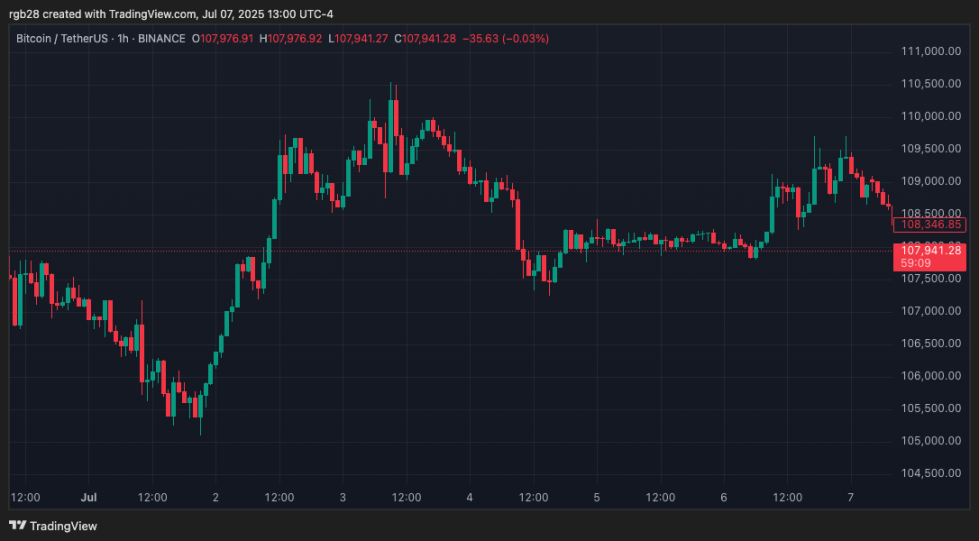
Bitcoin (BTC) trades at $108,941 in the one-week chart. source: BTCUSDT on TradingView
Featured Image from Unsplash.com, Chart from TradingView.com
Editorial Process for bitcoinist is centered on delivering thoroughly researched, accurate, and unbiased content. We uphold strict sourcing standards, and each page undergoes diligent review by our team of top technology experts and seasoned editors. This process ensures the integrity, relevance, and value of our content for our readers.

Rubmar is a crypto enthusiast who likes learning and improving constantly. She enjoys reporting on the latest news and developments in the crypto industry. Rubmar also enjoys scrapbooking, crafting, simulation games, and watching football.

Lectures associées

Q-Day : Le compte à rebours avant que l'informatique quantique ne mette fin aux cryptomonnaies ?

**Q-Day et la Cryptographie : La Menace Quantique sur les Cryptomonnaies** L'avènement de l'ordinateur quantique tolérant aux fautes (CRQC) représente une menace existentielle pour les cryptomonnaies en raison de sa capacité à casser les algorithmes de chiffrement asymétrique actuels (comme ECDSA) via l'algorithme de Shor. Le "Q-Day", point critique où cette capacité devient pratique, est estimé entre 2035 et 2045. Les blockchains, par leur nature immuable et décentralisée, sont particulièrement vulnérables. Le risque est immédiat pour les actifs dont la clé publique est déjà exposée sur la chaîne (ex : certaines anciennes adresses Bitcoin). La migration vers la cryptographie post-quantique (PQC), comme les algorithmes basés sur les réseaux (ML-KEM/DSA) ou les hachages (SLH-DSA), est donc urgente. Cependant, cette transition est extrêmement complexe : * **Pour Bitcoin** : Le défi principal est la gouvernance et la gestion sociale des UTXO historiques à risque. Une mise à jour progressive par soft fork est privilégiée, mais elle se heurte à l'inflation de la taille des signatures PQC et à un dilemme éthique sur le gel éventuel des actifs non migrés. * **Pour Ethereum** : La migration nécessite une refonte à plusieurs niveaux (comptes, consensus, couche de données). La stratégie repose sur l'agilité cryptographique, l'abstraction de compte pour les utilisateurs et des solutions techniques comme leanXMSS couplé à un zkVM pour compresser les grandes signatures. La fenêtre d'action confortable est estimée à 5-8 ans. L'industrie doit se coordonner à l'échelle de l'écosystème (protocoles, portefeuilles, bourses). La menace quantique n'anéantira pas la blockchain, mais force une reconfiguration fondamentale de ses bases cryptographiques, testant sa résilience technique et sociale.

marsbitIl y a 6 h

Q-Day : Le compte à rebours avant que l'informatique quantique ne mette fin aux cryptomonnaies ?

marsbitIl y a 6 h

Compte à rebours pour Q-Day : L'informatique quantique va-t-elle mettre fin aux cryptomonnaies ?

La cryptographie moderne est vulnérable face aux ordinateurs quantiques, en particulier l'algorithme de Shor, menaçant les systèmes actuels comme RSA et ECC. Le « Q-Day », moment où les ordinateurs quantiques pourront casser ces cryptosystèmes, est estimé entre 2035 et 2045. La cryptographie post-quantique (PQC) se développe, avec des algorithmes comme ML-KEM, ML-DSA et SLH-DSA normalisés par le NIST, pour garantir une sécurité durable. Dans le domaine de la blockchain, le Bitcoin et l'Ethereum sont particulièrement exposés. Pour Bitcoin, le risque principal concerne les UTXO dont la clé publique est déjà exposée sur la chaîne. La migration vers des algorithmes PQC se heurte à des défis techniques (signatures plus volumineuses) et à un dilemme de gouvernance concernant les fonds dormants. Ethereum, grâce à son agilité cryptographique et à l'abstraction de compte, pourrait adopter une approche plus graduelle, notamment via ses L2. La transition ne sera pas uniquement technique, mais nécessitera un large consensus social et une coordination à l'échelle de l'écosystème. Le véritable enjeu n'est pas l'absence de solutions, mais la capacité de l'écosystème à migrer de manière coordonnée avant que les risques quantiques ne deviennent une réalité économique. La fenêtre d'action confortable est estimée à 5-8 ans.

链捕手Il y a 6 h

Compte à rebours pour Q-Day : L'informatique quantique va-t-elle mettre fin aux cryptomonnaies ?

链捕手Il y a 6 h

Trading

Spot
活动图片