29 Million Impressions, Only $71 Earned: How to Make Money from Traffic on X Platform?

marsbitPublié le 2025-12-26Dernière mise à jour le 2025-12-26

Résumé

An experiment on X platform revealed that chasing high exposure metrics does not translate to meaningful revenue. After generating 28.9 million impressions and gaining 37.5k followers through aggressive tactics like spamming comments and piggybacking on popular accounts, the author earned only $71.49. The key insight is that exposure is a vanity metric—it doesn’t drive earnings. What matters is engagement from paid verified users. Comments and reposts from premium users carry the most weight, while likes and free user interactions contribute little. The platform’s algorithm filters out bot-driven activity, making inflated exposure worthless. The author also experienced negative side effects: bot followers diluted audience quality, reduced trust with the algorithm, and increased the risk of being flagged as spam. The recommended strategy shifts focus to quality over quantity: aim for 3-5% engagement rates, prioritize comments from verified users (45-50% of total followers), and create original content. Sustainable monetization comes from building a genuine community, not chasing empty metrics.

Written by: MAD Vincent

Compiled by: Chopper, Foresight News

I did exactly what they said: frantically spammed comments, closely followed top accounts to ride on their traffic, and jumped on every trending topic, chasing impressions like chips in a bull market.

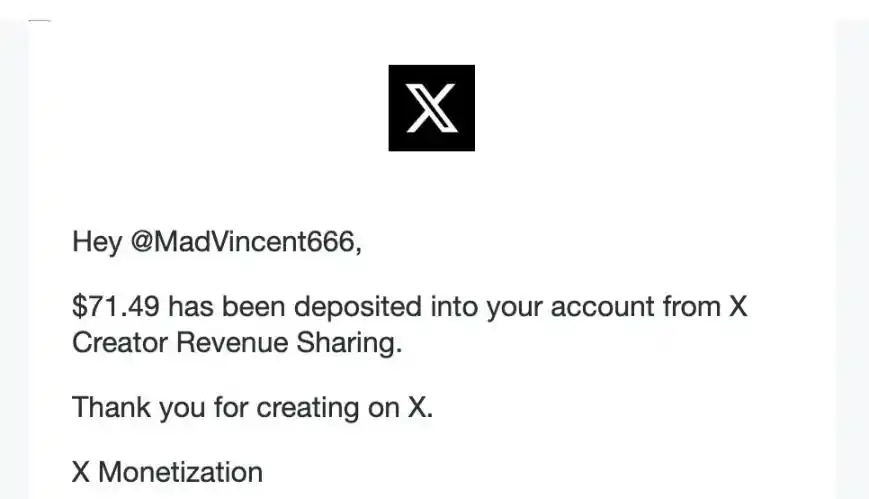
After 29 million impressions, the X platform paid me $71.49.

This is a warning. As of 2025, those still chasing impressions on the X platform are neither seizing the initiative nor working hard—they are merely the exit liquidity for bot traffic.
The Lie Everyone Believes

At some point, the crypto community (CT) reached a consensus: "The higher the impressions, the more money you make." This was half-true in the past. But by 2025, it has become a complete fallacy.

Today, impressions are nothing but a vanity metric: they look glamorous and addictive but are utterly useless for actual earnings. They can make your data panel as beautiful as a bull market chart, but the corresponding bank deposit is pitifully small, akin to a forgotten small wallet.

I learned this lesson the hard way.
My Personal Experiment (A.K.A. How I Got Rugged)

In mid-December 2025, I launched this aggressive traffic experiment: posting over 200 comments daily, specifically targeting top accounts' posts to蹭热度 (ride on their popularity), without limiting myself to any vertical, aiming for an all-out "indiscriminate bombardment."

Movies, gaming, politics, cryptocurrency, memes, sports... as long as it was a hot topic, I jumped in to comment.

Soon, my actions echoed across the platform: "Bro, I see you everywhere," "The algorithm must love you," "This data is explosive growth."

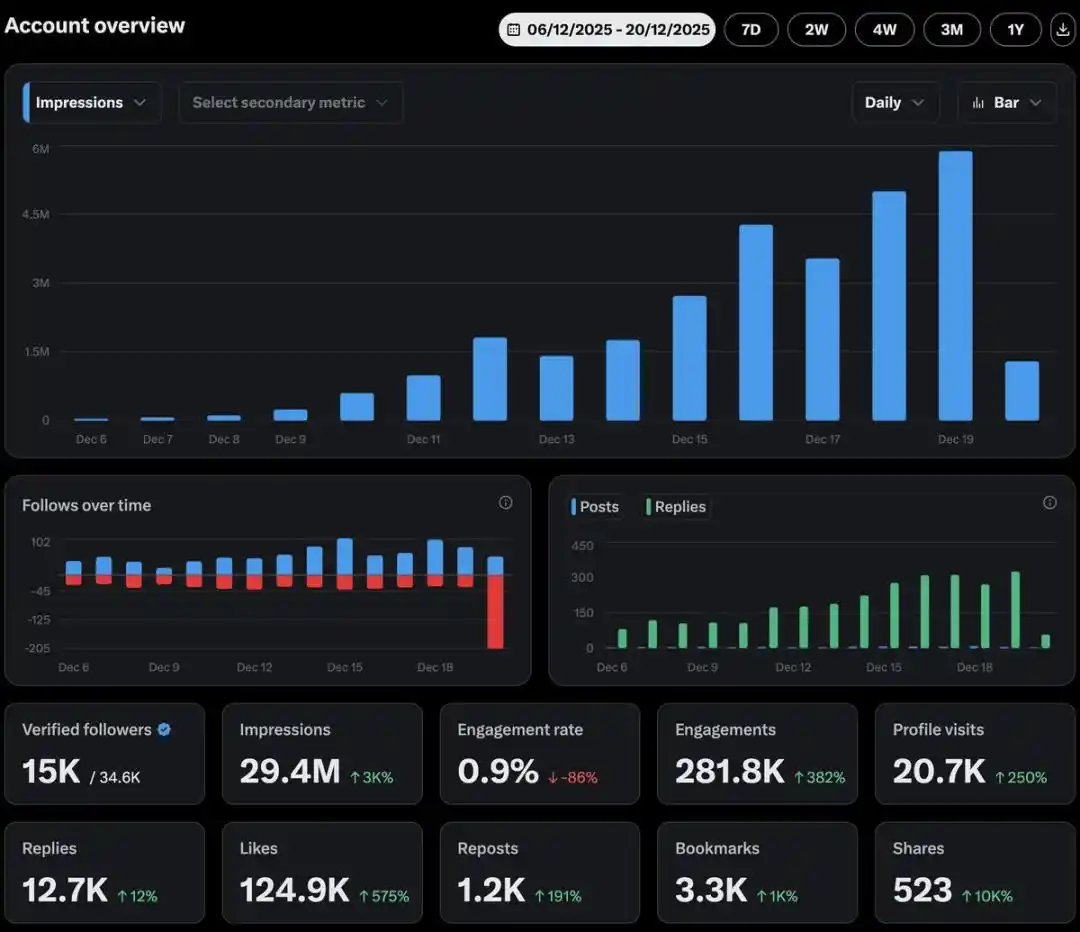
Now, let's look at the specific results: 28.9 million impressions, 267.7k engagements, 119.5k likes, 11.8k comments, 3.1k bookmarks, 20k profile visits, 37.5k followers, with verified users accounting for about 41%.

On average, I only posted 4 original pieces of content per day, with the rest of the traffic全靠 "comment section蹭热度 (riding on popularity)." Looking solely at the data panel, it was a crushing advantage. But when payday came, the deposit was only $71.49.

It was then that I fully understood: impressions don't make money; high-quality interactions from paying users are what matter.

The monetization logic of the X platform has long changed. It no longer rewards exposure but rather who interacts with you.

If your engagement data doesn't come from paying verified users, it's no different from having no engagement at all.

The Real Rules of X Platform Monetization in 2025

There's no mystery behind this; it's just that many are unwilling to accept reality. The real monetization rules are as follows.

Only engagement types from paying verified users count towards monetization: comments, reposts, bookmarks, likes, and the engagement must occur within monetizable reply posts.

Some engagement types are无效 for monetization: free user engagement, bot traffic, skyrocketing impressions without paying user participation, "fake viral" posts without paying user engagement.

One comment from a paying verified user might be worth far more than 100 bot likes.

Additionally, engagement has varying weights; not all are equal. Comments and reposts carry the highest weight, followed by bookmarks, with likes being the lowest.

So, if your engagement data shows the following characteristics: many likes, few comments, low verified user ratio—then your account may look popular but has no monetization value.

The Unmentioned Bot Traffic Trap

Riding on the popularity of top accounts' comment sections seems like a shortcut to gaining followers, but it's actually a distribution engine for bot traffic.

Here's what really happens: your comment gets pushed to a bot network → impressions skyrocket → engagement data appears healthy → at settlement, the platform filters out all invalid traffic.

This is why the absurd result of "29 million impressions, only $71 earned" occurs. This isn't a system glitch; it's the precise execution of platform rules.

This Playstyle Is Ruining Your Account

This is not only an extremely low ROI practice but also causes irreversible damage to your account.

Bot Follower Pollution

In just a few days, my account gained over 2500 bot followers. These bots lower:

  • The account's verified user ratio

  • The platform's trust rating for you

  • Future settlement amounts

Audience Dilution

Your followers are no longer a targeted audience but have become worthless "noise." The platform understands this, advertisers understand this, and ultimately, your earnings will reflect this directly.

Algorithmic Downgrade Penalty

Posting 200+ comments daily →极易触发限流 (easily triggers rate-limiting). Content lacks vertical focus →无法向算法传递清晰的账号标签 (unable to convey clear account labels to the algorithm). Ultimately, your account will be flagged by the algorithm as a "suspected spam account."

Creator Burnout

You think you're dominating the platform's hot list, but then the bank deposit notification hits you like a ton of bricks. Most creators give up at this very moment.

What I Did

I completely overturned my previous strategy: cleaned up 2500 bot followers, removed 5000 zombie followers, stopped the comment-section popularity riding, and focused on building a genuine follower community.

In the short term, account metrics确实下滑了 (did decline), but the long-term health of the account is recovering.

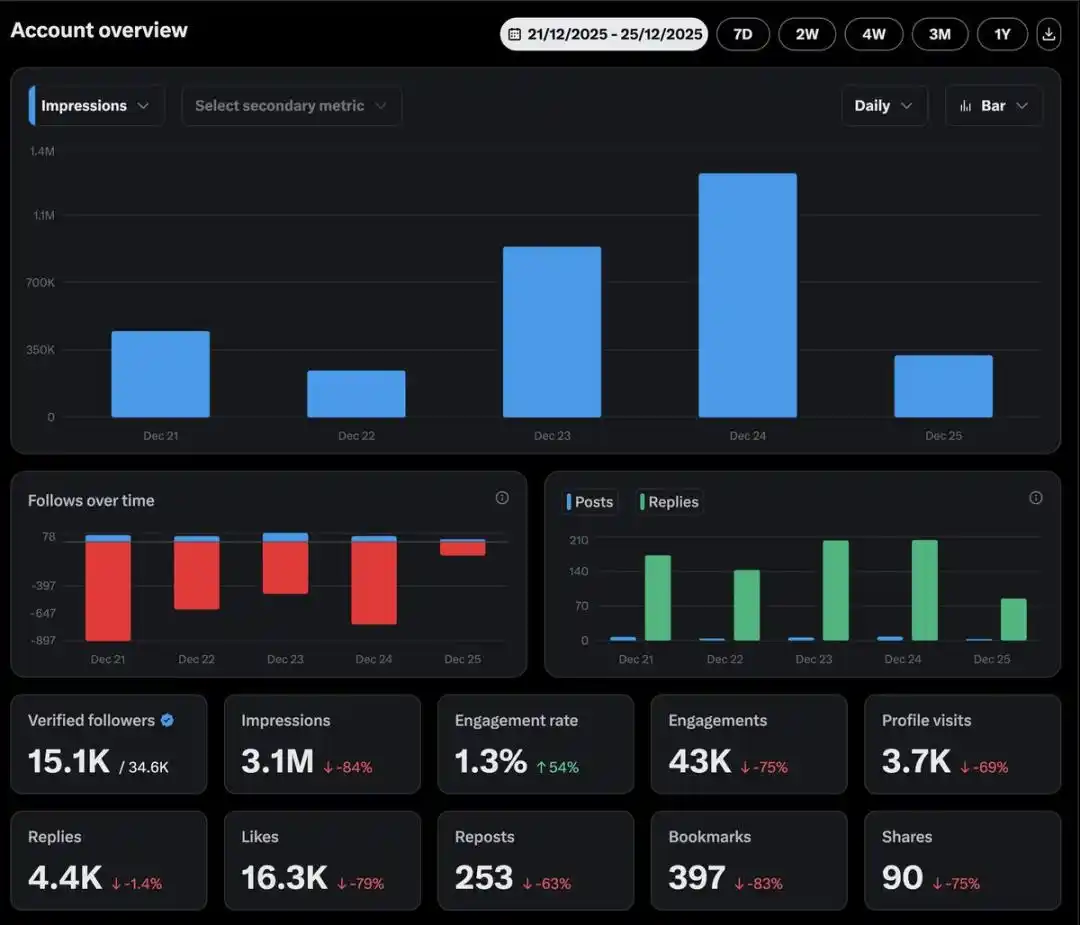
In the next settlement cycle, my account data showed new characteristics: lower impressions, higher quality engagement (check the engagement rate percentage), more precise follower growth, and significantly reduced creative pressure.
The Core Metrics Actually Worth Focusing On

If you want to make money on the X platform, aim for the following goals:

  • 3%-5% engagement rate

  • High-engagement posts dominated by comments

  • 45%-50% verified user ratio

  • Consistent output of original content

Having fewer impressions is okay; having high-quality user interaction is key. Achieve these, and you'll go from "Why are my earnings so terrible?" to "So this is how you achieve stable monetization."

The Final Truth

Impressions are like the siren's song: they make you think you've seized the initiative, make you feel like you're the platform's focus, and give you an illusion of "importance."

But they don't bring a single cent of profit. What monetizes is high-quality interaction from paying users. In 2025, the X platform will not reward "traffic speculators"; it will only reward "content builders."


Questions liées

QWhat was the author's total earnings from 29 million impressions on X platform?

AThe author earned only $71.49 from 29 million impressions on the X platform.

QAccording to the article, what is the key factor for actual monetization on X platform in 2025?

AHigh-quality interactions from paid verified users, not just high impression counts, are the key to actual monetization.

QWhat negative consequences did the author experience from chasing impressions via comment spamming?

AThe author gained over 2500 bot followers, diluted their audience, risked algorithm downgrades, and experienced psychological burnout.

QWhat types of user interactions are considered most valuable for monetization on X platform?

AComments and reposts from paid verified users carry the highest weight for monetization, followed by bookmarks, with likes being the least valuable.

QWhat core metrics should creators focus on to achieve stable earnings on X platform according to the article?

ACreators should aim for a 3%-5% engagement rate, high-quality interactions like comments, 45%-50% verified user ratio, and consistent original content output.

Lectures associées

BREAKING : Mastercard ouvre son réseau de paiement mondial aux crypto-monnaies — Quelles altcoins font partie de l'accord ?

**Mastercard ouvre son réseau mondial de paiement à la crypto.** Le 3 juin, Mastercard a annoncé élargir son infrastructure de règlement mondial pour prendre en charge le règlement sur chaîne via des stablecoins réglementés. Cela permet pour la première fois de régler les transactions par carte 24h/24 et 7j/7, y compris les week-ends et jours fériés. **Stablecoins et blockchains sélectionnés.** Six stablecoins réglementés sont pris en charge dans un premier temps : l'USDC de Circle, le PYUSD de PayPal, l'USDG et l'USDP émis par Paxos, le RLUSD de Ripple et le SoFiUSD de SoFi. Le règlement s'effectuera sur huit réseaux blockchain : Ethereum, Solana, Polygon, Base, Arbitrum, XRP Ledger, Canton et Tempo. **Changements en back-end uniquement.** Cette annonce concerne la couche de règlement, pas une modification des produits pour les consommateurs. Les émetteurs et acquéreurs du réseau Mastercard peuvent désormais choisir de régler les transactions par carte en utilisant ces stablecoins sur chaîne, en parallèle des processus traditionnels en monnaie fiduciaire. Aucun changement n'est requis pour le titulaire de la carte. **Avantages clés.** L'infrastructure backend de compensation et de finalisation des transactions peut désormais fonctionner en continu sur des blockchains, éliminant les interruptions dues aux horaires bancaires, fermetures de week-end et jours fériés, une source historique de friction. **Partenaires et déploiement.** Les premiers partenaires incluent ARQ, CBW Bank, Cross River, Lead Bank et Nuvei. Le déploiement initial cible les États-Unis et l'Amérique latine avant une expansion plus large d'ici 2026. **Une validation institutionnelle majeure.** Ce déploiement en conditions réelles (et non comme un pilote) par le deuxième plus grand réseau de cartes au monde représente la validation institutionnelle la plus claire à ce jour pour l'économie des stablecoins, selon l'annonce.

bitcoinistIl y a 2 h

BREAKING : Mastercard ouvre son réseau de paiement mondial aux crypto-monnaies — Quelles altcoins font partie de l'accord ?

bitcoinistIl y a 2 h

Le Rallye Qui N'a Pas Eu Lieu

Le marché du Bitcoin subit une pression significative dans un contexte macroéconomique plus strict, avec des anticipations de resserrement de la Fed et un retrait massif des ETF spot américains. Le prix, en baisse de 13% à environ 67 000$, est repassé sous la moyenne du marché (True Market Mean à 77,8k$), confirmant la persistance du régime de marché baissier. Les indicateurs on-chain se détériorent : la base de coût des détenteurs à court terme est inférieure à la moyenne clé, signe d'un marché baissier avancé. Le ratio des profits/pertes réalisés s'est effondré, montrant une dominance des ventes à perte. Les nouveaux acheteurs, notamment ceux entrés entre 78k$ et 82k$, sont sous pression. Hors-chaîne, le prix a été rejeté à la base de coût moyenne des ETF (~83k$), désormais une résistance. Les flux spot sont nettement négatifs, indiquant une domination des vendeurs. Bien qu'un événement de liquidation de positions longues ait réduit l'effet de levier, la demande spot durable reste absente. Les marchés d'options reflètent une prudence persistante, avec une demande pour une protection contre la baisse et une prime de volatilité élevée, sans pour autant signaler un point de capitulation majeur. En conclusion, le marché reste fragile, avec une faiblesse structurelle, une offre provenant d'investisseurs piégés et un manque de demande d'achat solide, le laissant vulnérable à d'autres corrections au sein de la structure baissière plus large.

insights.glassnodeIl y a 4 h

Le Rallye Qui N'a Pas Eu Lieu

insights.glassnodeIl y a 4 h

WLFI lance l'alerte : Les portefeuilles sous sanctions pourraient bloquer les transferts de crypto

Les sénateurs américains Elizabeth Warren et Jack Reed surveillaient déjà World Liberty Financial (WLFI) avant l'avis de conformité de mardi, ayant précédemment demandé aux autorités d'examiner si des adresses liées à la Russie, à la Corée du Nord et au mélangeur de confidentialité Tornado Cash avaient contourné les contrôles de la présale du projet. WLFI a rejeté ces allégations, affirmant appliquer des vérifications strictes contre le blanchiment d'argent et d'identité. Cependant, le projet a admis que ses contrats intelligents intègrent des pouvoirs codés pour geler, restreindre ou brûler les soldes des portefeuilles, ce qui suscite des interrogations sur son positionnement dans la finance décentralisée (DeFi). L'avertissement de conformité publié mardi sur X indique clairement que les transferts impliquant des personnes, entités ou adresses de portefeuille sous sanctions peuvent être retardés, restreints ou rejetés. WLFI justifie ces contrôles par la nécessité de respecter les obligations réglementaires. Cet avis est intervenu le même jour où le Département du Trésor américain a pris des sanctions contre plusieurs plateformes cryptographiques iraniennes, dont le plus grand échange, Nobitex, accusé d'avoir traité des transactions pour le Corps des gardiens de la révolution islamique. Le Trésor affirme que le régime iranien utilise les actifs numériques pour contourner les sanctions. WLFI exhorte ses utilisateurs à vérifier que leurs fonds et adresses n'ont aucun lien avec des activités interdites avant tout transfert, et poursuivra son examen des transactions pour les risques liés aux sanctions. Cette posture de conformité crée une tension avec l'image publique du projet, car si la couche blockchain est décentralisée, l'application doit respecter les règles fédérales.

bitcoinistIl y a 5 h

WLFI lance l'alerte : Les portefeuilles sous sanctions pourraient bloquer les transferts de crypto

bitcoinistIl y a 5 h

Trading

Spot
Futures
活动图片