Over the past few weeks, we’ve shipped a series of customer‑driven upgrades to the Token Terminal API. In this post, you’ll get a quick tour of the changes—along with concrete, real‑world examples that show how teams are already putting our API to work.
New: Breakdown API useful for building MCP servers
AI is everywhere, it seems. At Token Terminal, our product team has been deep in the weeds on integrating AI first into the way we build our product. As part of that focus, we’ve been iterating internally and with customers on MCP servers (think of them as LLM-friendly API wrappers), and we’ve shipped a few internal APIs to make it easier to work with our data.
The new breakdown API helps developers, analysts, and AI agents break down standardized metrics into more digestible chunks — particularly useful for token-constrained LLMs. For instance, you can break down Uniswap’s fee data by chain and aggregate it into monthly sums over the past 180 days. Instead of multiple API calls and parsing hundreds of data points, a single request now returns a clean, structured response for each chain.
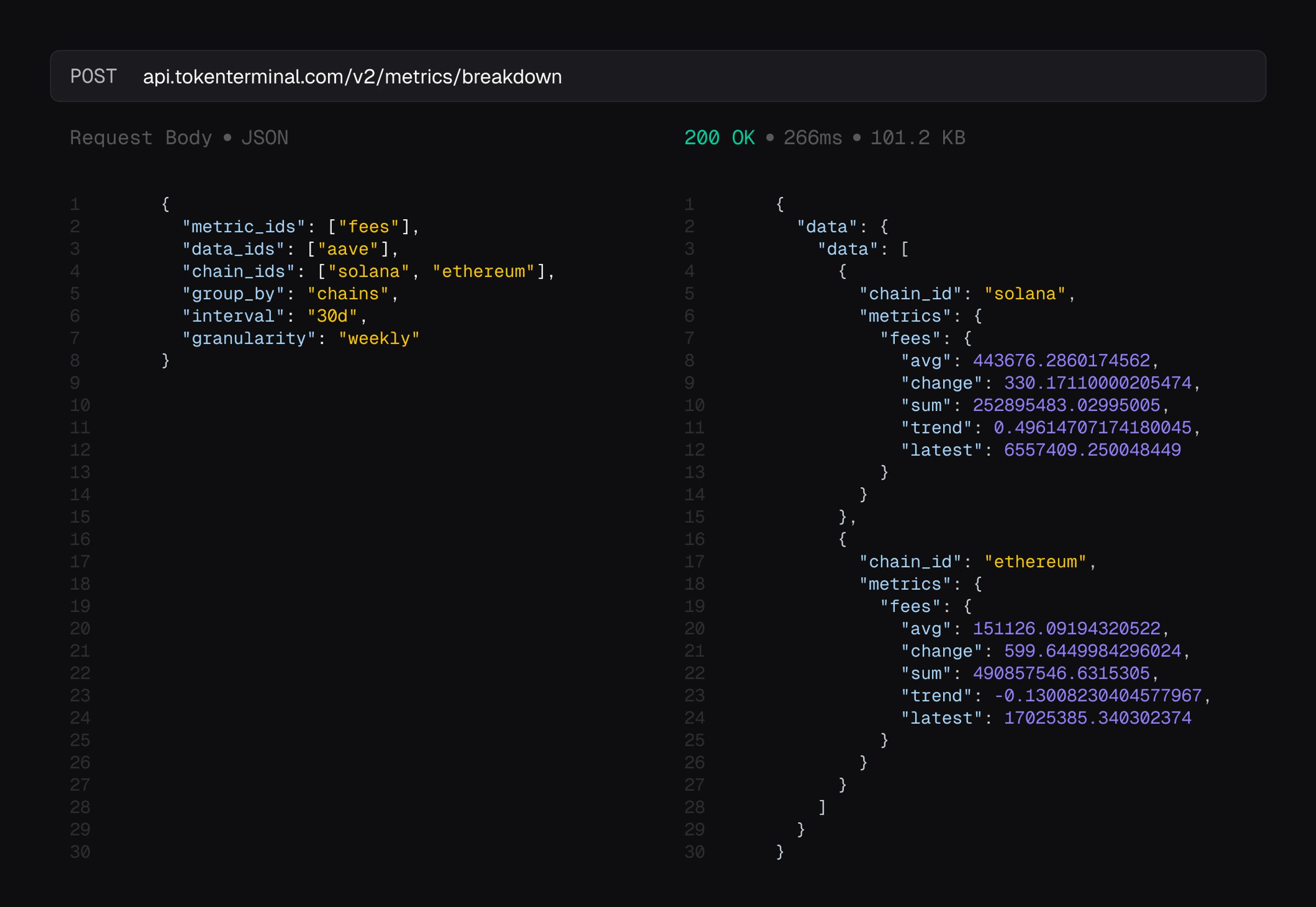
As we’ve been revamping our product UI wthis new endpoint has become a go-to for pulling specific aggregations — like sums or averages — over defined time periods. We’ve also supported customers building in the AI space by helping them adopt this lighter API footprint, which keeps token usage low when interacting with different models.
To learn more, check out our docs and our new best practices guide on optimizing applications that reference Token Terminal data..
New: Product Data is Live in Explorer and the API
Thanks to our new product breakdowns, you can explore data for projects by the products that makes up their business. For stablecoin issuers like Circle and Tether, you can now compare data across their different stablecoin and tokenized asset products such as USDC and USDT
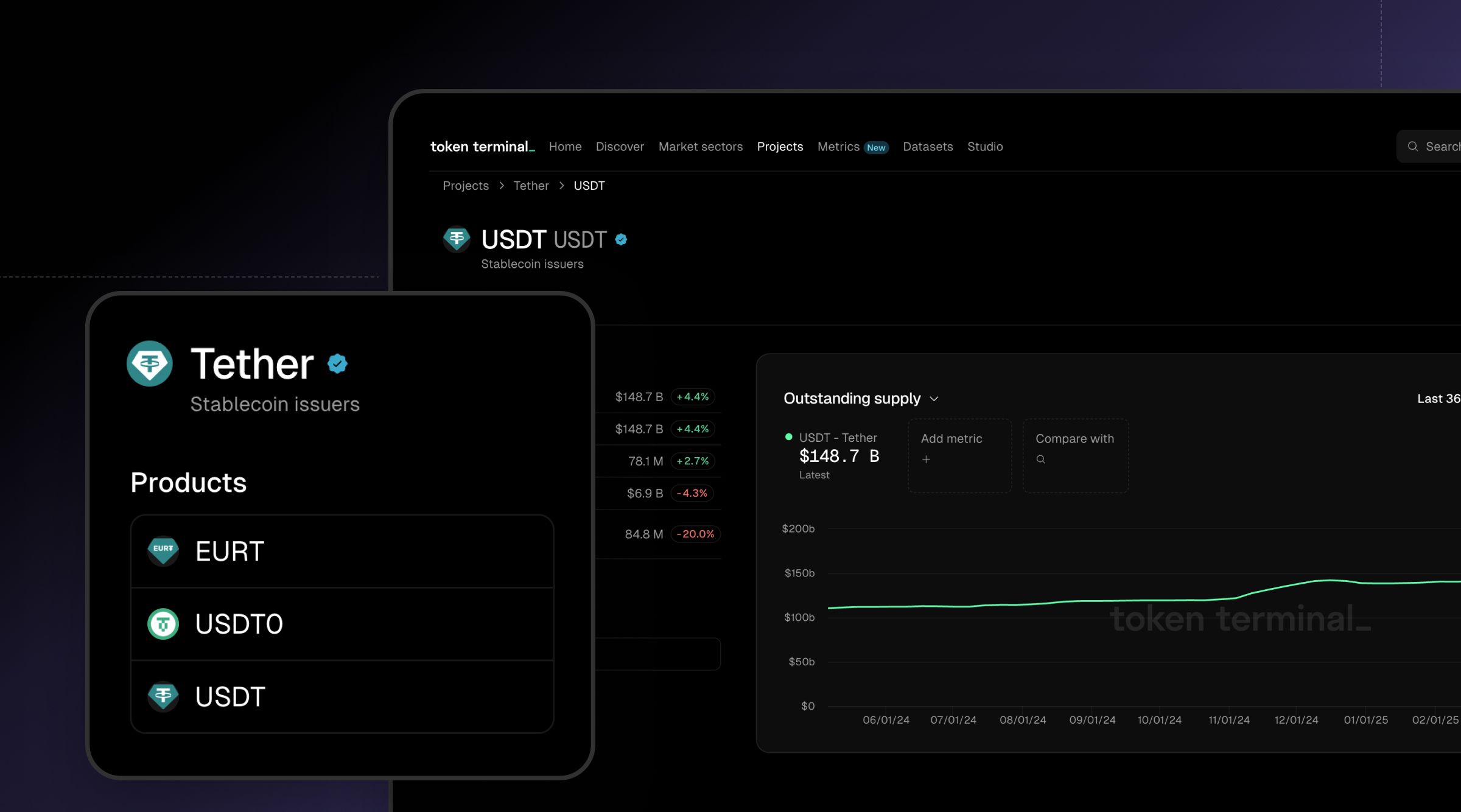
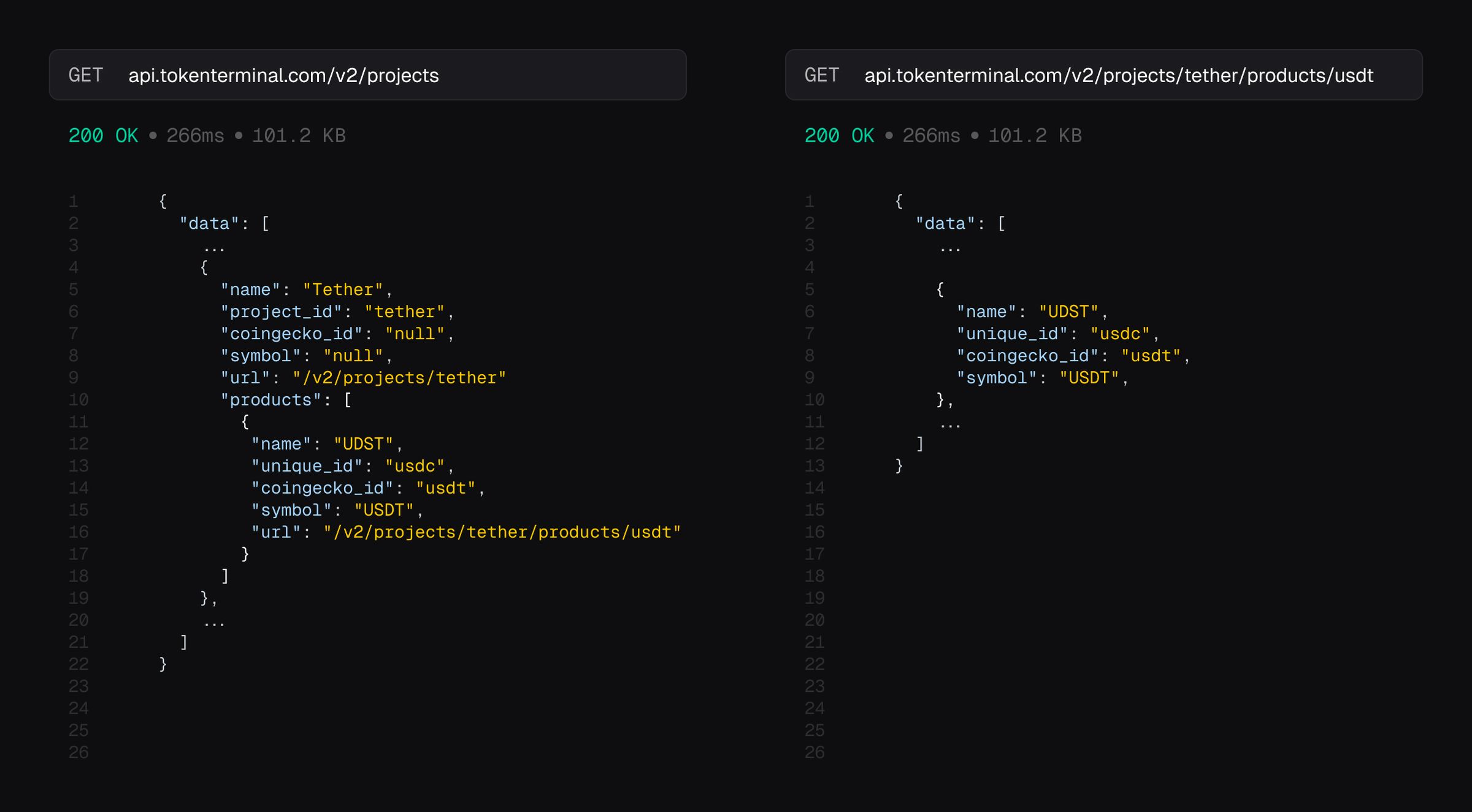
And in the API, you can now discover, explore, and breakdown data by product for some of the most popular projects. When pulling projects from the API, you’ll now get a list of all available products for every project. You can then follow the associated URL to pull in data specifically about that product.
We’ve also updated our metrics endpoints to allow you to easily filter project data by product or by chain, allowing you to get precise answers to questions like “What’s the outstanding supply of Circle’s EURC stablecoin on Solana?”
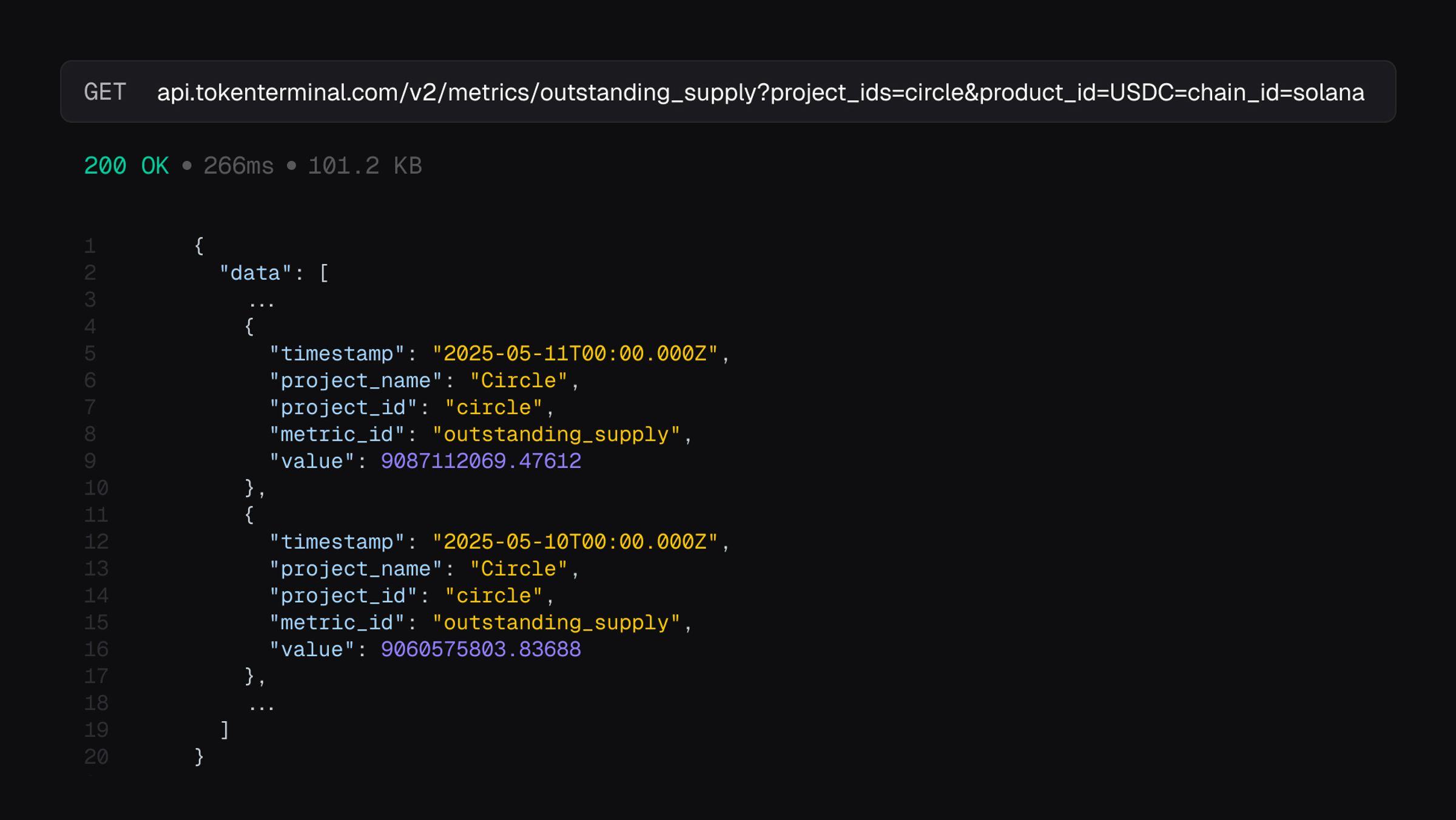
Explore our updated docs for product endpoints to get started with our new data models.
Customer Spotlight: Learn how Theia uses the Token Terminal API to invest
Theia, a crypto investment fund founded by former private equity professionals John McNiff and Felipe Montealegre, applies a fundamentals-driven approach to blockchain projects. Before discovering Token Terminal, Theia struggled with fragmented and unstructured data, slowing down their investment analysis. Now, their Python-based system, powered by Token Terminal’s API, delivers clean, up-to-date metrics directly into Jupyter notebooks—no dashboards, just pure, actionable data. This streamlined setup enables them to model live on calls, benchmark protocols in real-time, and focus on strategic decisions instead of data wrangling.
Read the full case study to learn more about how Theia is building an automated support system for their investment process.
Updated Infrastructure = Updated Limits
Our team spent some time over the last month upgrading our API’s database and backend services. Our goal was to make it easier for our API to serve a much higher volume of requests; we've seen a clear uptick in API usage from AI applications that leverage Token Terminal as the default data source for standardized financial metrics for blockchain-based businesses. Going forward, all API users are able to make 10x more requests per minute and 250x more requests per day.
| Limits | Previously | Now |
|---|---|---|
| Per minute | 100 | 1,000 |
| Per day | 1,000 | 250,000 |
The authors of this content, or members, affiliates, or stakeholders of Token Terminal may be participating or are invested in protocols or tokens mentioned herein. The foregoing statement acts as a disclosure of potential conflicts of interest and is not a recommendation to purchase or invest in any token or participate in any protocol. Token Terminal does not recommend any particular course of action in relation to any token or protocol. The content herein is meant purely for educational and informational purposes only, and should not be relied upon as financial, investment, legal, tax or any other professional or other advice. None of the content and information herein is presented to induce or to attempt to induce any reader or other person to buy, sell or hold any token or participate in any protocol or enter into, or offer to enter into, any agreement for or with a view to buying or selling any token or participating in any protocol. Statements made herein (including statements of opinion, if any) are wholly generic and not tailored to take into account the personal needs and unique circumstances of any reader or any other person. Readers are strongly urged to exercise caution and have regard to their own personal needs and circumstances before making any decision to buy or sell any token or participate in any protocol. Observations and views expressed herein may be changed by Token Terminal at any time without notice. Token Terminal accepts no liability whatsoever for any losses or liabilities arising from the use of or reliance on any of this content.
Stay in the loop
Join our mailing list to get the latest insights!