Celsius recovery plan proposed amid community-led short-squeeze attempt

CointelegraphPublié le 2022-06-20Dernière mise à jour le 2022-06-20

Résumé

Celsius’ lead investor BnkToTheFuture and its co-founder Simon Dixon have offered to assist the network by deploying similar “financial innovation” used in 2016 to save cryptocurrency exchange Bitfinex from liquidation.

Celsius’ lead investor BnkToTheFuture and its co-founder Simon Dixon have offered to assist the network by deploying similar “financial innovation” used in 2016 to save cryptocurrency exchange Bitfinex from liquidation.


Although the statement from Dixon on Saturday, June 18, did not include specific details of the recovery plan offered to the Celsius’ board and CEO Alex Mashinsky, Dixon noted it would be similar to the one offered to Bitfinex after its hack in August 2016, which he claims was resolved within nine months.
“I believe traditional finance will not have a timely solution for Celsius as we saw in the past with Mt. Gox that still remains unresolved 10 years later. I believe that this can only be solved with a solution using financial innovation like we did with Bitfinex that was resolved within 9 months and worked out very well for depositors.”
Dixon noted that as a Celsius shareholder and lender, and due to the “short-term systemic impact on those that own Bitcoin,” he was “keen to support Celsius with a recovery plan,” 
“It’s my position to offer solutions as we have the experience, licenses, and technology to do so,” he stated.
BnkToTheFuture is a global online investment platform that allows investors to invest in financial technology companies, funds, and other new alternative financial products. The platform touts a network of over 85,000 qualified investors. In June 2020, Celsius launched an equity offering with the investment platform, raising $20.46 million through 1039 investors.
The Bitfinex Solution
Dixon’s plans for Celsius take inspiration from his firm’s solutions in August 2016, after Bitfinex announced it lost approximately 120,000 Bitcoin (BTC) in a cybersecurity breach, causing a loss of around $72 million of customers’ funds at the time.
Rather than pursuing liquidation proceedings, Bitfinex instead came up with an innovative recovery plan, which involved “promises to repay” in the form of BFX tokens to customers, representing the value of the money lost in the hack.
These tokens were tradable on the open market or could be held later for future repayment of $1 per token, and effectively allowed customers to speculate on the company’s recovery.
Later in the month, BnkToTheFuture added to the solution by working with Bitfinex to allow customers to convert their BFX tokens into equity in the company.
Around seven months later, BnkToTheFuture reported that the plan had been working, with victims recovering between 75% to 100% of their funds through the various measures available to them.
“In 2016, Bitfinex needed a plan to recover from their hack and the company I co-founded, BnkToTheFuture.com, supported them and executed a recovery that involved security tokens, debt, and equity and gave investors a very high return for the high risk they took.”
Dixon did not confirm whether his recovery plan would work the same way with a token, only that it would be solved using similar innovative methods.
Gamestop-style short-squeeze brewing
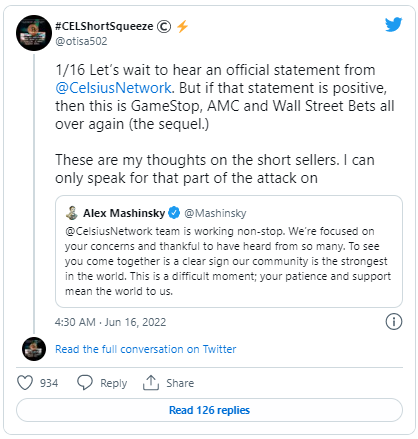
However, there’s also an unofficial community-led recovery plan which appears to be gaining traction on Twitter under the hashtag #CELShortSqueeze.
The movement is attempting to force short-sellers of the Celsius token to cover their short positions by purposefully driving up the price of the CEL token through the mass purchase and withdrawals of the CEL token from various exchanges.
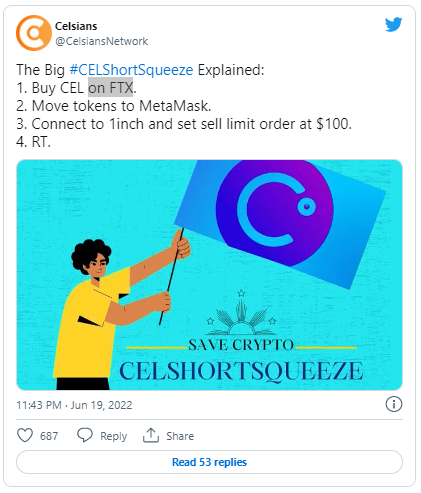

Short-selling is an investment strategy in which an investor borrows shares and immediately sells them, with the aim of buying them back later at a lower price and pocketing the difference. It allows an investor to profit from the decline of a share or asset. 
Short-squeezing occurs when a shorted asset instead rises in value, which forces short sellers to buy back the shares they initially sold in order to keep their losses from mounting. However, buying back shares when the price is rising can cause further upward price movements, which can then further squeeze out short-sellers.
The same strategy was initiated by users of the subreddit r/wallstreetbets in the January 2021, which saw stocks of the American video game retailer reach highs of almost $500 per share, around 25 times the valuation at the beginning of the month.

Celsius dominated headlines earlier this month after the popular crypto lender paused withdrawals due to “extreme market conditions.” 
The halting of withdrawals have locked customers out of their money, with many fearing that funds locked up on the platform may never again see the light of day, should the platform go belly up.
On June 20, Celsius released a statement to the Celsius community, noting that its objective continues to be stabilizing its liquidity and operations.
“It has been one week since we paused withdrawals, Swap, and transfers. We want our community to know that our objective continues to be stabilizing our liquidity and operations. This process will take time.”
The platform said it aims to maintain an open dialogue with regulators and officials and will continue to find a resolution. Meanwhile, the platform will be pausing its Twitter Spaces and Ask-Me-Anythings (AMAs).


Celsius (CEL) is priced at $0.636 at the time of writing, down 92% from its all-time high.

Lectures associées

Bitcoin à 400 000 $ ? Un analyste utilise un modèle de l'or pour faire une prédiction audacieuse pour 2026

L'analyste Vivek Sen suggère, via un post sur X, que le Bitcoin pourrait atteindre 400 000 dollars d'ici 2026. Cette projection audacieuse s'appuie sur une comparaison visuelle des graphiques, superposant la structure de cassure historique de l'or à la trajectoire actuelle du BTC. L'argument central est que le Bitcoin, souvent présenté comme une réserve de valeur numérique, pourrait suivre un schéma similaire à celui de l'or après son entrée sur les marchés institutionnels via les ETF. Cependant, l'article souligne que cette "superposition" graphique est un outil spéculatif et non un modèle de prévision fiable. Il met en garde contre les différences fondamentales entre les deux actifs : le marché du Bitcoin est plus réfléchi, plus volatile et influencé par des facteurs spécifiques (flux des ETF, leverage crypto, liquidités des exchanges) absents du marché plus établi et macro de l'or. Pour que ce scénario de 400 000 $ reste crédible, plusieurs conditions seraient nécessaires : des entrées institutionnelles soutenues, un environnement macroéconomique favorable aux actifs durs, une demande robuste pour les ETF Bitcoin et le maintien d'une tendance haussière sur le long terme. En conclusion, cette cible très ambitieuse est présentée comme un scénario de marché optimiste tiré d'une analyse sur les réseaux sociaux, et non comme une prédiction probabiliste. Elle illustre le récit haussier mais doit être confrontée aux données réelles de flux et de prix pour avoir une quelconque validité.

bitcoinistIl y a 3 h

Bitcoin à 400 000 $ ? Un analyste utilise un modèle de l'or pour faire une prédiction audacieuse pour 2026

bitcoinistIl y a 3 h

Un Trader de Bitcoin Affirme que les Sommets et les Creux des Cycles Correspondent à des Délais Exactement Identiques

Un trader utilisant le pseudonyme Ryan (@DodysDD) affirme avoir identifié une précision mathématique étonnante dans les cycles de prix du Bitcoin. Selon son analyse, les phases de marché haussier, du plus bas au plus haut (ATH), dureraient exactement 1064 jours, comme observé lors des cycles 2014-2017, 2018-2021 et 2022-2025. De même, les phases baissières (du pic au creux) correspondraient à 364 jours, comme en 2017-2018 et 2021-2022. Ce schéma, s'il se vérifiait, offrirait aux investisseurs un cadre temporel simple pour anticiper les tendances majeures. Cependant, l'article souligne les risques inhérents à ce type de théorie. La précision apparente dépend souvent du choix des points de référence (cours de clôture, sommets intradays...), ce qui peut conduire à une sélection biaisée des données. Il n'existe aucune preuve que le Bitcoin soit régi par un minutage aussi exact, son prix étant influencé par une multitude de facteurs (halvings, conditions macroéconomiques, psychologie des investisseurs...). Malgré ces limites, ce récit cyclique trouve un écho dans la communauté des traders, surtout dans un contexte actuel d'incertitude sur la phase de marché. Il fournit une narration simple face à la complexité. En conclusion, si l'observation sert de cadre d'analyse populaire, elle doit être abordée avec scepticisme et ne peut, à elle seule, prédire les futurs sommets ou creux du marché.

bitcoinistIl y a 8 h

Un Trader de Bitcoin Affirme que les Sommets et les Creux des Cycles Correspondent à des Délais Exactement Identiques

bitcoinistIl y a 8 h

94 billions, le plus grand financement de l'année pour les robots humanoïdes est apparu

Dans le secteur des robots humanoïdes, un tournant majeur est marqué par le financement record de 14 milliards de dollars (environ 94,9 milliards de yuans) levé par l'entreprise allemande Neura. Cette levée de fonds de série C, menée par des investisseurs industriels de renom comme Schaeffler et Bosch, ainsi que des géants technologiques (NVIDIA, Amazon), porte l'évaluation de Neura à environ 70 milliards de dollars. Cet investissement massif signale un changement profond : la filière passe d'une phase de démonstration technologique à une phase d'industrialisation et de déploiement concret en usine. Contrairement aux sociétés axées sur un robot humanoïde "universel" (comme Figure AI), Neura adopte une approche pragmatique, ciblant d'abord des applications industrielles verticales et spécifiques, comme en témoigne son partenariat avec BMW. La conjonction de plusieurs facteurs explique cet afflux de capitaux : les progrès de l'IA (modèles de grande taille) qui améliorent les capacités de perception et de décision des robots, et les pressions structurelles sur le marché du travail (vieillissement, pénurie de main-d'œuvre, coûts salariaux) qui créent une demande croissante dans la fabrication. Les principaux défis pour une adoption massive ne sont plus uniquement techniques. Ils concernent désormais les coûts d'adaptation aux lignes de production existantes, la formation des opérateurs et la mise en place d'un réseau de maintenance fiable. L'entrée en scène de capitaux industriels expérimentés démontre une confiance accrue dans la capacité du secteur à résoudre ces problèmes d'ingénierie et de modèle commercial, achevant ainsi la transition cruciale du laboratoire au sol de l'usine.

marsbitIl y a 13 h

94 billions, le plus grand financement de l'année pour les robots humanoïdes est apparu

marsbitIl y a 13 h

Trading

Spot
Futures
活动图片