
7.6 Million South Africans Are Crypto Investors, Social Media Main Source of Crypto-Related Information

newsbtcPublié le 2022-06-17Dernière mise à jour le 2022-06-17

Résumé

About 22% of South Africa’s adult population, or 7.6 million people, are cryptocurrency investors.

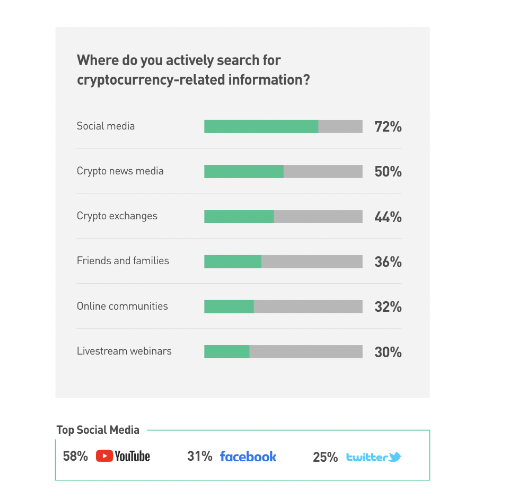
About 22% of South Africa’s adult population, or 7.6 million people, are cryptocurrency investors, findings by a study done by Kucoin cryptocurrency exchange have shown. According to the study, 72% of the respondents said they get information concerning particular crypto projects via social media. Influencers and media personalities were also found to be key opinion leaders that are promoting cryptocurrencies.

Influencers and Media Personalities Found to Be Key Opinion Leaders

According to the findings of a new Kucoin study, about 22% of South Africa’s adult population aged between 18 and 60 (or about 7.6 million people) are cryptocurrency investors. The study also found that 65% of crypto investors “consider crypto to be the future of finance.” The report added that a large percentage of the users appear to prefer digital assets as their favored means of savings to earn stable returns.

Explaining how South Africans are sourcing information concerning crypto projects that they choose to invest in, the study findings reveal that nearly three-quarters (72%) of respondents are getting this information via social media. Besides social media, influencers and media personalities were found to be the main opinion leaders in the crypto promotion space.
Study: 7.6 Million South Africans Are Crypto Investors, Social Media Main Source of Crypto-Related Information

Commenting on South Africans’ apparent preference for social media platforms as their first-choice information source, Kucoin CEO Johnny Lyu told Bitcoin.com News:

The data revealed by Statists shows that 30 million South Africans are social network users, and this figure is projected to grow to 40 million users by 2026. The country is seeing a rapid growth of influencers, TikTok bloggers and creators for whom social media have proven to be an easy and accessible source of income. The examples of well-known bloggers of African descent such as Khaby Lame are encouraging many Africans to spend more and more time on social networks in search of work, earnings and dating.

Lyu also noted that social media has become the quickest way for users to obtain information. He said this is particularly true now when “users’ time is now fragmented, and obtaining information quickly and effectively has become a mainstream way of life.”

South Africa’s Unequal Wealth Distribution

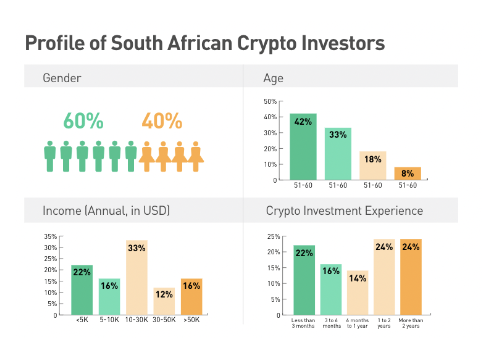
Meanwhile, in demographic terms, the cryptocurrency exchange’s study found that South African crypto investors are predominantly “male and younger generations.” Men are estimated to account for 60% of crypto investors while some 42% of the investors are thought to be aged 18 to 30. The study meanwhile exposes South Africa’s unequal wealth distribution and how low-income earners appear to use crypto as a tool for redressing the situation.

“The unequal distribution of wealth in the country is well illustrated by the findings of the report, as 22% of crypto investors earn less than $5,000 a year, while 16% earn more than $50,000 during the same period,” the study report explained.
Study: 7.6 Million South Africans Are Crypto Investors, Social Media Main Source of Crypto-Related Information

While the study’s findings do suggest that interest in cryptocurrency is growing, the constant reports of South African crypto investors losing funds to scammers have nonetheless attracted the attention of regulators who have responded by either cracking down on crypto entities or warning the public against investing in cryptocurrencies.

However, despite the response from regulators, the study still found that South African crypto investors are “maintaining a positive attitude” towards cryptocurrencies as these are proving to be “capable of improving people’s standing financially.” Such adoption of cryptocurrencies is having the right impact on the local crypto market in general and this, in turn, helps to remove fraudulent individuals and players, the report said.

Tags in this story
crypto influencers, Crypto Scams, Cryptocurrency, Johnny Lyu, Khaby Lame, KuCoin, Social Media, South Africa crypto investors

What are your thoughts on this study’s findings? Let us know in the comments section below.


Terence Zimwara
Terence Zimwara is a Zimbabwe award-winning journalist, author and writer. He has written extensively about the economic troubles of some African countries as well as how digital currencies can provide Africans with an escape route.



Report: Kenyan and Nigerian Central Bankers Attack Cryptocurrencies but Endorse CBDCs
EMERGING MARKETS | 4 days ago


Report: Cryptocurrency Can Potentially Complement Mobile Money Argues Kenyan Banker
EMERGING MARKETS | May 20, 2022


Image Credits: Shutterstock, Pixabay, Wiki Commons


Disclaimer: This article is for informational purposes only. It is not a direct offer or solicitation of an offer to buy or sell, or a recommendation or endorsement of any products, services, or companies. Bitcoin.com does not provide investment, tax, legal, or accounting advice. Neither the company nor the author is responsible, directly or indirectly, for any damage or loss caused or alleged to be caused by or in connection with the use of or reliance on any content, goods or services mentioned in this article.

Read disclaimer
Show comments

More Popular News
In Case You Missed It

Bitcoin ATM Operator Indicted in New York Allegedly Running Illegal Business Attracting Criminals

Bitcoin ATM Operator Indicted in New York Allegedly Running Illegal Business Attracting Criminals
A bitcoin ATM operator has been indicted in New York for running an illegal business "marketed towards individuals engaged in criminal activity." The district attorney in charge described: "Robert Taylor allegedly went to great lengths to keep his bitcoin kiosk ... read more.

Bill ‘On Digital Currency’ Caps Crypto Investments for Russians, Opens Door for Payments


Goldman Predicts US Recession Odds at 35% in 2 Years, John Mauldin Wouldn't Be Surprised if Stocks Fell 40%


Australia to List Bitcoin ETF After 4 Clearinghouse Participants Commit to Meet Stringent Margin Terms


Ethereum Foundation's Financial Report Discloses It Holds $1.6 Billion in Assets, 80.5% Held in Ether





Lectures associées

Un Trader de Bitcoin Affirme que les Sommets et les Creux des Cycles Correspondent à des Délais Exactement Identiques

Un trader utilisant le pseudonyme Ryan (@DodysDD) affirme avoir identifié une précision mathématique étonnante dans les cycles de prix du Bitcoin. Selon son analyse, les phases de marché haussier, du plus bas au plus haut (ATH), dureraient exactement 1064 jours, comme observé lors des cycles 2014-2017, 2018-2021 et 2022-2025. De même, les phases baissières (du pic au creux) correspondraient à 364 jours, comme en 2017-2018 et 2021-2022. Ce schéma, s'il se vérifiait, offrirait aux investisseurs un cadre temporel simple pour anticiper les tendances majeures. Cependant, l'article souligne les risques inhérents à ce type de théorie. La précision apparente dépend souvent du choix des points de référence (cours de clôture, sommets intradays...), ce qui peut conduire à une sélection biaisée des données. Il n'existe aucune preuve que le Bitcoin soit régi par un minutage aussi exact, son prix étant influencé par une multitude de facteurs (halvings, conditions macroéconomiques, psychologie des investisseurs...). Malgré ces limites, ce récit cyclique trouve un écho dans la communauté des traders, surtout dans un contexte actuel d'incertitude sur la phase de marché. Il fournit une narration simple face à la complexité. En conclusion, si l'observation sert de cadre d'analyse populaire, elle doit être abordée avec scepticisme et ne peut, à elle seule, prédire les futurs sommets ou creux du marché.

bitcoinistIl y a 3 h

Un Trader de Bitcoin Affirme que les Sommets et les Creux des Cycles Correspondent à des Délais Exactement Identiques

bitcoinistIl y a 3 h

94 billions, le plus grand financement de l'année pour les robots humanoïdes est apparu

Dans le secteur des robots humanoïdes, un tournant majeur est marqué par le financement record de 14 milliards de dollars (environ 94,9 milliards de yuans) levé par l'entreprise allemande Neura. Cette levée de fonds de série C, menée par des investisseurs industriels de renom comme Schaeffler et Bosch, ainsi que des géants technologiques (NVIDIA, Amazon), porte l'évaluation de Neura à environ 70 milliards de dollars. Cet investissement massif signale un changement profond : la filière passe d'une phase de démonstration technologique à une phase d'industrialisation et de déploiement concret en usine. Contrairement aux sociétés axées sur un robot humanoïde "universel" (comme Figure AI), Neura adopte une approche pragmatique, ciblant d'abord des applications industrielles verticales et spécifiques, comme en témoigne son partenariat avec BMW. La conjonction de plusieurs facteurs explique cet afflux de capitaux : les progrès de l'IA (modèles de grande taille) qui améliorent les capacités de perception et de décision des robots, et les pressions structurelles sur le marché du travail (vieillissement, pénurie de main-d'œuvre, coûts salariaux) qui créent une demande croissante dans la fabrication. Les principaux défis pour une adoption massive ne sont plus uniquement techniques. Ils concernent désormais les coûts d'adaptation aux lignes de production existantes, la formation des opérateurs et la mise en place d'un réseau de maintenance fiable. L'entrée en scène de capitaux industriels expérimentés démontre une confiance accrue dans la capacité du secteur à résoudre ces problèmes d'ingénierie et de modèle commercial, achevant ainsi la transition cruciale du laboratoire au sol de l'usine.

marsbitIl y a 8 h

94 billions, le plus grand financement de l'année pour les robots humanoïdes est apparu

marsbitIl y a 8 h

Le marché de la pré-introduction en bourse d'Anthropic chute après qu'une directive américaine force l'arrêt du modèle

Anthropic a annoncé avoir reçu une directive du gouvernement américain lui ordonnant de suspendre l'accès aux modèles Claude Fable 5 et Claude Mythos 5 pour les ressortissants étrangers, y compris ses propres employés étrangers. Cette mesure d'urgence, justifiée par des préoccupations de sécurité nationale liées au contrôle des exportations, a forcé la désactivation mondiale des deux modèles le 12 juin. Les autres modèles d'Anthropic, comme Claude Opus 4.8, restent opérationnels. La réaction du marché a été immédiate : le contrat perpétuel lié à Anthropic sur Hyperliquid a chuté de 3,7%, reflétant l'impact sur sa valorisation pré-IPO. Anthropic a contesté la base de cette directive, arguant que la vulnérabilité de "jailbreak" évoquée par le gouvernement était mineure, déjà connue et non exclusive à ses modèles. La société a averti qu'un tel seuil d'intervention, s'il était généralisé, pourrait stopper les déploiements de nouveaux modèles d'IA de pointe. Cet événement illustre comment la régulation de l'IA devient un facteur négociable sur les marchés financiers. Les instruments tokenisés et les contrats pré-IPO permettent désormais aux traders de réagir instantanément à ce type de nouvelles réglementaires, même en l'absence d'informations publiques détaillées. Cela intègre l'infrastructure d'IA dans une dynamique de marché spéculative similaire à celle de la cryptomonnaie, avec des risques de volatilité basée sur des informations incomplètes.

bitcoinistIl y a 14 h

Le marché de la pré-introduction en bourse d'Anthropic chute après qu'une directive américaine force l'arrêt du modèle

bitcoinistIl y a 14 h

Trading

Spot
Futures
活动图片