$26 Billion: An 'All-Chinese Team' Backs the World's Highest-Valued AI Programming Company

marsbitPublié le 2026-05-31Dernière mise à jour le 2026-05-31

Résumé

Cognition AI, the company behind the AI programmer "Devin," has raised over $1 billion in new funding at a valuation of $26 billion, just eight months after reaching a $10.2 billion valuation. The round was led by Lux Capital, General Catalyst, and 8VC. Founded by three young Chinese entrepreneurs with strong competitive programming backgrounds, Cognition initially gained fame with Devin, marketed as the world's first AI software engineer capable of handling tasks from start to finish. While its early demos were impressive, real-world usage revealed reliability and cost-effectiveness issues, leading to a significant price cut for Devin in 2025. A pivotal moment came when Cognition acquired the assets of AI IDE company Windsurf after a failed acquisition by OpenAI. This move gave Cognition a crucial developer-facing tool, allowing it to pursue a two-pronged strategy: Devin for autonomous task execution and Windsurf for integrated, collaborative coding within an IDE. This shift helped the company move away from the controversial "AI replacement" narrative towards a model of augmenting human engineers, particularly for repetitive or maintenance tasks. This strategic pivot is backed by strong commercial metrics. The company reports a 10x increase in enterprise usage this year, with an annual revenue run-rate of $492 million and a 50% month-over-month growth in enterprise Devin usage over the past six months. Its client list now includes major corporations like Goldman Sachs an...

By AI Alphabet

$26 billion is the latest price tag the capital market has placed on AI programming company Cognition.

Just last September, Cognition AI had barely crossed the $10 billion valuation threshold, and at that time, it was already enough of a Silicon Valley legend.

Three young Chinese co-founders, collectively winners of 5 International Olympiad in Informatics gold medals, built the prototype of "the world's first AI software engineer" Devin from a short-term rental apartment. In just over two years since its founding, the company's valuation had surged to $10 billion.

Chinese, Olympiad, Harvard, MIT, dropping out to start a business, AI Agent... each label is attention-grabbing enough. Cognition is undoubtedly one of the most story-rich companies in the AI programming track.

Now, this story has been pushed a significant step forward by the capital market.

According to a Bloomberg report, Cognition AI, the company behind Devin, has secured over $1 billion in new funding, with a post-money valuation reaching $26 billion. This round was co-led by Lux Capital, General Catalyst, and 8VC, with participation from Ribbit Capital, Atreides Management, Founders Fund, and others. Cognition has officially confirmed this funding round and its latest valuation.

This means that in just over eight months since its previous valuation of $10.2 billion, Cognition's valuation has grown to 2.5 times its original value.

01 What Capital is Buying is More Than Just an AI Programmer

The leading capital in this round is quite representative.

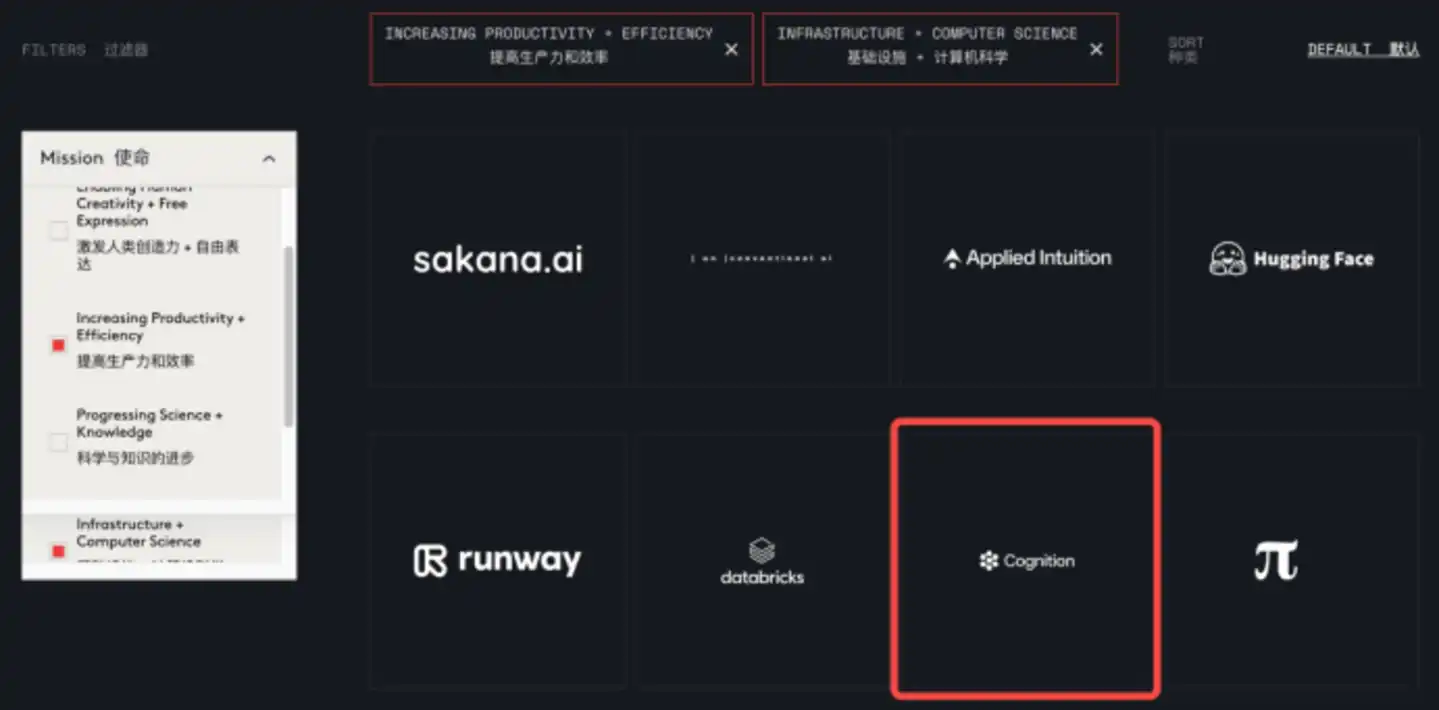
Lux Capital is a highly recognizable hard-tech fund in Silicon Valley, with long-term investments in frontier science, deep tech, AI, robotics, aerospace, defense, and computing infrastructure—projects that are "relatively hardcore." On its own investment page, Cognition is categorized under "Productivity Enhancement + Infrastructure + Computer Science."

It can be said that Lux Capital's investment in Cognition focuses on Cognition's potential to turn AI Agents into software engineering infrastructure.
General Catalyst, on the other hand, focuses on the opportunity for enterprise processes to be transformed by AI. This firm is not just a traditional VC; it calls itself a "global investment and transformation company" on its website, emphasizing 'transformation' in recent years—using capital, operations, and corporate relationships to drive the transformation of traditional industries and large institutions.

Besides Cognition, General Catalyst is also doubling down on Anthropic. Over the past year, it has participated in multiple massive funding rounds for Anthropic.

As a co-leading firm, 8VC brings imagination for government and large enterprise deployments. This firm has long bet on "enterprise software infrastructure within complex organizations," and Cognition's client list already includes government or public-sector clients like the US Army, US Navy, and NASA. 8VC's participation as a lead investor affirms Cognition's narrative.

In addition to the three leading firms, existing shareholder Founders Fund continues to increase its stake. The approximately $400 million funding round in 2025, which valued the company at around $10.2 billion post-money, was led by Founders Fund. This firm, co-founded by Peter Thiel, has always had an aggressive investment style, preferring technology companies that can reshape industrial structures, such as SpaceX, Palantir, Anduril, Stripe, OpenAI, etc.

Lux Capital long bets on hard tech and frontier computing, General Catalyst excels at enterprise software and large institution transformation, 8VC carries enterprise software and government market genes, and Founders Fund is one of Cognition's early shareholders. The simultaneous presence of these types of capital in Cognition's funding round is enough to indicate that investors no longer see Cognition merely as a developer tools company, but as a candidate for the next generation of software engineering infrastructure.

The $26 billion post-money valuation fully proves market confidence, and the most direct reason capital is willing to continue driving up the price is growth.

Cognition has presented very solid commercialization data: enterprise usage has grown over 10-fold since the beginning of this year, revenue run-rate has jumped from $37 million in May last year to the current $492 million, and enterprise-side Devin usage has maintained a 50% month-over-month growth for the past six months.

Although $492 million is not confirmed annual revenue but an annualized run-rate calculated based on the current income pace, this growth curve is still astonishing. Investors can already see enterprise clients genuinely paying, genuinely using, and usage is still rapidly climbing—this is nothing short of legendary for a company founded in 2023.

The AI programming track is indeed thriving. Code, issues, tests, PRs, documentation are inherently highly digital work objects; whether a task is completed can be verified through tests, code reviews, and deployment results.

And for enterprises, software teams always have an endless list of tasks, each time-consuming and expensive (at least, senior engineers' hourly rates are expensive). If an AI Agent can reliably take over a portion of clear, repetitive, and verifiable software engineering tasks, it becomes engineering capacity that enterprises are willing to pay for.

Behind the $26 billion, what capital is truly buying is a judgment: software development is becoming the earliest work scenario where AI Agents are being procured on a large scale by enterprises.

02 After Devin's Explosive Popularity, Reality Poured Cold Water

Cognition first gained widespread attention through what, at the time, seemed an extremely bold vision.

Before Devin, AI programming tools mostly remained in "assistant" roles. GitHub Copilot helps programmers complete code, ChatGPT and Claude can explain errors and generate functions, while Cursor integrates AI into the editor, allowing developers to write and edit simultaneously.

But Devin took a significant step forward. It was directly defined by Cognition as an "AI Software Engineer." Users only need to describe requirements in natural language, such as developing a website, building an application feature, or fixing an issue in a codebase, and Devin would independently break down the task, write the code, fix bugs, until the project runs.

When Cognition released the Devin demo in March 2024, the entire developer community was ignited. It was promoted as the world's first AI programmer, and to some extent, became one of the landmark products that truly brought the vibe coding wave into the mainstream.

The founders themselves also came with a story. All three—Scott Wu, Steve Hao, and Walden Yan—are Chinese and hail from the informatics Olympiad circle, collectively holding 5 IOI gold medals. They are not traditional business-oriented founders but resemble a group of young people exceptionally skilled at coding, trying to train another entity that can code.

After Devin's launch, the company quickly secured support from top-tier VCs like Founders Fund, Khosla Ventures, and Bain Capital Ventures, forming a strong capital lineup. Enterprise clients also began to emerge, with names like Goldman Sachs, Citi, and Ramp being linked to Devin.

In July 2025, when Goldman Sachs introduced Devin, a Fast Company headline even directly stated, "Goldman Sachs's New AI Software Engineer Never Sleeps." This highlighted one of the most compelling aspects of Agents for enterprises: they can operate 24/7, no shifts needed, never stopping due to nights, weekends, or time zones.

That was Cognition's earliest moment in the spotlight. A young team, Chinese founders with informatics competition backgrounds, an AI Agent claiming to handle software development end-to-end, plus top-tier VC and major client endorsements. All these elements together formed almost the standard opening of a Silicon Valley AI legend.

However, a tall tree attracts the wind. When the story is told too beautifully, problems inevitably follow.

Initially, Devin's breakout success was largely built on the company's demos. When external developers began scrutinizing frame-by-frame and testing in real environments, doubts emerged. Some believed Devin's demos were carefully edited, omitting processes that made it appear less perfect. For instance, one segment was questioned for potentially showing Devin creating a bug and then fixing it, presenting the illusion of smoothly completing the task.

Devin thus became embroiled in a "fakery" controversy for a period—its promotional tone leaned too heavily towards AI being fully autonomous, but real engineering environments are far more complex than demos.

Software development is never just about writing code; it involves requirement understanding, architectural judgment, contextual memory, team conventions, and a host of implicit constraints not written into issues. An Agent running doesn't mean it always runs in the right direction; it can generate code, but that doesn't mean the code is merge-worthy.

When Devin officially launched, the gap became even more apparent.

Its initial price was very high, starting at $500 per month. But its performance didn't seem to justify such a high price: Answer.AI continuously tested Devin for a month, assigning it 20 real engineering tasks. The result was only 3 successes, 14 failures, and 3 uncertain outcomes.
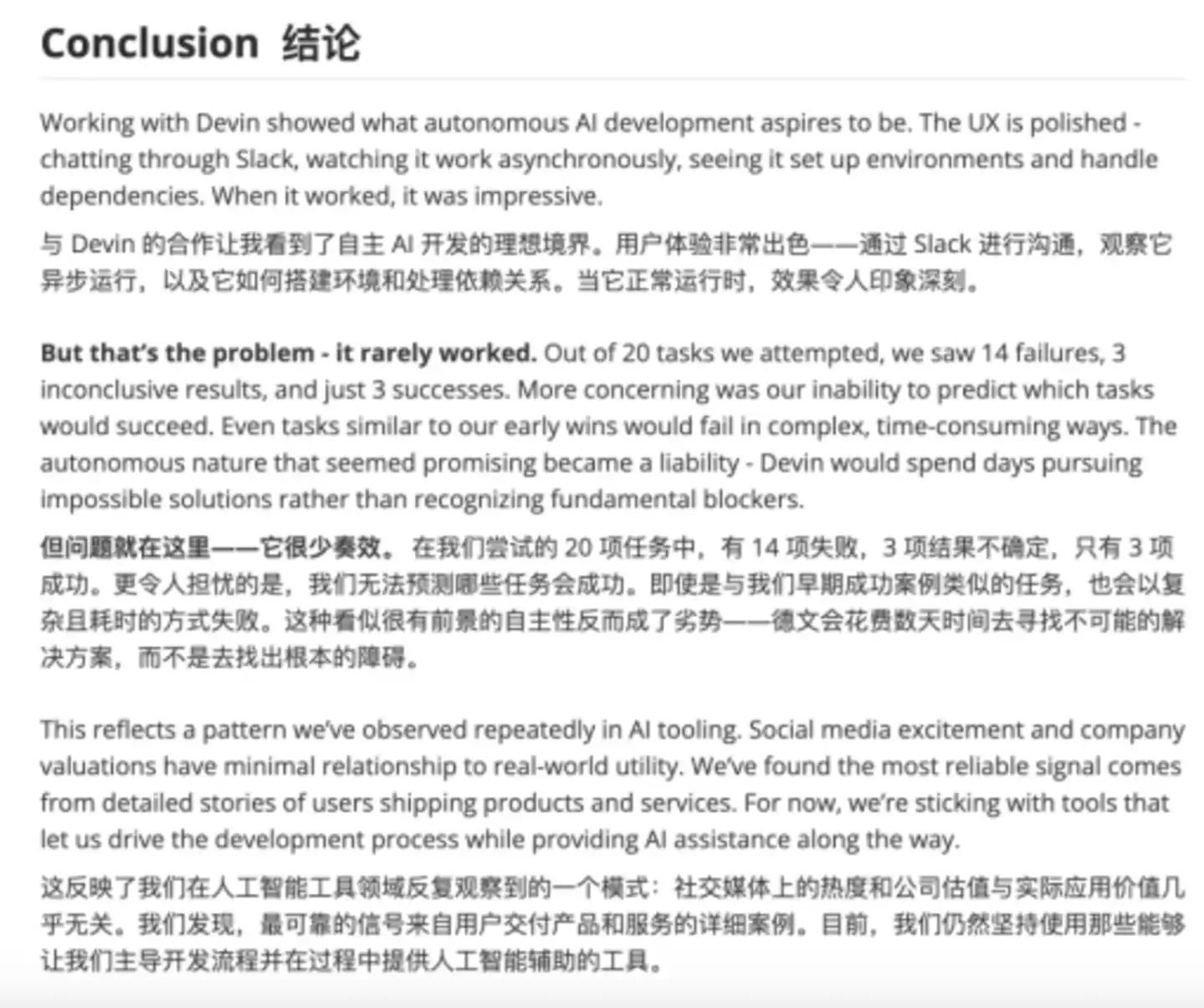
The biggest issue wasn't just the high failure rate, but the unpredictability of failures.

Some tasks that didn't seem complex would lead Devin into dead ends; some tasks themselves were infeasible, yet it would keep trying; sometimes it would generate overly complex, hard-to-maintain code, ultimately forcing engineers to spend more time reviewing and cleaning up.

And all this at such a high price.

Cognition also realized the $500/month threshold was too high. In April 2025, Cognition launched Devin 2.0, reducing the starting price from $500 per month to $20 and introducing a more flexible pay-as-you-go model.

But price reduction isn't a panacea. A tool designed to enhance efficiency ending up wasting more time and energy is hard to justify.

This is the core early-stage contradiction of autonomous Agents: the more AI resembles an independent engineer, the more users need to trust it, but the more it operates like a black box, the more troublesome deviations become.

Devin promised "give me the task," but many real engineering tasks aren't suitable to be handed over completely so early. An Agent running on its own for a long time and finally delivering a PR sounds advanced; but if PR quality is unstable, the engineer's review cost becomes even higher.

Interestingly, amidst this contrast, it was Cursor that captured the first wave of genuine developer dividends.

Because Cursor didn't initially promise to replace programmers. Its logic was gentler and more aligned with real workflows: AI helps modify code, explain errors, refactor files, generate tests on the side, but the developer remains in the editor. It's like a driving school car—you can at least hit the brakes when things seem off.

If Cognition's story ended here, it might have become another "hype" company lifted by the AI boom and then pulled back to earth by real user experience. But as mentioned earlier, reality is often more complex, and the AI programming track itself didn't stand still.

After Devin ignited the imagination of an "AI Software Engineer" and Cursor proved developers still needed a sense of control, foundation model giants like OpenAI, Google, and Anthropic also accelerated integrating coding capabilities into their own products and platforms.

On one side, the more controllable IDE route was rapidly expanding; on the other, model giants were moving down to the application layer. For Cognition to survive, it had to change.

And it was at this time that it "picked up" the treasure left by Windsurf.

03 Grasp Both Sides Firmly

The battle for Windsurf was arguably one of the most dramatic events in the AI coding tools sector in 2025.

At that time, Windsurf was already a highly regarded company in the AI IDE track. It was initially courted by OpenAI, with both sides engaged in lengthy acquisition talks, and the outside world once thought the deal was sealed.

However, the transaction ultimately didn't materialize, with one key reason being the complex partnership between OpenAI and Microsoft. At that time, Microsoft held broad licensing rights to OpenAI's technology and products, and Microsoft-owned GitHub Copilot was a major competitor in the AI programming space. Windsurf was concerned that if acquired by OpenAI, its technology and products might become entangled in the licensing framework between OpenAI and Microsoft, indirectly flowing to a potential competitor.

Just as OpenAI retreated, Google swiftly stepped in.

Google secured a non-exclusive license to Windsurf's technology for $2.4 billion, while bringing Windsurf CEO Varun Mohan, co-founder Douglas Chen, and several key R&D personnel to Google DeepMind.

It happened on a Friday, very quickly. Google took the founders and some core technology licenses. OpenAI failed to complete the acquisition. Windsurf's original corporate entity, product, brand, clients, and 250 employees were left in an awkward position.

It was at this moment that Cognition made its grand entrance.

The incident occurred on a Friday; by Monday, Cognition announced its acquisition of Windsurf's remaining assets, including the Windsurf IDE product itself, intellectual property, trademarks, brand, enterprise customer base, user data, and most of the remaining team's employees.

This move was almost crucial for Cognition's later return to the game, as it addressed exactly what Devin lacked most: a developer entry point.

Following the Windsurf acquisition, Cognition's commercialization pace noticeably accelerated. Windsurf itself already had $82 million in Annual Recurring Revenue (ARR) and over 350 enterprise clients at the time of acquisition. Cognition later disclosed that this acquisition more than doubled the company's ARR, and within seven weeks post-acquisition, the combined enterprise ARR grew over 30%.

Previously, Devin represented a more radical route. It wanted users to hand tasks to a cloud-based Agent, letting it plan, execute, debug, and deliver results autonomously. But Cursor's rise proved developers weren't necessarily willing to hand over tasks completely from the start. They were more accustomed to staying in the editor, watching AI modify code step-by-step, taking over and correcting course at any time.

Windsurf's addition gave Cognition an IDE, finally providing Cognition with more than just the "hand the task to AI" product form.

It began walking on two legs: one is Devin, responsible for asynchronous cloud-based task execution, suitable for handling engineering work that can be broken down, verified, and delivered as PRs; the other is Windsurf, responsible for the IDE entry point, allowing developers to work alongside AI in the coding environment, covering daily development scenarios similar to Cursor's domain.

If users are uncomfortable handing the steering wheel entirely to AI, then bring AI back into the editor as a controllable assistant. If enterprises indeed have a large volume of clear, repetitive, verifiable engineering tasks, let Devin act as a "formal employee" and take over part of the work in the background.

Cognition is no longer solely pursuing an all-powerful, autonomous AI programmer that can independently complete all tasks. It now covers two real needs within software engineering.

This coincidentally forms a contrast with the recently controversial Antigravity 2.0: Google initially focused on an IDE, but after the Antigravity update, it shifted directly towards a more Agent Manager-like interface, jumping from controllable IDE collaboration to black-box Agent scheduling. The direction is ambitious but also more prone to encountering Devin's early problems again.

Individual developers buying tools often consider feel, efficiency, price, and experience. If a tool isn't user-friendly, it's quickly abandoned. But enterprises buy processes and capacity. As long as an Agent can integrate into existing engineering systems and stably produce results for a portion of tasks, it has a chance to become a budget line item.

The most noticeable change in Cognition's narrative later lies here.

Early Devin was like an AI programmer in the spotlight, trying to prove it could code like a human programmer (without needing rest). Later Cognition seemed more like selling a suite of enterprise engineering automation systems: Devin handles asynchronous execution, Windsurf handles the development entry point, and enterprise clients embed them into their own software development workflows.

According to a May 29 TechCrunch interview, CEO Scott Wu clearly pulled Devin back from the "replace programmers" narrative. When asked if Devin could replace a mid-level programmer, his response was "Yes and no."

He emphasized that Cognition never shaped Devin towards "replacing humans." The team members themselves are programmers and don't wish for programmers to lose jobs. He stated Devin's capability varies with tasks, roughly between junior and mid-level engineers; it's more suited for handling the long-tail maintenance tasks many programmers dislike, such as legacy software upgrades, platform migrations, etc., freeing engineers from such grunt work to focus on more creative endeavors.

The two-legged combination precisely avoids the shortcomings of a single product. With only Devin, it appears too radical, and users worry about autonomous Agents being uncontrollable. With only Windsurf, it easily falls into direct competition with products like Cursor, Copilot, Claude Code, Codex. But Devin plus Windsurf gives Cognition a more complete story: serving developers' daily coding scenarios and serving enterprises needing to delegate tasks to Agents.

The data presented in the latest funding round also indicates its story is being validated by the market.

The company states enterprise usage has grown over 10-fold since the beginning of this year, revenue run-rate has reached $492 million, and enterprise-side Devin usage has maintained a 50% month-over-month growth for the past six months.

Clients like Goldman Sachs, Mercedes-Benz, Citi, Dell, Cisco, NASA, US Army, and US Navy also make its enterprise narrative no longer just a demo story.

The $26 billion valuation isn't capital buying a perfect programmer-replacing Devin, but the potential following Cognition's pivot: in the earliest landing sector for AI Agents, it could become the new entry point for enterprise software engineering.

Future software development will likely not completely revert to the era of human engineers coding alone, nor will it immediately transform into AI Agents taking over everything automatically. A more foreseeable scenario is a hybrid system: humans determine direction within the IDE, with AI assisting; some tasks are broken out and handled asynchronously by cloud-based Agents; code is still tested, reviewed, merged, and humans ultimately bear responsibility.

Cognition is betting on this middle ground.

Questions liées

QWhat is the latest valuation of Cognition AI after its recent funding round?

AAfter its recent funding round, Cognition AI's post-money valuation reached $26 billion.

QWhat were some of the initial criticisms and challenges faced by Cognition's flagship AI programmer, Devin?

ADevin faced criticisms for high pricing, unreliable performance with unpredictable failures, and concerns that its early demos were overly polished, leading to skepticism about its readiness for real-world engineering tasks.

QHow did the acquisition of Windsurf benefit Cognition AI's business strategy?

AThe acquisition of Windsurf provided Cognition with a popular IDE product, established enterprise customers, and intellectual property. This allowed Cognition to offer both an autonomous agent (Devin) and a collaborative IDE tool, addressing different software development needs and accelerating its commercialization and revenue growth.

QWhich major venture capital firms led the latest funding round for Cognition AI?

AThe latest funding round for Cognition AI was co-led by Lux Capital, General Catalyst, and 8VC.

QHow has Cognition AI's narrative about its product Devin evolved according to CEO Scott Wu?

ACEO Scott Wu shifted Devin's narrative away from being a direct replacement for human programmers. He emphasized that Devin is designed to handle tedious maintenance tasks, freeing up human engineers for more creative work, and that the company's goal is to augment, not replace, software developers.

Lectures associées

Alibaba « met en rayon », ByteDance « s’entraîne »

Durant la dernière semaine de mai, deux événements consécutifs dans l'industrie de l'IA ont révélé les stratégies divergentes des géants chinois Alibaba et ByteDance. Alibaba adopte une approche d'application immédiate et de monétisation. Son modèle Qwen est intégré à Taobao pour des fonctionnalités comme l'essayage virtuel et la comparaison de prix, visant à transformer l'expérience d'achat. L'entreprise se positionne comme l'infrastructure ("eau, électricité, gaz") et la "caisse enregistreuse" de l'ère IA, avec ses services cloud alimentant de nombreux modèles locaux. Cette stratégie, soutenue par des réorganisations internes et l'initiative "AI Credit", génère déjà des revenus, comme en témoigne la croissance de 40% des revenus cloud externes. Cependant, elle suppose que les capacités des modèles de base n'évolueront pas assez vite pour rendre ses applications obsolètes. ByteDance, via son département Seed, privilégie la recherche fondamentale à long terme. Son objectif est "d'explorer les limites de l'intelligence". Son modèle de génération vidéo Seedance 2.0, salué comme le plus performant au monde, et des publications académiques ambitieuses sur les "modèles du monde" illustrent cette voie. La société, qui n'est pas cotée en bourse, peut se permettre d'engager des dépenses d'investissement massives (jusqu'à 470 milliards de yuans en 2026 selon des rapports) et d'accorder à ses chercheurs le temps de publier sans pression commerciale immédiate. Mais cette approche "laboratoire Nobel" commence à être questionnée par des signes de commercialisation sur des produits comme Doubao. L'article suggère que cette divergence stratégique tient moins à une philosophie qu'à un statut : Alibaba, société cotée, est soumis à la pression des marchés pour montrer des retours rapides, tandis que ByteDance, privée, peut investir sur le très long terme. Le jour où ByteDance envisagera une introduction en bourse, la pérennité de sa stratégie de recherche pure sera véritablement mise à l'épreuve.

marsbitIl y a 54 mins

Alibaba « met en rayon », ByteDance « s’entraîne »

marsbitIl y a 54 mins

Trois ans plus tard : Retour sur mon jugement de 2023 concernant ChatGPT

Trois ans après ses prédictions sur ChatGPT en mars 2023, Wang Jianshuo revient sur ses vingt affirmations initiales, évaluées en mai 2026 par des agents IA. Sur les vingt points, la majorité des tendances de fond étaient correctes : l'essor du RAG comme architecture dominante pour l'injection de connaissances, le rôle central de l'interface utilisateur en langage naturel (LUI), l'émergence de protocoles pour un "réseau d'agents", et le rattrapage technologique rapide des modèles chinois. Des erreurs notables portent sur des chiffres précis, comme les 100 billions de paramètres supposés de GPT-4 (en réalité environ 1,8 billion) ou une estimation trop basse des coûts de formation des grands modèles. Certaines prévisions se sont révélées trop absolues ("l'IA ne fera jamais de mathématiques pures") ou ont négligé les disparités (aucune vague de chômage massif, mais un impact sévère sur les jeunes diplômés). L'analyse révèle que les intuitions sur les mécanismes et les directions se sont avérées bien plus fiables que les prédictions numériques ou temporelles, souvent trop optimistes à court terme. La prudence dans les formulations et la reconnaissance des incertitudes se sont montrées précieuses avec le recul. Ce bilan offre des leçons pour les futurs pronostics : privilégier les tendances aux chiffres, anticiper les effets distributifs et accepter que certaines questions demandent plus de trois ans pour être tranchées.

marsbitIl y a 8 h

Trois ans plus tard : Retour sur mon jugement de 2023 concernant ChatGPT

marsbitIl y a 8 h

Trois ans plus tard : un retour sur mes prédictions de 2023 concernant ChatGPT

Trois ans après ses prédictions sur le ChatGPT en mars 2023, Wang Jianshuo revient sur ses 20 affirmations initiales. Évaluées en mai 2026 par des agents IA, la plupart de ses intuitions sur les grandes tendances se sont révélées justes : le RAG est devenu l'architecture standard pour intégrer des connaissances, l'Interface Utilisateur en Langage Naturel (LUI) a créé un nouvel écosystème, et les modèles chinois ont presque rattrapé les leaders mondiaux. Des concepts comme les réseaux d'agents et la nature limitée du test de Turing se sont également matérialisés. Cependant, les prévisions quantitatives et les affirmations trop absolues ont souvent échoué. Le paramétrage supposé du GPT-4 (100T) était inexact, et les coûts de développement des modèles ont dépassé les estimations. Il a sous-estimé la vitesse de personnalisation des IA et l'impact distribué sur l'emploi des jeunes. La capture de valeur a surtout bénéficié à la couche matérielle (comme Nvidia), et non aux seules applications. Les leçons clés sont que les mécanismes et les directions sont plus fiables que les chiffres précis, que l'optimisme à court terme doit être tempéré, et que les nuances ("peut-être", "pour l'instant") rendent les prédictions plus robustes. Cette rétrospective souligne l'importance de distinguer les tendances confirmées des questions toujours ouvertes.

链捕手Il y a 11 h

Trois ans plus tard : un retour sur mes prédictions de 2023 concernant ChatGPT

链捕手Il y a 11 h

Trading

Spot
Futures

Articles tendance

Qu'est ce que $S$

Comprendre SPERO : Un aperçu complet Introduction à SPERO Alors que le paysage de l'innovation continue d'évoluer, l'émergence des technologies web3 et des projets de cryptomonnaie joue un rôle central dans la façon dont se dessine l'avenir numérique. Un projet qui a attiré l'attention dans ce domaine dynamique est SPERO, désigné comme SPERO,$$s$. Cet article vise à rassembler et à présenter des informations détaillées sur SPERO, afin d'aider les passionnés et les investisseurs à comprendre ses fondations, ses objectifs et ses innovations dans les domaines du web3 et de la crypto. Qu'est-ce que SPERO,$$s$ ? SPERO,$$s$ est un projet unique dans l'espace crypto qui cherche à tirer parti des principes de décentralisation et de la technologie blockchain pour créer un écosystème qui favorise l'engagement, l'utilité et l'inclusion financière. Le projet est conçu pour faciliter les interactions entre pairs de nouvelles manières, offrant aux utilisateurs des solutions et des services financiers innovants. Au cœur de SPERO,$$s$, l'objectif est d'autonomiser les individus en fournissant des outils et des plateformes qui améliorent l'expérience utilisateur dans l'espace des cryptomonnaies. Cela inclut la possibilité de méthodes de transaction plus flexibles, la promotion d'initiatives dirigées par la communauté et la création de voies pour des opportunités financières via des applications décentralisées (dApps). La vision sous-jacente de SPERO,$$s$ tourne autour de l'inclusivité, visant à combler les lacunes au sein de la finance traditionnelle tout en exploitant les avantages de la technologie blockchain. Qui est le créateur de SPERO,$$s$ ? L'identité du créateur de SPERO,$$s$ reste quelque peu obscure, car il existe peu de ressources publiques fournissant des informations détaillées sur son ou ses fondateurs. Ce manque de transparence peut découler de l'engagement du projet envers la décentralisation—une éthique que de nombreux projets web3 partagent, privilégiant les contributions collectives plutôt que la reconnaissance individuelle. En centrant les discussions autour de la communauté et de ses objectifs collectifs, SPERO,$$s$ incarne l'essence de l'autonomisation sans désigner des individus spécifiques. Ainsi, comprendre l'éthique et la mission de SPERO reste plus important que d'identifier un créateur unique. Qui sont les investisseurs de SPERO,$$s$ ? SPERO,$$s$ est soutenu par une diversité d'investisseurs allant des capital-risqueurs aux investisseurs providentiels dédiés à favoriser l'innovation dans le secteur crypto. L'objectif de ces investisseurs s'aligne généralement avec la mission de SPERO—priorisant les projets qui promettent des avancées technologiques sociétales, l'inclusivité financière et la gouvernance décentralisée. Ces fondations d'investisseurs s'intéressent généralement à des projets qui non seulement offrent des produits innovants, mais qui contribuent également positivement à la communauté blockchain et à ses écosystèmes. Le soutien de ces investisseurs renforce SPERO,$$s$ en tant que concurrent notable dans le domaine en rapide évolution des projets crypto. Comment fonctionne SPERO,$$s$ ? SPERO,$$s$ utilise un cadre multifacette qui le distingue des projets de cryptomonnaie conventionnels. Voici quelques-unes des caractéristiques clés qui soulignent son unicité et son innovation : Gouvernance décentralisée : SPERO,$$s$ intègre des modèles de gouvernance décentralisée, permettant aux utilisateurs de participer activement aux processus de décision concernant l'avenir du projet. Cette approche favorise un sentiment de propriété et de responsabilité parmi les membres de la communauté. Utilité du token : SPERO,$$s$ utilise son propre token de cryptomonnaie, conçu pour servir diverses fonctions au sein de l'écosystème. Ces tokens permettent des transactions, des récompenses et la facilitation des services offerts sur la plateforme, améliorant ainsi l'engagement et l'utilité globaux. Architecture en couches : L'architecture technique de SPERO,$$s$ supporte la modularité et l'évolutivité, permettant une intégration fluide de fonctionnalités et d'applications supplémentaires à mesure que le projet évolue. Cette adaptabilité est primordiale pour maintenir la pertinence dans le paysage crypto en constante évolution. Engagement communautaire : Le projet met l'accent sur des initiatives dirigées par la communauté, utilisant des mécanismes qui incitent à la collaboration et aux retours d'expérience. En cultivant une communauté forte, SPERO,$$s$ peut mieux répondre aux besoins des utilisateurs et s'adapter aux tendances du marché. Accent sur l'inclusion : En proposant des frais de transaction bas et des interfaces conviviales, SPERO,$$s$ vise à attirer une base d'utilisateurs diversifiée, y compris des individus qui n'ont peut-être pas engagé auparavant dans l'espace crypto. Cet engagement envers l'inclusion s'aligne avec sa mission globale d'autonomisation par l'accessibilité. Chronologie de SPERO,$$s$ Comprendre l'histoire d'un projet fournit des aperçus cruciaux sur sa trajectoire de développement et ses jalons. Voici une chronologie suggérée cartographiant les événements significatifs dans l'évolution de SPERO,$$s$ : Phase de conceptualisation et d'idéation : Les idées initiales formant la base de SPERO,$$s$ ont été conçues, s'alignant étroitement avec les principes de décentralisation et de concentration sur la communauté au sein de l'industrie blockchain. Lancement du livre blanc du projet : Suite à la phase conceptuelle, un livre blanc complet détaillant la vision, les objectifs et l'infrastructure technologique de SPERO,$$s$ a été publié pour susciter l'intérêt et les retours de la communauté. Construction de la communauté et engagements précoces : Des efforts de sensibilisation actifs ont été entrepris pour construire une communauté d'adopteurs précoces et d'investisseurs potentiels, facilitant les discussions autour des objectifs du projet et recueillant du soutien. Événement de génération de tokens : SPERO,$$s$ a organisé un événement de génération de tokens (TGE) pour distribuer ses tokens natifs aux premiers soutiens et établir une liquidité initiale au sein de l'écosystème. Lancement de la première dApp : La première application décentralisée (dApp) associée à SPERO,$$s$ a été mise en ligne, permettant aux utilisateurs d'interagir avec les fonctionnalités principales de la plateforme. Développement continu et partenariats : Des mises à jour et des améliorations continues des offres du projet, y compris des partenariats stratégiques avec d'autres acteurs de l'espace blockchain, ont façonné SPERO,$$s$ en un acteur compétitif et évolutif sur le marché crypto. Conclusion SPERO,$$s$ se dresse comme un témoignage du potentiel du web3 et de la cryptomonnaie pour révolutionner les systèmes financiers et autonomiser les individus. Avec un engagement envers la gouvernance décentralisée, l'engagement communautaire et des fonctionnalités conçues de manière innovante, il ouvre la voie vers un paysage financier plus inclusif. Comme pour tout investissement dans l'espace crypto en rapide évolution, les investisseurs et utilisateurs potentiels sont encouragés à mener des recherches approfondies et à s'engager de manière réfléchie avec les développements en cours au sein de SPERO,$$s$. Le projet illustre l'esprit d'innovation de l'industrie crypto, invitant à une exploration plus approfondie de ses nombreuses possibilités. Bien que le parcours de SPERO,$$s$ soit encore en cours, ses principes fondamentaux pourraient en effet influencer l'avenir de nos interactions avec la technologie, la finance et entre nous dans des écosystèmes numériques interconnectés.

101 vues totalesPublié le 2024.12.17Mis à jour le 2024.12.17

Qu'est ce que $S$

Qu'est ce que AGENT S

Agent S : L'avenir de l'interaction autonome dans Web3 Introduction Dans le paysage en constante évolution de Web3 et des cryptomonnaies, les innovations redéfinissent constamment la manière dont les individus interagissent avec les plateformes numériques. Un projet pionnier, Agent S, promet de révolutionner l'interaction homme-machine grâce à son cadre agentique ouvert. En ouvrant la voie à des interactions autonomes, Agent S vise à simplifier des tâches complexes, offrant des applications transformantes dans l'intelligence artificielle (IA). Cette exploration détaillée plongera dans les subtilités du projet, ses caractéristiques uniques et les implications pour le domaine des cryptomonnaies. Qu'est-ce qu'Agent S ? Agent S se présente comme un cadre agentique ouvert révolutionnaire, spécifiquement conçu pour relever trois défis fondamentaux dans l'automatisation des tâches informatiques : Acquisition de connaissances spécifiques au domaine : Le cadre apprend intelligemment à partir de diverses sources de connaissances externes et d'expériences internes. Cette approche double lui permet de construire un riche répertoire de connaissances spécifiques au domaine, améliorant ainsi sa performance dans l'exécution des tâches. Planification sur de longs horizons de tâches : Agent S utilise une planification hiérarchique augmentée par l'expérience, une approche stratégique qui facilite la décomposition et l'exécution efficaces de tâches complexes. Cette fonctionnalité améliore considérablement sa capacité à gérer plusieurs sous-tâches de manière efficace et efficiente. Gestion d'interfaces dynamiques et non uniformes : Le projet introduit l'Interface Agent-Ordinateur (ACI), une solution innovante qui améliore l'interaction entre les agents et les utilisateurs. En utilisant des Modèles de Langage Multimodaux de Grande Taille (MLLMs), Agent S peut naviguer et manipuler sans effort diverses interfaces graphiques. Grâce à ces fonctionnalités pionnières, Agent S fournit un cadre robuste qui aborde les complexités impliquées dans l'automatisation de l'interaction humaine avec les machines, préparant le terrain pour d'innombrables applications en IA et au-delà. Qui est le créateur d'Agent S ? Bien que le concept d'Agent S soit fondamentalement innovant, des informations spécifiques sur son créateur restent insaisissables. Le créateur est actuellement inconnu, ce qui souligne soit le stade naissant du projet, soit le choix stratégique de garder les membres fondateurs sous le radar. Quoi qu'il en soit, l'accent reste mis sur les capacités et le potentiel du cadre. Qui sont les investisseurs d'Agent S ? Étant donné qu'Agent S est relativement nouveau dans l'écosystème cryptographique, des informations détaillées concernant ses investisseurs et soutiens financiers ne sont pas explicitement documentées. Le manque d'aperçus publiquement disponibles sur les fondations d'investissement ou les organisations soutenant le projet soulève des questions sur sa structure de financement et sa feuille de route de développement. Comprendre le soutien est crucial pour évaluer la durabilité du projet et son impact potentiel sur le marché. Comment fonctionne Agent S ? Au cœur d'Agent S se trouve une technologie de pointe qui lui permet de fonctionner efficacement dans divers environnements. Son modèle opérationnel est construit autour de plusieurs caractéristiques clés : Interaction homme-ordinateur semblable à l'humain : Le cadre offre une planification IA avancée, s'efforçant de rendre les interactions avec les ordinateurs plus intuitives. En imitant le comportement humain dans l'exécution des tâches, il promet d'élever l'expérience utilisateur. Mémoire narrative : Utilisée pour tirer parti des expériences de haut niveau, Agent S utilise la mémoire narrative pour suivre les historiques de tâches, améliorant ainsi ses processus de prise de décision. Mémoire épisodique : Cette fonctionnalité fournit aux utilisateurs un accompagnement étape par étape, permettant au cadre d'offrir un soutien contextuel au fur et à mesure que les tâches se déroulent. Support pour OpenACI : Avec la capacité de fonctionner localement, Agent S permet aux utilisateurs de garder le contrôle sur leurs interactions et flux de travail, s'alignant avec l'éthique décentralisée de Web3. Intégration facile avec des API externes : Sa polyvalence et sa compatibilité avec diverses plateformes IA garantissent qu'Agent S peut s'intégrer sans effort dans des écosystèmes technologiques existants, en faisant un choix attrayant pour les développeurs et les organisations. Ces fonctionnalités contribuent collectivement à la position unique d'Agent S dans l'espace crypto, alors qu'il automatise des tâches complexes en plusieurs étapes avec un minimum d'intervention humaine. À mesure que le projet évolue, ses applications potentielles dans Web3 pourraient redéfinir la manière dont les interactions numériques se déroulent. Chronologie d'Agent S Le développement et les jalons d'Agent S peuvent être encapsulés dans une chronologie qui met en évidence ses événements significatifs : 27 septembre 2024 : Le concept d'Agent S a été lancé dans un document de recherche complet intitulé “Un cadre agentique ouvert qui utilise les ordinateurs comme un humain”, présentant les bases du projet. 10 octobre 2024 : Le document de recherche a été rendu publiquement disponible sur arXiv, offrant une exploration approfondie du cadre et de son évaluation de performance basée sur le benchmark OSWorld. 12 octobre 2024 : Une présentation vidéo a été publiée, fournissant un aperçu visuel des capacités et des caractéristiques d'Agent S, engageant davantage les utilisateurs et investisseurs potentiels. Ces jalons dans la chronologie illustrent non seulement les progrès d'Agent S, mais indiquent également son engagement envers la transparence et l'engagement communautaire. Points clés sur Agent S Alors que le cadre Agent S continue d'évoluer, plusieurs attributs clés se distinguent, soulignant sa nature innovante et son potentiel : Cadre innovant : Conçu pour offrir une utilisation intuitive des ordinateurs semblable à l'interaction humaine, Agent S propose une approche nouvelle de l'automatisation des tâches. Interaction autonome : La capacité d'interagir de manière autonome avec les ordinateurs via une interface graphique signifie un bond vers des solutions informatiques plus intelligentes et efficaces. Automatisation des tâches complexes : Avec sa méthodologie robuste, il peut automatiser des tâches complexes en plusieurs étapes, rendant les processus plus rapides et moins sujets aux erreurs. Amélioration continue : Les mécanismes d'apprentissage permettent à Agent S de s'améliorer grâce à ses expériences passées, améliorant continuellement sa performance et son efficacité. Polyvalence : Son adaptabilité à travers différents environnements d'exploitation comme OSWorld et WindowsAgentArena garantit qu'il peut servir un large éventail d'applications. Alors qu'Agent S se positionne dans le paysage Web3 et crypto, son potentiel à améliorer les capacités d'interaction et à automatiser les processus représente une avancée significative dans les technologies IA. Grâce à son cadre innovant, Agent S incarne l'avenir des interactions numériques, promettant une expérience plus fluide et efficace pour les utilisateurs à travers divers secteurs. Conclusion Agent S représente un saut audacieux en avant dans le mariage de l'IA et de Web3, avec la capacité de redéfinir notre interaction avec la technologie. Bien qu'il soit encore à ses débuts, les possibilités de son application sont vastes et convaincantes. Grâce à son cadre complet abordant des défis critiques, Agent S vise à mettre les interactions autonomes au premier plan de l'expérience numérique. À mesure que nous plongeons plus profondément dans les domaines des cryptomonnaies et de la décentralisation, des projets comme Agent S joueront sans aucun doute un rôle crucial dans la façon dont la technologie et la collaboration homme-machine évolueront à l'avenir.

808 vues totalesPublié le 2025.01.14Mis à jour le 2025.01.14

Qu'est ce que AGENT S

Comment acheter S

Bienvenue sur HTX.com ! Nous vous permettons d'acheter Sonic (S) de manière simple et pratique. Suivez notre guide étape par étape pour commencer votre parcours crypto.Étape 1 : Création de votre compte HTXUtilisez votre adresse e-mail ou votre numéro de téléphone pour ouvrir un compte sur HTX gratuitement. L'inscription se fait en toute simplicité et débloque toutes les fonctionnalités.Créer mon compteÉtape 2 : Choix du mode de paiement (rubrique Acheter des cryptosCarte de crédit/débit : utilisez votre carte Visa ou Mastercard pour acheter instantanément Sonic (S).Solde :utilisez les fonds du solde de votre compte HTX pour trader en toute simplicité.Prestataire tiers :pour accroître la commodité d'utilisation, nous avons ajouté des modes de paiement populaires tels que Google Pay et Apple Pay.P2P :tradez directement avec d'autres utilisateurs sur HTX.OTC (de gré à gré) : nous offrons des services personnalisés et des taux de change compétitifs aux traders.Étape 3 : stockage de vos Sonic (S)Après avoir acheté vos Sonic (S), stockez-les sur votre compte HTX. Vous pouvez également les envoyer ailleurs via un transfert sur la blockchain ou les utiliser pour trader d'autres cryptos.Étape 4 : tradez des Sonic (S)Tradez facilement Sonic (S) sur le marché Spot de HTX. Il vous suffit d'accéder à votre compte, de sélectionner la paire de trading, d'exécuter vos trades et de les suivre en temps réel. Nous offrons une expérience conviviale aux débutants comme aux traders chevronnés.

1.6k vues totalesPublié le 2025.01.15Mis à jour le 2025.03.21

Comment acheter S

Discussions

Bienvenue dans la Communauté HTX. Ici, vous pouvez vous tenir informé(e) des derniers développements de la plateforme et accéder à des analyses de marché professionnelles. Les opinions des utilisateurs sur le prix de S (S) sont présentées ci-dessous.

活动图片














