Long-term Bitcoin Holders Data Points to Price Breakout

Tap Chi BitcoinPublié le 2023-06-01Dernière mise à jour le 2023-06-01

Résumé

Analysts at Bitfinex are currently anticipating “short-term market turbulence and price volatility risks” in June, especially with near-term expiration at the end of the month.Potential price levels that could act as a magnet according to the options market positioning are the maximum pain at expiration in May and June of $27,000 and $24,000 respectively.

Bitcoin volatility is dropping to historic lows due to macroeconomic instability and low market Liquidity . However, on-chain data and options markets signal volatility in June.

Used to measure daily price volatility, the Bitcoin Volatility Index shows a 30-day price movement of 1.52%, less than half of the historical annual average. (usually above 4%).

According to Glassnode, the bullish volatility prediction is a “reasonable conclusion” based on the fact that low volatility has only occurred in 19.3% of Bitcoin’s price history.

The latest weekly update from the on-chain analytics firm shows that Glassnode's monthly logical volatility metric for Bitcoin has slipped below the historic Bollinger Band lower limit, implying volatility is about to increase.
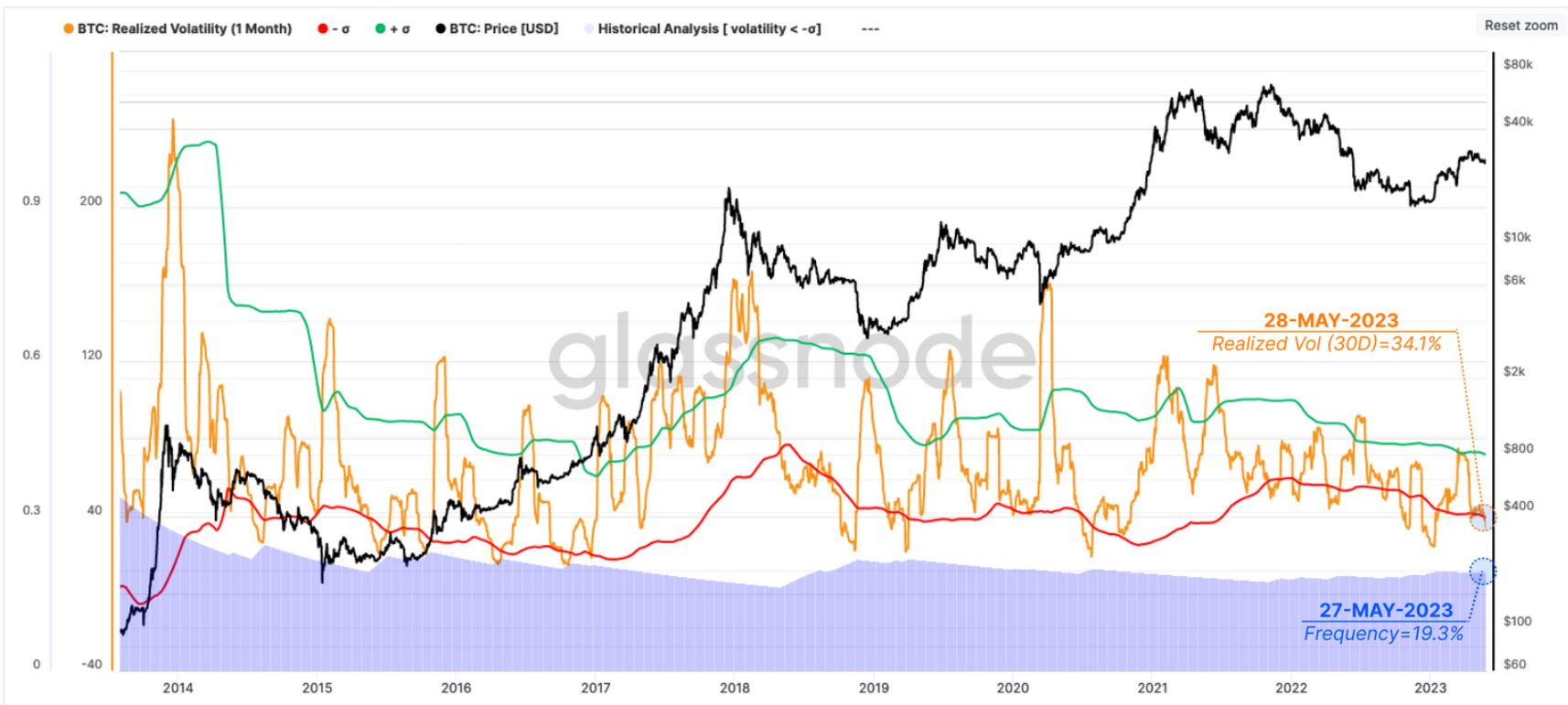
Bolinger Bands for Bitcoin Monthly Reasonable Volatility | Source: Glassnode

Bitcoin on-chain transfer volumes on exchanges have dropped to historic lows. According to the report, the price is also trading in favor of the short-term holders, indicating the “equilibrium position between gains and losses for new investors” who bought during and after the 2021-2022 bull cycle. Currently, only 50% of investors make a profit, the rest lose.

However, while short-term holders have reached equilibrium, long-term holders have moved in the recent correction, reinforcing the volatility argument.

Glassnode classifies coins that hold more than 155 days in a wallet as a long-term holder supply.

The gray bars in the image below show the long-term holders (LTH) binary spending indicator, which tracks whether LTH's average spend over the past 7 days is enough to reduce their total holdings. .

The chart shows previous instances where LTH spending has increased, often with increased volatility.
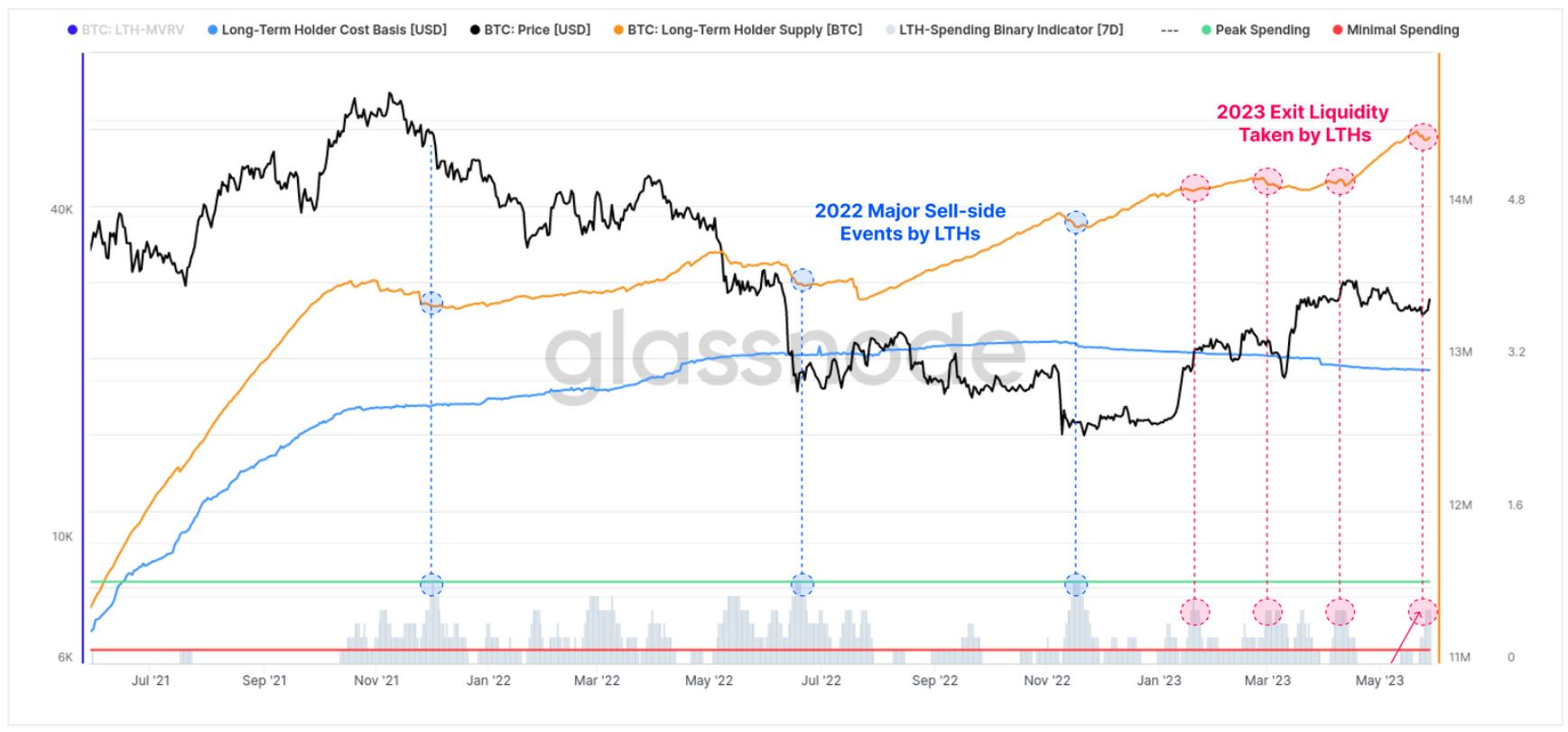
Long Term Holder Spending Binary Indicator | Source: Glassnode

Bitcoin’s recent price correction caused the indicator to drop slightly, “showing 4 out of 7 days of net divestment of LTH, which is similar to the Liquidity exit events so far this year.”

Analysts expect a wave of volatility to reach an equilibrium, where the market moves primarily due to accumulation or distribution of long-term holders' supply.

Options market data points to a similar theory of impending volatility.

The options market's latest expiration in May turned out to be a dull event, despite its nominal value of $2.3 billion. However, prolonged volatility compression could build momentum for an upcoming major price move.

Bitfinex's latest Alpha report shows that the DVOL index (which represents the market's expectations of Bitcoin's potential volatility over the next 30 days) has dropped to 45 from 50 just before expiration, representing a low annual.
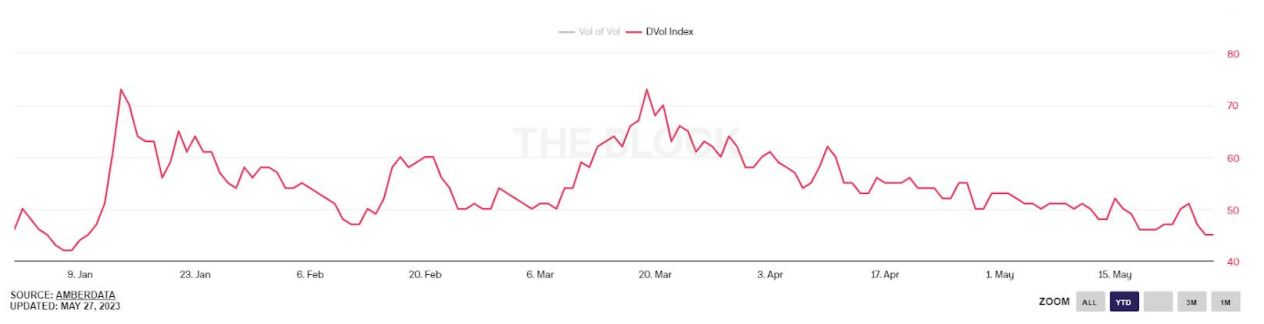
DVOL Index for Bitcoin Options | Source: Bitfinex

Implied volatility in options contracts refers to the market's expectation of an asset's future volatility, as reflected in the options' prices.

Bitfinex analysts said expectations of low volatility could be attributed to "coming events that are expected to change the market" or "uncertainty or market participants' increased risk aversion." ".

Right now, options traders are showing risk aversion and increasing their bearish positions as the month of May approaches the end of June.

Bitcoin put-to-call ratio increased from 0.38 to 0.5. A higher weighted put option shows that traders are slowly turning bearish.

Analysts at Bitfinex are currently anticipating “short-term market turbulence and price volatility risks” in June, especially with near-term expiration at the end of the month.

Potential price levels that could act as a magnet according to the options market positioning are the maximum pain at expiration in May and June of $27,000 and $24,000 respectively.

Maximum pain (also known as option pain) is a concept used in options trading and refers to the price at which the buyer must bear the maximum loss.
Lectures associées

NGRAVE dévoile le micrologiciel ZERO 1.8 avec le protocole QR universel et le support des jetons Polygon

**NGRAVE dévoile le firmware ZERO 1.8 avec le Protocole QR Universel et la prise en charge des jetons Polygon** Le 27 août 2026, NGRAVE a publié le firmware 1.8 pour son portefeuille matériel ZERO. Cette mise à jour introduit le Protocole QR Universel open-source (sous licence MIT), un nouveau format de QR animé qui accélère et fiabilise significativement la synchronisation et la signature des transactions en permettant un balayage à tout moment. Le support des actifs est élargi avec l'ajout de nombreux jetons sur Polygon (USDC, USDT0, WETH, WBTC, DAI, AAVE, LINK, UNI), ainsi que PAXG et AMP sur Ethereum et USDT sur MultiversX. Parallèlement, la liste des actifs a été rationalisée en supprimant les jetons inactifs ou obsolètes. Le support des chaînes BNB Beacon Chain et Groestlcoin a été arrêté. Conçu comme une norme ouverte et vérifiable, le Protocole QR Universel rend toute communication entre le ZERO et l'application LIQUID visible et vérifiable de manière indépendante. Basé sur l'écosystème UR de Blockchain Commons, il étend son support à plusieurs blockchains. L'application NGRAVE LIQUID supporte déjà le protocole ; les utilisateurs n'ont donc qu'à mettre à jour leur appareil ZERO. NGRAVE, société belge de sécurité des actifs numériques, propose une suite d'auto-garde comprenant le portefeuille ZERO, la solution de sauvegarde GRAPHENE et l'application compagnon LIQUID.

cointelegraphIl y a 14 mins

NGRAVE dévoile le micrologiciel ZERO 1.8 avec le protocole QR universel et le support des jetons Polygon

cointelegraphIl y a 14 mins

Nimiq lance le deuxième concours de Mini Apps pour les développeurs et les créateurs d'IA

Nimiq, un projet blockchain open source axé sur les paiements numériques, a lancé la deuxième édition de son concours Mini Apps. D'une durée de quatre semaines à partir du 24 août, cette compétition invite développeurs, spécialistes de l'IA et hackers indépendants à créer des applications open source pour Nimiq Pay. Elle propose 17 000 $ de prix dans le cadre d'un tournoi en trois cycles doté de plus de 50 000 $ au total. Cette nouvelle édition fait suite à un premier concours ayant reçu 62 soumissions. Les participants utilisent le Nimiq Pay Mini Apps Framework pour créer et héberger des applications web légères, accessibles directement via Nimiq Pay. Ce modèle permet aux développeurs de conserver le contrôle total de leurs applications et de leur propriété intellectuelle, sans frais de soumission, commissions ou partage de revenus. Max Burger, directeur exécutif de Nimiq, présente cette initiative comme un "moment App Store" pour les paiements en crypto, permettant d'intégrer des extensions à l'expérience de paiement Nimiq. Le framework simplifie le lancement d'applications en évitant aux développeurs de construire une infrastructure de paiement dédiée. Le concours est ouvert jusqu'au 18 septembre. Les projets éligibles incluent des jeux, outils de productivité, marchés, expériences sociales et autres applications web. Cette démarche s'inscrit dans la stratégie de Nimiq de transformer son application de paiement en une plateforme ouverte, offrant plus de fonctionnalités aux utilisateurs tout en permettant aux développeurs de distribuer leurs créations directement à la communauté.

TheNewsCryptoIl y a 1 h

Nimiq lance le deuxième concours de Mini Apps pour les développeurs et les créateurs d'IA

TheNewsCryptoIl y a 1 h

Trading

Spot
活动图片