Coin Price Today May 29: Bitcoin closes the week above $28,000, ending a 3-week losing streak as Altcoin show signs of recovery

Tap Chi BitcoinPublié le 2023-05-29Dernière mise à jour le 2023-05-29

Résumé

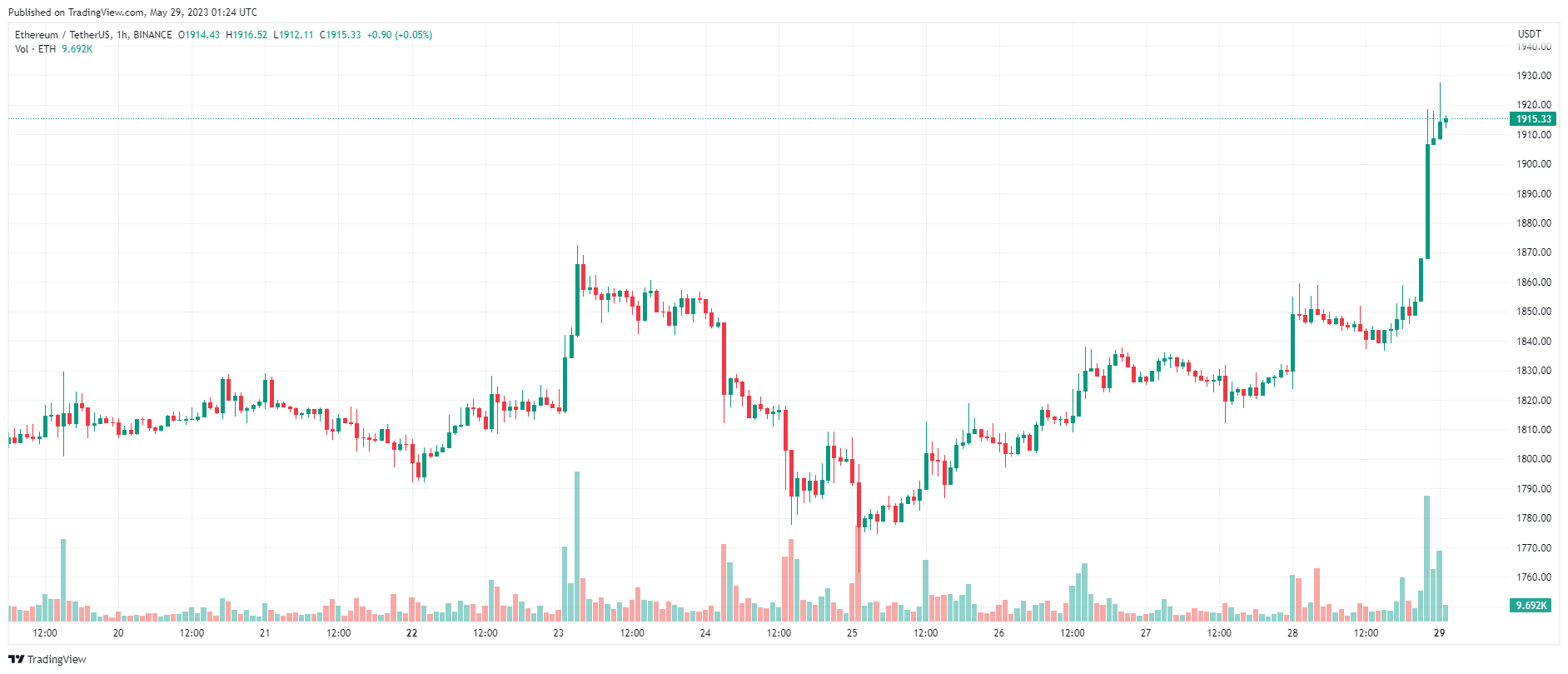
Following Bitcoin's momentum, Ethereum (ETH), the 2nd largest asset by market capitalization, has also bounced more than 3%, surpassing the $1,900 mark and currently trading around $1,915.

Bitcoin unexpectedly bounced back, closing the week in the green above $28,000, officially ending a three-week losing streak.
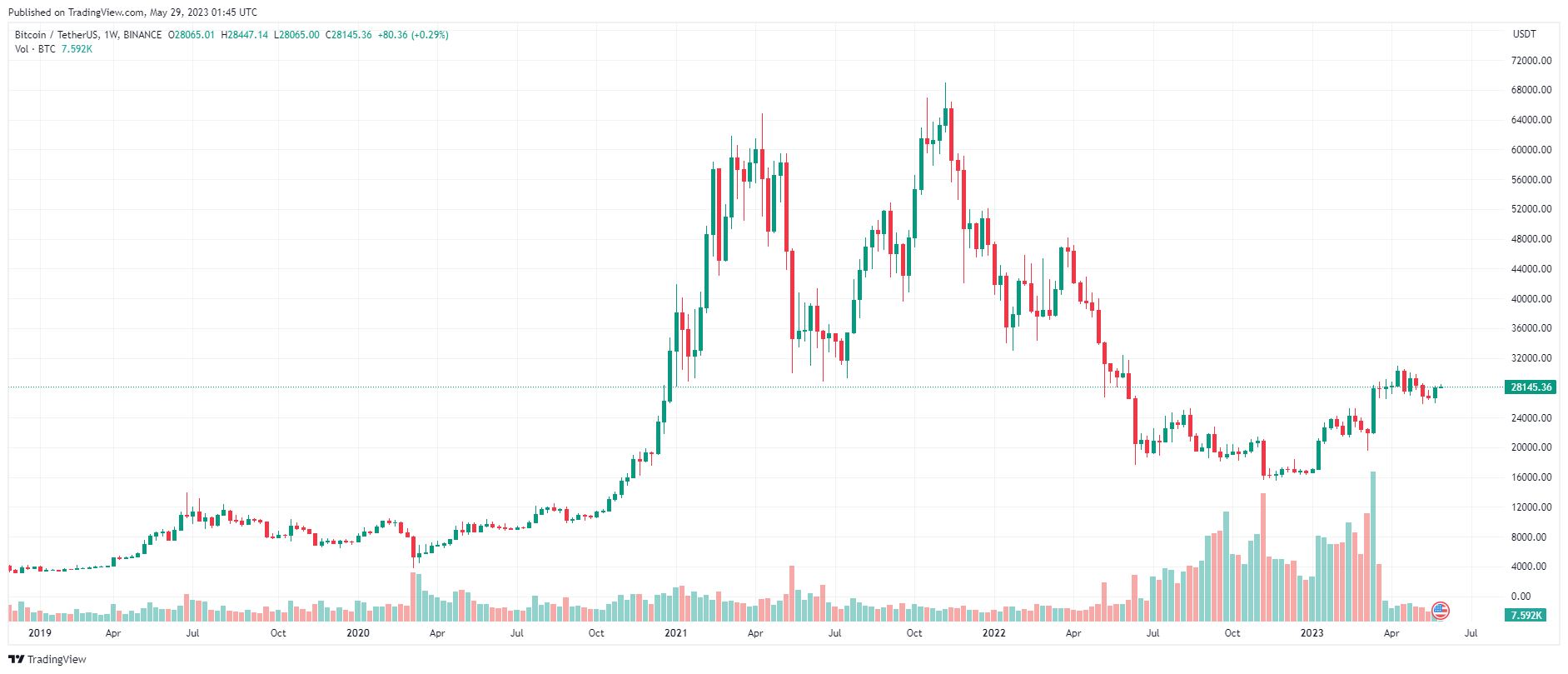
BTC Price Chart – 1 week | Source: TradingView

The president of Russia's second-largest bank said there is every reason to expect the Chinese yuan to replace the dollar as the world's main reserve currency.

He emphasized that the central bank of Russia has begun to reserve in yuan, and more than 70% of trade between Russia and China is paid in yuan and rubles.

The president of Russia's VTB Bank, Andrey Kostin, told a Russia-China business forum in Shanghai last week that the Chinese yuan would replace the US dollar as the reserve currency. and payments of the world in the next 10 years.

“China is currently the second largest economy in the world and will soon become the leading one.”

The president of VTB Bank explained that the monetary and financial system that has existed for decades ensures the hegemony of the United States and its Western allies, with the USD and the euro accounting for three-quarters of all payments. bridge. He emphasized that, while the greenback is the world's main reserve currency, the West in general, especially the United States, has used it as a weapon.

In February, the US Treasury Department announced "unprecedented" and "expanding" sanctions against VTB and Sberbank, Russia's two largest banks.

Russia and China are increasingly strengthening economic ties and using local currencies in commercial transactions. In April, the Chinese yuan surpassed the USD to become the most traded currency in Russia. This trend is expected to continue growing in the future, as both countries seek to reduce their dependence on the dollar.

Many have warned that the weaponization of the USD will lead to the greenback losing its status as a global reserve currency. More and more countries are promoting the use of national currencies to reduce dependence on USD.

The BRICS economic bloc has been ramping up efforts to de-dollarize and has proposed a single currency. Ten Southeast Asian countries have agreed to promote the use of national currencies, and recently top officials from nine Asian countries met in Iran to discuss de-dollarization measures.

However, the International Monetary Fund (IMF) did not see a “rapid change” in USD reserves, despite the growing trend of de-dollarization.

In a recent interview, Arthur Hayes said that the US debt ceiling issue could favor Bitcoin (BTC). When the debt ceiling is reached, it can have significant economic and financial implications.

Hayes noted that a 4.9% inflation rate, coupled with debt defaults, could cause the US economy to collapse. So residents of the country can start looking towards digital assets like Bitcoin for safety.

On May 27, the Financial Times reported that the US may not meet its debt payment deadline of June 5. According to the Finance Secretary, Janet Yellen, the government may run out of money and she also mentioned that printing more USD might not solve the problem.

According to the on-chain analytics platform, the number of addresses holding 0 to 1 BTC has been growing since April.
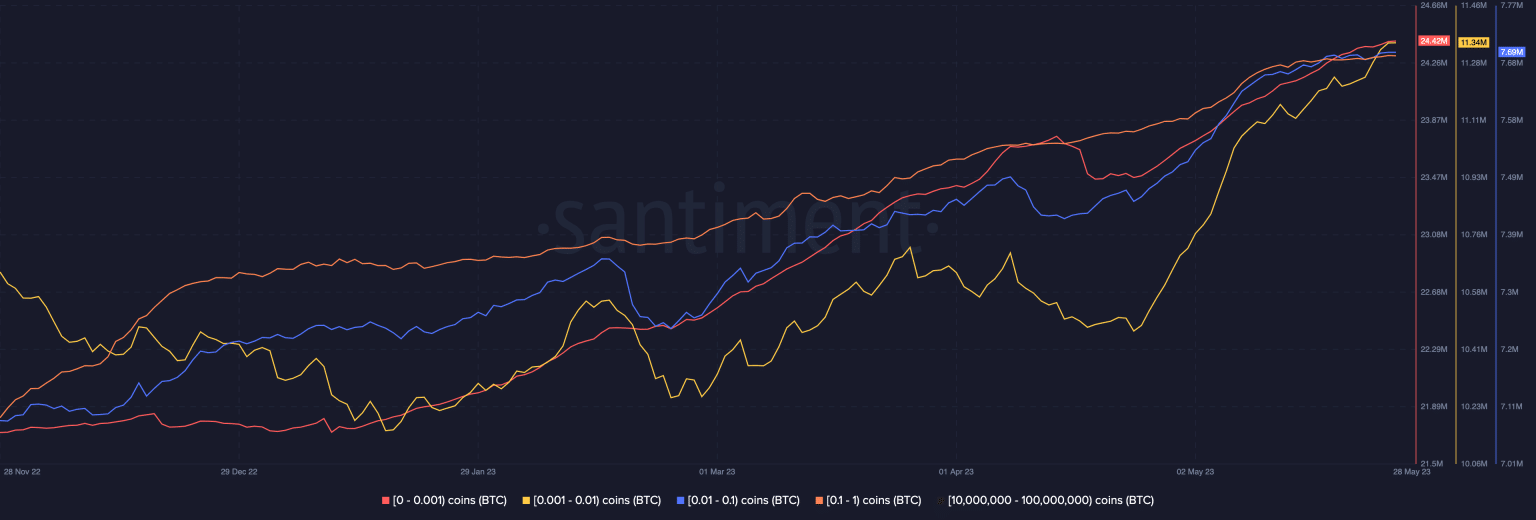
Source: Santiment

This supply allocation indicates increased activity in the retail group. On the Circulating Supply side, the index has moved up, touching 1.17 million in the past 30 days.

Circulating Supply supply emphasizes the number of unique BTC transacted in a particular time period. Therefore, the increase in this indicator implies that the amount of BTC participating in buying and selling has sanitize after the downturn of the previous few weeks.

Additionally, Bitcoin exchange inflows have dropped to 3,105. The drop in this metric indicates less deposits on exchanges, leading to a easing of selling pressure.
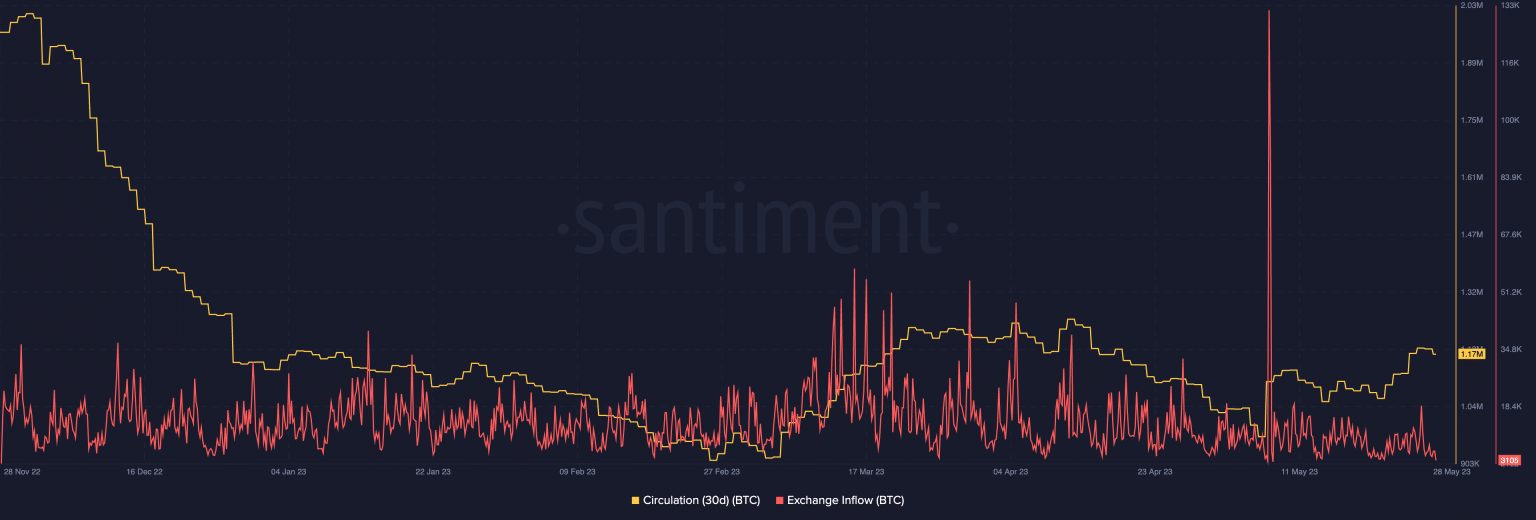
Source: Santiment

Altcoin rallied after BTC unexpectedly bounced above $28,000.

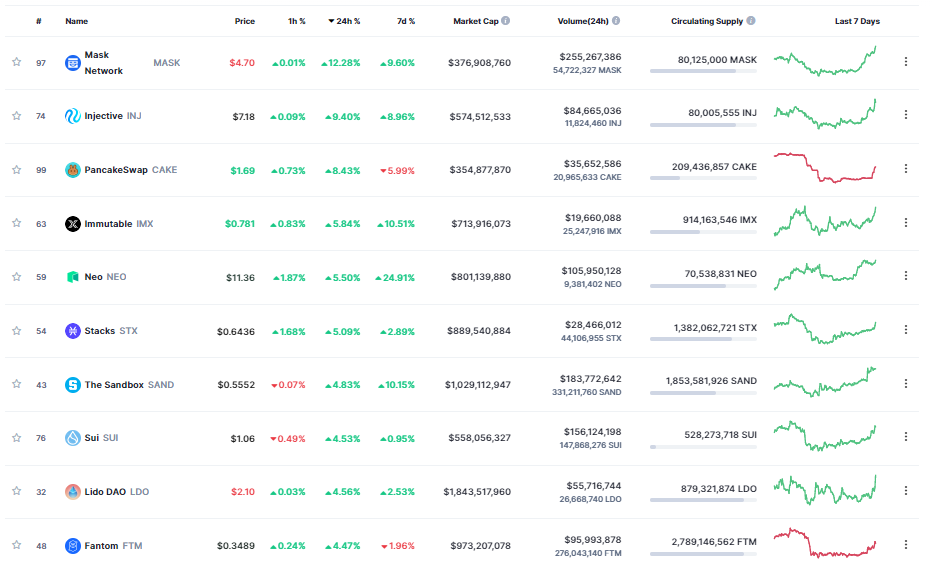
Mask Network (MASK) was the best performing project of the day with an increase of more than 12%, wiping out the loss of the past week.

Injective (INJ), PancakeSwap (CAKE), ImmutableX (IMX), Neo (NEO), Stacks (STX), The Sandbox (SAND), Sui (SUI), Lido DAO (LDO), Fantom (FTM)… grew from 4-9% in the last 24 hours.
Source: Coinmarketcap

Following Bitcoin's momentum, Ethereum (ETH), the 2nd largest asset by market capitalization, has also bounced more than 3%, surpassing the $1,900 mark and currently trading around $1,915.
ETH price chart – 1 hour | Source: TradingView

Lectures associées

L'industrie informatique américaine contre les interdictions : pourquoi Nvidia, OpenAI et Google se prononcent pour un IA ouverte

Plus de 270 entreprises et organisations, dont Nvidia, OpenAI, Google, Microsoft et SpaceX, ont signé une lettre ouverte s'opposant aux restrictions prématurées sur les modèles d'IA aux poids ouverts (« open weights ») aux États-Unis. Elles plaident pour un écosystème ouvert, estimant que cela stimule l'innovation, la concurrence et la sécurité, en permettant un examen indépendant des modèles. La lettre, datée du 24 juillet 2026, appelle les décideurs politiques à éviter les interdictions générales, à ne pas assimiler des techniques légitimes comme la distillation à une appropriation illégale, et à privilégier des mesures juridiques ciblées contre les abus. Le PDG de Nvidia, Jensen Huang, soutient que l'ouverture renforce la sécurité et la souveraineté technologique. Cependant, des voix comme celle de Dario Amodei, dirigeant d'Anthropic, expriment de vives inquiétudes. Il considère la disponibilité de modèles puissants aux poids ouverts, comme le modèle chinois Kimi K3 récemment publié, comme un risque majeur pour la sécurité, facilitant potentiellement la création d'outils de piratage. Le débat oppose donc deux visions : une majorité de l'industrie américaine prônant l'ouverture comme gage de leadership et de résilience, et une minorité alertant sur les dangers d'une diffusion incontrôlée de capacités d'IA avancées. L'incapacité à retirer des modèles une fois publiés et les risques d'exécution autonome sont au cœur des préoccupations.

cryptonews.ruIl y a 40 mins

L'industrie informatique américaine contre les interdictions : pourquoi Nvidia, OpenAI et Google se prononcent pour un IA ouverte

cryptonews.ruIl y a 40 mins

Après 8 ans, le streamer célèbre Dishi découvre que son "frère" de la crypto lui a escroqué des dizaines de millions

Après huit ans, l'influenceur chinois "帝师" (Di Shi) a découvert qu'il avait été escroqué de dizaines de millions de yuans (jusqu'à 30 millions de RMB selon certaines sources) par un ancien ami du secteur des cryptomonnaies, Sun Zeyu. Sun, présenté comme un investisseur expérimenté et co-fondateur du portefeuille matériel CoolBitX et de Genesis Capital, a trompé Di Shi en lui faisant investir dans de faux actifs. Le mécanisme de l'escroquerie était élaboré : au lieu d'acheter de vrais Ethereum (ETH), Sun a créé une blockchain privée forkée, sur laquelle seuls sept portefeuilles existaient (six contrôlés par Sun et un appartenant à Di Shi). Les "jetons" détenus par Di Shi n'avaient donc aucune valeur réelle. La confiance avait été établie sur plusieurs années par des retraits réussis de plusieurs millions de yuans et la réputation publique de Sun. Di Shi n'est pas la seule victime. D'autres acteurs de la crypto auraient également perdu des sommes importantes (de 300 000 à 1,5 million de dollars) dans des "investissements" gérés par Sun, qui aurait désormais quitté la Chine. Cet incident met en lumière les risques majeurs des arnaques par "délégation d'investissement" (代投) dans les cryptomonnaies, exploitant les asymétries d'information et la confiance. Il sert d'avertissement : ne jamais confier ses actifs à un tiers, toujours vérifier soi-même la réalité des actifs sur un explorateur de blockchain publique, acquérir des connaissances de base avant d'investir et se méfier des promesses de rendements élevés ou des recommandations entre "amis".

Odaily星球日报Il y a 1 h

Après 8 ans, le streamer célèbre Dishi découvre que son "frère" de la crypto lui a escroqué des dizaines de millions

Odaily星球日报Il y a 1 h

NGRAVE dévoile le micrologiciel ZERO 1.8 avec le protocole QR universel et le support des jetons Polygon

**NGRAVE dévoile le firmware ZERO 1.8 avec le Protocole QR Universel et la prise en charge des jetons Polygon** Le 27 août 2026, NGRAVE a publié le firmware 1.8 pour son portefeuille matériel ZERO. Cette mise à jour introduit le Protocole QR Universel open-source (sous licence MIT), un nouveau format de QR animé qui accélère et fiabilise significativement la synchronisation et la signature des transactions en permettant un balayage à tout moment. Le support des actifs est élargi avec l'ajout de nombreux jetons sur Polygon (USDC, USDT0, WETH, WBTC, DAI, AAVE, LINK, UNI), ainsi que PAXG et AMP sur Ethereum et USDT sur MultiversX. Parallèlement, la liste des actifs a été rationalisée en supprimant les jetons inactifs ou obsolètes. Le support des chaînes BNB Beacon Chain et Groestlcoin a été arrêté. Conçu comme une norme ouverte et vérifiable, le Protocole QR Universel rend toute communication entre le ZERO et l'application LIQUID visible et vérifiable de manière indépendante. Basé sur l'écosystème UR de Blockchain Commons, il étend son support à plusieurs blockchains. L'application NGRAVE LIQUID supporte déjà le protocole ; les utilisateurs n'ont donc qu'à mettre à jour leur appareil ZERO. NGRAVE, société belge de sécurité des actifs numériques, propose une suite d'auto-garde comprenant le portefeuille ZERO, la solution de sauvegarde GRAPHENE et l'application compagnon LIQUID.

cointelegraphIl y a 1 h

NGRAVE dévoile le micrologiciel ZERO 1.8 avec le protocole QR universel et le support des jetons Polygon

cointelegraphIl y a 1 h

Trading

Spot
活动图片