Zashi Becomes Zodl: Zcash Wallet Rebrands Following Internal Split

bitcoinistPublicado a 2026-02-17Actualizado a 2026-02-17

Resumen

Zashi, the flagship mobile wallet for Zcash, has been rebranded to "Zodl" following a formal split from the Electric Coin Company (ECC), its original developer. The rebrand signals continuity in the product and team, but under a new corporate entity called the Zcash Open Development Lab (ZODL). Users are not required to take any action, as the update will not impact the wallet's functionality. The change comes after a governance rupture in January 2025, when the entire ECC team left due to a dispute with Bootstrap, the nonprofit governing ECC. The conflict centered around a proposal to move Zashi into a for-profit structure and attract external investment, which Bootstrap argued required careful handling due to nonprofit fiduciary duties. Despite the corporate restructuring, the team's mission remains focused on privacy-first payments and financial sovereignty. The wallet will continue operating as Zcash's flagship product, now independently developed and funded outside the Zcash development fund.

Zashi, the flagship mobile wallet built by Zcash’s original engineering team, is rebranding to “Zodl” as its developers formally operate outside the Electric Coin Company (ECC) structure. The change matters less as a cosmetic refresh than as a signal: the same builders are continuing product work, but under a new corporate banner after a governance rupture that spilled into public view in early January.

Zcash Wallet Zashi Renamed Zodl

In a post on X dated Feb. 16, the wallet team said the next app update will rename Zashi to Zodl “without impacting the user experience,” stressing there is “no action required” from users. “It’s a new brand for a new chapter, but everything else stays the same: the wallet, the team behind it, and our commitment to Zcash,” the announcement read. “We’re moving forward with clarity and purpose, and this change reflects the building momentum.”

The post also tied the rebrand to a broader organizational reset. “In January of this year, the entire Electric Coin Company (ECC) team, the original creators of Zcash and Zashi, left ECC and formed a new company,” it said, naming the new entity Zcash Open Development Lab (ZODL) and positioning Zodl as the “Zcash flagship wallet.” The team framed the move as a way to pursue growth “without reliance on the Zcash development fund,” while keeping continuity on shipping and support.

On mission, the wallet team used language that will be familiar to long-time Zcash followers, explicitly anchoring the product roadmap to privacy-first payments. “We envision a world without mass financial surveillance. A world where law-abiding people can transact freely and privately, without fear that their data will be exploited or weaponized,” the post said. “There is no sovereignty without privacy. Our banner has changed, but our mission has not.”

The immediate practical effect for users is limited: the same app is expected to update in place, with branding changes rolling out across channels, including the Discord support presence. The more consequential change is governance and ownership context: the wallet is now explicitly presented as a product of ZODL rather than ECC, after weeks of public dispute about who could control, finance, and potentially commercialize consumer-facing efforts around Zashi.

The Background Story

The break traces back to a late-2025 clash between ECC leadership and Bootstrap, the 501(c)(3) nonprofit that governs ECC. In early January, former ECC CEO Josh Swihart said board actions left the team no viable path inside the existing structure. “Unfortunately, decisions made by four of Bootstrap’s board members forced every person at ECC to exit the company, very quickly,” Swihart wrote on the Zcash Community Forum on Jan. 9. “I wish we hadn’t been forced to move so quickly. But we had no choice. This is a serious matter. It is not a game. And as you see, the consequences, severe.”

Bootstrap, for its part, has argued the flashpoint was a proposed transaction to move Zashi into a for-profit structure and attract outside capital, which it says had to be handled as a related-party deal involving nonprofit-controlled assets.

In a public statement and accompanying timeline, Bootstrap described talks around external investment and “alternative structures to privatize Zashi” intensifying in late October 2025, then accelerating in December amid rushed deadlines, incomplete documentation, and legal constraints tied to nonprofit fiduciary duties. The timeline states that matters “rapidly escalated” around Dec. 20 when the board was presented with a Jan. 1 deadline to approve a deal, followed by leadership departures in early January and the broader team exit shortly after.

At press time, Zcash traded at $284.34.
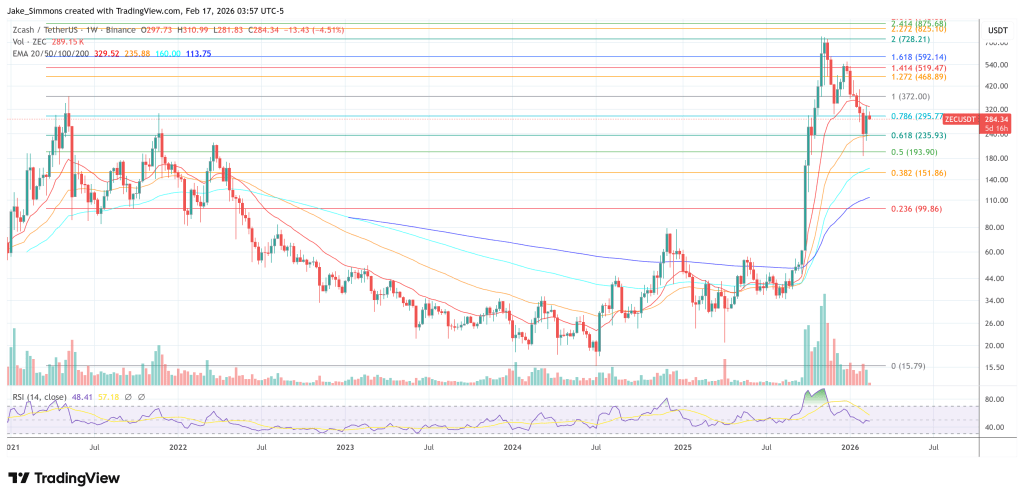
ZEC price remains below the 0.786 Fib, 1-week chart | Source: ZECUSDT on TradingView.com

Lecturas Relacionadas

Winter for Crypto IPOs: Consensys and Ledger Withdraw Applications

The crypto IPO window is tightening significantly in 2026, marked by prominent companies delaying or pausing their public listing plans. Following a successful 2025 "harvest year" that saw Circle, Bullish, and Gemini go public amidst a bull market, the tide has turned. Consensys, developer of MetaMask, recently postponed its IPO until at least fall 2026. Hardware wallet leader Ledger also suspended its planned US listing due to unfavorable market conditions, with Kraken having previously delayed its own plans. This shift is driven by a cooling market in 2026, characterized by a significant Bitcoin price correction, declining trading volumes, and reduced investor risk appetite for crypto stocks. The poor post-IPO performance of 2025 listings like Circle and Bullish, which saw major share price declines, has heightened investor caution. This contrasts sharply with the current AI sector, where companies like SpaceX, OpenAI, and Anthropic are commanding massive valuations and investor enthusiasm based on narratives of stable, exponential growth. Crypto companies now face pressure to transition from hype-driven models to demonstrating reliable cash flows and robust compliance. While the paused IPO plans may lead to valuation resets and affect ecosystem liquidity, they also accelerate industry consolidation toward stronger, more compliant infrastructure players. A potential recovery in Bitcoin's price and clearer regulations could reopen the IPO window in the latter half of 2026.

marsbitHace 33 min(s)

Winter for Crypto IPOs: Consensys and Ledger Withdraw Applications

marsbitHace 33 min(s)

ChatGPT Can Manage Your Money for You. Would You Trust It with Your Bank Account?

OpenAI has launched a personal finance tool for ChatGPT, currently in preview for US-based ChatGPT Pro users. This feature allows users to connect their bank and investment accounts (via Plaid, supporting over 12,000 institutions) directly to ChatGPT. It analyzes transactions, generates visual dashboards, and offers conversational financial advice—such as budgeting or planning for major purchases—based on the user's actual data. This move follows OpenAI's acquisitions of fintech startups Roi and Hiro Finance, signaling a strategic push into vertical "super assistant" applications, similar to its earlier health-focused feature. However, the launch has sparked significant privacy concerns. Critics question the safety of granting such sensitive financial access to an AI, especially amid ongoing lawsuits alleging OpenAI shared user chat data with third parties like Meta and Google. OpenAI emphasizes that ChatGPT only reads data (no transaction capabilities), deletes it within 30 days if disconnected, and offers opt-out options for model training. Yet, trust remains a major hurdle. The trend reflects a broader industry shift: AI companies like Anthropic and Perplexity are also targeting high-value, data-rich domains like finance and health. While technically promising, the tool operates in a regulatory gray area—it provides personalized guidance but disclaims formal financial advice or liability. Ultimately, OpenAI's challenge is convincing users to trust an AI with their most private financial information.

marsbitHace 34 min(s)

ChatGPT Can Manage Your Money for You. Would You Trust It with Your Bank Account?

marsbitHace 34 min(s)

Trading

Spot
Futuros
活动图片