ChatGPT Can Manage Your Money for You. Would You Trust It with Your Bank Account?

marsbitPublicado a 2026-05-16Actualizado a 2026-05-16

Resumen

OpenAI has launched a personal finance tool for ChatGPT, currently in preview for US-based ChatGPT Pro users. This feature allows users to connect their bank and investment accounts (via Plaid, supporting over 12,000 institutions) directly to ChatGPT. It analyzes transactions, generates visual dashboards, and offers conversational financial advice—such as budgeting or planning for major purchases—based on the user's actual data. This move follows OpenAI's acquisitions of fintech startups Roi and Hiro Finance, signaling a strategic push into vertical "super assistant" applications, similar to its earlier health-focused feature. However, the launch has sparked significant privacy concerns. Critics question the safety of granting such sensitive financial access to an AI, especially amid ongoing lawsuits alleging OpenAI shared user chat data with third parties like Meta and Google. OpenAI emphasizes that ChatGPT only reads data (no transaction capabilities), deletes it within 30 days if disconnected, and offers opt-out options for model training. Yet, trust remains a major hurdle. The trend reflects a broader industry shift: AI companies like Anthropic and Perplexity are also targeting high-value, data-rich domains like finance and health. While technically promising, the tool operates in a regulatory gray area—it provides personalized guidance but disclaims formal financial advice or liability. Ultimately, OpenAI's challenge is convincing users to trust an AI with their most p...

On May 15, OpenAI launched a new feature that left many feeling "both excited and uneasy" — a ChatGPT personal finance tool. Simply put, you can now directly connect your bank accounts and investment accounts to ChatGPT.

This feature is currently available for preview only to ChatGPT Pro users (monthly fee $200) in the United States. OpenAI uses the financial data service Plaid to facilitate account connections, supporting over 12,000 financial institutions, including JPMorgan Chase, Fidelity, Charles Schwab, Robinhood, American Express, and Capital One.

It sounds great. But the comments section almost exploded — would you really dare to give your bank account to an AI?!

01

What Does Your "AI Personal CFO" Look Like?

First, let's see what this tool can actually do.

Users go to the "Finances" option in the ChatGPT sidebar, click start, or directly type "@Finances, connect my accounts" in the dialog box. ChatGPT will then guide you through connecting your bank accounts via Plaid. The entire authorization process is essentially the same as linking your bank card in apps like Venmo or Robinhood — Plaid's tokenized authentication mechanism means ChatGPT itself does not have access to your bank passwords.
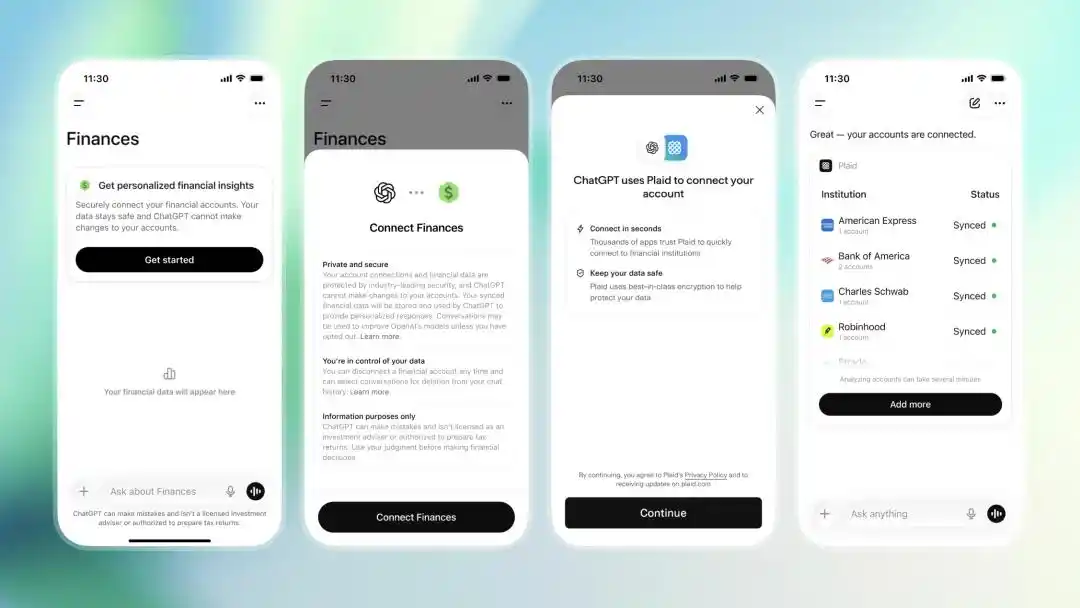
You need to connect your bank account via Plaid first | Image source: OpenAI

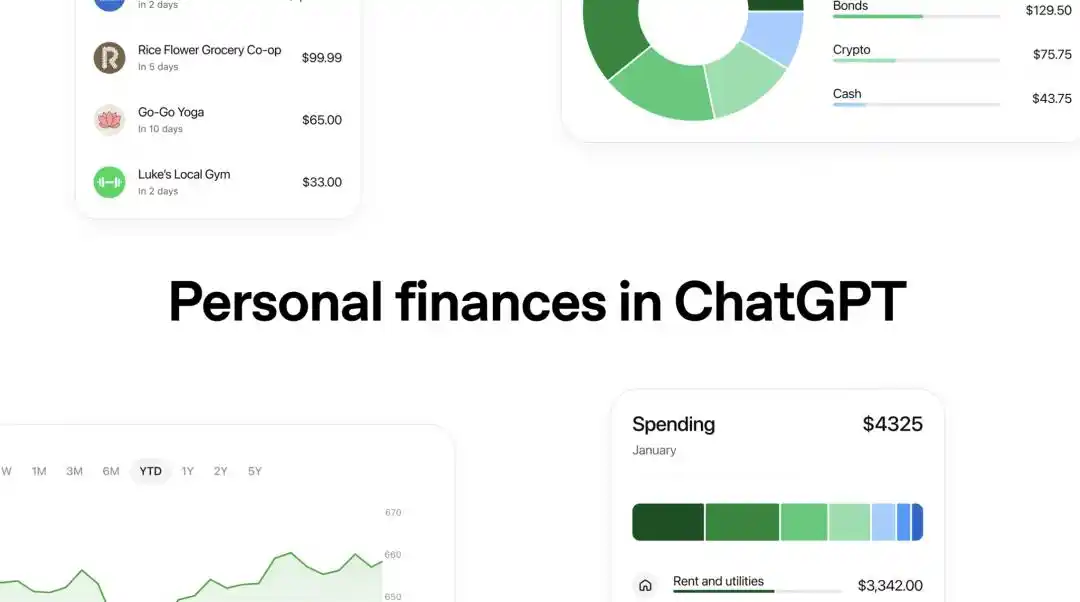
Once connected, ChatGPT will take a few minutes to sync and categorize your financial data, then generate a visual financial dashboard. This dashboard covers comprehensive information: checking and savings account balances, transaction history, spending breakdown by category, monthly recurring subscription services, upcoming bills, payroll deposit records, investment portfolio performance, as well as liabilities like credit card debt and mortgages.

But the dashboard is just the starting point. The really interesting part is "conversational finance management." Unlike traditional budgeting tools like Mint or YNAB, ChatGPT doesn't require you to look at charts, browse categories, or manually set budgets. You simply ask questions in natural language, and it provides answers based on your actual data.
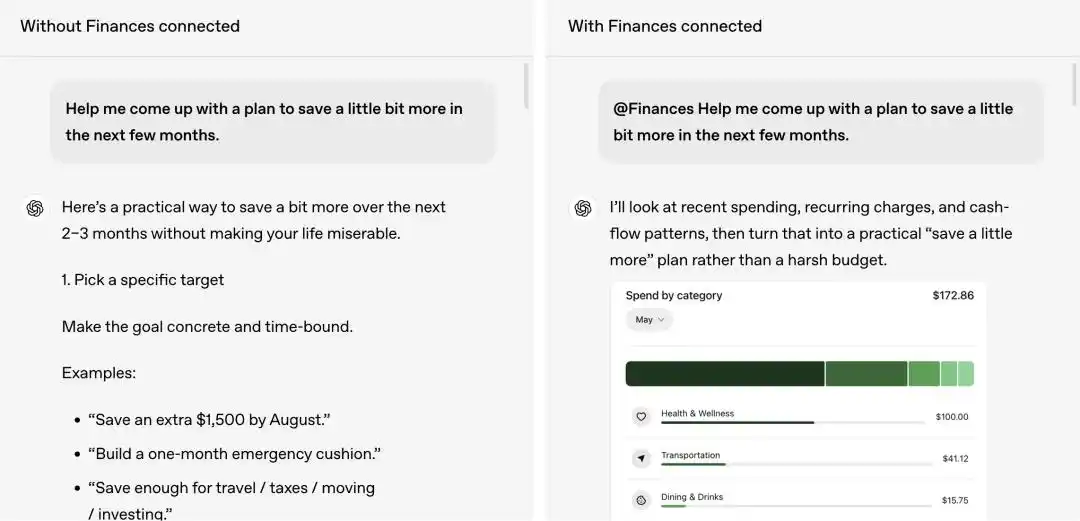
Comparison of financial questions before (left) and after (right) using personal financial data. Clearly, the latter is more planned and targeted | Image source: OpenAI

OpenAI provided several example scenarios: you can ask, "Am I spending more lately than before? What's changed?" ChatGPT will analyze your transaction history for spending trends.

You can say, "Help me make a plan to buy a house locally within five years," and it will calculate based on your income, savings rate, and current liabilities; you can even tell it, "I still owe my parents some money" or "I plan to buy a car early next year." ChatGPT will store this information in its "financial memory," and subsequent conversations will consider this context.

This is completely different from ChatGPT's previous experience in answering financial questions. Before, if you asked it "How should I save money to buy a house?" you'd get a bunch of generic textbook financial advice. Now that it can see your bank account balance, monthly spending structure, investment returns, and debt ratio, the suggestions are no longer generic nonsense like "we recommend saving 20% of your salary each month."

OpenAI also hinted at the next step: soon supporting Intuit data integration, allowing users to have ChatGPT analyze the specific tax impact of selling a particular stock or assess their approval probability for a certain credit card application.

OpenAI wants to evolve ChatGPT from "helping you look up a concept" to "helping you make decisions."

02

Two Acquisitions, Three Strategic Moves

OpenAI didn't undertake this on a whim.

Its groundwork has actually been underway for over half a year. In October 2025, OpenAI acquired the personal finance app Roi, and its founder Sujith Vishwajith subsequently joined OpenAI.

In April 2026, OpenAI acquired another personal finance startup, Hiro Finance, with founder Ethan Bloch and the entire team joining. Hiro's positioning was "AI personal CFO" and had helped users manage over $1 billion in assets. Bloch previously founded the automated savings app Digit, which was acquired for over $200 million in 2021.

Two acquisitions, two fintech veterans, half a year — OpenAI is clearly building a "financial task force" in a planned manner.

The driving data behind this is also staggering. OpenAI revealed that over 200 million people ask financial-related questions on ChatGPT every month — from budget management to how to cut expenses. These users were already using a "general-purpose chatbot" for financial tasks, except previously ChatGPT's responses lacked personalized data support.
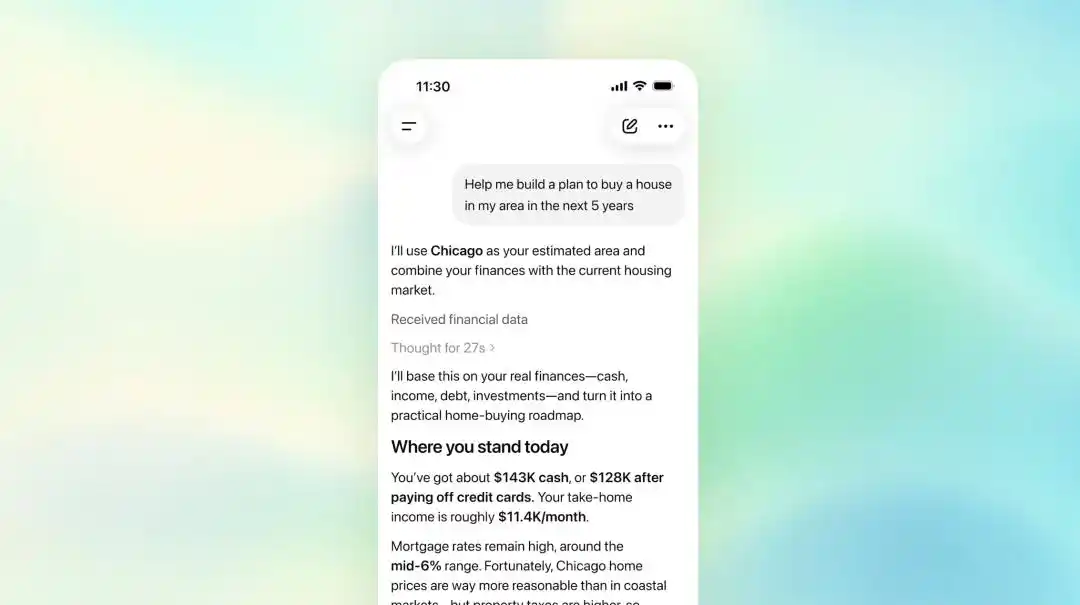
Users can directly conduct financial analysis within ChatGPT | Image source: OpenAI

Now, with Plaid's account connections and the stronger reasoning capabilities of the GPT-5.5 model, ChatGPT's goal is clear: to evolve from a "chat-about-anything" general assistant into a "super assistant" that truly understands your financial situation.

OpenAI has actually already tested this path before.

In January of this year, it launched ChatGPT Health, allowing users to connect medical records and health apps like Apple Health and MyFitnessPal. Official data shows over 230 million people ask health questions on ChatGPT weekly. From health to finance, OpenAI is shaping ChatGPT into an entry point covering all "high-value decision-making" scenarios in life.

03

Privacy Storm Arrives Faster Than the Product

But the problem is, managing money isn't like writing copy. What you're handing over isn't a prompt, but your entire financial profile.

Following the release of this feature, reactions on social media were overwhelmingly skeptical. Someone commented on Twitter: "What sane person would willingly give that level of access to OpenAI?" Others immediately brought up past issues: "You guys were just hit with a class-action lawsuit for secretly sharing ChatGPT conversation data with Google and Facebook."

This isn't baseless. Just one day before the finance feature launch, a new class-action lawsuit was filed in a California federal court, alleging that OpenAI embedded Meta Pixel and Google Analytics tracking codes in the ChatGPT webpage, transmitting chat topics, user IDs, email addresses, and other information to Meta and Google for ad targeting without user knowledge. The complaint points out that many users discuss extremely private topics like finance, health, and law on ChatGPT.
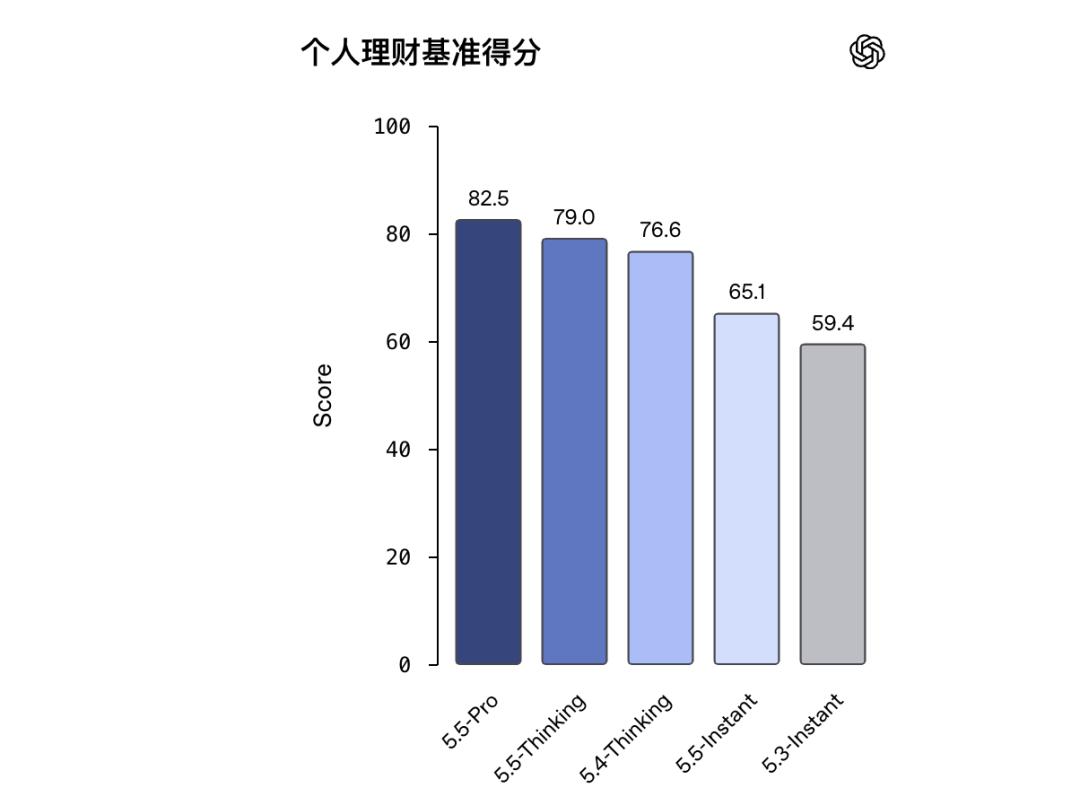
OpenAI officially stated that GPT-5.5 Pro performs better for private financial analysis | Image source: OpenAI

Getting sued for allegedly secretly sharing user chat data, then launching a new product that asks users to connect their bank accounts — this timing coincidence is almost a PR disaster-level coincidence.

OpenAI clearly recognizes the trust issue. It repeatedly emphasized in its announcement that ChatGPT cannot perform any actions on user accounts, nor can it see full account numbers; it can only read balances, transaction history, investment portfolios, and liability information. Upon disconnection, data will be deleted within 30 days. Users can also view and delete the financial "memories" ChatGPT retains.

But one detail is noteworthy — there is an optional switch in the system called "Improve the model for everyone." If users turn it on, their financial conversation data will be used to train the AI model. Although this switch is off by default, its very existence sends a signal:

Your financial data, within OpenAI's system, can theoretically become training material.

04

AI Companies Collectively Rush Towards "High-Value Data"

Viewing ChatGPT's financial tool within a broader context reveals a collective shift in the AI industry.

The era of general-purpose chatbots is ending; the war for "vertical super assistants" has begun.

OpenAI launched health in January and finance in May; Anthropic released ten professional AI Agents for the financial industry in early May, directly targeting banking, insurance, and asset management, with data sources including Moody's, S&P Capital IQ, and Morningstar — news that caused FactSet's stock to drop 8% that day. Perplexity also launched "Computer for Professional Finance" around the same time, targeting professional investment research teams, supporting connections to data sources like PitchBook and Daloopa, and offering 35 preset financial workflows.

Interestingly, Perplexity's financial product recently also started supporting user connections to brokerage accounts via Plaid — using the same infrastructure as ChatGPT. This means Plaid is becoming the underlying pipeline for the "AI finance management" era, much like Stripe for online payments.

But the strategic differences between companies are also evident. OpenAI is taking a consumer (C) route, aiming to bring every ordinary person's bank account into ChatGPT. Anthropic and Perplexity are taking a business (B) route, aiming to let financial professionals use AI to replace some functions of Bloomberg Terminal.

However, whether B or C, the core logic is the same: whoever gains access to users' most private, highest-value data occupies the entry point in the next phase of AI.

Health data, financial data, legal data — these fields are being collectively targeted by AI companies not because AI suddenly became good at finance, but because these scenarios naturally require personalization, inherently involve high-frequency interaction, and naturally have a willingness to pay.

05

The Ultimate Test for the "Super Assistant"

Returning to ChatGPT's launch. From a product logic perspective, it's actually quite well done: using Plaid connections ensures a baseline of security, read-only permissions rather than operational permissions reduce risk, and the 30-day data deletion provides an exit mechanism. OpenAI also stated it will soon support Intuit connections, allowing users to analyze the tax impact of stock sales or assess credit card approval probabilities.

But there is a chasm between a well-made product and user trust.

Sam Altman wants to turn ChatGPT into a "personal super assistant," covering every aspect of life from writing to search, from health to finance, from programming to shopping. This vision is undeniably grand. But the grander the vision, the higher the demand for trust. And OpenAI's track record on privacy issues doesn't inspire complete confidence.

A comment on Slashdot was quite direct: "Hand over your bank account to a hallucinating chatbot? Since when can AI's financial advice be written into the disclaimer?"

This is harsh but touches the core issue. There's a fundamental difference between AI financial tools and traditional financial advisors — human financial advisors are subject to financial regulation, have licenses, and bear legal responsibility; ChatGPT's terms of service clearly state it does not provide investment advice and bears no financial consequences.

When a tool looks like a financial advisor, talks like a financial advisor, and even understands your spending data better than most advisors — yet legally, it is nothing of the sort — this itself is a gray area that needs serious discussion.

OpenAI says it will first gather feedback from Pro users before deciding whether to open it up to Plus users. This is a smart strategy — using the most adventurous hardcore users to "beta test." But if the trust issue isn't resolved, the larger user base might never see it.

Technically, ChatGPT is ready to manage your money.

But are you ready? This might be an unavoidable choice for everyone in the AI era.

Geek's Question

Would you be willing to connect your bank account to an AI chatbot? Why or why not?

This article is from the WeChat public account "GeekPark" (ID: geekpark), author: Huà Lín Wǔ Wáng


Preguntas relacionadas

QWhat is the new ChatGPT feature announced by OpenAI, and what does it allow users to do?

AOpenAI announced a personal finance tool for ChatGPT, currently in preview for U.S. ChatGPT Pro users. It allows users to connect their bank and investment accounts (through the financial data service Plaid) directly to ChatGPT, enabling it to analyze personal financial data and provide tailored advice.

QWhat are some of the key privacy concerns raised about this new ChatGPT feature?

AMajor privacy concerns include users handing over sensitive financial data to OpenAI, especially following recent lawsuits alleging OpenAI shared user chat data with companies like Meta and Google. There is also concern about the 'Improve the model for everyone' optional setting, which could allow financial conversation data to be used for AI training.

QHow does OpenAI's approach with its finance tool differ from that of companies like Anthropic and Perplexity in the financial AI space?

AOpenAI is targeting the consumer (C端) market, aiming to connect individual bank accounts to ChatGPT for personal finance management. In contrast, Anthropic and Perplexity are focused on the business/professional (B端) market, providing AI tools for financial professionals with data from sources like Moody's and PitchBook, aiming to replace parts of platforms like Bloomberg Terminal.

QWhat previous acquisitions did OpenAI make to build its finance capabilities?

ATo build its finance capabilities, OpenAI acquired the personal finance app Roi in October 2025 and the personal finance startup Hiro Finance in April 2026. These acquisitions brought in founders and teams with fintech expertise to form a 'financial commando unit' within OpenAI.

QAccording to the article, what is a fundamental legal distinction between an AI like ChatGPT and a human financial advisor?

AA fundamental legal distinction is that human financial advisors are regulated, licensed, and bear legal liability for their advice. In contrast, ChatGPT's terms of service clearly state that it does not provide investment advice and bears no responsibility for financial outcomes, creating a significant regulatory grey area.

Lecturas Relacionadas

Winter for Crypto IPOs: Consensys and Ledger Withdraw Applications

The crypto IPO window is tightening significantly in 2026, marked by prominent companies delaying or pausing their public listing plans. Following a successful 2025 "harvest year" that saw Circle, Bullish, and Gemini go public amidst a bull market, the tide has turned. Consensys, developer of MetaMask, recently postponed its IPO until at least fall 2026. Hardware wallet leader Ledger also suspended its planned US listing due to unfavorable market conditions, with Kraken having previously delayed its own plans. This shift is driven by a cooling market in 2026, characterized by a significant Bitcoin price correction, declining trading volumes, and reduced investor risk appetite for crypto stocks. The poor post-IPO performance of 2025 listings like Circle and Bullish, which saw major share price declines, has heightened investor caution. This contrasts sharply with the current AI sector, where companies like SpaceX, OpenAI, and Anthropic are commanding massive valuations and investor enthusiasm based on narratives of stable, exponential growth. Crypto companies now face pressure to transition from hype-driven models to demonstrating reliable cash flows and robust compliance. While the paused IPO plans may lead to valuation resets and affect ecosystem liquidity, they also accelerate industry consolidation toward stronger, more compliant infrastructure players. A potential recovery in Bitcoin's price and clearer regulations could reopen the IPO window in the latter half of 2026.

marsbitHace 55 min(s)

Winter for Crypto IPOs: Consensys and Ledger Withdraw Applications

marsbitHace 55 min(s)

Breaking: OpenAI Undergoes Major Reorganization, President Brockman Assumes Command

OpenAI has announced a major internal reorganization just months before its anticipated IPO. The company is merging its three flagship product lines—ChatGPT, Codex, and the API platform—into a single, unified product organization. The most significant leadership change involves co-founder and President Greg Brockman moving from a background technical role to take full, permanent control over all product strategy. This follows the indefinite medical leave of AGI Deployment CEO Fidji Simo. Additionally, ChatGPT's longtime lead, Nick Turley, has been reassigned to enterprise products, with former Instagram executive Ashley Alexander taking over consumer offerings. The consolidation, internally framed as a strategic move towards an "Agentic Future," aims to break down internal silos and create a cohesive "Super App." This planned desktop application would integrate ChatGPT's conversational abilities, Codex's coding power, and a rumored internal web browser named "Atlas" to autonomously perform complex user tasks. The reorganization occurs amid significant internal and external pressures. OpenAI has recently seen a wave of high-profile departures, including Sora co-lead Bill Peebles and other senior technical leaders, leading to concerns about a thinning executive bench. Externally, rival Anthropic recently secured funding at a staggering $900 billion valuation, surpassing OpenAI's own. Google's upcoming I/O developer conference also poses a competitive threat. Analysts suggest the dramatic restructure is a pre-IPO move to present a clearer, more focused narrative to Wall Street—streamlining operations and demonstrating decisive leadership under Brockman to counter internal turbulence and intense market competition.

marsbitHace 4 hora(s)

Breaking: OpenAI Undergoes Major Reorganization, President Brockman Assumes Command

marsbitHace 4 hora(s)

Trading

Spot
Futuros

Artículos destacados

Qué es $BANK

Banco AI: Un Paso Revolucionario en el Futuro de la Banca Introducción En una era marcada por avances rápidos en tecnología, Banco AI se sitúa en la intersección de la inteligencia artificial (IA) y los servicios bancarios. Este proyecto innovador busca redefinir el panorama financiero, mejorando la eficiencia operativa, las medidas de seguridad y las experiencias del cliente a través del poder de la IA. Al embarcarnos en esta exploración de Banco AI, profundizaremos en lo que implica el proyecto, sus dinámicas operativas, su contexto histórico y hitos significativos. ¿Qué es Banco AI? En su esencia, Banco AI representa una iniciativa transformadora destinada a integrar la inteligencia artificial en varias operaciones bancarias. Este proyecto aprovecha las capacidades de la IA para automatizar procesos, mejorar los protocolos de gestión de riesgos y mejorar la interacción con los clientes a través de servicios personalizados. Los objetivos principales de Banco AI incluyen: Automatización de Funciones Bancarias: Al aprovechar las tecnologías de IA, Banco AI tiene como objetivo automatizar tareas rutinarias, reduciendo la carga sobre los recursos humanos y mejorando la eficiencia. Mejora en la Gestión de Riesgos: El proyecto utiliza algoritmos de IA para predecir e identificar riesgos, fortaleciendo así las medidas de seguridad contra fraudes y otras amenazas. Personalización de Servicios Bancarios: Banco AI se centra en ofrecer productos y servicios financieros a medida al analizar datos y comportamientos de los clientes. Mejoramiento de la Experiencia del Cliente: La implementación de soluciones impulsadas por IA, como chatbots y asistentes virtuales, tiene como objetivo proporcionar a los usuarios interacciones más humanas, revolucionando la forma en que los clientes se relacionan con los bancos. Con estos objetivos, Banco AI se posiciona como un jugador crucial para hacer que la banca sea más eficiente, segura y centrada en el usuario. ¿Quién es el Creador de Banco AI? Los detalles sobre el creador de Banco AI siguen siendo desconocidos. Como tal, no se ha identificado a ninguna persona u organización específica en la información disponible. El anonimato que rodea el inicio del proyecto plantea preguntas, pero no resta valor a su ambiciosa visión y objetivos. ¿Quiénes Son los Inversores de Banco AI? Al igual que con el creador del proyecto, no se ha divulgado información específica sobre los inversores u organizaciones que apoyan a Banco AI. Sin esta información, es un desafío delinear el respaldo financiero y el apoyo institucional que podrían estar impulsando el proyecto hacia adelante. No obstante, la importancia de contar con una sólida base de inversión es fundamental para sostener el desarrollo en un campo tan innovador. ¿Cómo Funciona Banco AI? Banco AI opera en múltiples frentes innovadores, centrándose en factores únicos que lo diferencian de los marcos bancarios tradicionales. A continuación, se presentan las características operativas clave: Automatización: Al aplicar algoritmos de aprendizaje automático, Banco AI automatiza varios procesos manuales dentro de los bancos. Esto resulta en la reducción de costos operativos y permite que los trabajadores humanos redirijan sus esfuerzos hacia actividades más estratégicas. Gestión Avanzada de Riesgos: La integración de la IA en las prácticas de gestión de riesgos equipa a los bancos con herramientas para predecir con precisión amenazas potenciales como el fraude, garantizando que la información y los activos de los clientes permanezcan seguros. Recomendaciones Financieras Personalizadas: A través del aprendizaje continuo a partir de las interacciones con los clientes, los sistemas de IA desarrollan una comprensión matizada de las necesidades del usuario, lo que les permite ofrecer consejos adaptados sobre decisiones financieras. Interacciones Mejoradas con los Clientes: Al utilizar chatbots y asistentes virtuales impulsados por IA, Banco AI permite una experiencia más atractiva para el cliente, permitiendo a los usuarios resolver sus consultas rápidamente, reduciendo así los tiempos de espera y mejorando los niveles de satisfacción. En conjunto, estas características operativas posicionan a Banco AI como un pionero en el sector bancario, estableciendo nuevos parámetros para la entrega de servicios y la excelencia operativa. Línea de Tiempo de Banco AI Entender la trayectoria de Banco AI requiere mirar su contexto histórico. A continuación, se presenta una línea de tiempo que destaca hitos y desarrollos importantes: Inicios de 2010: La conceptualización de la integración de la IA en los servicios bancarios comenzó a ganar atención a medida que las instituciones bancarias reconocieron los posibles beneficios. 2018: Se produjo un aumento notable en la implementación de tecnologías de IA cuando los bancos comenzaron a utilizar herramientas de IA como chatbots para el servicio al cliente básico y sistemas de gestión de riesgos para mejorar la seguridad. 2023: La sofisticación de la IA continuó avanzando, con la introducción de IA generativa para tareas más complejas como el procesamiento de documentos y análisis de inversiones en tiempo real. Este año marcó un salto significativo en las capacidades que la tecnología de IA otorgó a los bancos. 2024-Estatus Actual: A partir de este año, Banco AI se encuentra en una trayectoria ascendente, con investigaciones y desarrollos en curso que pronto mejorarán las capacidades en las operaciones bancarias. La continua exploración de las aplicaciones de IA sugiere emocionantes desarrollos aún por venir. Puntos Clave Sobre Banco AI Integración de la IA en la Banca: Banco AI se centra en adoptar inteligencia artificial para optimizar los procesos bancarios y mejorar la experiencia del usuario. Enfoque en Automatización y Gestión de Riesgos: El proyecto enfatiza fuertemente estas áreas, con el objetivo de desplazar la carga de tareas rutinarias mientras mejora los marcos de seguridad a través de análisis predictivos. Soluciones Bancarias Personalizadas: Al aprovechar los datos de los clientes, Banco AI permite servicios bancarios adaptados a las necesidades individuales de los usuarios. Compromiso con el Desarrollo: Banco AI se mantiene comprometido con esfuerzos de investigación y desarrollo continuos, asegurando su adaptabilidad y relevancia continua a medida que la tecnología sigue evolucionando. Conclusión En resumen, Banco AI ejemplifica un paso crucial hacia adelante en la industria bancaria, aprovechando la inteligencia artificial para redefinir los paradigmas operativos, mejorar la seguridad y promover la satisfacción del cliente. A pesar de las lagunas en la información sobre el creador y los inversores, los objetivos claros y los mecanismos funcionales de Banco AI proporcionan una sólida base para su evolución continua. A medida que la tecnología de IA sigue avanzando y fusionándose con el sector bancario, Banco AI está bien posicionado para impactar significativamente el futuro de los servicios financieros, mejorando la forma en que entendemos e interactuamos con la banca.

143 Vistas totalesPublicado en 2024.04.06Actualizado en 2024.12.03

Qué es $BANK

Cómo comprar BANK

¡Bienvenido a HTX.com! Hemos hecho que comprar Lorenzo Protocol (BANK) sea simple y conveniente. Sigue nuestra guía paso a paso para iniciar tu viaje de criptos.Paso 1: crea tu cuenta HTXUtiliza tu correo electrónico o número de teléfono para registrarte y obtener una cuenta gratuita en HTX. Experimenta un proceso de registro sin complicaciones y desbloquea todas las funciones.Obtener mi cuentaPaso 2: ve a Comprar cripto y elige tu método de pagoTarjeta de crédito/débito: usa tu Visa o Mastercard para comprar Lorenzo Protocol (BANK) al instante.Saldo: utiliza fondos del saldo de tu cuenta HTX para tradear sin problemas.Terceros: hemos agregado métodos de pago populares como Google Pay y Apple Pay para mejorar la comodidad.P2P: tradear directamente con otros usuarios en HTX.Over-the-Counter (OTC): ofrecemos servicios personalizados y tipos de cambio competitivos para los traders.Paso 3: guarda tu Lorenzo Protocol (BANK)Después de comprar tu Lorenzo Protocol (BANK), guárdalo en tu cuenta HTX. Alternativamente, puedes enviarlo a otro lugar mediante transferencia blockchain o utilizarlo para tradear otras criptomonedas.Paso 4: tradear Lorenzo Protocol (BANK)Tradear fácilmente con Lorenzo Protocol (BANK) en HTX's mercado spot. Simplemente accede a tu cuenta, selecciona tu par de trading, ejecuta tus trades y monitorea en tiempo real. Ofrecemos una experiencia fácil de usar tanto para principiantes como para traders experimentados.

755 Vistas totalesPublicado en 2025.05.09Actualizado en 2025.05.09

Cómo comprar BANK

Discusiones

Bienvenido a la comunidad de HTX. Aquí puedes mantenerte informado sobre los últimos desarrollos de la plataforma y acceder a análisis profesionales del mercado. A continuación se presentan las opiniones de los usuarios sobre el precio de BANK (BANK).

活动图片