XRP price retreats to $1.35 support – But ONE signal points to recovery

ambcryptoPublicado a 2026-03-27Actualizado a 2026-03-27

Resumen

XRP's risk-adjusted returns, as measured by the Sharpe Ratio, have shown signs of recovery, moving into positive territory at 0.0267 after a significant decline in February. This suggests the asset may be generating better returns relative to its volatility. However, the price has repeatedly retreated to the $1.35 support level. For a sustained bullish recovery, increased spot demand and aggressive buyer activity are crucial. Recent data shows a drop in the Taker Buy-Sell Ratio, indicating sellers have regained dominance. Additionally, a recent spike in Open Interest and the Estimated Leverage Ratio points to increased speculative trading, which raises the risk of liquidation events and higher price volatility.

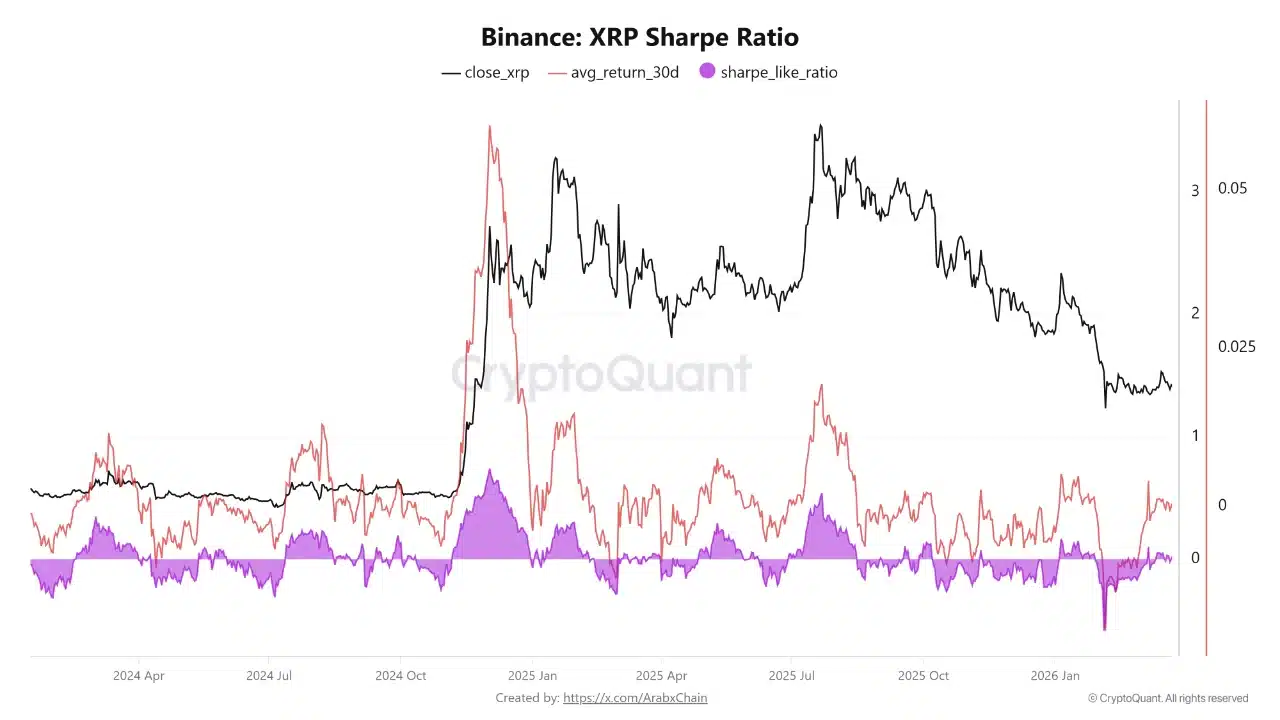
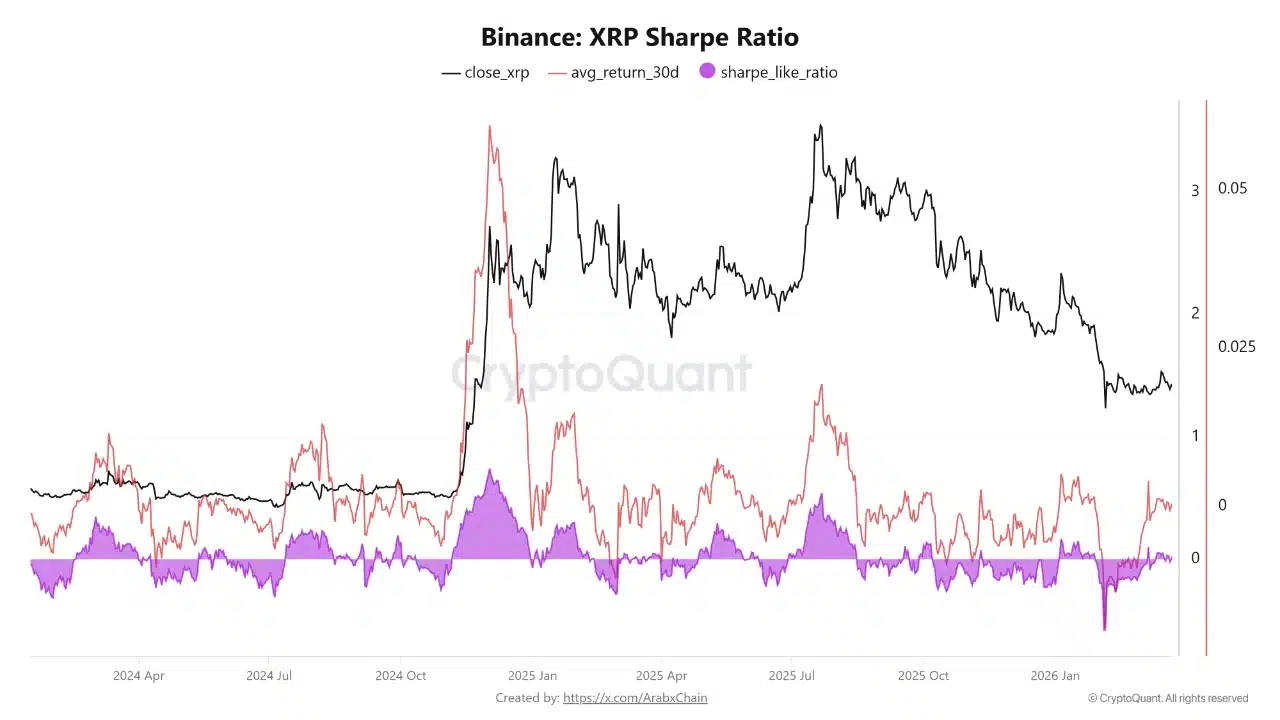
The risk-adjusted returns could be improving for Ripple [XRP], data showed. The Sharpe Ratio is used to help investors understand if an asset generates high returns, once adjusted for volatility.
Source: CryptoQuant

A rising Sharpe Ratio would imply a better risk-adjusted performance, observed an analyst in a post on CryptoQuant Insights. The metric saw a deep decline in February as the early January rally faded into a deeper downtrend. At that time, a Bitcoin [BTC] and crypto market-wide sell-off forced XRP prices from $2.35 to $1.21, a 48% drop.

The XRP gains in mid-March saw the 30-day returns spike higher. Recently, the Sharpe Ratio has improved gradually and has been hovering around the positive territory with a reading of 0.0267.

A sustained increase in the metric would mean that XRP is generating more gains with less volatility and could set the stage for a gradual bullish recovery. Yet, over the past six weeks, the price has kept pulling back to the $1.35 support, the same level XRP retested once more on the 26th of March.

The positive reading on the Sharpe Ratio showed that the risk-adjusted returns have improved moderately. It remains to be seen if the situation improves for the investors.

A drop-off in demand reflected bearish XRP sentiment

To keep the risk-adjusted returns rising, XRP needs increased demand which drive a sustained uptrend. A market that is not overleveraged would also keep the deep liquidity hunts at bay, reducing the daily volatility.
Source: CryptoQuant

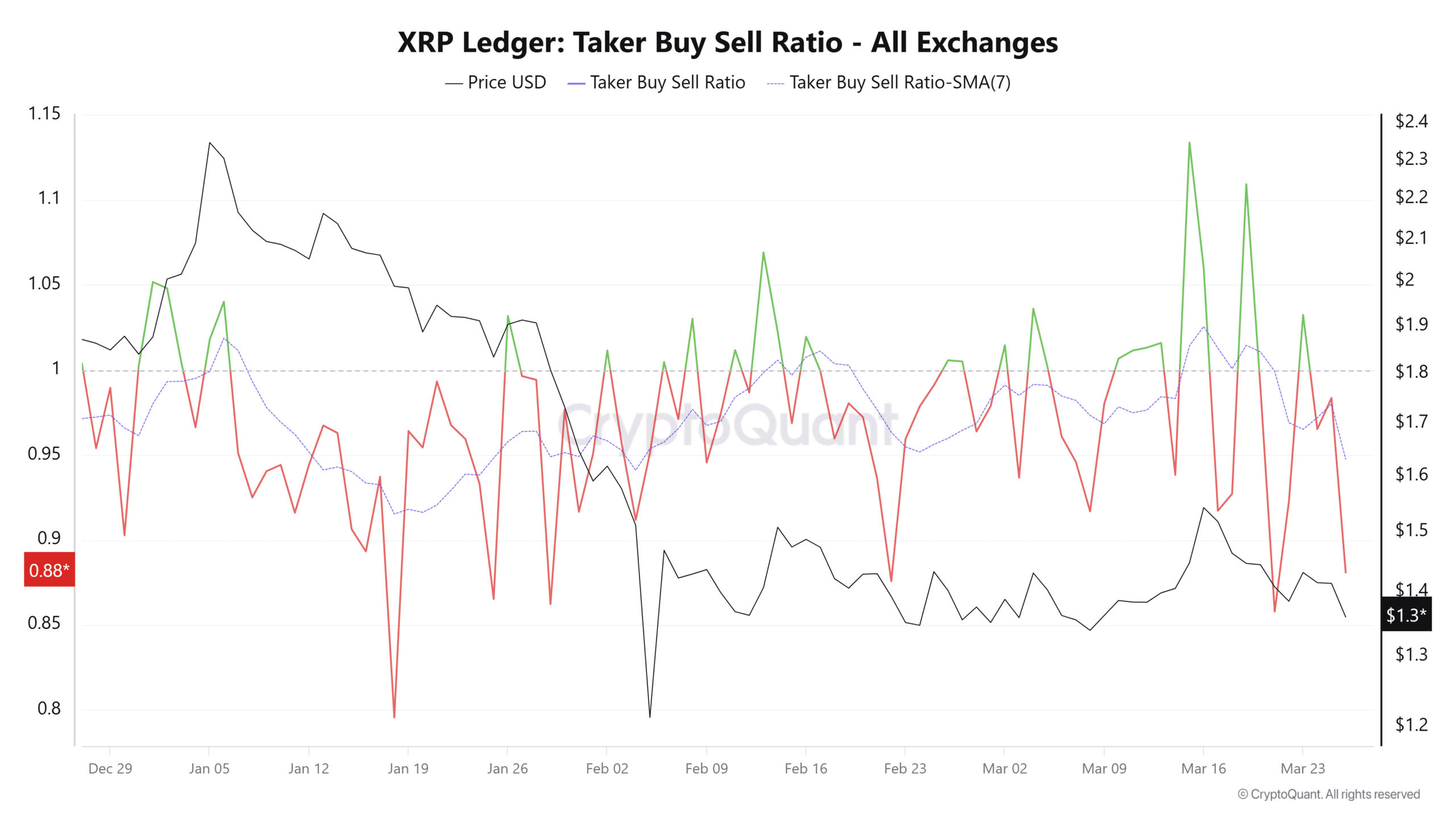
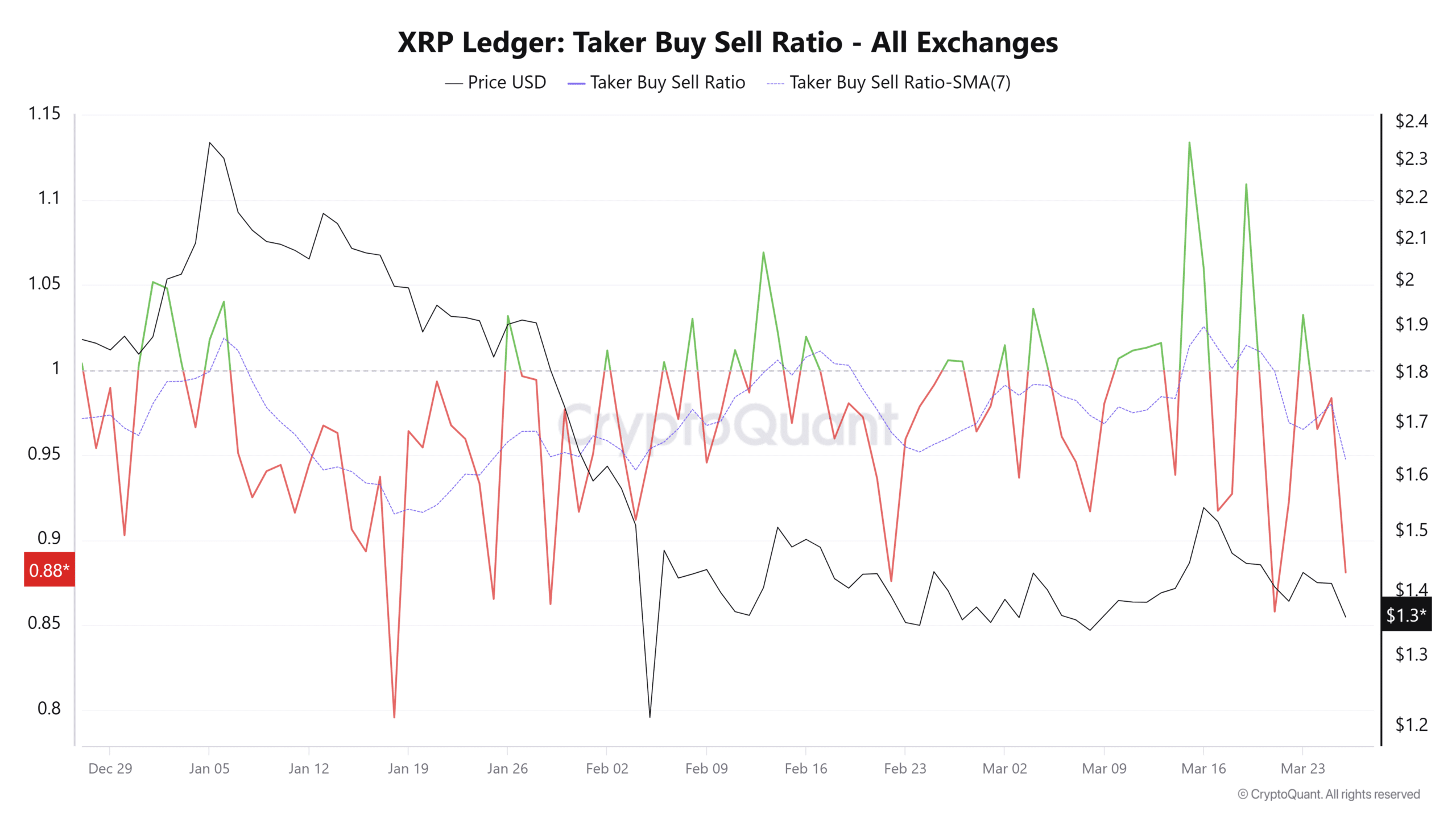
The Taker Buy-Sell Ratio was examined to understand the buyer aggression. In mid-March, when XRP rallied to $1.54 when Bitcoin reached $75k, the taker buy orders were prevalent. The 7-day moving average of the taker Buy/Sell Ratio climbed above 1 and stayed there for a few days, something that has only happened thrice in 2026.

This impetus didn’t last long. Over the past ten days, the crypto market correction saw sellers take the upper hand once again.
Source: CryptoQuant

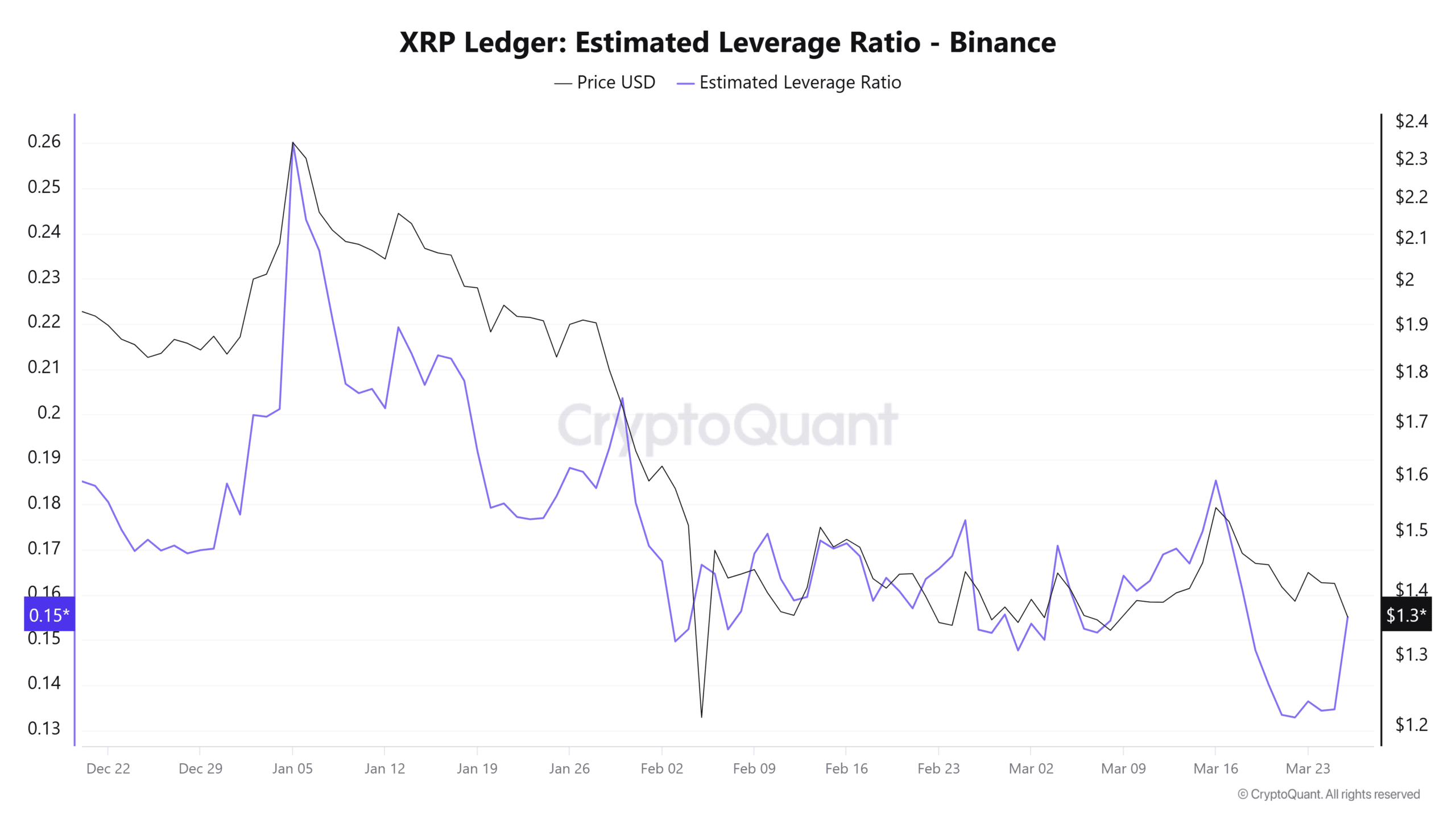
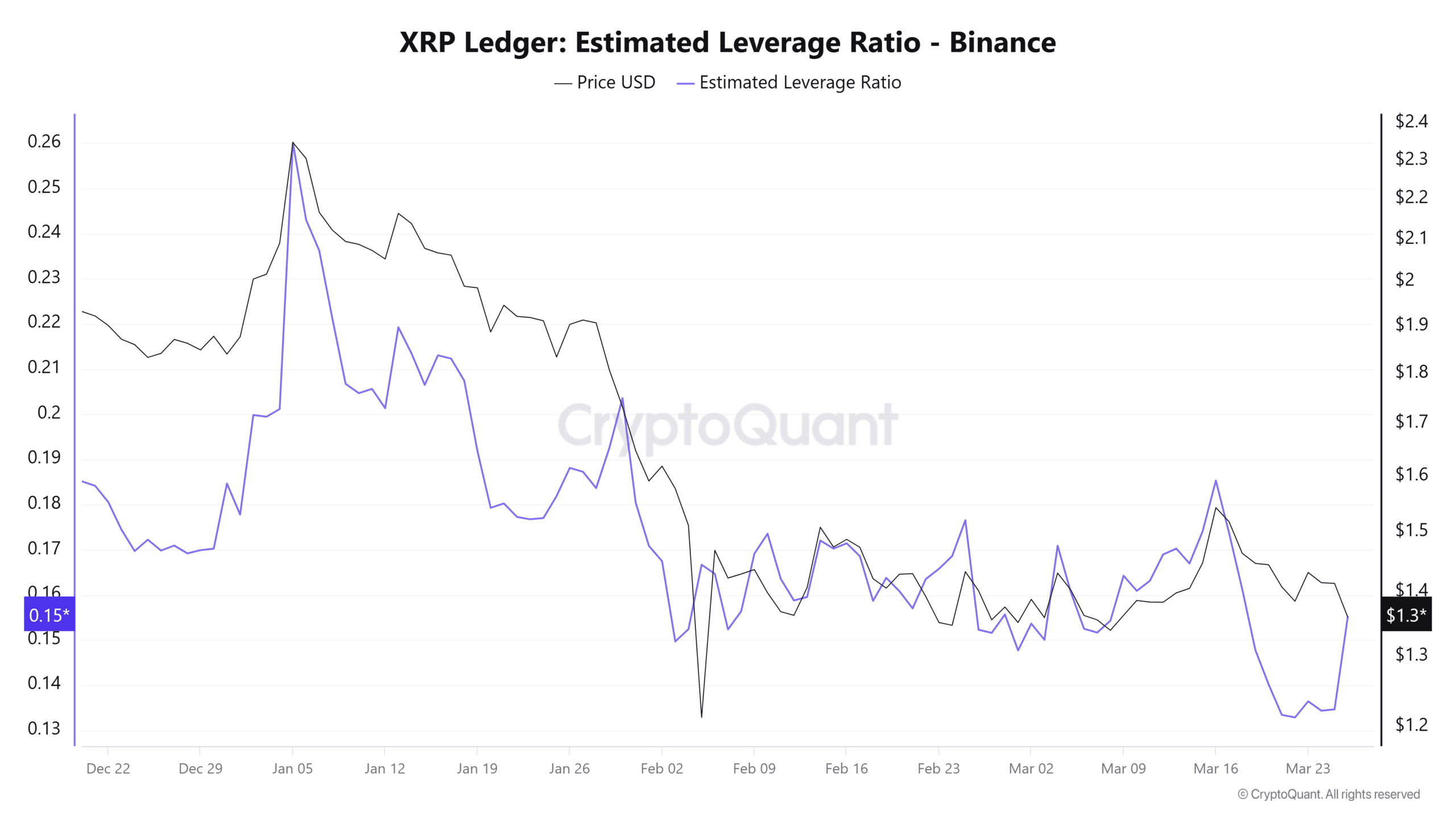
Additionally, the estimated leverage ratio has seen an uptick lately. An AMBCrypto report had pointed out that the reduced Open Interest (OI) behind XRP, combined with increased spot demand, meant that volatility risk was falling.

However, in the past 24 hours, the XRP OI has increased by 5.4%, the Estimated Leverage Ratio also spiked from 0.134 to 0.155. It signaled increased risk appetite from speculative traders. At the same time, it also warned of an increased threat of a hunt for liquidations and the associated price volatility.


Final Summary

  • The Sharpe ratio climbed back into positive territory after the deep drop during the February price correction.
  • Sustained spot demand and aggressive buyer activity are needed for XRP to defend the $1.20-$1.35 support and climb higher. Current market conditions were not favorable.


Preguntas relacionadas

QWhat does the Sharpe Ratio indicate for Ripple (XRP) according to the article?

AThe Sharpe Ratio indicates that the risk-adjusted returns for XRP are improving, meaning it is generating more gains with less volatility, which could set the stage for a gradual bullish recovery.

QWhat was the price range of XRP during the February sell-off mentioned in the article?

ADuring the February sell-off, XRP prices dropped from $2.35 to $1.21, representing a 48% decline.

QWhat does the Taker Buy-Sell Ratio measure, and what did it show for XRP in mid-March?

AThe Taker Buy-Sell Ratio measures buyer aggression. In mid-March, it showed that taker buy orders were prevalent, and its 7-day moving average climbed above 1, indicating strong buying pressure.

QWhat recent change in the Estimated Leverage Ratio signals increased risk for XRP traders?

AThe Estimated Leverage Ratio spiked from 0.134 to 0.155, signaling an increased risk appetite from speculative traders and a heightened threat of liquidation hunts and price volatility.

QWhat are the two key factors needed for XRP to defend its support level and climb higher, as per the final summary?

ASustained spot demand and aggressive buyer activity are needed for XRP to defend the $1.20-$1.35 support level and climb higher.

Lecturas Relacionadas

Who Will Define the Rules of the AI Era? Anthropic Discusses the 2028 US-China AI Landscape

This article, based on Anthropic's analysis, outlines the intensifying systemic competition between the U.S./allies and China for AI leadership by 2028. It argues that access to advanced computing power ("compute") is the critical bottleneck, where the U.S. currently holds a significant advantage through chip export controls and allied innovation. However, China's AI labs remain competitive by exploiting policy loopholes—via chip smuggling, overseas data center access, and "model distillation" attacks to copy U.S. model capabilities—keeping them close to the frontier. The piece presents two contrasting scenarios for 2028. In the first, decisive U.S. action to tighten compute controls and curb distillation locks in a 12-24 month AI capability lead, cementing democratic influence over global AI norms, security, and economic infrastructure. In the second, policy inaction allows China to achieve near-parity through continued access to U.S. technology, enabling Beijing to promote its AI stack globally and integrate advanced AI into its military and governance systems, altering the strategic balance. Anthropic contends that maintaining a decisive U.S. lead is essential for shaping safe AI development and governance. The core recommendation is for U.S. policymakers to urgently close compute and model access loopholes while promoting global adoption of the U.S. AI technology stack to secure a lasting strategic advantage.

marsbitHace 1 hora(s)

Who Will Define the Rules of the AI Era? Anthropic Discusses the 2028 US-China AI Landscape

marsbitHace 1 hora(s)

“Why Didn’t You Buy 2x Long SK Hynix?”

The article discusses the immense popularity of the "2x Long SK Hynix ETF" (07709.HK) in Hong Kong, which became the world's largest single-stock leveraged ETF by May 2026. Launched in October 2025, the ETF's net value soared over 1000% in seven months, significantly outperforming the 324% gain of SK Hynix's underlying stock, driven by the AI boom and a critical shift in industry demand from computing power to memory. It highlights the mechanics and risks of daily-rebalanced leveraged ETFs. In a smooth bullish market, they generate amplified returns, but during volatile periods—exemplified by market swings during geopolitical tensions in the Strait of Hormuz in March-April 2026—they suffer severe "volatility decay," where choppy price action can cause losses far exceeding twice the drop of the underlying asset. The piece frames SK Hynix, as NVIDIA's primary HBM supplier, within the classic cycle of the memory chip industry—a commoditized sector prone to boom-and-bust cycles of shortage, price hikes, overcapacity, and crashes. While current AI-driven demand and high margins (Q1 2026毛利率~79%) create a "super cycle," the article questions its sustainability. It warns that extreme profits will inevitably tempt competitors like Samsung and Micron to ramp up HBM production, potentially eroding scarcity. Furthermore, the entire narrative remains tethered to the massive AI capital expenditure of tech giants. In conclusion, the ETF's trajectory symbolizes the accelerated, all-in nature of the current AI revolution, where timeframes are compressed and market moves are extreme. However, it also underscores that while industry trends define ultimate returns, macro-geopolitical risks dictate the volatile and uncertain path to get there.

marsbitHace 1 hora(s)

“Why Didn’t You Buy 2x Long SK Hynix?”

marsbitHace 1 hora(s)

a16z Crypto: A Guide to the CLARITY Act for Crypto Entrepreneurs

The CLARITY Act, a bipartisan crypto market structure bill, has advanced through the Senate Banking Committee, marking a potential historic shift in U.S. digital asset regulation. For years, a lack of clear rules has stifled innovation, pushed development overseas, and exposed consumers to risk. This bill aims to establish a comprehensive framework, providing long-needed regulatory clarity for blockchain networks and digital assets. It builds upon previous legislative efforts like FIT21 and the House version of CLARITY, which gained strong bipartisan support. CLARITY is crucial because it recognizes that blockchain networks are fundamentally different from traditional companies. Networks operate through decentralized, shared rules rather than centralized control. Applying corporate legal frameworks to networks forces them into a centralized model, concentrating power and value. In contrast, decentralized blockchain networks can function as user-owned public infrastructure, distributing value more equitably among participants. The bill seeks to enable the safe launch of networks in the U.S., clarify regulatory jurisdiction between the SEC and CFTC, oversee crypto exchanges, and enhance consumer protections. Its passage would align U.S. law with the nature of decentralized technology, allowing builders to operate transparently and fund projects domestically without structural compromises due to regulatory uncertainty. Similar to the positive impact seen after the stablecoin-focused GENIUS Act, CLARITY could unlock a new wave of innovation, helping the U.S. reclaim leadership in the crypto space while combating fraud and abuse.

链捕手Hace 1 hora(s)

a16z Crypto: A Guide to the CLARITY Act for Crypto Entrepreneurs

链捕手Hace 1 hora(s)

Trading

Spot
Futuros

Artículos destacados

Cómo comprar ONE

¡Bienvenido a HTX.com! Hemos hecho que comprar Harmony (ONE) sea simple y conveniente. Sigue nuestra guía paso a paso para iniciar tu viaje de criptos.Paso 1: crea tu cuenta HTXUtiliza tu correo electrónico o número de teléfono para registrarte y obtener una cuenta gratuita en HTX. Experimenta un proceso de registro sin complicaciones y desbloquea todas las funciones.Obtener mi cuentaPaso 2: ve a Comprar cripto y elige tu método de pagoTarjeta de crédito/débito: usa tu Visa o Mastercard para comprar Harmony (ONE) al instante.Saldo: utiliza fondos del saldo de tu cuenta HTX para tradear sin problemas.Terceros: hemos agregado métodos de pago populares como Google Pay y Apple Pay para mejorar la comodidad.P2P: tradear directamente con otros usuarios en HTX.Over-the-Counter (OTC): ofrecemos servicios personalizados y tipos de cambio competitivos para los traders.Paso 3: guarda tu Harmony (ONE)Después de comprar tu Harmony (ONE), guárdalo en tu cuenta HTX. Alternativamente, puedes enviarlo a otro lugar mediante transferencia blockchain o utilizarlo para tradear otras criptomonedas.Paso 4: tradear Harmony (ONE)Tradear fácilmente con Harmony (ONE) en HTX's mercado spot. Simplemente accede a tu cuenta, selecciona tu par de trading, ejecuta tus trades y monitorea en tiempo real. Ofrecemos una experiencia fácil de usar tanto para principiantes como para traders experimentados.

239 Vistas totalesPublicado en 2024.12.12Actualizado en 2025.03.21

Cómo comprar ONE

Discusiones

Bienvenido a la comunidad de HTX. Aquí puedes mantenerte informado sobre los últimos desarrollos de la plataforma y acceder a análisis profesionales del mercado. A continuación se presentan las opiniones de los usuarios sobre el precio de ONE (ONE).

活动图片












