XRP Just Hit An Infamous Liquidity Pocket, Here’s What Happened Last Time It Hit

bitcoinistPublicado a 2026-01-21Actualizado a 2026-01-21

Resumen

XRP has once again traded into a known liquidity pocket between $1.90 and $1.75, a key support zone since December 2024. This area has repeatedly attracted price action, including after XRP's all-time high of $3.65 in July 2025. Historical data shows visits to this zone often result in a relief bounce, such as the rebound above $2.40 in early January. Currently, the daily Stochastic RSI indicates deeply oversold conditions, which have previously aligned with rebounds. If the zone holds, a bounce is likely. However, a decisive break below with strong selling pressure could shift the outlook to bearish. Recent trading activity suggests many holders are near breakeven, which may increase selling pressure if prices don't rise.

XRP has once again traded directly into a price zone that a few traders have come to recognize as a liquidity pocket. This area has acted as a magnet for price since December 2024, causing repeated tests and reactions that stand out clearly on the price chart. In a recent technical breakdown shared on X, crypto analyst ChartNerd highlighted how XRP has repeatedly made contact with this liquidity pocket over the past year and the cryptocurrency might be approaching a relief bounce.

Liquidity Pocket: Support Or Springboard?

Technical analysis of XRP’s price action shows that the cryptocurrency is now trading within a liquidity zone that has acted as a support range since December 2024. This liquidity zone, which spans the range from $1.90 to $1.75, has acted as a price magnet for many months. Even after reaching its all-time high of $3.65 in July 2025, XRP entered into a multi-month correction that eventually found support at this liquidity zone.

According to the analysis, nearly every prior visit to this zone was followed by some form of relief, especially when momentum indicators aligned. The last time XRP returned to this level, it slowed down its decline and eventually bounced back above $2.4 in early January.

However, the most recent push downwards played out as a 20% decline after a rejection at the $2.40 zone in early January, which has essentially pushed the XRP price action back to trading within this liquidity range and has started to show tentative stabilization.

To bring further confirmation to the setup, the analyst included the daily Stochastic RSI below the price chart. This momentum indicator, which measures relative strength and conditions of overbought or oversold pressure, is currently sitting in deeply oversold territory according to the chart. These oversold conditions in the Stoch RSI aligned with rebounds off this same liquidity pocket.
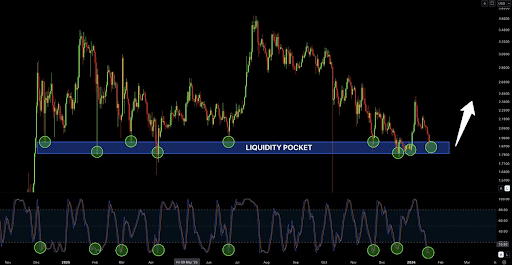
XRP Price Chart. Source: @ChartNerdTA On X

What Happens Next?

If history repeats itself, the repeated tests of this liquidity pocket and accompanying oversold signals might be clearing the road for a bounce. If XRP was underneath this pocket and rejecting at this level, that would be bearish. Holding it as support for a long duration points to a strong support strength in this area.

That said, there is another possibility that the reverse could happen. Should XRP break decisively below this zone with strong selling pressure, the technical setup would shift from supportive to bearish and leave the price action trending downwards.

Trading activity hints that recent buyers may be in a tough spot, because the mix of holders now resembles the early 2022 structure when price pressure was high. That means many participants may be below their breakeven cost basis, and this can build selling pressure over time if prices fail to move higher.

Price fails to recover | Source: XRPUSDT on Tradingview.com

Criptos en tendencia

Preguntas relacionadas

QWhat is the specific price range of the liquidity pocket that XRP has repeatedly tested since December 2024?

AThe liquidity pocket spans the price range from $1.90 to $1.75.

QAccording to the analyst, what technical indicator is currently showing deeply oversold conditions that align with previous rebounds from this liquidity pocket?

AThe daily Stochastic RSI is currently sitting in deeply oversold territory.

QWhat was the outcome the last time XRP returned to this liquidity zone in early January?

AThe last time XRP returned to this level, it slowed down its decline and eventually bounced back above $2.4.

QWhat is the bearish scenario that could occur if XRP fails to hold the liquidity pocket as support?

AIf XRP breaks decisively below this zone with strong selling pressure, the technical setup would shift to bearish, leaving the price action trending downwards.

QWhy does the article suggest that recent buyers may be in a tough spot, comparing the current situation to early 2022?

ABecause the mix of holders resembles the early 2022 structure when price pressure was high, meaning many participants may be below their breakeven cost basis, which can build selling pressure over time if prices fail to move higher.

Lecturas Relacionadas

human.tech Launches Clean SDK for Privacy-First Web3 Apps

human.tech has launched the Clean SDK, a toolkit enabling developers to build privacy-first Web3 applications with transparent accountability. Released alongside Aztec's version 5, the SDK provides components for integrating zero-knowledge identity verification, sanctions screening, and private transactions, without developers handling sensitive user data or building compliance infrastructure from scratch. It uses zero-knowledge proofs and programmable verification to allow apps to confirm user legitimacy and sanctions compliance while keeping identities confidential. The first application built on the SDK, Shield, a privacy bridge to Aztec, also launched. It allows users to transfer assets privately while proving a unique human is behind each transfer and that funds have passed sanctions checks, as verified by a May 2026 audit. The SDK offers three core verification techniques: Proof of Innocence (sanctions screening against 23 sources), Proof of Personhood (simpler verification via Human Passport), and Proof of Clean Hands (higher-assurance zero-knowledge government ID checks). This allows apps to authenticate users and transactions without exposing personal data. Designed for Aztec builders, the SDK lets developers add programmable privacy to decentralized apps, eliminating the need to create their own verification and ZK infrastructure. Shield demonstrates its practical use for private bridges, but the SDK aims to enable a wider ecosystem of private, accountable financial apps and services. The launch addresses growing demand for infrastructure that balances privacy and accountability. The SDK avoids traditional identity databases, storing encrypted data off-chain, screening at both entry and exit points, and including a gated disclosure mechanism for legal requests. human.tech's products, including the Clean SDK, focus on using zero-knowledge technology to enable verifiable personhood and privacy in digital systems.

TheNewsCryptoHace 4 min(s)

human.tech Launches Clean SDK for Privacy-First Web3 Apps

TheNewsCryptoHace 4 min(s)

Unlocking $100 Million in Liquidity? Pump.fun's New Policy Tests the 5-Minute Pump Technique

Pump.fun, a popular meme coin launchpad, has introduced a new standard mechanism called BOOST. It aims to address a significant capital efficiency issue: when a newly launched token graduates from its initial bonding curve to a liquidity pool (LP), roughly 20% of its liquidity becomes permanently locked as "dead liquidity," estimated to waste over $100 million annually. Instead of locking these funds permanently, BOOST repurposes them. Upon a token's migration, approximately 20% of the settlement funds (e.g., 17.6 SOL or ~$2516 USDC) are used to buy back the token on the open market over a 5-minute period via a Time-Weighted Average Price (TWAP) mechanism. All purchased tokens are immediately burned. This creates a brief, systematic buy pressure immediately after migration, potentially generating a short-term price surge ("pump") while permanently reducing the token's circulating supply. The goal is to enhance the immediate post-launch trading experience, potentially increasing trader retention and sustainable protocol revenue, which funds ongoing token buybacks. However, concerns exist that this artificial 5-minute boost could lower the barrier for launching low-quality tokens and lead to steeper price crashes once the buy pressure stops, if followed by large sell-offs. The feature automatically applies to tokens migrating after July 21, 2024, but not to previously migrated tokens or those launched via the Mayhem AI Agent lab.

marsbitHace 12 min(s)

Unlocking $100 Million in Liquidity? Pump.fun's New Policy Tests the 5-Minute Pump Technique

marsbitHace 12 min(s)

Podcast Notes | Conversation with GSR Asset Management Head: To Determine if This Crypto Rally is Real, Just Watch the Lending Rates on Aave

Podcast Summary: Dialogue with GSR's Head of Asset Management: To Determine if This Crypto Rally is Real, Just Check Lending Rates on Aave Andy Baehr, Managing Director of Asset Management at GSR, discusses the current crypto market, characterizing it as stuck in a state of "ambivalence" with short-lived, unsustainable rallies. He outlines a simple framework: the market moves between "ambivalence" and "conviction" (sustained upward momentum). Currently, every rally resembles a single-stage rocket booster that quickly fizzles out. Baehr identifies three key signals to watch: 1) DeFi lending rates, 2) the potential passage of the CLARITY Act, and 3) the market forming a consensus on the "Fed hawkish peak." He emphasizes that the most immediate indicator for the sustainability of the recent CPI-triggered rally is the USDC borrowing rate on Aave, currently around 3.75%—close to U.S. Treasury yields. The absence of a credit spread indicates low leverage demand and a lack of market energy. He explains that a healthy, sustained rally requires layered buying pressure. Last year's rally progressed from an ETH short squeeze to crypto-native trader influx and finally to ETF inflows. Currently, this structure is missing. Other potential structural buyers like Digital Asset Treasury (DAT) companies are absent, and ETF flows have proven transient. Baehr notes that while small-cap crypto tokens outperformed large caps in Q2—a potential sign of capitation in major assets—capital is also flowing to more exciting opportunities like AI stocks and tech IPOs, leaving crypto sidelined. Regarding DeFi, he highlights that platforms like Aave provide a clear, real-time signal of leverage demand through their supply/demand-driven interest rates. A significant, sustained rate increase would signal genuine market conviction. He also observes the quiet emergence of fixed-income-like products and vaults in DeFi. On regulation, the probability of the CLARITY Act passing before the August 7th deadline has dropped linearly from 75% to below 40% on Polymarket. Baehr suggests its passage would be treated as a bullish surprise, a potent driver for price movement. However, political hurdles, including ethical clause debates and disclosures about the First Family's crypto profits, remain significant obstacles. Ultimately, the market awaits clarity on the Fed's terminal rate under Chair Warsh. Until the "Fed Solstice"—the point where the market collectively understands the peak of hawkish policy—sustained conviction will be difficult to achieve.

marsbitHace 43 min(s)

Podcast Notes | Conversation with GSR Asset Management Head: To Determine if This Crypto Rally is Real, Just Watch the Lending Rates on Aave

marsbitHace 43 min(s)

Trading

Spot

Artículos destacados

Qué es XRP 2.0

XRP 2.0: Una Nueva Frontera en el Panorama de las Criptomonedas Introducción a XRP 2.0 En el siempre cambiante ámbito de las criptomonedas, nuevos proyectos surgen continuamente, compitiendo por atención y adopción. Una de estas iniciativas prometedoras es XRP 2.0, un nuevo proyecto de criptomoneda diseñado para aprovechar la tecnología blockchain avanzada y metodologías de encriptación robustas. Aunque el nombre establece paralelismos con el XRP de Ripple, es crucial señalar que XRP 2.0 opera de manera independiente, enfocándose en mejorar la seguridad de las transacciones, la privacidad y la escalabilidad. A medida que el panorama financiero digital abraza cada vez más soluciones descentralizadas, XRP 2.0 busca contribuir de manera significativa a web3 y a la expansión general de los proyectos de criptomonedas. ¿Qué es XRP 2.0? En esencia, XRP 2.0 es un proyecto de criptomoneda que busca crear un ecosistema de moneda digital seguro y descentralizado. Su tecnología fundamental integra principios avanzados de blockchain con técnicas de encriptación de vanguardia. El objetivo principal de XRP 2.0 es establecerse como una plataforma confiable y eficiente que permita la ejecución rápida de transacciones mientras prioriza la protección de la privacidad de sus usuarios. El proyecto se promociona como una solución a muchas limitaciones enfrentadas por las criptomonedas existentes, proponiendo un sistema que puede manejar un mayor volumen de transacciones con mejor velocidad y privacidad. Esta versatilidad posiciona a XRP 2.0 como un competidor significativo en un mercado plagado de diversas monedas digitales. ¿Quién es el Creador de XRP 2.0? La identidad del creador detrás de XRP 2.0 ha sido señalada como 'Wilbur.' Sin embargo, los detalles completos sobre Wilbur o su entidad asociada siguen siendo elusivos. La anonimidad de muchos creadores de criptomonedas no es un fenómeno poco común en la industria, a menudo diseñado para mantener un grado de privacidad y seguridad. ¿Quiénes son los Inversores de XRP 2.0? Hasta ahora, la información específica relacionada con las fundaciones o organizaciones de inversión que apoyan a XRP 2.0 no está disponible públicamente. En el sector de las criptomonedas, el respaldo de inversores respetables puede influir significativamente en la credibilidad y el éxito de un proyecto, sin embargo, la transparencia sobre los patrocinadores financieros de XRP 2.0 no se ha establecido. ¿Cómo Funciona XRP 2.0? XRP 2.0 se destaca al emplear una combinación de tecnología blockchain y algoritmos de encriptación avanzados que aseguran transacciones seguras y descentralizadas. Su estructura innovadora incluye características únicas diseñadas para fomentar el compromiso del usuario y ampliar las funcionalidades más allá de las transacciones convencionales de criptomonedas. Entre estas características, XRP 2.0 incorpora capacidades impulsadas por IA, como funcionalidades de texto a imagen y de texto a voz. Estas adiciones están diseñadas para mejorar la experiencia interactiva de los usuarios, promoviendo una mayor aplicabilidad en diversos sectores. Al unir avances tecnológicos con un diseño centrado en el usuario, XRP 2.0 busca captar la atención de una amplia gama de individuos y empresas que buscan integrar soluciones de criptomonedas en sus marcos operativos. Cronología de XRP 2.0 Entender XRP 2.0 requiere examinar los hitos que han definido su viaje hasta ahora: 23 de julio de 2023: Se presenta XRP 2.0 como un nuevo proyecto de criptomonedas, con el objetivo de revolucionar las capacidades de transacciones seguras y descentralizadas en el ámbito de blockchain. 8 de septiembre de 2023: Se lanza otro proyecto, XRP20, marcando la aparición de un token ERC-20 en la blockchain de Ethereum que no guarda relación con XRP 2.0. 13 de noviembre de 2023: El Libro Mayor de XRP experimenta una actualización significativa con el lanzamiento de la versión 2.0.0 del software del servidor rippled. Es esencial señalar que este desarrollo está desconectado del proyecto de criptomonedas XRP 2.0. Puntos Clave sobre XRP 2.0 Para destilar la esencia de XRP 2.0, surgen varios factores críticos: Características Únicas: La inclusión de características como texto a imagen y texto a voz impulsadas por IA diversifica aún más las aplicaciones potenciales de XRP 2.0. Tecnología Blockchain: El marco utiliza mecanismos avanzados de blockchain y protocolos de encriptación, asegurando un entorno seguro y descentralizado para las transacciones. Escalabilidad y Privacidad: XRP 2.0 prioriza la protección mejorada de la privacidad en los procesos de transacción y la escalabilidad necesaria para acomodar una base de usuarios creciente. No Afiliación con Ripple: Es importante destacar que, a pesar de su nombre, XRP 2.0 no tiene ninguna lealtad ni colaboración con el XRP de Ripple, diferenciando su marco operativo y objetivos dentro del ecosistema de criptomonedas. Conclusión XRP 2.0 representa una ambiciosa aventura en la esfera de las criptomonedas, buscando ofrecer una combinación de seguridad, privacidad y eficiencia en las transacciones digitales. Al integrar tecnologías sofisticadas y características amigables para el usuario, el proyecto se propone ampliar los horizontes de lo que la criptomoneda puede lograr en la economía digital de hoy. Si bien la anonimidad de su creador y la falta de inversores revelados pueden generar cuestionamientos para algunos, el enfoque de XRP 2.0 en funcionalidades avanzadas y descentralización realza su atractivo en un mercado de criptomonedas cada vez más abarrotado. A medida que el paisaje de las criptomonedas sigue evolucionando, XRP 2.0 podría emerger como un jugador crucial en la expansión de soluciones blockchain seguras y escalables.

224 Vistas totalesPublicado en 2024.04.05Actualizado en 2024.12.03

Qué es XRP 2.0

Cómo comprar XRP

¡Bienvenido a HTX.com! Hemos hecho que comprar XRP (XRP) sea simple y conveniente. Sigue nuestra guía paso a paso para iniciar tu viaje de criptos.Paso 1: crea tu cuenta HTXUtiliza tu correo electrónico o número de teléfono para registrarte y obtener una cuenta gratuita en HTX. Experimenta un proceso de registro sin complicaciones y desbloquea todas las funciones.Obtener mi cuentaPaso 2: ve a Comprar cripto y elige tu método de pagoTarjeta de crédito/débito: usa tu Visa o Mastercard para comprar XRP (XRP) al instante.Saldo: utiliza fondos del saldo de tu cuenta HTX para tradear sin problemas.Terceros: hemos agregado métodos de pago populares como Google Pay y Apple Pay para mejorar la comodidad.P2P: tradear directamente con otros usuarios en HTX.Over-the-Counter (OTC): ofrecemos servicios personalizados y tipos de cambio competitivos para los traders.Paso 3: guarda tu XRP (XRP)Después de comprar tu XRP (XRP), guárdalo en tu cuenta HTX. Alternativamente, puedes enviarlo a otro lugar mediante transferencia blockchain o utilizarlo para tradear otras criptomonedas.Paso 4: tradear XRP (XRP)Tradear fácilmente con XRP (XRP) en HTX's mercado spot. Simplemente accede a tu cuenta, selecciona tu par de trading, ejecuta tus trades y monitorea en tiempo real. Ofrecemos una experiencia fácil de usar tanto para principiantes como para traders experimentados.

1.5k Vistas totalesPublicado en 2024.12.10Actualizado en 2026.06.02

Cómo comprar XRP

Discusiones

Bienvenido a la comunidad de HTX. Aquí puedes mantenerte informado sobre los últimos desarrollos de la plataforma y acceder a análisis profesionales del mercado. A continuación se presentan las opiniones de los usuarios sobre el precio de XRP (XRP).

活动图片













