XRP Army Rift: Zach Rector Accuses Jake Claver Of Misleading The Community

bitcoinistPublicado a 2026-01-02Actualizado a 2026-01-02

Resumen

Zach Rector has publicly accused fellow XRP community figure Jake Claver, CEO of Digital Ascension Group, of misleading investors. Rector specifically targeted Claver's highly confident but failed prediction that XRP would reach $100 by the end of 2025, arguing it was not merely a wrong forecast but a manipulative tactic implying insider knowledge. Beyond price predictions, Rector made serious allegations regarding XRP-focused funds operated through Claver's Digital Wealth Partners. He claims there is a significant discrepancy between Claver's public statements and private investor reports, alleging one fund lost over 4% before fees. Rector cited a past legal case involving fabricated documents to question Claver's credibility and called for a third-party audit of the funds, stating he will not trust the performance reports without verified financials.

A loud internal fight is spilling out across the XRP Army, with Zach Rector accusing Jake Claver of using high-certainty price narratives, most notably the “$100 XRP by end of 2025” call, to pull attention, credibility, and capital from the community.

Rector released a two-part video series on Dec 31, aimed at “addressing Jake Claver’s lies.” Claver, the CEO of Digital Ascension Group, ist one of the louder XRP bulls. While the $100 XRP call by Jan. 1, 2026 clearly failed, Rector argues that the miss wasn’t just a bad call, it was the certainty and urgency behind it, sold into a community that has spent years marinating in catalyst talk, NDA hints, and timeline debates.

The $100 XRP Call

Rector said he has challenged the $100 XRP claim throughout 2025 and was surprised Claver continued doubling down into the final days of the year. In Rector’s telling, the problem is not prediction-making, he said he has missed targets too, but the way extreme outcomes were marketed as near-certain, with the implication of privileged information.

He played a clip from Claver’s live show after Rector criticized the $100 call. When confronted, Claver did not concede, instead implying he may “know something.”

“If I was going to pivot, should have pivoted by now,” Claver said in the clip Rector quoted. “Unless I know something. Why wouldn’t I? ... We’ll see what ends up happening by the end of the year. We’ll see where the price is. And I think the results will speak for themselves.”

Rector argued that this kind of messaging: NDA-coded, “trust me” signaling becomes a lever inside XRP culture, where many holders have learned to treat timelines and insider claims as tradable narratives. Rector calls this behaviour “manipulation,” saying Claver’s “business model is so reliant upon that manipulation” that he “can’t back out now.”

Serious Allegations

Rector’s sharper allegations go beyond price talk and into what he described as XRP-focused funds offered through Digital Wealth Partners (DWP). He claimed the community has sent “so much XRP” into Claver’s orbit and that there is “a massive discrepancy from what he’s saying publicly and what investors are telling me privately.”

“Jake and his scheme, his business has grown so big they’ve taken in so much XRP from our community,” Rector said. “There’s a massive discrepancy from what he’s saying publicly and what investors are telling me privately.”

Rector said he has received fund reports and performance updates and claimed he is not sharing them publicly out of concern about retaliation, alleging investors have been warned not to share reporting and that reports are being watermarked with timestamps. He also made a specific performance claim: “one of the funds... has been losing money all year,” he said, adding it “lost over 4% on the year,” before fees, including “AUM fees of 2% in some cases.”

Rector’s broader point was that XRP holders are being asked to accept a “trust me bro relationship” around returns, even as he says he has not heard from any investor who can confirm “payments and distributions coming out” in a way that matches the marketing.

To explain why he views the trust gap as serious for XRP holders, Rector leaned on a prior legal dispute involving Claver and Digital Ascension. Rector said the case is public record and described it as “VeriVend versus Jacob Levi Claver and Digital Ascension Group” in the Western District of New York. He read from what he described as court filings and emphasized that the allegations and admissions, as he presented them, involve fabricated wire confirmations and impersonation.

“This is a serious deal,” Rector said, arguing the behavior he described should matter to XRP holders being asked to trust performance claims, NDAs, and time-sensitive narratives. He urged viewers to review the “answer to the complaint,” which he said includes admissions such as registering a VeriVend-related domain and fabricating purported wire transfer confirmations.

Rector also said the case settled, pointing to a “mediation certification” dated Feb. 12, 2025. He claimed, separately, that Claver paid the opposition in XRP to settle, an assertion Rector stated as a confirmation.

Rector framed his goal as containment rather than escalation, saying he wants the community “to stay together” and “not be divided,” but he also laid down an explicit remedy: third-party verification. “I want a third-party audit of those funds,” he said, arguing that absent audited financials he will not trust performance reporting tied to XRP strategies.

At press time, XRP traded at $1.85.
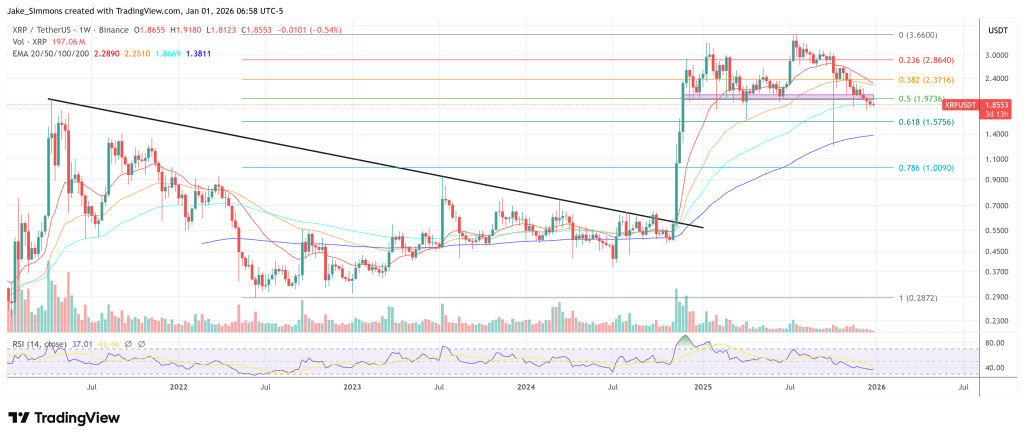
XRP remains below key support, 1-week chart | Source: XRPUSDT on TradingView.com

Preguntas relacionadas

QWhat is the main accusation Zach Rector makes against Jake Claver in the XRP community?

AZach Rector accuses Jake Claver of using high-certainty price narratives, specifically the '$100 XRP by end of 2025' prediction, to mislead the community and attract attention, credibility, and capital, which Rector describes as manipulation.

QWhat specific evidence does Rector provide to challenge Claver's credibility beyond the price prediction?

ARector references a public legal case, 'VeriVend versus Jacob Levi Claver and Digital Ascension Group,' in the Western District of New York, alleging it involved fabricated wire confirmations and impersonation, and claims the case was settled with Claver paying in XRP.

QWhat does Rector allege about the performance of funds managed by Claver's associated company, Digital Wealth Partners (DWP)?

ARector claims that one of the funds has been losing money all year, with a loss of over 4% before fees, and that there is a discrepancy between public statements and private investor reports, with investors being warned not to share watermarked performance updates.

QWhat solution does Zach Rector propose to address the trust issues he raises about Jake Claver's operations?

ARector calls for a third-party audit of the funds managed by Claver's associated entities, stating that without audited financials, he will not trust the performance reporting related to XRP strategies.

QHow did Jake Claver respond when confronted about his failed $100 XRP price prediction?

AWhen confronted, Claver did not concede but instead implied he might 'know something,' suggesting he had privileged information and stating, 'We'll see what ends up happening by the end of the year. We'll see where the price is. And I think the results will speak for themselves.'

Lecturas Relacionadas

War Trade Unwinding | TradeXYZ Weekend Observations

Weekend markets saw a clear return of risk appetite. Major indices rose broadly, with significant gains in tech and precious metals, while energy sectors fell sharply on the "end of war" narrative. On June 14, oil prices initially rose on reports Iran had not yet finalized a memorandum of understanding. Later, YNET reported Trump might immediately lift the maritime blockade on Iran and the Strait of Hormuz. At 21:30, Trump confirmed on Truth Terminal that a deal with Iran was done, authorizing an immediate end to the US blockade and toll-free opening of the Strait. Iran's deputy foreign minister simultaneously announced an immediate and permanent halt to military actions on multiple fronts. Oil prices had already fallen to weekend boundaries, pre-pricing the news. The S&P 500 subsequently touched 7530. Markets will likely remain in a waiting period until the formal peace deal signing on June 19. At the moment of the deal announcement, gold jumped from ~4,221 to a high of 4,337, and silver from ~67.85 to 70.83, before stabilizing at higher levels. Individual stocks and ETFs like NBIS, RKLB, and LITE performed strongly. NBIS, added to the Nasdaq index, saw a target price increase due to strong AI cloud growth. RKLB, also added to the index, benefited from positive SpaceX valuation sentiment. LITE received a $1,130 target from JPMorgan. SPCX rose quickly after Musk tweeted SpaceX could potentially reach ~$1 trillion in revenue by 2030. In summary, the market shock from the multi-month war is beginning to dissipate. Israel's actions remain the key variable before the June 19 signing. Upcoming events like Fed Chair Warsh's debut and BoJ rate hike expectations will also significantly impact markets this week.

marsbitHace 3 min(s)

War Trade Unwinding | TradeXYZ Weekend Observations

marsbitHace 3 min(s)

Will the Next Crypto Bull Run Start with On-Chain Trading of SpaceX?

This article presents a scenario-based forecast for the crypto industry from 2026 to 2029, arguing that the next major cycle will be driven not by technological narratives but by legal access to real-world assets. The author predicts that by mid-2026, pre-IPO perpetual contracts for top private companies like SpaceX, OpenAI, and Anthropic on platforms like Hyperliquid will become the primary gateway for accessing quality assets, as most crypto-native tokens fail to capture real value. The much-hyped AI x Crypto intersection largely fails except for prediction markets, which thrive on betting on AI model supremacy. By 2027, public blockchain foundations are forced to choose between catering to retail speculation or building compliant infrastructure for institutions, with many opting for the latter. Growth in stablecoins and tokenized private credit/equity hits a "triple ceiling" due to regulatory and political uncertainty rather than market demand. The pivotal shift is forecast for 2028. A major liquidation event in pre-IPO perpetuals exposes the structural flaw of synthetic markets lacking a real underlying asset anchor. In response, regulatory changes finally allow the public solicitation of private securities resales to verified accredited investors. This creates a legitimate secondary market for real company equity, which then becomes the core asset class of the new bull market, relegating synthetic perps to a niche role. By 2029, the industry becomes "boring" but foundational. Tokens without claims on real cash flows or assets cease trading. Stablecoin growth is steady but politically capped. Crypto infrastructure fades from view as it gets absorbed into traditional finance backends. The article's central thesis is that the key bottleneck for crypto's next phase is legal and regulatory channels for real asset ownership, not technology.

marsbitHace 1 hora(s)

Will the Next Crypto Bull Run Start with On-Chain Trading of SpaceX?

marsbitHace 1 hora(s)

The Value Distribution of Stablecoins

**Summary: The Value Distribution of Stablecoins** The article argues that stablecoins are evolving from mere trading tools into broader channels for dollar access. It divides the stablecoin ecosystem into four layers to analyze how value is distributed: 1. **Issuance Layer:** Mints stablecoins, holds reserve assets, and captures the spread between reserve yield and user costs (e.g., Tether, Circle). This layer currently earns the largest profit margin. 2. **Infrastructure Layer:** Connects stablecoins to the traditional financial system, handling fiat on/off-ramps, banking integration, compliance (KYC/AML), and asset management (e.g., Bridge, BVNK). This is the "unglamorous" but critical work, building the essential bridges between crypto and real-world finance. 3. **Acquiring/Distribution Layer:** Integrates stablecoins into merchant systems, manages payment flows, and provides enterprise financial software (e.g., Stripe, Coinbase). They act as the access point for businesses. 4. **Application Layer:** The end-users and businesses that ultimately use stablecoins for payments, settlements, or as a store of value. They benefit from convenience but have little pricing power. The core thesis is that while the issuance layer currently dominates profits, the often-overlooked **infrastructure layer holds significant long-term potential**. The real challenge and barrier to mass adoption is not the on-chain transfer of stablecoins (which is simple), but the complex "last mile" integration into existing business workflows, banking systems, and regulatory frameworks across different countries. Companies in this layer are currently in a "land grab" phase, investing heavily to build networks, secure bank partnerships, and establish compliance pathways. While their position is currently pressured by the profitable issuers above and distribution platforms below, the article suggests that if stablecoins become a default financial rail for businesses, the infrastructure providers who have done the hard work of integration will ultimately gain strong pricing power and become entrenched, essential players.

marsbitHace 8 hora(s)

The Value Distribution of Stablecoins

marsbitHace 8 hora(s)

The Value Distribution of Stablecoins

The Value Distribution of Stablecoins The article argues that stablecoins are evolving from a mere trading tool into a broad "dollar channel." It analyzes the industry's value chain through four layers: 1. **Issuance Layer (e.g., Tether, Circle):** The top layer that mints stablecoins, holds reserve assets, and captures the thickest interest rate spread. 2. **Infrastructure Layer (e.g., Bridge, BVNK):** Connects stablecoins to the traditional financial system, handling critical but complex "dirty work" like fiat on/off-ramps, banking integration, compliance (KYC/AML), and cross-border settlement. 3. **Acquiring/Distribution Layer (e.g., Stripe, Coinbase):** Embeds stablecoins into merchant systems, manages payment flows, and integrates with enterprise software. 4. **Application Layer:** End-users and businesses that ultimately use stablecoins for payments, settlement, or storing value. The author posits that while the issuance layer currently captures the most profit, the most overlooked and potentially critical layer is infrastructure. The core challenge for stablecoin adoption isn't the on-chain transfer (which is simple), but bridging the gap between blockchain and the real-world financial system. This involves solving practical problems for businesses: fiat conversion, reconciliation, tax handling, and user onboarding. Infrastructure companies are currently in a difficult "land-grab" phase—building networks, securing banking relationships, and achieving compliance country-by-country. They face pressure from both the profitable issuance layer above and distribution platforms below. However, the author suggests this layer is building a crucial moat. Once stablecoins become a default business rail, the infrastructure players who have done the hard work of integration may gain significant, durable value and pricing power.

链捕手Hace 8 hora(s)

The Value Distribution of Stablecoins

链捕手Hace 8 hora(s)

Trading

Spot
Futuros

Artículos destacados

Qué es XRP 2.0

XRP 2.0: Una Nueva Frontera en el Panorama de las Criptomonedas Introducción a XRP 2.0 En el siempre cambiante ámbito de las criptomonedas, nuevos proyectos surgen continuamente, compitiendo por atención y adopción. Una de estas iniciativas prometedoras es XRP 2.0, un nuevo proyecto de criptomoneda diseñado para aprovechar la tecnología blockchain avanzada y metodologías de encriptación robustas. Aunque el nombre establece paralelismos con el XRP de Ripple, es crucial señalar que XRP 2.0 opera de manera independiente, enfocándose en mejorar la seguridad de las transacciones, la privacidad y la escalabilidad. A medida que el panorama financiero digital abraza cada vez más soluciones descentralizadas, XRP 2.0 busca contribuir de manera significativa a web3 y a la expansión general de los proyectos de criptomonedas. ¿Qué es XRP 2.0? En esencia, XRP 2.0 es un proyecto de criptomoneda que busca crear un ecosistema de moneda digital seguro y descentralizado. Su tecnología fundamental integra principios avanzados de blockchain con técnicas de encriptación de vanguardia. El objetivo principal de XRP 2.0 es establecerse como una plataforma confiable y eficiente que permita la ejecución rápida de transacciones mientras prioriza la protección de la privacidad de sus usuarios. El proyecto se promociona como una solución a muchas limitaciones enfrentadas por las criptomonedas existentes, proponiendo un sistema que puede manejar un mayor volumen de transacciones con mejor velocidad y privacidad. Esta versatilidad posiciona a XRP 2.0 como un competidor significativo en un mercado plagado de diversas monedas digitales. ¿Quién es el Creador de XRP 2.0? La identidad del creador detrás de XRP 2.0 ha sido señalada como 'Wilbur.' Sin embargo, los detalles completos sobre Wilbur o su entidad asociada siguen siendo elusivos. La anonimidad de muchos creadores de criptomonedas no es un fenómeno poco común en la industria, a menudo diseñado para mantener un grado de privacidad y seguridad. ¿Quiénes son los Inversores de XRP 2.0? Hasta ahora, la información específica relacionada con las fundaciones o organizaciones de inversión que apoyan a XRP 2.0 no está disponible públicamente. En el sector de las criptomonedas, el respaldo de inversores respetables puede influir significativamente en la credibilidad y el éxito de un proyecto, sin embargo, la transparencia sobre los patrocinadores financieros de XRP 2.0 no se ha establecido. ¿Cómo Funciona XRP 2.0? XRP 2.0 se destaca al emplear una combinación de tecnología blockchain y algoritmos de encriptación avanzados que aseguran transacciones seguras y descentralizadas. Su estructura innovadora incluye características únicas diseñadas para fomentar el compromiso del usuario y ampliar las funcionalidades más allá de las transacciones convencionales de criptomonedas. Entre estas características, XRP 2.0 incorpora capacidades impulsadas por IA, como funcionalidades de texto a imagen y de texto a voz. Estas adiciones están diseñadas para mejorar la experiencia interactiva de los usuarios, promoviendo una mayor aplicabilidad en diversos sectores. Al unir avances tecnológicos con un diseño centrado en el usuario, XRP 2.0 busca captar la atención de una amplia gama de individuos y empresas que buscan integrar soluciones de criptomonedas en sus marcos operativos. Cronología de XRP 2.0 Entender XRP 2.0 requiere examinar los hitos que han definido su viaje hasta ahora: 23 de julio de 2023: Se presenta XRP 2.0 como un nuevo proyecto de criptomonedas, con el objetivo de revolucionar las capacidades de transacciones seguras y descentralizadas en el ámbito de blockchain. 8 de septiembre de 2023: Se lanza otro proyecto, XRP20, marcando la aparición de un token ERC-20 en la blockchain de Ethereum que no guarda relación con XRP 2.0. 13 de noviembre de 2023: El Libro Mayor de XRP experimenta una actualización significativa con el lanzamiento de la versión 2.0.0 del software del servidor rippled. Es esencial señalar que este desarrollo está desconectado del proyecto de criptomonedas XRP 2.0. Puntos Clave sobre XRP 2.0 Para destilar la esencia de XRP 2.0, surgen varios factores críticos: Características Únicas: La inclusión de características como texto a imagen y texto a voz impulsadas por IA diversifica aún más las aplicaciones potenciales de XRP 2.0. Tecnología Blockchain: El marco utiliza mecanismos avanzados de blockchain y protocolos de encriptación, asegurando un entorno seguro y descentralizado para las transacciones. Escalabilidad y Privacidad: XRP 2.0 prioriza la protección mejorada de la privacidad en los procesos de transacción y la escalabilidad necesaria para acomodar una base de usuarios creciente. No Afiliación con Ripple: Es importante destacar que, a pesar de su nombre, XRP 2.0 no tiene ninguna lealtad ni colaboración con el XRP de Ripple, diferenciando su marco operativo y objetivos dentro del ecosistema de criptomonedas. Conclusión XRP 2.0 representa una ambiciosa aventura en la esfera de las criptomonedas, buscando ofrecer una combinación de seguridad, privacidad y eficiencia en las transacciones digitales. Al integrar tecnologías sofisticadas y características amigables para el usuario, el proyecto se propone ampliar los horizontes de lo que la criptomoneda puede lograr en la economía digital de hoy. Si bien la anonimidad de su creador y la falta de inversores revelados pueden generar cuestionamientos para algunos, el enfoque de XRP 2.0 en funcionalidades avanzadas y descentralización realza su atractivo en un mercado de criptomonedas cada vez más abarrotado. A medida que el paisaje de las criptomonedas sigue evolucionando, XRP 2.0 podría emerger como un jugador crucial en la expansión de soluciones blockchain seguras y escalables.

176 Vistas totalesPublicado en 2024.04.05Actualizado en 2024.12.03

Qué es XRP 2.0

Cómo comprar XRP

¡Bienvenido a HTX.com! Hemos hecho que comprar XRP (XRP) sea simple y conveniente. Sigue nuestra guía paso a paso para iniciar tu viaje de criptos.Paso 1: crea tu cuenta HTXUtiliza tu correo electrónico o número de teléfono para registrarte y obtener una cuenta gratuita en HTX. Experimenta un proceso de registro sin complicaciones y desbloquea todas las funciones.Obtener mi cuentaPaso 2: ve a Comprar cripto y elige tu método de pagoTarjeta de crédito/débito: usa tu Visa o Mastercard para comprar XRP (XRP) al instante.Saldo: utiliza fondos del saldo de tu cuenta HTX para tradear sin problemas.Terceros: hemos agregado métodos de pago populares como Google Pay y Apple Pay para mejorar la comodidad.P2P: tradear directamente con otros usuarios en HTX.Over-the-Counter (OTC): ofrecemos servicios personalizados y tipos de cambio competitivos para los traders.Paso 3: guarda tu XRP (XRP)Después de comprar tu XRP (XRP), guárdalo en tu cuenta HTX. Alternativamente, puedes enviarlo a otro lugar mediante transferencia blockchain o utilizarlo para tradear otras criptomonedas.Paso 4: tradear XRP (XRP)Tradear fácilmente con XRP (XRP) en HTX's mercado spot. Simplemente accede a tu cuenta, selecciona tu par de trading, ejecuta tus trades y monitorea en tiempo real. Ofrecemos una experiencia fácil de usar tanto para principiantes como para traders experimentados.

1.4k Vistas totalesPublicado en 2024.12.10Actualizado en 2026.06.02

Cómo comprar XRP

Discusiones

Bienvenido a la comunidad de HTX. Aquí puedes mantenerte informado sobre los últimos desarrollos de la plataforma y acceder a análisis profesionales del mercado. A continuación se presentan las opiniones de los usuarios sobre el precio de XRP (XRP).

活动图片