The Value Distribution of Stablecoins

链捕手Publicado a 2026-06-15Actualizado a 2026-06-15

Resumen

The Value Distribution of Stablecoins The article argues that stablecoins are evolving from a mere trading tool into a broad "dollar channel." It analyzes the industry's value chain through four layers: 1. **Issuance Layer (e.g., Tether, Circle):** The top layer that mints stablecoins, holds reserve assets, and captures the thickest interest rate spread. 2. **Infrastructure Layer (e.g., Bridge, BVNK):** Connects stablecoins to the traditional financial system, handling critical but complex "dirty work" like fiat on/off-ramps, banking integration, compliance (KYC/AML), and cross-border settlement. 3. **Acquiring/Distribution Layer (e.g., Stripe, Coinbase):** Embeds stablecoins into merchant systems, manages payment flows, and integrates with enterprise software. 4. **Application Layer:** End-users and businesses that ultimately use stablecoins for payments, settlement, or storing value. The author posits that while the issuance layer currently captures the most profit, the most overlooked and potentially critical layer is infrastructure. The core challenge for stablecoin adoption isn't the on-chain transfer (which is simple), but bridging the gap between blockchain and the real-world financial system. This involves solving practical problems for businesses: fiat conversion, reconciliation, tax handling, and user onboarding. Infrastructure companies are currently in a difficult "land-grab" phase—building networks, securing banking relationships, and achieving compliance...

Author:@0xjiawei

Previous chapters discussed the broad trend: stablecoins are evolving from mere trading instruments into a generalized channel for US dollars.

This chapter examines how the stablecoin pie is divided.
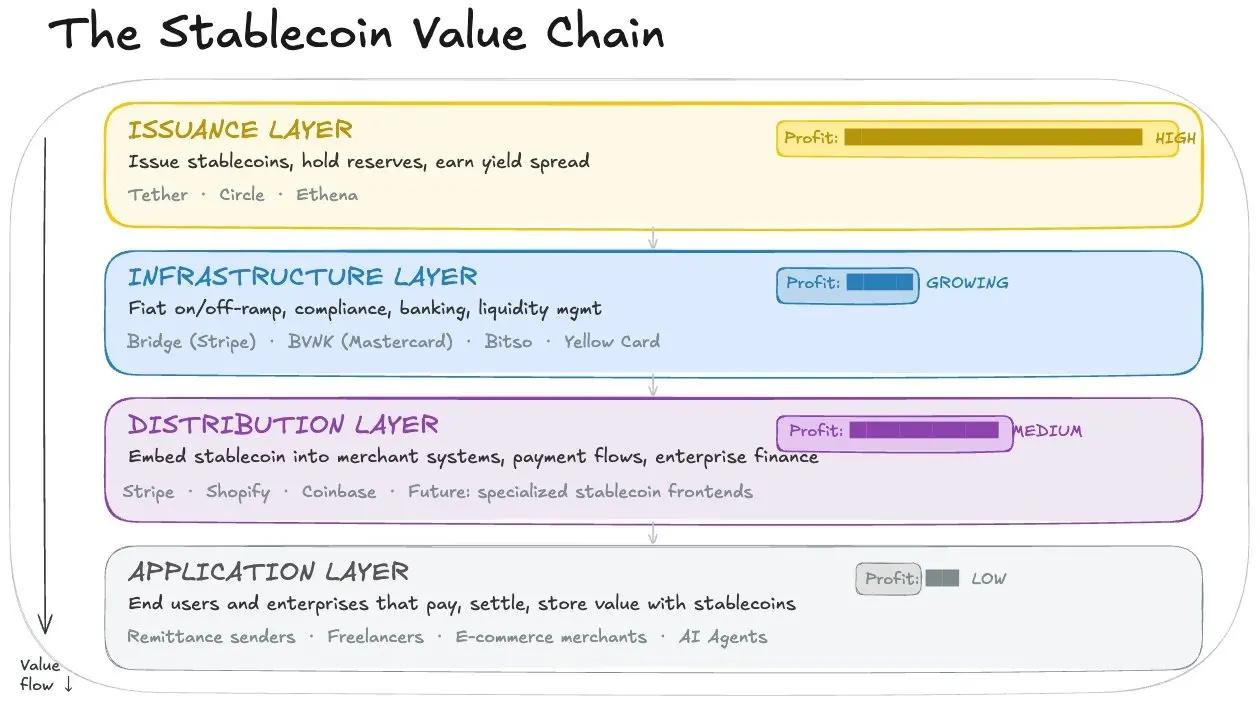
I categorize stablecoins into four layers:

  1. Issuance Layer: Mints stablecoins, holds reserve assets, earns the spread. Representatives: Tether and Circle;
  2. Infrastructure Layer: Connects stablecoins to the real-world financial system—fiat on/off ramps, bank integrations, asset management, compliance. Representatives: Bridge (acquired by Stripe), BVNK (acquired by Mastercard), Bitso, Yellow Card, etc.
  3. Acquiring/Distribution Layer: Embeds stablecoins into merchant systems, manages payment flows, enterprise financial software. Representatives: Stripe, Infini, Coinbase.
  4. Application Layer: End-users and businesses that use stablecoins for payments, settlement, and storage of value.

The Issuance Layer receives user funds and captures the thickest spread; the middle two layers profit from volume, distribution fees, and underlying infrastructure; the Application Layer enjoys convenience but has little bargaining power.

I believe the Infrastructure Layer is currently underappreciated.

It handles the "dirty work": integrating with banks, handling KYC/AML, processing local fiat on/off ramps, connecting merchants, APIs, card networks, and solving settlement and regulatory issues across different countries.

Conversely, this is also where its moat lies. Because technically, transferring USDC on-chain is not the hard part. The real difficulty is penetrating the real world—getting a Latin American company, an African payment provider, or an overseas platform to incorporate stablecoins into their daily cash flows. Someone has to do this dirty work.

The On-Chain Part is Easiest, the Bridge to Reality is Hardest

At first glance, stablecoin payments seem straightforward: fast on-chain transfers, low fees—isn't it just about distributing the product to users?

But the real challenge for stablecoins is the vast gap between the chain and the real-world financial system. Businesses have decision and migration costs; they won't switch their entire workflow just because they heard stablecoins settle in 1 second.

A series of questions arise: How to convert fiat to stablecoins? How to convert back? How to handle reconciliation and taxation? Will the bank block us later? Do users still need to learn how to use a wallet?

The core work of the Infrastructure Layer is bridging the two sides: connecting to the chain and wallets on one end, and to banks, local payment networks, enterprise systems, and compliance on the other.

Stripe's acquisition of Bridge in 2025 bought its stablecoin orchestration system—helping businesses integrate stablecoin capabilities into their operations. Mastercard's announced acquisition of BVNK in March 2026 had similar reasoning.

In other words, traditional payment companies are competing to become the default gateway for businesses using stablecoins.

The key to scaling stablecoin payments lies here.

Paving the Way

Looking further into the Infrastructure Layer:

  1. On/Off Ramps + Currency Exchange. Most business scenarios involve the process "local currency → stablecoin → local currency." This involves banking relationships, compliance, liquidity, and other issues.
  2. API + Account Layer. Businesses need a set of financial capabilities embedded into their workflows—account opening, payments, fund splitting, clearing, reconciliation. This is somewhat like financial SaaS, similar to the Neobank concept.
  3. Payment Network Connectivity. The more payment rails, banks, and regions connected, the more dependent clients become, gradually increasing switching costs.
  4. Capital Efficiency. Helping businesses reduce idle funds, waiting times, and FX losses.

I believe its characteristics dictate a path of initial hardship followed by reward.

  • Grunt Work: It requires connecting banks, achieving compliance, obtaining licenses, and building local teams country by country.
  • Front-loaded Investment to Capture Entry Points: Businesses won't easily switch their payment infrastructure. Those who first secure large clients, banking relationships, compliance pathways, and local fiat rails will later benefit from network effects. Currently, these companies are in a "land grab" phase, far from harvest time.
  • Squeezed by Upstream and Downstream: Upstream issuers take the spread first, while downstream platforms want to control the user interface. The infrastructure layer is in the middle, in an awkward position—"everyone needs you, but no one wants you to earn too much."

Currently, it is in the intermediate stage of moving toward "bargaining power formation."

If we only look at today, the Issuance Layer takes the largest profit, while the Infrastructure Layer is thinner and more capital-intensive.

But if we're talking about how to invest in stablecoins, the seigniorage logic of the Issuance Layer is already well understood by the market, with pricing increasingly revolving around interest rates, regulation, and profit sharing. The Infrastructure Layer is less noticeable today, often simply because it's still in the early investment phase. Bargaining power and user habits haven't fully solidified yet.

Once stablecoins further become the default rails for enterprise funds, the true beneficiaries will be those who, over the years, successfully bridged stablecoins into real-world commercial systems.


Preguntas relacionadas

QAccording to the article, how many layers is the stablecoin ecosystem divided into? Name them.

AThe stablecoin ecosystem is divided into four layers: 1. Issuance Layer, 2. Infrastructure Layer, 3. Acquirer/Distribution Layer, and 4. Application Layer.

QWhich layer does the author believe is currently undervalued or underappreciated, and why?

AThe author believes the Infrastructure Layer is currently undervalued. It's considered less glamorous because it involves difficult 'dirty work' like bank integration, KYC/AML, local fiat on/off-ramps, merchant onboarding, and solving cross-border regulatory issues. However, this complexity also creates its moat.

QWhat is the core challenge for enabling widespread stablecoin payment adoption, as described in the article?

AThe core challenge is bridging the gap between the blockchain and the real-world financial system. While moving tokens on-chain is technically simple, the real difficulty lies in integrating stablecoins into business workflows, handling fiat conversions, accounting, tax compliance, and overcoming enterprise decision and switching costs.

QWhat strategic moves by traditional payment companies (Stripe and Mastercard) does the article mention, and what is their goal?

AThe article mentions Stripe's acquisition of Bridge in 2025 and Mastercard's announcement to acquire BVNK in 2026. Their goal is to secure the role of becoming the default gateway/entry point for businesses wanting to integrate stablecoin capabilities into their operations.

QWhat are the three key characteristics of the Infrastructure Layer that make it a 'first bitter, then sweet' business?

A1. It involves hard 'dirty work' requiring country-by-country bank integrations, compliance, licensing, and local team building. 2. It requires significant upfront investment to capture market entry points (clients, banking relationships, compliance paths) before network effects can develop. 3. It is squeezed between the profitable upstream Issuance Layer and the downstream platforms that want to control user access, making its position initially precarious.

Lecturas Relacionadas

Dan Koe: The Counterintuitive Truth—You Don't Need to Remember Everything You Read

Dan Koe: The Counterintuitive Truth — You Don't Need to Remember Everything You Read The central idea is that deliberately trying to remember information is often misguided. True learning isn't about memorizing facts but about having important knowledge surface naturally when needed through use. Most forgetting is normal, not a failure. The article reframes learning using a control theory framework—a four-step feedback loop: having a clear Goal, accurately Sensing your current state, Comparing the gap, and Acting to close it. Most learning stalls because people only do step 2 (blind input) without a goal to create the necessary "error signal" for focused action. The most effective method is to start with output, not input. Begin a meaningful personal project first, and learn only what's necessary to complete it. This project-driven, "just-in-time" learning ensures knowledge is contextual and retained. The concept of a "Second Brain" often fails because it becomes a digital graveyard—over-collected and under-utilized. The goal should be building a "Second Subconscious"—a dynamic system that proactively surfaces relevant ideas during creation, not a static storage vault. Tools like Obsidian+Claude or Eden can help by automating organization and enabling semantic search, but their value depends on linking knowledge to active projects. Ultimately, what matters is not what you store, but what you filter and internalize. Focus on ideas that shape your worldview, use projects as filters, and transform collected material through writing and sharing. AI should be used to reduce friction in research and editing, not to formulate your core views. In conclusion, remembering is a byproduct, not the goal. Knowledge that sticks comes from pursuing personal goals, applying it in real projects, and digesting it through creation. The tools are merely aids; the crucial step is to start doing meaningful work and let the necessary knowledge find you.

marsbitHace 7 min(s)

Dan Koe: The Counterintuitive Truth—You Don't Need to Remember Everything You Read

marsbitHace 7 min(s)

A New Era: The Fundamental Transformation of China's Entrepreneurs

A profound generational shift is underway among Chinese entrepreneurs. The wealth and influence once dominated by real estate and internet giants is now being claimed by a new wave of founders driving breakthroughs in AI, semiconductors, and robotics. This change is vividly reflected in 2026's wealth rankings. Figures like Zhang Yiming (ByteDance), Liang Wenfeng (DeepSeek), Chen Tianshi (Cambricon), and Wang Xingxing (Unitree Robotics) are ascending. Their wealth stems not from traditional business models but from market expectations for future technological competitiveness, with AI, chips, and smart hardware becoming the primary engines of wealth creation. Their common trait is a foundational focus on technology, often starting from the laboratory rather than a business plan. Examples include Chen Tianshi's decade-long push in AI chips, Liang Wenfeng's core algorithmic innovations at DeepSeek with a compact team, and Zhu Yiming's "no salary until profitable" 9-year journey to build Changxin Memory into a global DRAM player. This transition marks a fundamental shift in China's economic imperative: from commercial expansion and learning to indigenous innovation and deep industrial capability. While the previous generation built the foundational market and infrastructure, this new cohort is tasked with achieving global leadership in core technologies, moving China from "keeping pace" to pioneering original, breakthrough innovations that are industrialized at scale. The baton is being passed to those competing on the world stage through technological originality.

marsbitHace 7 min(s)

A New Era: The Fundamental Transformation of China's Entrepreneurs

marsbitHace 7 min(s)

Once-Popular Web3 Enters Wave of Layoffs

The once-hot Web3 industry is experiencing a severe wave of layoffs. While many companies attribute job cuts to AI-driven restructuring, the primary reason is often financial pressure. The Web3 sector, at the intersection of tech and finance, has been hit particularly hard. Employees at major cryptocurrency exchanges report sudden, impersonal layoffs—often with system access revoked overnight—and minimal or no severance. Common tactics include setting impossible performance targets or terminating employees for minor policy violations. The working atmosphere has become toxic, marked by intense monitoring, excessive meetings, and management obsessed with control and internal politics rather than product innovation. The industry's core business model is collapsing. Exchange revenue from trading fees and listing charges has plummeted due to a decline in quality projects and retail investor exodus. Events like the massive forced liquidation on October 10th further shattered confidence. Competition from on-chain derivatives platforms and prediction markets is intensifying the downturn. As layoffs continue, displaced workers struggle to find new opportunities. Many transition to the AI sector, but face significant bias from traditional finance and even some AI firms, which view crypto industry experience with suspicion. The current downturn appears more structural than cyclical, driven by unsustainable practices, internal strife, and a failure to innovate, raising questions about the industry's future trajectory.

marsbitHace 1 hora(s)

Once-Popular Web3 Enters Wave of Layoffs

marsbitHace 1 hora(s)

Trading

Spot
活动图片