Witnessing History! Just Now, the First Limit-Up! Are Commodities Rallying Across the Board?

marsbitPublicado a 2025-12-15Actualizado a 2025-12-15

Resumen

On December 15, the platinum futures contract on the Guangzhou Futures Exchange surged by 7%, hitting a daily limit up for the first time since its listing, closing at 482.4 yuan/gram. Palladium futures also rose sharply by 4.73%. This rally reflects a broader global trend, with international platinum prices up 93% year-to-date, driven by structural supply constraints and growing demand. Supply-side issues are critical. Over 70% of global platinum production comes from South Africa, where aging infrastructure, power instability, and high operational costs hinder output. Similarly, palladium supply remains tight, with Russia—supplying over 40%—facing geopolitical risks. Global platinum supply has declined significantly from 258.4 tons in 2021 to an estimated 227.4 tons in 2024. Demand is robust and diversifying. Automotive applications (37.4% of platinum demand) remain stable, while industrial use (30%) spans chemicals, glass, and electronics. The hydrogen economy presents a major growth opportunity, as platinum is essential for fuel cells and electrolyzers. Investment demand is rising due to macroeconomic uncertainty and potential monetary easing. Analysts are bullish long-term, with some predicting platinum could reach $2,170–$2,300/oz by 2026. However, risks include high volatility, potential demand substitution from elevated prices, and sensitivity to global industrial activity. The rally underscores a broader commodities momentum, with some drawing parallels to Bitcoin...

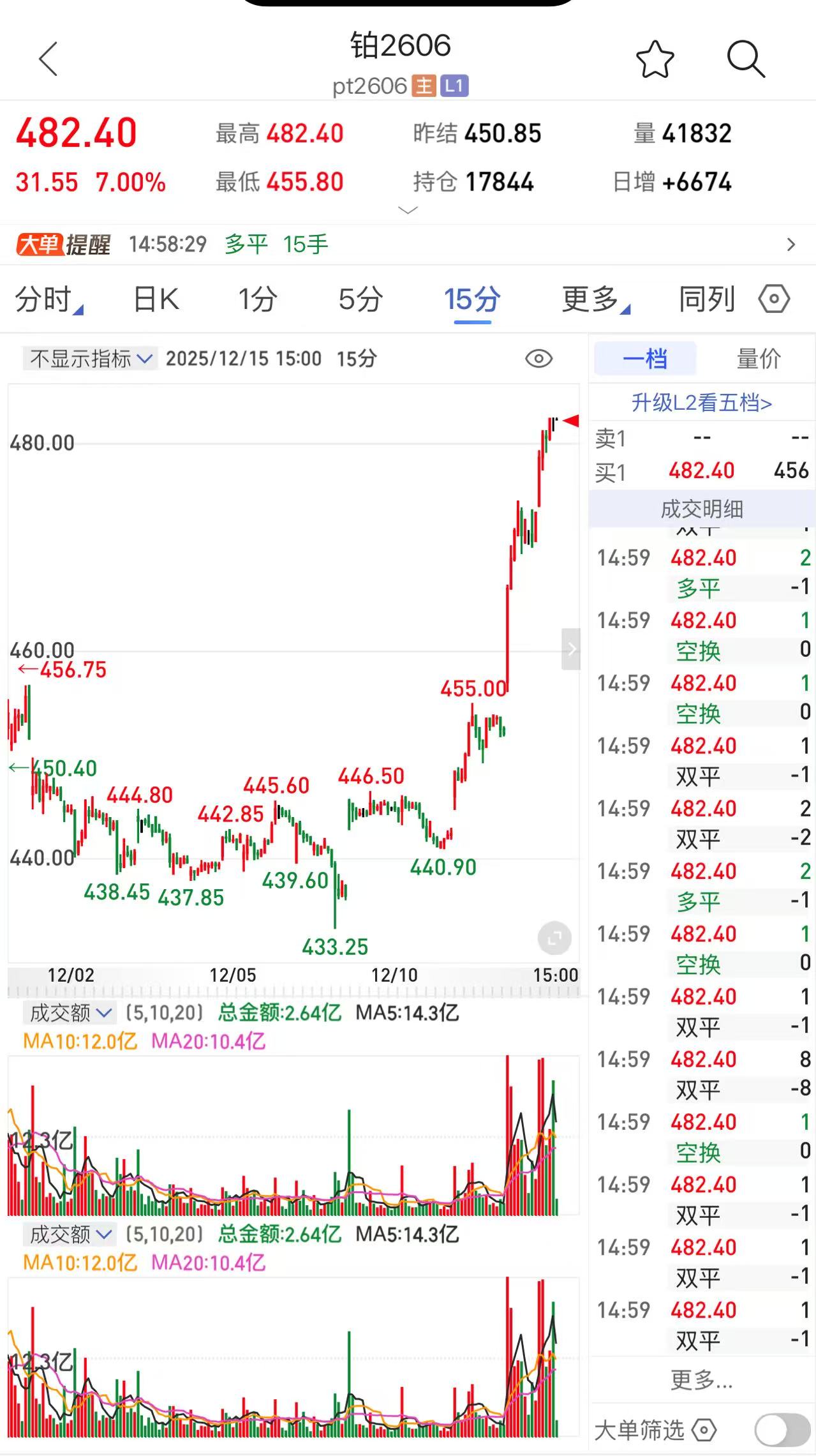
On December 15th, the domestic futures market witnessed a remarkable rally. The main platinum futures contract listed on the Guangzhou Futures Exchange surged robustly during the trading session, firmly hitting the limit-up in the afternoon with an intraday gain of 7%, closing at 482.4 yuan per gram.

Notably, this marks the first limit-up since the listing of this contract, with trading volume also surging to 41,800 lots on the same day, indicating strong participation and enthusiasm from market funds.

In a similar vein, the main palladium futures contract, also a platinum group metal, showed strong performance, with intraday gains once exceeding 5%, closing up 4.73% at 407.6 yuan per gram. This synchronized surge signals that platinum and palladium, these relatively "low-profile" precious metals, are officially capturing the attention of more investors. Shifting the focus to the global market, platinum's strong momentum had already been evident.

Since the beginning of this year, international platinum prices have soared, with a cumulative increase reaching a staggering 93%, completely breaking the multi-year downtrend and becoming one of the most dazzling performers among commodities this year. This interconnected rise, both domestically and internationally, is not an isolated event; it is driven by profound and lasting changes in fundamental supply and demand dynamics.


II. Analysis of the Rally Drivers: Structural Shortage and New Demand Narratives

Market analysis generally agrees that the core driver of this platinum and palladium rally stems from long-accumulated supply-demand contradictions, rather than short-term speculative sentiment. Muhammad Umair, a financial analyst at FXEmpire, pointed out that the main forces pushing platinum prices higher come from the dual squeeze of growing industrial demand and an increasingly tight supply structure.

From the supply side, a long-term contraction trend is significant.

Global platinum supply has been in a tight state for several consecutive years. According to data from the World Platinum Investment Council (WPIC), global total platinum supply in 2024 is forecast at 227.4 tons, showing a noticeable decline from 258.4 tons in 2021 and remaining at the lower end of the historical supply range.

Platinum supply primarily consists of mine production (over 75%) and recycling.

Currently, the South African mines, which account for over 70% of global production, continue to be plagued by multiple challenges including unstable power supply, aging mine infrastructure, and rising operational costs, severely constraining output from the mining side. Simultaneously, a long-term lack of capital expenditure has created bottlenecks for mine capacity expansion.

Analysis from Xinhu Futures indicates that the platinum market has been in a physical deficit for many consecutive years, and this structural supply gap is the fundamental reason supporting the steady upward shift in its price center. The supply situation for palladium is equally concerning. Although global total palladium supply in 2024 is expected to increase slightly by 3.6% year-on-year to 292.84 tons, inventory levels have fallen to multi-year lows, leaving the market with extremely weak buffering capacity.

More importantly, Russia supplies over 40% of the world's mined palladium, and any potential risks in geopolitics or trade could impact the already fragile supply chain, exacerbating market volatility.


From the demand side, traditional support remains solid, and new bright spots are emerging.

​While supply remains constrained, the demand side demonstrates strong resilience and new growth potential.

WPIC data shows that global total platinum demand in 2024 is forecast at 258.25 tons, far exceeding the同期 supply, clearly indicating a supply-demand deficit.

The automotive sector remains the largest source of platinum demand currently, accounting for about 37.4% in 2024, primarily used in manufacturing catalytic converters for vehicle exhaust. Although the global auto industry is transitioning towards electrification, demand for platinum from traditional internal combustion engine vehicles, particularly some diesel vehicles facing stricter emission standards, remains stable. Furthermore, due to price factors, the ongoing substitution of platinum for palladium in some catalytic applications provides additional support for platinum demand. Industrial demand is another stable pillar, accounting for about 30%, widely used in high-end manufacturing sectors such as chemicals, glass, electronics, and medical applications.

However, what most excites the market is the vast potential brought by the hydrogen energy industry. Platinum is an indispensable catalyst material in Proton Exchange Membrane Fuel Cells (PEMFC) and is also a crucial electrode material in electrolyzers for water splitting (a key technology for green hydrogen production). As countries worldwide actively advance the energy transition, the rapid development of the hydrogen energy industry chain is expected to open a long-term and potentially huge new growth avenue for platinum demand. Cong Shanshan, an analyst at Huishang Futures, pointed out that hydrogen energy is becoming a new core growth driver for platinum demand.

Additionally, the recovery in investment demand should not be overlooked. Against a backdrop of increased global macroeconomic uncertainty and expectations for a potential shift in monetary policy by major central banks, platinum, which possesses both precious metal financial attributes and strong industrial properties, has attracted inflows from funds seeking diversification and safe-haven assets. The sustained increase in holdings of palladium ETFs this year also reflects warming investment sentiment.


III. Market Outlook: Value Reassessment Coexists with Potential Risks

Regarding the future market, while specific price point predictions vary among analysis institutions, the view of a bullish medium-to-long-term trend predominates.
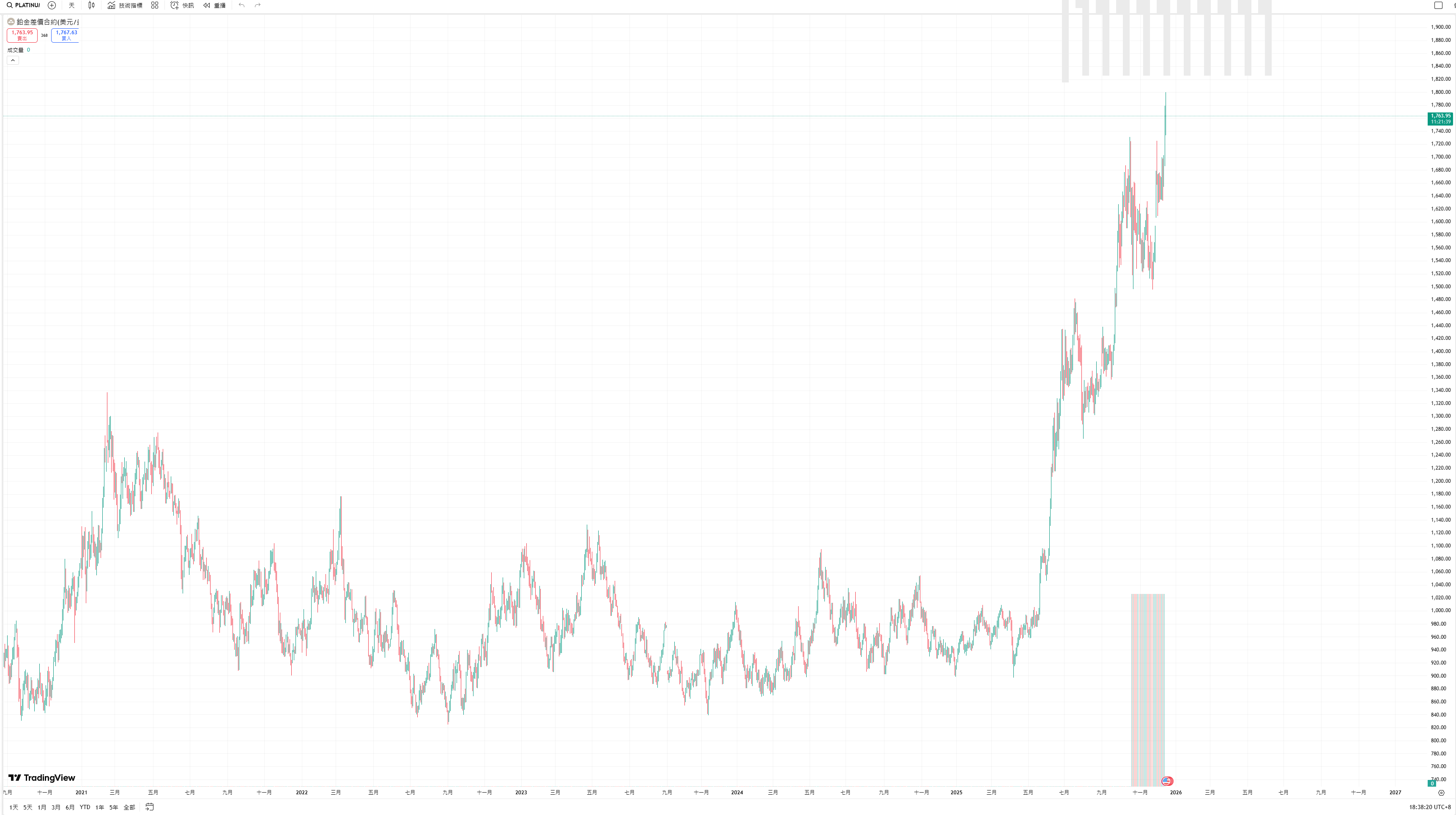
Muhammad Umair holds a relatively aggressive view, believing the current rally is not over. He forecasts that platinum prices could climb to the range of $2170-$2300 per ounce by 2026. This expectation is significantly higher than the median forecast of $1550-$1670 per ounce for next year by most Wall Street institutions.

Cong Shanshan, an analyst at Huishang Futures, stated that the prospect of a shift in the Federal Reserve's monetary policy expectations (such as interest rate cuts) and the resulting looser liquidity outlook are macro-level positives for precious metal prices including platinum and palladium.

Concurrently, the strength in gold and silver prices also supports platinum and palladium through precious metal sector correlation.

She emphasized that, from a medium-to-long-term perspective, against a backdrop of loose liquidity, if investors continue to view platinum as an alternative investment to gold, its price will receive solid support. Xinhu Futures also believes that the "structural gap in the platinum and palladium markets will persist, driving prices steadily higher". However, market participants also need to be wary of potential risks. Firstly, the overall platinum and palladium markets are much smaller than gold, inherently leading to higher price volatility; rapid short-term gains could accumulate correction pressure. Secondly, high prices may prompt some industrial users to seek alternative materials or process improvements, thereby dampening long-term demand. Finally, the global macroeconomic situation, particularly the industrial activity sentiment in major economies, will continue to directly impact the industrial demand for platinum and palladium.


IV. Conclusion: Precious Metal Opportunities in the New Cycle

In summary, the recent price explosion in platinum and palladium is the result of the combined effect of a long-term reversal in fundamental supply and demand, empowerment from new application scenarios, and changes in the macro-financial environment. South Africa's supply woes, geopolitical risks associated with Russia, and the grand narrative of the hydrogen economy together form a solid foundation for this value reassessment.

The listing of domestic platinum and palladium futures provides investors with more convenient participation tools, expected to further enhance market attention and liquidity for these two metals. In a broader asset allocation perspective, it's not just niche precious metals like platinum and palladium that are shining; the entire commodities market is showing signs of活跃 (activity).

From energy to metals, prices of various basic assets are rotating, seemingly heralding a new cycle of volatility and opportunity. As traditionally defined commodities纷纷启动 (start rallying across the board), Bitcoin, representing the innovation of value storage in the digital age, is also being increasingly discussed and its属性 (attribute) as "digital gold" is gaining more attention. If commodities are all rallying, can Bitcoin, as digital gold, be far behind?


Preguntas relacionadas

QWhat was the significant event that occurred in the domestic futures market on December 15th, as described in the article?

AThe platinum futures main contract listed on the Guangzhou Futures Exchange surged and hit the limit-up (涨停) for the first time since its listing, with a daily gain of 7%, closing at 482.4 yuan per gram.

QAccording to the article, what are the two main drivers behind the recent surge in platinum and palladium prices?

AThe core drivers are a long-term accumulation of supply-demand contradictions, specifically strong industrial demand growth and a tightening supply格局 (structure).

QWhich country is highlighted as a major source of palladium supply, and what potential risk does this pose?

ARussia is highlighted as supplying over 40% of the world's mined palladium. The potential risk is that any geopolitical or trade-related risks could impact the already vulnerable supply chain and increase market volatility.

QWhat emerging industry is identified as a significant new source of demand for platinum, and what specific applications does it have in this industry?

AThe hydrogen energy industry is identified as a significant new source of demand. Platinum is an indispensable catalyst material in Proton Exchange Membrane (PEM) fuel cells and an important electrode material in electrolyzers for green hydrogen production.

QWhat is the more aggressive price target for platinum by 2026, as mentioned by one analyst in the article?

AAnalyst Muhammad Umair projected a more aggressive price target of $2,170 to $2,300 per ounce for platinum by 2026.

Lecturas Relacionadas

The King of Blind Date Attire in Korea: How SK Hynix Made a Comeback Against Samsung?

In South Korea's dating scene, SK Hynix employees are now highly sought after, a status shift fueled by the company's astronomical profits and employee bonuses, projected to reach up to 6.1 million RMB per person by 2027. This marks a dramatic reversal for the long-time second-place player in memory semiconductors, which has now surpassed its rival Samsung in annual operating profit. The turnaround story began in 2008 when a struggling Hynix, emerging from bankruptcy restructuring, took a risky bet by agreeing to develop High Bandwidth Memory (HBM) with AMD. At the time, HBM had no clear market beyond high-end graphics cards and was a costly, complex technology. Major players like Samsung, pursuing its own HMC technology, declined. For Hynix, with only memory as its core business, it was a gamble born of necessity. The pivotal moment came in 2012 when SK Group Chairman Chey Tae-won acquired Hynix. Defying industry downturns, he invested heavily in R&D and fabrication, sustaining the HBM project through over a decade of commercial uncertainty and internal challenges. A key break occurred around 2016-2017 when Samsung faced production issues supplying HBM2 for Google's TPU, allowing SK Hynix to gain a crucial foothold in the data center market. The AI explosion post-ChatGPT in 2022 was the catalyst, turning HBM into a critical bottleneck for AI accelerators like NVIDIA's GPUs. By 2025, SK Hynix captured 62% of the global HBM market, leaving Samsung at 17%. For the first time, its annual operating profit exceeded Samsung's. Analysts point to the "innovator's dilemma" to explain Samsung's miss: its vast, successful business portfolio made it risk-averse, preventing an all-in bet on the initially niche HBM technology. In contrast, SK Hynix, as a challenger with its back against the wall, had no choice but to commit fully. The story highlights how Korea's chaebol system allows for ultra-long-term bets beyond quarterly pressures. However, SK Hynix's lead isn't guaranteed. Samsung is aggressively catching up on HBM4, and challenges like customer concentration (heavy reliance on NVIDIA) and technical hurdles in advanced packaging remain. The narrative underscores a market truth: the greatest alpha often comes from betting on uncertain, long-term directions others dismiss, much like HBM in 2008.

marsbitHace 18 min(s)

The King of Blind Date Attire in Korea: How SK Hynix Made a Comeback Against Samsung?

marsbitHace 18 min(s)

Understanding Hash in One Article: The "Browser Miner" on Ethereum

Hash is an Ethereum-based ERC-20 token described as a "browser-minable post-quantum token." Its key features include enabling browser-based GPU mining without specialized hardware, a fixed supply cap of 21 million tokens, immutable and permissionless smart contracts with no team allocation or pre-mining, and an emphasis on post-quantum security using Keccak256 hashing. The mining mechanism is a simplified on-chain proof-of-work where miners solve unique challenges tied to their wallet address. Key design elements prevent answer theft, with epochs resetting every 100 blocks (~20 minutes) and a per-block minting limit. Emission follows a Bitcoin-like halving schedule every 100,000 mints, starting at 100 tokens per mint. Projections suggest all tokens could be mined within approximately 294 days if a target rate of one mint per minute is sustained. Hash emphasizes "post-quantum" security by leveraging hash-based primitives like Keccak256, which are considered more resistant to quantum attacks compared to elliptic-curve cryptography. While not a fully post-quantum asset, it aligns with Ethereum's broader post-quantum research narrative. The project completed its Genesis sale at $0.03 and began trading on Uniswap, with its price reaching around $0.19. The initial circulating supply is small, with 5% sold in Genesis and 5% allocated to liquidity. The majority (47.6% of total supply) is allocated to early-stage mining, leading to a front-loaded emission schedule. This structure, combined with low initial liquidity, makes Hash a high-volatility, high-risk project dependent on sustained miner participation and market demand to absorb new supply.

marsbitHace 32 min(s)

Understanding Hash in One Article: The "Browser Miner" on Ethereum

marsbitHace 32 min(s)

OpenAI's Largest Internal Wealth Creation: 600 People Cash Out a Total of $6.6 Billion, 75 Take Home the Maximum $30 Million Each

A Wall Street Journal report reveals OpenAI's unprecedented pre-IPO wealth creation. In a single employee stock sale last October, over 600 current and former employees sold shares, collectively cashing out approximately $6.6 billion. Due to high investor demand, the company tripled the individual sale cap to $30 million, with about 75 employees selling the maximum amount. This event represents the largest such transaction in tech industry history for a private company. OpenAI's valuation was $500 billion for this tender offer. Employees with over two years of tenure were eligible, allowing many post-ChatGPT hires their first liquidity event. The company's stock has reportedly grown over 100-fold in seven years. Following a restructuring, employees collectively hold about 26% of OpenAI. The scale of executive wealth is also staggering. In court testimony related to Elon Musk's lawsuit, President and co-founder Greg Brockman confirmed his OpenAI stake is worth around $30 billion. Analysis indicates about 165 current and former employees hold a combined ~$164.9 billion in equity, averaging nearly $1 billion per person in paper wealth. OpenAI's per-employee stock-based compensation is estimated to be 34 times the average of major tech firms before their IPOs. OpenAI continues its rapid ascent, closing a $122 billion funding round at an $852 billion valuation in March. With monthly revenue hitting $2 billion, over 900 million weekly ChatGPT users, and plans for a potential trillion-dollar IPO in late 2026, this wealth-creation engine shows no signs of stopping.

链捕手Hace 55 min(s)

OpenAI's Largest Internal Wealth Creation: 600 People Cash Out a Total of $6.6 Billion, 75 Take Home the Maximum $30 Million Each

链捕手Hace 55 min(s)

Trading

Spot
Futuros

Artículos destacados

Cómo comprar CC

¡Bienvenido a HTX.com! Hemos hecho que comprar CC(Canton) (CC) sea simple y conveniente. Sigue nuestra guía paso a paso para iniciar tu viaje de criptos.Paso 1: crea tu cuenta HTXUtiliza tu correo electrónico o número de teléfono para registrarte y obtener una cuenta gratuita en HTX. Experimenta un proceso de registro sin complicaciones y desbloquea todas las funciones.Obtener mi cuentaPaso 2: ve a Comprar cripto y elige tu método de pagoTarjeta de crédito/débito: usa tu Visa o Mastercard para comprar CC(Canton) (CC) al instante.Saldo: utiliza fondos del saldo de tu cuenta HTX para tradear sin problemas.Terceros: hemos agregado métodos de pago populares como Google Pay y Apple Pay para mejorar la comodidad.P2P: tradear directamente con otros usuarios en HTX.Over-the-Counter (OTC): ofrecemos servicios personalizados y tipos de cambio competitivos para los traders.Paso 3: guarda tu CC(Canton) (CC)Después de comprar tu CC(Canton) (CC), guárdalo en tu cuenta HTX. Alternativamente, puedes enviarlo a otro lugar mediante transferencia blockchain o utilizarlo para tradear otras criptomonedas.Paso 4: tradear CC(Canton) (CC)Tradear fácilmente con CC(Canton) (CC) en HTX's mercado spot. Simplemente accede a tu cuenta, selecciona tu par de trading, ejecuta tus trades y monitorea en tiempo real. Ofrecemos una experiencia fácil de usar tanto para principiantes como para traders experimentados.

160 Vistas totalesPublicado en 2026.04.21Actualizado en 2026.04.21

Cómo comprar CC

Cómo comprar BLEND

¡Bienvenido a HTX.com! Hemos hecho que comprar Fluent (BLEND) sea simple y conveniente. Sigue nuestra guía paso a paso para iniciar tu viaje de criptos.Paso 1: crea tu cuenta HTXUtiliza tu correo electrónico o número de teléfono para registrarte y obtener una cuenta gratuita en HTX. Experimenta un proceso de registro sin complicaciones y desbloquea todas las funciones.Obtener mi cuentaPaso 2: ve a Comprar cripto y elige tu método de pagoTarjeta de crédito/débito: usa tu Visa o Mastercard para comprar Fluent (BLEND) al instante.Saldo: utiliza fondos del saldo de tu cuenta HTX para tradear sin problemas.Terceros: hemos agregado métodos de pago populares como Google Pay y Apple Pay para mejorar la comodidad.P2P: tradear directamente con otros usuarios en HTX.Over-the-Counter (OTC): ofrecemos servicios personalizados y tipos de cambio competitivos para los traders.Paso 3: guarda tu Fluent (BLEND)Después de comprar tu Fluent (BLEND), guárdalo en tu cuenta HTX. Alternativamente, puedes enviarlo a otro lugar mediante transferencia blockchain o utilizarlo para tradear otras criptomonedas.Paso 4: tradear Fluent (BLEND)Tradear fácilmente con Fluent (BLEND) en HTX's mercado spot. Simplemente accede a tu cuenta, selecciona tu par de trading, ejecuta tus trades y monitorea en tiempo real. Ofrecemos una experiencia fácil de usar tanto para principiantes como para traders experimentados.

162 Vistas totalesPublicado en 2026.04.24Actualizado en 2026.04.24

Cómo comprar BLEND

Cómo comprar ACN

¡Bienvenido a HTX.com! Hemos hecho que comprar AITECH CLOUD NETWORK (ACN) sea simple y conveniente. Sigue nuestra guía paso a paso para iniciar tu viaje de criptos.Paso 1: crea tu cuenta HTXUtiliza tu correo electrónico o número de teléfono para registrarte y obtener una cuenta gratuita en HTX. Experimenta un proceso de registro sin complicaciones y desbloquea todas las funciones.Obtener mi cuentaPaso 2: ve a Comprar cripto y elige tu método de pagoTarjeta de crédito/débito: usa tu Visa o Mastercard para comprar AITECH CLOUD NETWORK (ACN) al instante.Saldo: utiliza fondos del saldo de tu cuenta HTX para tradear sin problemas.Terceros: hemos agregado métodos de pago populares como Google Pay y Apple Pay para mejorar la comodidad.P2P: tradear directamente con otros usuarios en HTX.Over-the-Counter (OTC): ofrecemos servicios personalizados y tipos de cambio competitivos para los traders.Paso 3: guarda tu AITECH CLOUD NETWORK (ACN)Después de comprar tu AITECH CLOUD NETWORK (ACN), guárdalo en tu cuenta HTX. Alternativamente, puedes enviarlo a otro lugar mediante transferencia blockchain o utilizarlo para tradear otras criptomonedas.Paso 4: tradear AITECH CLOUD NETWORK (ACN)Tradear fácilmente con AITECH CLOUD NETWORK (ACN) en HTX's mercado spot. Simplemente accede a tu cuenta, selecciona tu par de trading, ejecuta tus trades y monitorea en tiempo real. Ofrecemos una experiencia fácil de usar tanto para principiantes como para traders experimentados.

92 Vistas totalesPublicado en 2026.04.28Actualizado en 2026.04.28

Cómo comprar ACN

Discusiones

Bienvenido a la comunidad de HTX. Aquí puedes mantenerte informado sobre los últimos desarrollos de la plataforma y acceder a análisis profesionales del mercado. A continuación se presentan las opiniones de los usuarios sobre el precio de A (A).

活动图片













