Why Only Dollar-Cost Averaging Can Capture Bitcoin's Long-Term Dividends?

比推Publicado a 2026-03-06Actualizado a 2026-03-06

Resumen

This article argues that dollar-cost averaging (DCA) is the optimal strategy for capturing Bitcoin's long-term gains, supported by historical backtesting and forward-looking models. The strategy involves investing a fixed amount regularly, regardless of market conditions. A five-year DCA simulation, starting in January 2021 with weekly $250 investments, resulted in a total investment of $67,500, acquiring approximately 1.65 BTC at an average price of $40,884. At a price of $71,000, the portfolio was worth ~$120,500, a 76% gain. Projections show even higher returns at $100,000 and the expected 2025 cycle peak of ~$126,000. A shorter-term DCA example starting in January 2024 showed an initial paper loss at current prices but significant projected profits at higher future price points. A comparison over five years also demonstrated that DCA into Bitcoin outperformed DCA into the S&P 500. Long-term modeling, based on Bitcoin's power-law growth curve, projects a median price of around $430,000 by 2030. A four-year DCA plan starting in 2026 could accumulate roughly 0.30 BTC, leading to substantial returns even under conservative price estimates. The key conclusion is that while entry timing affects the magnitude of gains, the duration of the holding period is the most critical factor for maximizing returns.

Written by: Cointelegraph

Compiled by: AididiaoJP, Foresight News

Original title: Why Only Dollar-Cost Averaging Can Capture Bitcoin's Long-Term Dividends?


Both backtest data and forward-looking models indicate that using a dollar-cost averaging (DCA) strategy to buy Bitcoin is the best way to invest in BTC. Will this method still work in the next bull market?

Bitcoin has experienced a 50% plunge over the past 5 months, and savvy investors adjust their strategies during such bear markets and correction periods. This strategy is called dollar-cost averaging (DCA), which involves investing a fixed amount regularly, regardless of market conditions.

By examining historical market cycle data and BTC price forward simulations, we can more clearly see how this steady investment approach performs across different entry times and investment horizons.

Five Years of DCA in Bitcoin Yields Substantial Net Gains

Starting from January 2021, investing $250 weekly in Bitcoin via DCA, the total investment over five years would be $67,500. According to DCA simulation data, this strategy would have accumulated 1.65097905 BTC, with an average purchase price of $40,884.

At Bitcoin's current price of nearly $71,000, this 1.65097905 BTC is worth approximately $120,500, resulting in a profit of $53,000 (a 76% increase). If Bitcoin rises to $100,000, the holdings would be worth about $165,000; and at the cycle peak of nearly $126,000 in October 2025, the holdings would reach a value of $208,000.
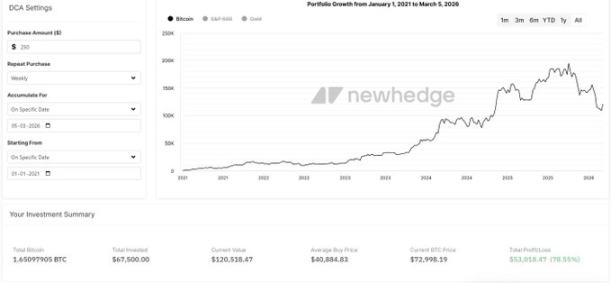
Bitcoin DCA Cycle 2021-2026 Source: Newhedge

Now consider a shorter investment period to see the impact of entry timing on early returns. Starting weekly $250 DCA from January 2024, the total investment is $28,500, accumulating 0.36863166 BTC with an average purchase price of $77,312.

At the current price of $71,000, this Bitcoin is worth approximately $26,909, representing a 6% paper loss. At a price of $100,000, the holdings would be worth $36,863; at the cycle peak of $126,000, the holdings would be worth $46,448.

In February this year, Swan Bitcoin analyst Adam Livingston compared on platform X the returns of DCA into BTC versus the S&P 500 index over the past five years. Investing $100 weekly resulted in $42,508 for BTC and $37,470 for the S&P 500, with returns of 62.9% and 43.6% respectively.

Livingston noted that although Bitcoin is highly volatile, historical data shows that persisting with DCA during downturns leads to higher long-term gains.
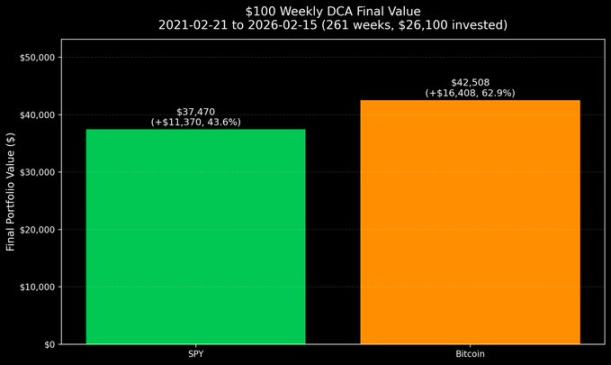
Weekly $100 DCA: BTC vs. S&P 500 Source: Adam Livingston/X

Long-Term Models: Time is the Key

Forward-looking simulation studies have also tested the effectiveness of DCA starting in 2026. Starting a weekly $250 DCA from January 2026 until March 2030 would mean a total investment of approximately $54,250.

The price prediction is based on Bitcoin's long-term power law growth curve (which tracks the historical relationship between Bitcoin's price and time on a logarithmic scale). This model generates a rising support band and a median trendline, largely consistent with previous market cycles.
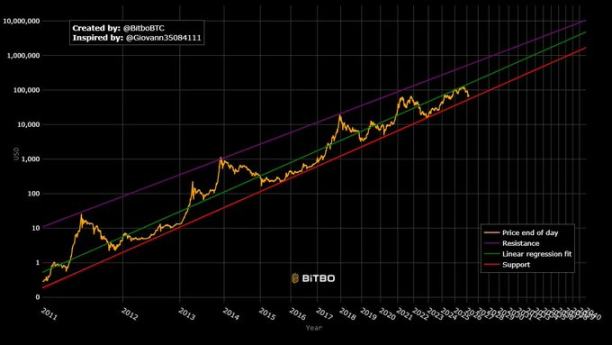
Bitcoin Power Law Growth Curve Source: Bitbo.io

Based on this model, analysts estimate the long-term trend support could break above $100,000 by 2028, which also serves as the foundational assumption for future DCA modeling. Bitcoin Well's simulation shows that by March 2030, the median price projection is approximately $430,000.

Accounting for potential price deviations, the model also considers the upper and lower bounds of the power law channel, providing a lower estimate (approx. $274,000) and a higher estimate (approx. $900,000).

Based on these assumptions, four years of DCA would accumulate roughly 0.30 BTC:

  • If BTC price is $274,000, holdings value ~$82,200.

  • If BTC price is $430,000 (median projection), holdings value ~$129,000.

  • If BTC price is $900,000, holdings value ~$270,000.
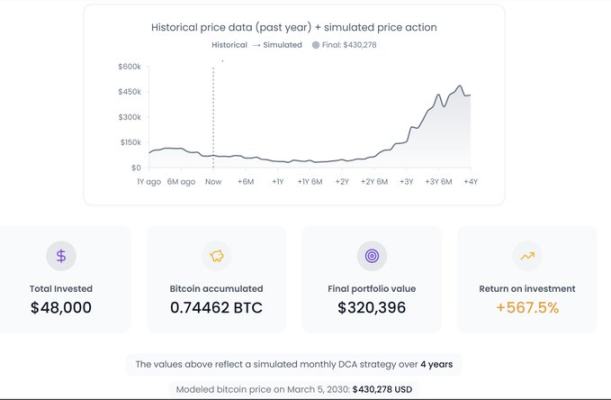
DCA Investment Results as of March 2030 Source: Bitcoin Well

In November 2025, Bitcoin researcher Sminston With conducted a study using a similar predictive model to test the impact of entry time on long-term returns. The findings revealed that even buying at a price 20% higher than the then price of $94,000 and selling at a price 20% lower than the projected 2035 median price, the remaining holdings after ten years would still yield a profit of nearly 300%.

In this simulation, the final total assets were 7.7 times the initial investment.

The study concluded: Entry timing affects the level of returns, but the duration of holding is the key determinant of the magnitude of gains.



Original link:https://www.bitpush.news/articles/7617498

Preguntas relacionadas

QWhat is the main investment strategy discussed in the article for capturing Bitcoin's long-term gains?

AThe main investment strategy discussed is Dollar-Cost Averaging (DCA), which involves investing a fixed amount of money at regular intervals, regardless of market conditions.

QAccording to the backtest data, how much profit was generated from a 5-year DCA strategy starting in January 2021 with a weekly investment of $250?

AThe 5-year DCA strategy generated a profit of $53,000, a 76% increase, with the total investment of $67,500 growing to approximately $120,500 at a Bitcoin price of $71,000.

QWhat model is used to predict Bitcoin's future price in the long-term simulations mentioned in the article?

AThe long-term price predictions are based on Bitcoin's power-law growth curve model, which tracks the historical relationship between Bitcoin's price and time on a logarithmic scale.

QHow does the performance of a DCA strategy compare to investing in the S&P 500 index over a five-year period, as cited in the article?

AOver a five-year period, a weekly DCA investment of $100 in Bitcoin yielded $42,508 (a 62.9% return), outperforming the S&P 500 index, which yielded $37,470 (a 43.6% return).

QWhat is the key conclusion from the research by Bitcoin researcher Sminston With regarding the timing of entry and long-term holding?

AThe key conclusion is that while the timing of entry affects the magnitude of returns, the duration of holding (long-term holding) is the primary determinant of the overall profit size.

Lecturas Relacionadas

Behind ZEC's Over 30% Plunge: An 'Unlimited Minting' Vulnerability with No Way to Prove if It Was Ever Exploited

A critical vulnerability was discovered in Zcash's Orchard privacy pool, allowing for the theoretical creation of undetectable counterfeit ZEC. Researcher Taylor Hornby found the flaw on May 29th, 2024, within the Orchard circuit's cryptographic constraints, which could let an attacker bypass asset conservation rules. Although a rapid emergency fix was deployed within days via a coordinated soft and hard fork, a core uncertainty remains: due to Orchard's privacy features, it is impossible to cryptographically prove whether this "unlimited mint" flaw was exploited in the nearly four years since the pool's 2022 launch. This uncertainty, rather than the patched flaw itself, triggered a market panic, causing ZEC's price to drop over 30%. While the Zcash Foundation stated no evidence of exploitation was found, independent entity Shielded Labs emphasized the impossibility of definitively proving no counterfeit ZEC was ever created. The incident highlights the unique trust challenge in privacy systems. To address this, developers are proposing a new network upgrade with enhanced auditing to allow verifiable proof of supply integrity. Notably, the researcher utilized the newly released AI model Claude Opus 4.8 as a tool during the security review, signaling the growing role of advanced AI in uncovering complex cryptographic vulnerabilities.

marsbitHace 2 min(s)

Behind ZEC's Over 30% Plunge: An 'Unlimited Minting' Vulnerability with No Way to Prove if It Was Ever Exploited

marsbitHace 2 min(s)

imToken's 10th Anniversary Unveils Strategic Direction for the Next Decade: Evolving from a Trusted Main Wallet to a Personal Digital Hub

On its tenth anniversary, decentralized wallet imToken announced its strategic vision for the next decade: evolving from a "trusted main wallet" into a "personal control interface." This new direction aims to help users manage not only digital assets but also identity, permissions, and AI agent actions in an increasingly open and intelligent internet. imToken outlined that while the past decade focused on Store, Send, and Stake—securing assets, enabling transfers, and facilitating network participation—the future introduces a fourth core proposition: Sign. This expanded concept goes beyond transaction signing to encompass expressing intent, granting permissions, setting rules, delegating actions, and revoking authorizations. As AI agents gain autonomy, imToken emphasizes the need for clear, verifiable, and revocable user control over their actions. CEO Ben He stated that imToken's mission is shifting from enabling ownership of digital assets to ensuring user sovereignty over their entire digital world in the AI era. The company's core principle has been upgraded from "Digital Assets, Under Your Control" to "Your Digital World, Under Your Control." Future development will focus on three areas: upholding self-custody principles, extending security from transactions to authorizations and automated actions, and building product capabilities for managing permissions, delegations, policies, and revocations. imToken views the wallet's role as expanding into a trusted control interface for human-AI collaboration, where managing keys, signatures, and permissions forms the infrastructure for personal digital sovereignty. Founded in 2016, imToken serves millions of users across 150+ countries, providing non-custodial wallet services supporting over 50 blockchain networks.

marsbitHace 3 min(s)

imToken's 10th Anniversary Unveils Strategic Direction for the Next Decade: Evolving from a Trusted Main Wallet to a Personal Digital Hub

marsbitHace 3 min(s)

With 300 Million Financing to Accumulate ETH, the Hidden Concerns Behind BitMine's High-Yield Preferred Shares

BitMine, led by Thomas Lee, plans to raise up to $300 million through an initial public offering of 3 million shares of perpetual Series A preferred stock on the NYSE (ticker: BMNP). The stock offers a fixed 9.5% annual dividend. The funds are intended to further the company's accumulation of Ethereum, expand its staking node operations, and for general corporate purposes. This move comes as BitMine faces significant challenges. Its massive Ethereum holdings, over 5.3 million ETH (roughly 4.5% of circulating supply), are currently at an unrealized loss exceeding $8.5 billion due to the crypto market downturn. The company's core business model relies on staking these ETH holdings to generate yield, which it presents as the primary means to cover the new, substantial annual dividend obligation of approximately $28.5 million if the offering is fully subscribed. While the model is similar to MicroStrategy's bitcoin-focused strategy of using capital markets to fund crypto acquisitions, BitMine's product differs with its fixed, non-adjustable dividend rate. The company acknowledges risks, stating dividend payments could also come from cash reserves, asset sales, or future financing, and warns that staking yields may underperform or be illiquid during market stress. The 9.5% fixed rate reflects the higher risk premium demanded from investors for a company heavily exposed to Ethereum's volatility.

Foresight NewsHace 7 min(s)

With 300 Million Financing to Accumulate ETH, the Hidden Concerns Behind BitMine's High-Yield Preferred Shares

Foresight NewsHace 7 min(s)

A Year of Observing Agent Payments: The Cold Reality Behind the Hot Narrative

A Year in Agent Payments: The Cold Reality Behind a Hot Narrative This article examines the current state of "Agent payments," a year after it became a major trend at the intersection of AI, payments, and crypto. Despite significant investments from major players like Stripe, Visa, and Google, the author—having built products and spoken with merchants and developers—finds genuine, large-scale demand still lacking. Key findings across several hyped scenarios reveal structural challenges: * **Agent-to-Merchant Commerce:** For most product categories (e.g., clothing, electronics), AI shopping via chat is inferior to traditional visual e-commerce. Merchant interest is largely defensive, focused on future-proofing rather than current consumer demand. True potential exists only in specific, high-frequency/low-decision scenarios (like food orders) or for simplifying broken checkout experiences, but these require massive consumer distribution, favoring incumbents. * **Agent-to-API/Machine Commerce:** While stablecoin micropayments are touted for API calls, developers already solve small-value payments via prepaid credits and subscriptions. Large SaaS providers prefer enterprise contracts over fragmented micro-pricing. The market exists for long-tail services outside the top providers but is inherently smaller than the hype suggests. * **Agent-to-Agent Payments:** This remains a theoretical long-term vision with negligible real transaction volume. The core challenges—discovery, trust, negotiation, dispute resolution—are unsolved. While the potential for a new, high-speed settlement layer is real, it is not the current market. * **Agent Finance:** This is the sole area with existing, paying customers (fund managers, DeFi users). AI enhances real-time monitoring and autonomous rebalancing, offering real capability gains. However, competition favors established, regulated institutions with existing licenses and client relationships. The author concludes that the core deficiency in the Agent economy is not merely a payment layer, but a more complex **coordination** capability—figuring out how Agents and humans work together, verify task completion, and settle outcomes. Payment is just one component of settlement, which is itself part of coordination. For large companies, investing now is a defensive, long-term bet with minimal cost. For startups, however, the imperative is to find markets that exist today, not wait for a future wave that remains on the horizon.

marsbitHace 9 min(s)

A Year of Observing Agent Payments: The Cold Reality Behind the Hot Narrative

marsbitHace 9 min(s)

China's First Embodied Data Compliance Outbound: How Does Paxini Become a Game-Changer for Industry Development?

"Embodied Intelligence Data Compliance Goes Global: A Breakthrough Moment. At the 2026 World Intelligent Industry Expo, Paxini, the sole Chinese company authorized for cross-border embodied data transfer, launched a pioneering project in Tianjin. This marks the first officially approved case of its kind in China, resolving a major industry bottleneck for compliant international data flow. As the ultimate direction of AI evolution, embodied intelligence relies on vast, multi-modal physical world interaction data. Despite booming global demand, stringent compliance had previously trapped the domestic industry. Paxini's breakthrough establishes a formal compliance framework, setting a benchmark for standardized development. The core of Paxini's success lies in its industry-leading data infrastructure and compliant security architecture, aligning with national data strategy. It operates a large-scale 'data collection factory' for high-quality, multi-modal data and has established a full-chain compliant pathway from 'collection-processing-certification-outbound transfer'. This dual advantage in data scale/quality and compliance secures its leadership. Beyond immediate commercial impact, the project signifies long-term strategic value: international market validation from top-tier financial institutions and the compounding benefits of ecosystem building. High-quality physical world data possesses enduring value. By solving fundamental infrastructure and compliance challenges, Paxini not only contributes a 'Chinese model' to the global embodied intelligence industry but also solidifies a key competitive moat for the long haul. This enables safe, efficient global flow of China's quality embodied data, amplifying its influence in the intelligent manufacturing landscape."

marsbitHace 10 min(s)

China's First Embodied Data Compliance Outbound: How Does Paxini Become a Game-Changer for Industry Development?

marsbitHace 10 min(s)

Trading

Spot
Futuros
活动图片



