2 Months, Valuation Soars from $8.8B to $68B! The Largest AI Model Hub OpenRouter May Be Acquired

链捕手Publicado a 2026-07-24Actualizado a 2026-07-24

Resumen

Stripe is reportedly in talks to acquire AI model marketplace OpenRouter for a price nearing $10 billion, a dramatic increase from its $1.3 billion valuation just two months prior. The deal, which could be announced within a month, would see the payment giant absorb a key "router" or aggregation layer in the AI infrastructure stack. OpenRouter provides developers with a single API to access over 400 large language models (LLMs), automatically routing queries to the most suitable model based on cost, capability, and speed. This allows AI applications to optimize expenses while maintaining user experience. Founded in 2023 by ex-OpenSea co-founder Alex Atallah and Louis Vichy, OpenRouter has grown rapidly, reaching $50 million in annualized revenue by April and serving over one million developers. For Stripe, the acquisition of OpenRouter follows its late-2025 purchase of usage-based billing platform Metronome. The combined strategy aims to create an integrated suite for the AI economy: OpenRouter would handle model selection and routing, Metronome would manage granular usage-based billing, and Stripe's core platform would process payments. This positions Stripe to control a critical part of the AI application value chain, influencing which models get used while simplifying cost management for enterprise customers.

Author: New Zhiyuan

Stripe is in talks to acquire OpenRouter

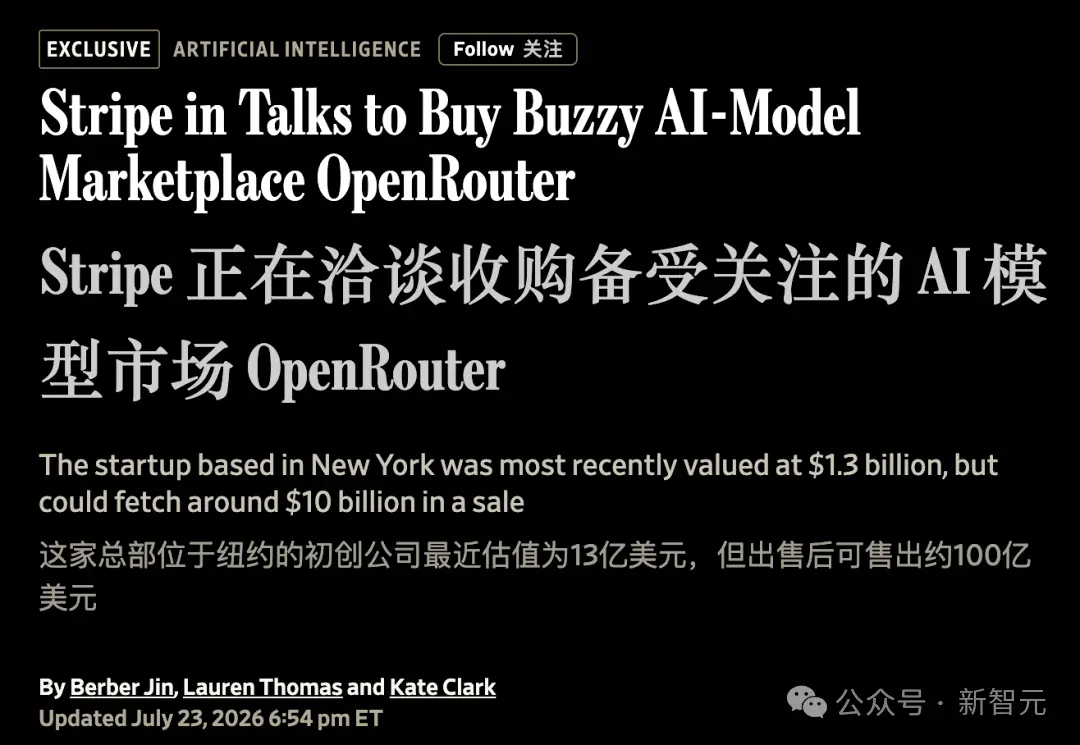
According to separate reports from The Wall Street Journal and The Information citing people familiar with the matter, the transaction price could be close to $10 billion (approximately RMB 68 billion).
  • https://www.wsj.com/tech/ai/stripe-in-talks-to-buy-buzzy-ai-model-marketplace-openrouter-decc6a74

  • https://www.theinformation.com/briefings/stripe-talks-buy-startup-openrouter

Just two months ago, OpenRouter's valuation was only $1.3 billion (approximately RMB 8.8 billion), representing a premium of nearly 7 times.

The deal could be announced within a month, but it may also fall through.

The Information reported that Databricks had also previously discussed an acquisition with OpenRouter, with unclear subsequent developments.

A Stripe spokesperson told The Wall Street Journal they "do not comment on rumors and speculation."

Most people may not have heard the name OpenRouter, but what it does is relevant to every AI user.


The AI App You Use Has a Price Comparison Engine Behind It

Open an AI translation tool, input a passage, and get the result a few seconds later.

What you don't see is: whether that passage was sent to GPT, Claude, or a much cheaper open-source model.

The decision of "which model to choose" is increasingly being made by middleware layers like OpenRouter.

A simple analogy: if AI models are flights, OpenRouter is Qunar (a travel search engine).

Developers can access over 400 large models through one API, automatically matching tasks based on complexity, cost, and response speed.

Summarizing a routine email doesn't require the most expensive cutting-edge model, while processing a legal contract would be routed to a more capable one.

The user experience remains the same, but the bill behind it can differ by several times.

This also explains one thing: why many AI products can maintain low prices or even be free.

OpenRouter was founded in 2023 by Alex Atallah and Louis Vichy.

Alex Atallah

Louis Vichy

Atallah's previous venture was the NFT marketplace OpenSea, which was valued at $13.3 billion at its peak.

After the NFT wave receded, he left in 2022 and turned to AI infrastructure.

He once said in an interview:

Inference is the fastest-growing cost for enterprises, and it often comes from more than four different models.

Growth data validates this assessment.

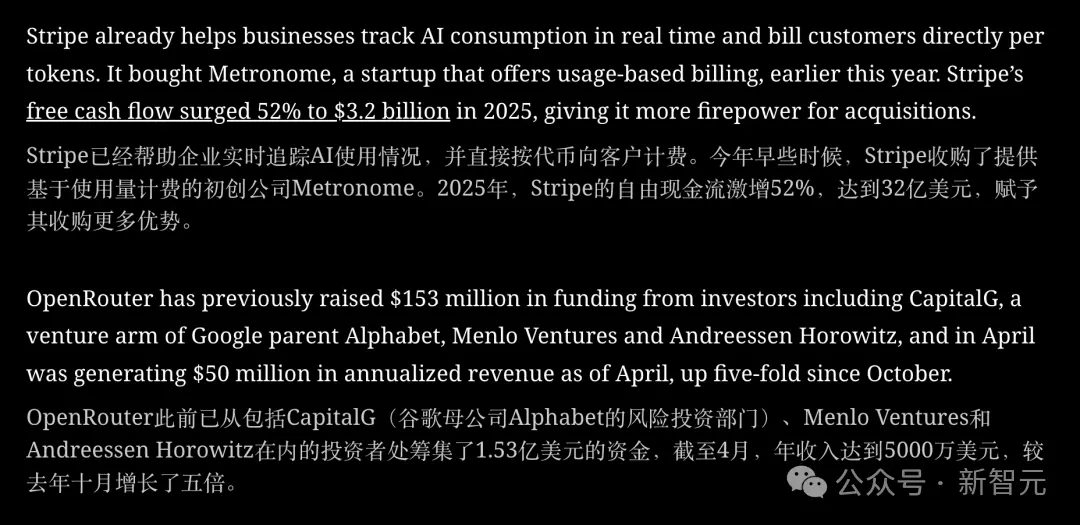
According to The Information, as of April this year, OpenRouter's annualized revenue reached $50 million, a fivefold increase in half a year.

The platform lists over 400 large models, with over 1 million developer users.

Investors include CapitalG (Alphabet's growth fund), Menlo Ventures, and a16z, with a cumulative financing of $153 million.


Stripe Aims to Be the Cashier and Dispatch Center of the AI Economy

Stripe is the world's largest internet payment processor, helping millions of businesses with online collection.

Over the past year, the company has been aggressively extending its business into AI infrastructure.

In December 2025, Stripe spent approximately $1 billion to acquire the usage-based billing platform Metronome.

Metronome helps AI companies charge customers based on token usage, with clients including OpenAI and Anthropic.

Stripe CEO Patrick Collison said at the time:

Usage-based pricing is the native business model for the AI era.

With the addition of OpenRouter, Stripe's intent becomes clear: selecting models, billing, and collecting payments, all integrated into one seamless chain.

If an AI application is compared to a restaurant, Stripe simultaneously becomes the ingredient dispatcher (helping you choose models), the utility meter (usage-based billing), and the cash register (payment processing).

For enterprise clients, a single supplier can manage all AI usage and billing.

Stripe has the resources to do this.

According to The Information, Stripe's free cash flow in 2025 was $3.2 billion, a year-on-year increase of 52%, with annual revenue of approximately $6.8 billion.
A secondary share sale in February pushed its valuation to $159 billion.

During the same period, Stripe, together with private equity firm Advent International, made an acquisition offer of approximately $53 billion to PayPal. PayPal considered the price too low, and negotiations are still ongoing.

Paying $10 billion for a company with $50 million in annual revenue seems like a sky-high price.

But OpenRouter's revenue grew fivefold in half a year, placing the bet on its growth rate.

More crucially, it's about position: as enterprises shift from being tied to a single AI model to using a mix of multiple models, whoever controls the routing layer gains the power to allocate traffic.

Which model gets prioritized and which gets pushed down the list is decided at this layer.

For the average user, the change won't come tomorrow, but the direction is already visible.

By acquiring Metronome, Stripe secured the "how to collect money." By acquiring OpenRouter, it secures "whose model to use." Combining these two questions creates the gateway for AI applications.

The cost of every AI product you use in the future, and the model choices behind it, are shifting downward from the hands of application developers to this infrastructure layer.


References:

  • https://www.wsj.com/tech/ai/stripe-in-talks-to-buy-buzzy-ai-model-marketplace-openrouter-decc6a74

  • https://www.theinformation.com/briefings/stripe-talks-buy-startup-openrouter

  • https://www.theinformation.com/articles/needs-openrouter

Preguntas relacionadas

QWhat is OpenRouter, and what role does it play in the AI ecosystem?

AOpenRouter is an AI model marketplace and routing platform that allows developers to access over 400 different large language models through a single API. It acts as an intermediary layer, automatically selecting the most suitable model for a task based on factors like cost, performance, and response speed, similar to a travel aggregator like '去哪儿' (Qunar) for AI models. This helps developers and applications optimize costs and performance without end-users being aware of the underlying model switches.

QWhy is Stripe interested in acquiring OpenRouter, and what is the reported potential deal value?

AStripe, a major online payment processor, is reportedly in talks to acquire OpenRouter for a price close to $10 billion (approximately 68 billion RMB). This interest aligns with Stripe's strategic expansion into AI infrastructure. Following its previous acquisition of the usage-based billing platform Metronome, acquiring OpenRouter would allow Stripe to offer a comprehensive suite covering AI model routing, usage-based billing, and payment processing, aiming to become a central hub for the AI economy.

QHow has OpenRouter's valuation changed recently, and what are its key growth metrics?

AOpenRouter's valuation has surged dramatically. Just two months prior to the acquisition talks, it was valued at $1.3 billion (approx. 8.8 billion RMB). The potential $10 billion deal represents a nearly 7x premium. In terms of growth, its annualized revenue reached $50 million as of April, having increased fivefold in just six months. The platform hosts over 400 models and boasts over 1 million developer users.

QWho are the founders of OpenRouter, and what is their background?

AOpenRouter was founded in 2023 by Alex Atallah and Louis Vichy. Alex Atallah is best known as a co-founder of the NFT marketplace OpenSea, which reached a peak valuation of $13.3 billion. After leaving OpenSea in 2022 following the NFT market downturn, he pivoted to building AI infrastructure. His experience with marketplaces likely influenced the creation of OpenRouter as a model aggregation and routing platform.

QWhat broader trend in the AI industry does the potential Stripe-OpenRouter deal signify?

AThe potential deal signifies a major trend of consolidation and vertical integration in the AI infrastructure layer. Companies like Stripe are moving to control key parts of the AI application stack—from model selection and routing (OpenRouter) to usage metering and billing (Metronome) and finally payment processing. This reflects a shift where critical decisions about cost, model choice, and billing for AI services are moving from individual application developers to underlying infrastructure platforms, which gain significant influence over the flow of traffic and spending in the AI economy.

Lecturas Relacionadas

The Verdict in Choi Tae-won's Divorce Case: Revealing the Inheritance Undercurrent Behind SK Hynix's Trillion-Won Empire

SK Group Chairman Chey Tae-won's high-profile divorce case, involving a record 1.38 trillion won settlement, has drawn attention to the succession plans for Korea's second-largest conglomerate, especially its crown jewel, SK hynix. Unlike traditional chaebol scripts centered on the eldest son, Chey's three children from his marriage to former President Roh Tae-woo's daughter, Roh Soh-yeong, are carving distinct, non-traditional paths. Eldest daughter Chey Yun-jung (b. 1989) is seen as the most evident successor. With a scientific and consulting background, she holds executive roles at SK bioscience and SK Inc.'s growth support department, focusing on future strategy and biopharma. Her marriage is to an AI infrastructure entrepreneur, not a traditional business alliance. Second daughter Chey Min-jung (b. 1991) took a unique route, voluntarily serving as a South Korean naval officer, including an anti-piracy deployment. She later worked on policy and strategy for SK hynix in Washington D.C. before co-founding an AI-driven healthcare startup. She married a former U.S. Marine Corps officer, connecting her to U.S. defense and policy circles—networks crucial for a global semiconductor giant. The only son, Chey In-geun (b. 1995), who studied physics like his father, worked briefly at SK E&S before joining McKinsey. Despite fitting the traditional "heir" profile as the eldest son, he remains silent and holds no public position or shares in SK, suggesting the old succession playbook is obsolete. As SK hynix's valuation soars, becoming a geopolitical asset in the AI era, the heirs' legitimacy is no longer automatic. They must prove themselves in fields like AI biotech, global policy, and strategic consulting. Their marriages also reflect new elite networks in tech and defense, not old political alliances. Their inheritance is the complex challenge of navigating a globalized, tech-driven world, not just a corporate throne.

marsbitHace 1 hora(s)

The Verdict in Choi Tae-won's Divorce Case: Revealing the Inheritance Undercurrent Behind SK Hynix's Trillion-Won Empire

marsbitHace 1 hora(s)

From OpenSea to OpenRouter: Is Alex Atallah Repeating His 'Exit at the Peak' Playbook?

From OpenSea to OpenRouter: Is Alex Atallah Repeating His "Exit at the Peak" Playbook? According to the Wall Street Journal, payments giant Stripe is in talks to acquire the AI model aggregation platform OpenRouter in a potential deal valuing the company near $100 billion. This would mark founder Alex Atallah's second creation of a company reaching a $100 billion valuation, following his co-founding of NFT marketplace OpenSea. OpenRouter, founded just over three years ago, has grown rapidly by acting as a unified gateway for developers to access over 400 AI models. It currently has about 10 million users and processes over 200 trillion tokens monthly. While the platform's annualized revenue is around $50 million, its valuation has skyrocketed from $1.3 billion in March 2026. The potential acquisition by Stripe, a company OpenRouter's founder once likened it to, represents a major expansion into AI infrastructure for the payments leader. This move echoes Atallah's previous timing with OpenSea, where he departed before the NFT market's significant downturn. For OpenRouter, selling now may be strategic. Despite its scale, its business model—charging a 5-5.5% fee on AI inference calls—faces pressure from competition, open-source models, and potential price wars among model providers, limiting its profitability narrative for an IPO. A key asset for potential acquirers like Stripe is OpenRouter's vast repository of real-world AI usage data, which offers unique insights into model performance and developer preferences that are difficult to replicate. Whether this potential deal signifies a new valuation benchmark for AI infrastructure or another market peak signal remains to be seen.

链捕手Hace 1 hora(s)

From OpenSea to OpenRouter: Is Alex Atallah Repeating His 'Exit at the Peak' Playbook?

链捕手Hace 1 hora(s)

Trading

Spot
活动图片