What To Expect For The Bitcoin Price This Week After Psychological Breakdown

bitcoinistPublicado a 2026-01-19Actualizado a 2026-01-19

Resumen

A crypto analyst, Doctor Profit, presents a bearish outlook for Bitcoin this week, expecting a continued downtrend. He notes that Bitcoin has been in a prolonged consolidation phase since November 2025, viewing this sideways movement as a precursor to a potential drop below $80,000. The analyst maintains short positions initiated between $115,000 and $125,000, with additional shorts planned only if Bitcoin revisits the $97,000-$107,000 range. He highlights January 21, 2026, as a key date due to the expected release of the CLARITY Act, which could provide regulatory clarity and impact the market. Doctor Profit remains extremely bearish, forecasting a possible decline to the $70,000-$75,000 range, representing a drop of over 20% from current levels.

A crypto analyst has delivered a detailed psychological breakdown outlining what investors, traders, and market watchers should expect from the Bitcoin price this week. The report focuses on market behavior that has remained largely unchanged and could most likely continue its bearish streak to new lows.

Bitcoin Price Expectation For The Week

Crypto market expert Doctor Profit has released a compelling report examining the Bitcoin price movement this week. In this analysis posted on X, he explained that Bitcoin has seen almost no meaningful price movement since November 2025. Price action remains stuck in a sideways consolidation, which the analyst views as a bearish sign that could eventually lead to another crash below the $80,000 zone.

Doctor Profit revealed that he had anticipated Bitcoin’s current consolidation months earlier. He warned that sideways movement would dominate the market before BTC faces a sharper pullback. That warning still stands, signaling a cautious, bearish outlook for the leading cryptocurrency.

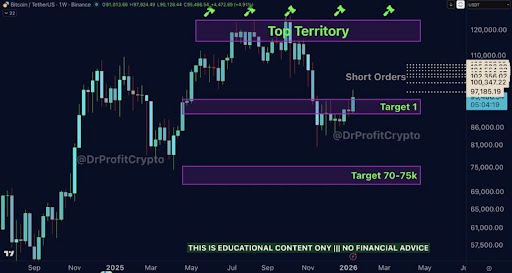
Because he expects Bitcoin to move lower, the analyst confirmed that he is still holding his short position from $115,000 and $125,000. He noted that additional shorts would only be considered if BTC revisits the $97,000-$107,000 range, and nowhere earlier. Doctor Profit also revealed that his first short, around $97,000, has already been filled, with another positioned near $98,000.

The analyst shared a detailed price chart showing all his short positions and Bitcoin’s “top territory” near $120,000. Several additional orders have also been placed between $97,000 and $110,000 to manage risk during the cryptocurrency’s prolonged consolidation phase.
Source: X

Beyond technical structures, the report highlighted January 21, 2026, as a key date for the crypto market, as it marks the expected release of the CLARITY Act bill. Doctor Profit stressed that once the bill is published, it would give institutions and traders a clear view of the regulatory framework, showing who regulates crypto, how exchanges would be treated, and whether the new rules would favor or restrict the industry.

Even without an immediate vote by the US Senate Banking Committee, Doctor Profit noted that the bill’s release alone could move markets. He explained that clarity eliminates uncertainty in the market, which is a powerful catalyst for price action. Notably, the vote on the bill has been scheduled for January 27, with its outcome set to shape the future of crypto regulations and also influence price movements.

Analyst Remains Extremely Bearish On Bitcoin

Doctor Profit has said in his report that he remains extremely bearish on the market, expecting another leg down that would officially confirm his bear market thesis. He stated that there have been no relevant updates to invalidate his outlook or support a new bullish narrative. His chart forecasts a potential drop toward the $70,000- $75,000 range. With Bitcoin currently trading above $92,500, that would mean a decline of over 20%.

BTC sees sharp crash | Source: BTCUSD on Tradingview.com

Preguntas relacionadas

QWhat is the crypto analyst Doctor Profit's overall outlook for Bitcoin's price this week?

ADoctor Profit maintains an extremely bearish outlook, expecting Bitcoin to continue its bearish streak and potentially drop to new lows, with a forecasted decline toward the $70,000-$75,000 range.

QWhat key date does the analyst highlight as important for the crypto market and why?

AThe analyst highlights January 21, 2026, as a key date because it is the expected release date of the CLARITY Act bill, which will provide regulatory clarity for the crypto industry and could move markets.

QWhat trading position is Doctor Profit currently holding based on his analysis?

ADoctor Profit confirmed he is still holding his short positions from $115,000 and $125,000, with additional shorts only considered if Bitcoin revisits the $97,000-$107,000 range.

QAccording to the report, what has been the dominant pattern in Bitcoin's price action since November 2025?

ABitcoin's price action has been dominated by a sideways consolidation with almost no meaningful movement, which the analyst views as a bearish sign.

QWhat is the significance of the CLARITY Act bill's release, even without an immediate vote?

AThe mere release of the bill is significant because it eliminates market uncertainty by providing clarity on the regulatory framework, which is a powerful catalyst for price action, regardless of an immediate vote.

Lecturas Relacionadas

Agent Race Ends, Super Workbench Takes Over

The era of fragmented AI agents is ending. Over the past month, China's tech giants—Tencent, Alibaba, and ByteDance—have simultaneously shifted strategy: instead of launching new, standalone AI agents, they are consolidating their various agent projects into unified "super workbenches." Tencent integrated its QClaw teams into WorkBuddy, a strategic product hailed as a potential third flagship after QQ and WeChat. Alibaba is merging its QoderWork, Wukong, and MuleRun agents into a new "Qianwen Office" platform under DingTalk's leadership. ByteDance rebranded its TRAE SOLO coding agent to TRAE Work, signaling a broader focus on workflow collaboration. This convergence marks a pivotal industry consensus. The initial exploration phase, where companies rapidly built numerous overlapping agents for different scenarios, proved costly and inefficient. With open-source tools eroding technical barriers, competition has shifted from agent creation to resource consolidation and cost control. Historically, platform wars are won not by creating more products, but by simplifying them—as seen with browsers unifying web access and super-apps consolidating services. Now, the "super workbench" aims to become the unified AI entry point for work. This reflects a deeper market realization: the primary audience for AI is no longer just programmers (a market in the tens of millions) but all knowledge workers (a market of billions). The real opportunity lies in augmenting everyday tasks—managing emails, documents, data, and meetings—across the entire workday. The core battleground is becoming control over the primary AI entry point that employees use daily. Tencent's WorkBuddy leverages WeChat and Tencent Docs; Alibaba's Qianwen Office taps into DingTalk's organizational data; ByteDance's TRAE Work integrates with Feishu's workflows. Whoever owns this "super workbench" gains strategic control over orchestrating enterprise data and APIs. This shift is redefining enterprise software. Traditional SaaS applications, valued for their user interfaces, will recede into the background. Their core functionalities will be exposed as standardized "Skills" or APIs for the super workbench's agents to invoke. Software value will shift from selling user seats to charging based on API calls and outcomes delivered. The evolution of agents is moving through clear stages: first as novel standalone products, then as consolidated primary work entry points, and finally as pervasive, invisible capabilities embedded into the digital fabric. The recent moves by major tech firms signal the transition from the first stage into the second, accelerating toward the third. In the end, the most successful agent technology may become invisible—like electricity or the HTTP protocol—a fundamental, unnamed infrastructure powering work itself.

marsbitHace 18 min(s)

Agent Race Ends, Super Workbench Takes Over

marsbitHace 18 min(s)

Michael Saylor: 110 Reasons to Oppose BIP-110

Michael Saylor presents 110 arguments against Bitcoin Improvement Proposal (BIP) 110, a soft fork aimed at restricting certain non-monetary data storage uses (like inscriptions) on the Bitcoin blockchain. He acknowledges the proponents' valid concerns—such as node costs, fee pressure, and preserving Bitcoin's monetary focus—but fundamentally disagrees with the proposed solution. Saylor argues that BIP 110 represents a dangerous precedent of using consensus rules to enforce value judgments on transaction validity, moving away from Bitcoin's core principles of neutrality and permissionless innovation. His key objections are organized into eleven categories: 1) It violates neutrality and hard consensus by banning currently valid transactions. 2) It fails to meet the high burden of proof required for a consensus change, lacking concrete data on the alleged crisis. 3) Its seven bundled technical restrictions are overly broad, targeting generic script functionalities and blocking future upgrade paths. 4) It sacrifices compatibility and future optionality by closing off designed upgrade hooks. 5) Its temporary rules add significant complexity (grandfathering, expiry states) without sufficient justification. 6) The economic and security impacts, particularly on miner revenue and fee markets, are uncertain and unmodeled. 7) Superior, market-based tools (fee markets, relay/mining policies) already exist to manage blockchain load. 8) It stifles innovation by creating a chilling effect for developers. 9) Its modified activation mechanism (55% threshold, forced signaling) is aggressive and risks network splits. 10) The precedent it sets—using consensus to suppress disliked but legal uses—is more dangerous than the problem it aims to solve. 11) A better path exists: improving measurements, refining resource-based policies, and allowing market forces to work. Saylor concludes that Bitcoin's strength lies in its neutral rules, open markets, and hard consensus. Changing these foundational elements to target specific use cases is an unnecessary and risky "iatrogenic" intervention. He advocates for guarding Bitcoin's neutrality rather than acting as its redeemer.

marsbitHace 33 min(s)

Michael Saylor: 110 Reasons to Oppose BIP-110

marsbitHace 33 min(s)

Trading

Spot
活动图片