Tron – Why TRX’s $1.96T stablecoin boom still faces ONE challenge

ambcryptoPublicado a 2026-06-30Actualizado a 2026-06-30

Resumen

Tron achieved $1.96 trillion in stablecoin settlements in Q1 2026, driven by its role as a fast, low-cost network for real-world dollar transfers and remittances. Daily active users grew 16% recently to 4.4 million, reflecting strong engagement. However, new user growth and broader DeFi adoption remain challenges. While stablecoin liquidity supports network activity and capital retention, with TVL at $4.4 billion, usage in lending and smart contracts is limited. Tron's future growth depends on expanding beyond payments into a more diversified on-chain ecosystem.

TRON’s [TRX] stablecoin settlement growth reflects more than rising transaction volumes. This is because it increasingly serves as the preferred network for real-world dollar transfers.

Low fees, fast settlement, and deep Tether [USDT] liquidity continue attracting remittances, peer-to-peer payments, and cross-border transactions that require speed over complex DeFi functionality.
Source: TRONSCAN

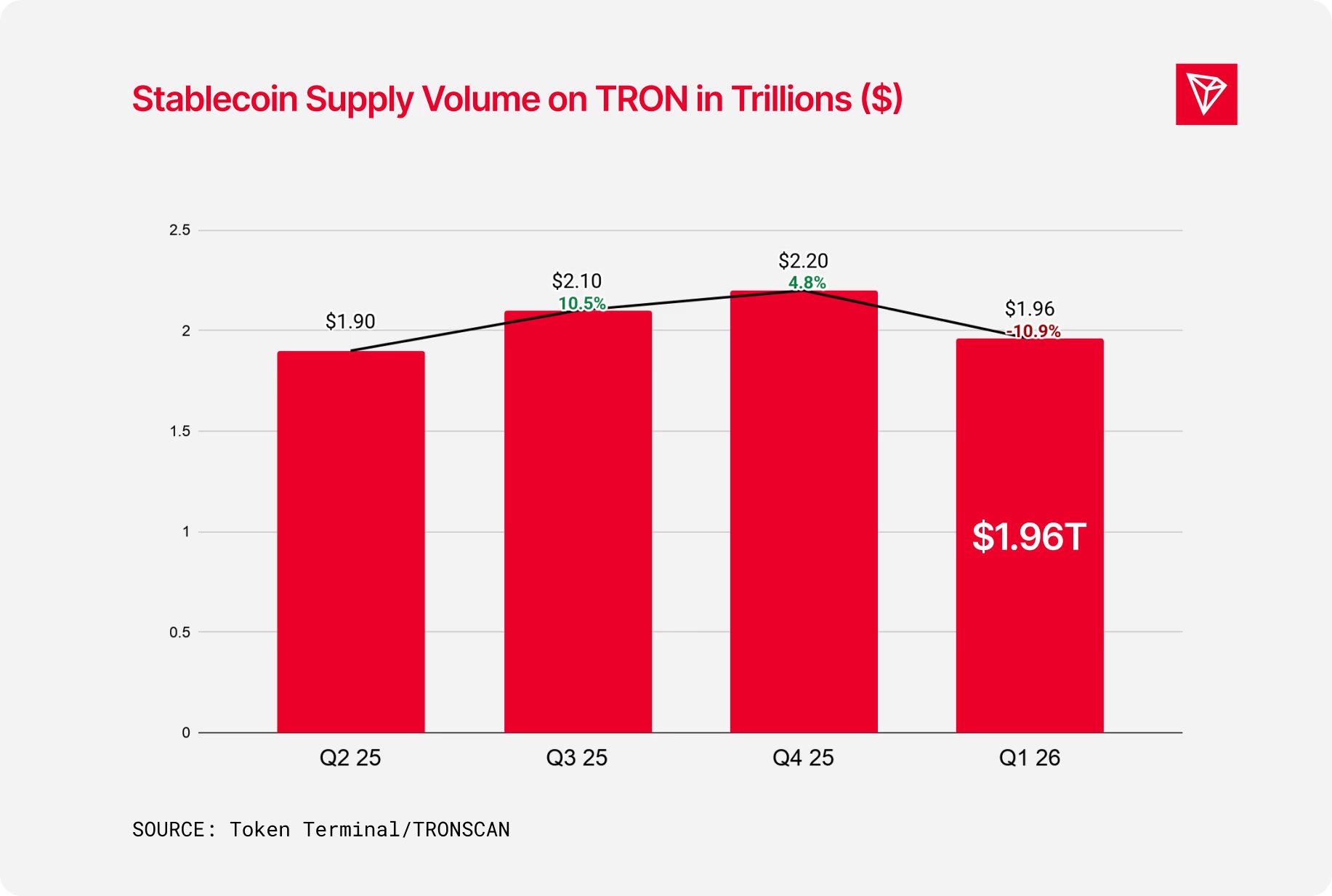
This trend was helpful for processing $1.96 trillion in stablecoin settlements for the first quarter of 2026 on TRON. Meanwhile, TRON also hosts approximately $85-86 billion in USDT. Much of this usage stems from users’ need for recurring payments.

As such, there is strong evidence to support that the usage patterns are providing a foundation for structural value in the network.

If the flow of payment dollars into the system continues to grow at the same rate or possibly increases and if USDT issuance continues to expand, then TRON will solidify itself as a leader in stablecoin settlement. Otherwise, faster competitors could erode its edge.

User activity reflects payment growth

TRON’s growing use of stablecoins for transaction settlement has boosted network activity. However, adoption trends show both positive and negative signals.

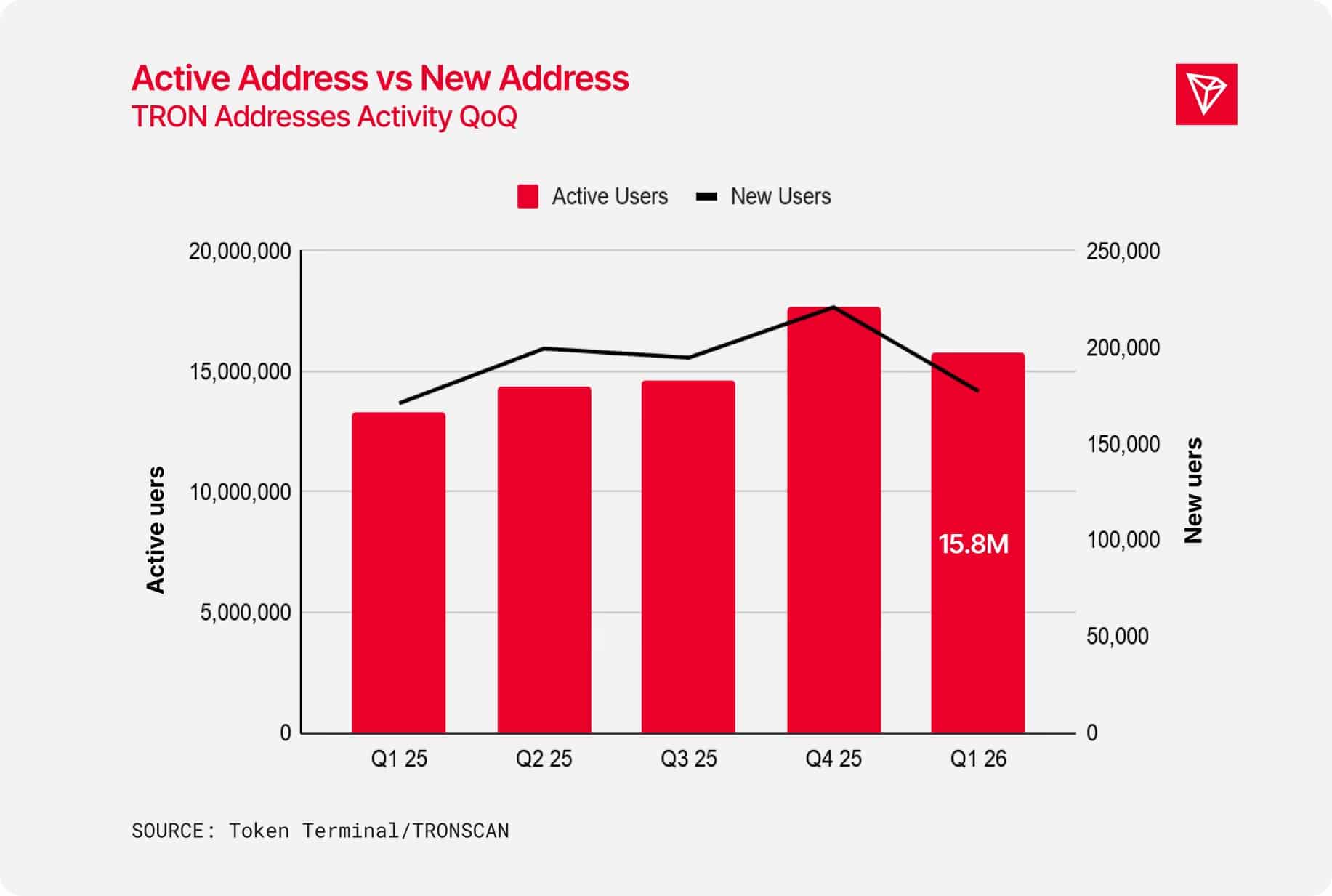
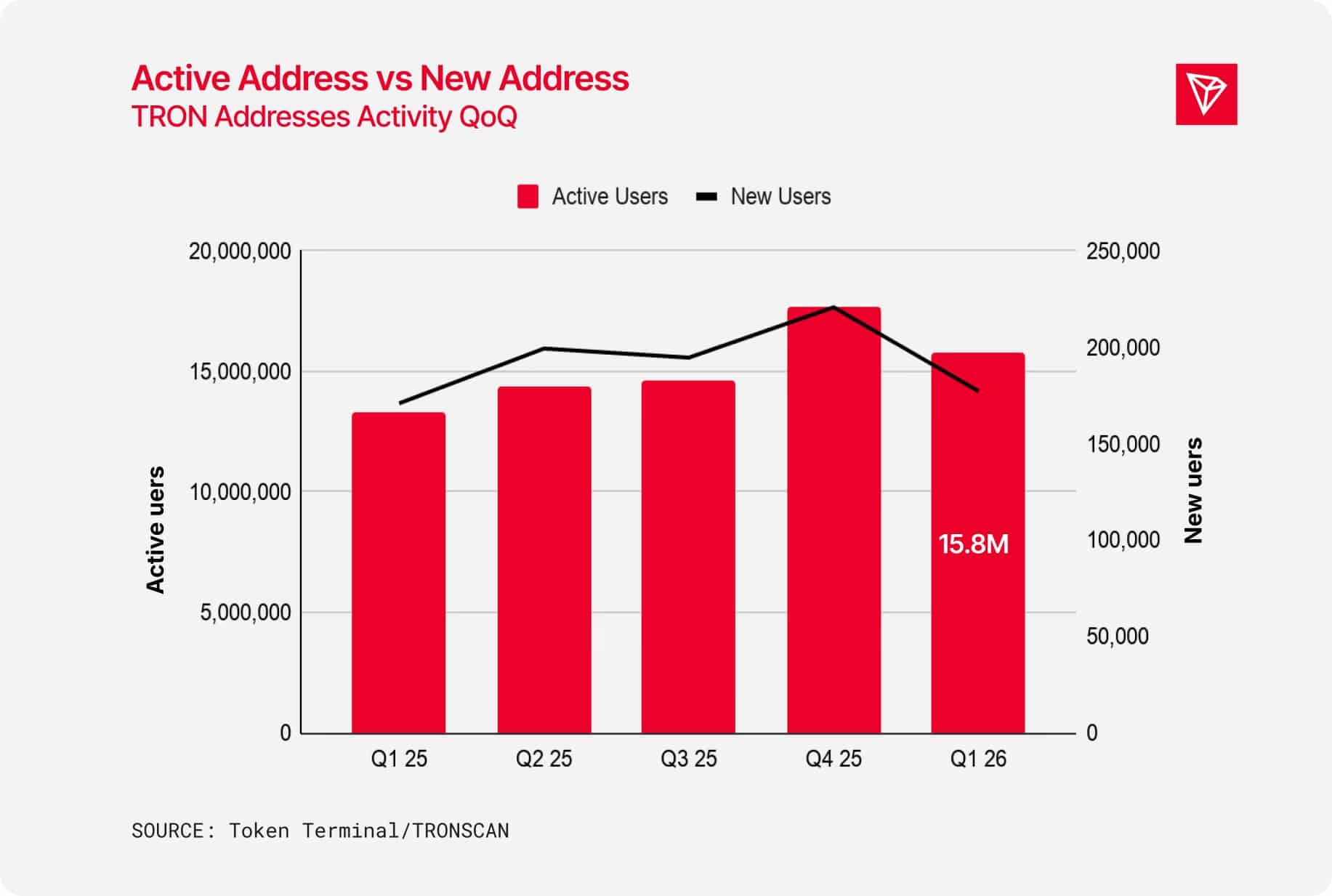
Daily active users rose 16% over the past thirty days to roughly 4.4 million, exceeding the Q1 average of 3.2 million and indicating stronger engagement from existing participants.
Source: TRONSCAN

However, quarterly data shows active addresses eased to 15.8 million from the Q4 2025 peak, while new address creation also declined. Thus, it appears that despite the decline in the number of new users being added, there continues to be strong activity due to the ability of users to pay using the network’s stablecoins.

Long-term growth of the network will likely depend upon additional new users entering the ecosystem in addition to sustained payments through the stablecoins. If existing users continue driving transaction growth, network activity could remain elevated. Moreover, sustaining long-term expansion will likely require stronger new-user onboarding alongside continued stablecoin payment demand.

Capital retention supports network growth

TRON’s expanding payment network is retaining capital on-chain, but growth remains concentrated in stablecoin settlements rather than broader DeFi activity. At press time, TVL has grown to roughly $4.4 billion and is supported mainly by stablecoins anchoring liquidity on the network.
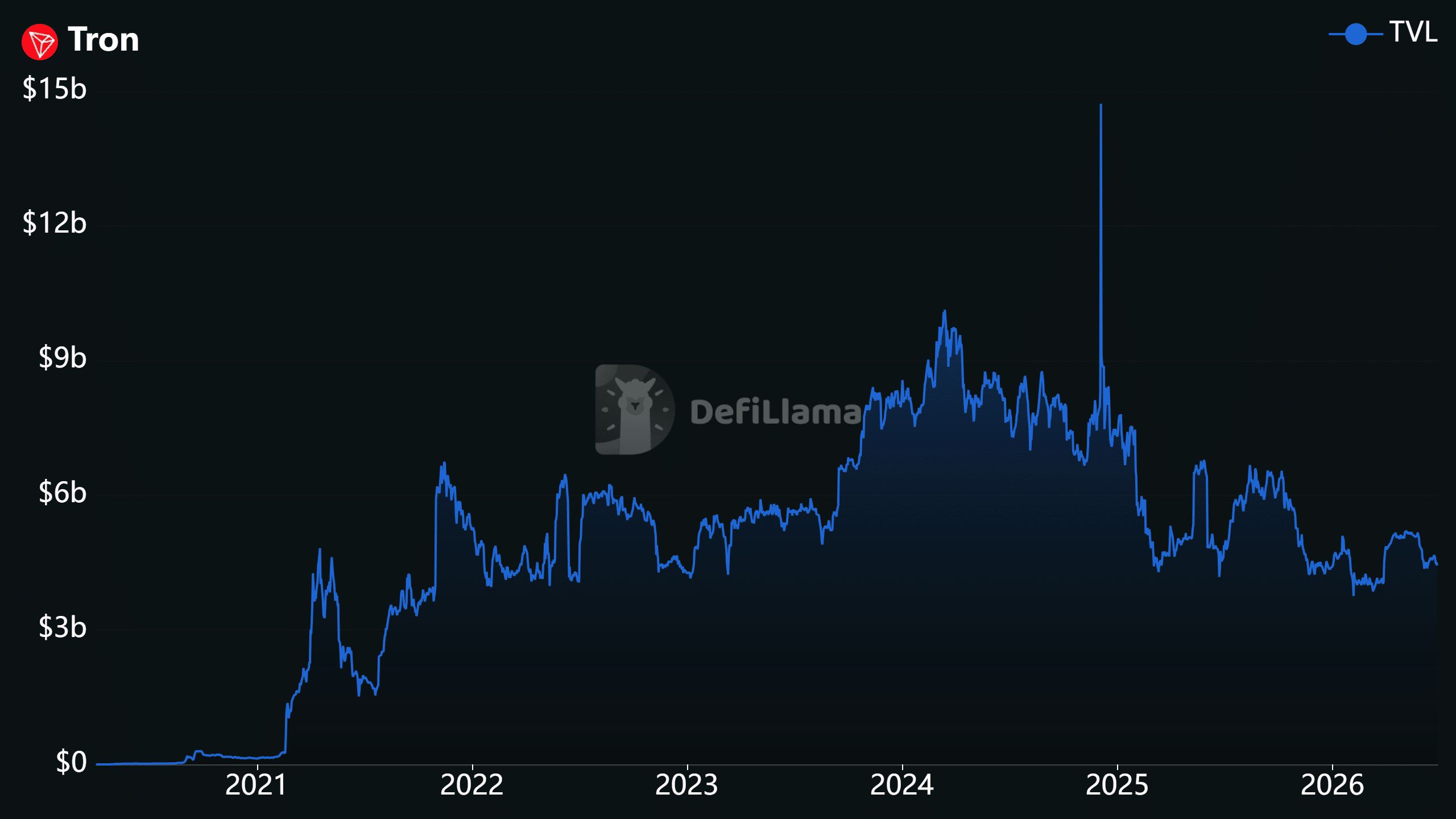
Source: DeFiLlama

Rather than exiting immediately after settlement, much of that capital circulates among transfers, which sustains transaction volume and network revenue. Efficiency also supports recurring TRX burns and validator rewards without significantly raising user costs.

However, dominance in payments has not translated into strong adoption of DeFi. Lending, decentralized exchanges, and smart contract activity remain relatively smaller contributors to usage.

If retained liquidity gradually expands into these sectors, TRON can strengthen its broader ecosystem. Otherwise, it will likely continue leading payments, relying less on growth driven by DeFi.


Final Summary

  • TRON’s payment growth remained strong, but broader ecosystem expansion still depends on DeFi adoption.
  • TRX retained payment liquidity, though sustained growth requires stronger on-chain utility beyond settlements.


Criptos en tendencia

Preguntas relacionadas

QWhat key challenge does TRON still face despite its massive stablecoin settlement growth in early 2026?

ADespite processing $1.96 trillion in stablecoin settlements in Q1 2026 and growing its daily active users, TRON's broader ecosystem expansion still depends on stronger DeFi adoption (like lending and decentralized exchanges). Its growth remains concentrated in payments rather than diverse on-chain utility.

QWhat are the primary factors driving TRON's popularity for stablecoin transactions, according to the article?

AThe primary factors are its low fees, fast settlement times, and deep Tether (USDT) liquidity. These make it the preferred network for real-world dollar transfers like remittances, peer-to-peer payments, and cross-border transactions that prioritize speed over complex DeFi functionality.

QHow did TRON's user activity metrics show both positive and negative signals recently?

APositively, daily active users rose 16% to roughly 4.4 million, exceeding the Q1 average. Negatively, quarterly active addresses eased from the Q4 2025 peak, and new address creation declined, indicating a slowdown in onboarding new users despite strong activity from existing ones.

QHow is the capital from stablecoin settlements contributing to TRON's network growth?

ACapital from settlements is largely retained on-chain, circulating among transfers instead of exiting immediately. This sustains transaction volume, network revenue, TRX burns, and validator rewards. However, this retained liquidity has not significantly expanded into broader DeFi sectors like lending or DEXs.

QWhat two conditions does the article state are necessary for TRON to solidify itself as a leader in stablecoin settlement?

AFirst, the flow of payment dollars into the system must continue to grow at the same rate or increase. Second, USDT issuance on the network must continue to expand. If these conditions are not met, faster competitors could erode TRON's edge.

Lecturas Relacionadas

AAVE Rallies 30% in a Week, Is It Back on Track?

Over the past week, the price of AAVE surged from around $70 to nearly $100, a rebound exceeding 30%. This occurred despite Aave's TVL continuing to decline following the Kelp DAO security incident. The price movement was partly driven by market rumors, first reported by CoinDesk, that Kraken was negotiating to acquire a stake in Aave. While Aave founder Stani Kulechov denied the specific terms, he confirmed discussions with multiple parties about purchasing Aave Labs' AAVE tokens. He also revealed ongoing work on Tokenomics 3.0, featuring an automated buyback mechanism, and plans to expand into securities-backed lending. Analysts remain optimistic about Aave's long-term prospects. Standard Chartered gave an extremely bullish $3,500 price target for 2030, citing DeFi revival and RWA tokenization. Grayscale offered a more conservative one-year target of $175. However, competitors like Morpho are gaining traction, with recent reports highlighting its advantages in capital efficiency and customization. Morpho also secured a massive $175 million funding round. Fundamentally, Aave maintains its dominance as the leading DeFi lending protocol. Its TVL is nearly double that of second-place Morpho and rivals the combined total of the next several competitors. Key metrics like active borrowing, total supply, and revenue significantly outpace rivals. While Aave faces challenges from newer, more flexible protocols, its deep liquidity and established position make it a preferred choice for large, yield-seeking users. The article concludes that despite setbacks, Aave's long-tested protocol merits ongoing attention in a market with increasingly scarce quality projects.

Foresight NewsHace 2 min(s)

AAVE Rallies 30% in a Week, Is It Back on Track?

Foresight NewsHace 2 min(s)

Real-life 'Black Mirror' Pumpfun Go: 40 Yuan to Lick Toilets, 14,000 USD for a Logo Tattoo on the Forehead

The article discusses the controversial new platform "Pumpfun Go," a bounty task platform launched by the meme coin platform Pump.fun. Its slogan is "Pay anyone to do anything." The platform allows users to anonymously post tasks with cryptocurrency rewards, which are held in escrow until completion and verification. The piece highlights extreme and disturbing tasks that have gained notoriety, such as licking a gas station toilet floor for roughly $5.63, eating live insects, getting a company logo tattooed on one's forehead for $14,000, and even a now-removed $700,000 bounty for suicide. These tasks are often linked to promoting specific meme coins by generating shocking, attention-grabbing content. While some tasks involve community-building or charity, critics, including New York Governor Kathy Hochul, condemn the platform for exploiting economic desperation and encouraging humiliating or dangerous behavior. They argue it mirrors dystopian narratives from shows like "Black Mirror" and movies like "Nerve," where online dares escalate for viewers' entertainment. Supporters and some participants counter that the platform provides much-needed income opportunities for the financially struggling. One user claimed the bounty money far exceeded his monthly salary. The article concludes by questioning the morality of a system where the wealthy pay for spectacle and the poor trade dignity for survival, reflecting a long history of public consumption of others' suffering. It suggests hope may lie in future technological abundance freeing people from such desperate choices.

marsbitHace 26 min(s)

Real-life 'Black Mirror' Pumpfun Go: 40 Yuan to Lick Toilets, 14,000 USD for a Logo Tattoo on the Forehead

marsbitHace 26 min(s)

Faked Trades, Clone Websites, 1105 Videos: Polymarket Under CFTC Scrutiny

The U.S. Commodity Futures Trading Commission (CFTC) has launched a wide-ranging investigation into prediction market platform Polymarket. The probe, triggered by a Wall Street Journal report, focuses on allegations of systematic marketing fraud. The report revealed Polymarket allegedly hired dozens of student content creators to post over 1,100 videos showing fake, profitable trades on cloned websites, without disclosing the paid relationships. These videos, with over 140 million views, were pivotal to user growth. Simultaneously, the National Association of Consumer Advocates (NACA) filed a lawsuit in Washington D.C., accusing Polymarket and its executives of deceptive advertising targeting college students. The suit details off-campus promotions and payments made through the CMO's personal PayPal account to influencers who failed to disclose sponsorships. The investigation places CFTC Chairman Michael Selig in a difficult position, as he has been a vocal advocate for prediction markets and is currently suing multiple states to assert federal jurisdiction over them. This case tests the CFTC's dual role as both promoter and enforcer. This marks Polymarket's second major clash with the CFTC. After a 2022 settlement and U.S. ban, it regained approval to operate in September 2025, secured a $20 billion investment, and saw its valuation soar. The current crisis, compounded by a recent $3.1 million front-end supply chain attack, represents the platform's most severe multi-front challenge since its founding.

Foresight NewsHace 28 min(s)

Faked Trades, Clone Websites, 1105 Videos: Polymarket Under CFTC Scrutiny

Foresight NewsHace 28 min(s)

Real-Life 'Black Mirror' Pumpfun Go: 40 Yuan to Lick a Toilet, $14,000 to Tattoo a Logo on Your Forehead

Pumpfun Go, a bounty task platform launched by the meme coin platform Pump.fun, is facing intense controversy. The platform's slogan "Pay anyone to do anything" has manifested in real-world tasks where participants perform increasingly extreme or demeaning acts for cryptocurrency rewards. These tasks range from licking a gas station toilet floor for roughly $5.63 to getting a permanent "bounty.fun" logo tattooed on one's forehead for $14,000. Other completed challenges include eating live insects and quitting a job on camera. The highest-value active bounty offers approximately $560,000 for climbing Mount Everest and placing a bet on a specified platform. While some tasks involve promoting meme coins or community events, the platform has drawn widespread criticism for incentivizing the exploitation of economic desperation. Participants, often citing "we need money" as their motivation, complete these tasks for sums that can far exceed their regular income. Critics, including New York Governor Kathy Hochul, have condemned Pumpfun Go as a dystopian system that commodifies human dignity and preys on the vulnerable. Supporters argue it provides a novel income opportunity for those in need. The debate highlights deeper societal issues around power, inequality, and the historical human fascination with spectacles of humiliation. The platform's existence raises questions about the ethical limits of anonymous online markets and the persistent reality where financial need forces individuals to trade their dignity for survival.

Odaily星球日报Hace 35 min(s)

Real-Life 'Black Mirror' Pumpfun Go: 40 Yuan to Lick a Toilet, $14,000 to Tattoo a Logo on Your Forehead

Odaily星球日报Hace 35 min(s)

Trading

Spot

Artículos destacados

Cómo comprar TRX

¡Bienvenido a HTX.com! Hemos hecho que comprar TRON (TRX) sea simple y conveniente. Sigue nuestra guía paso a paso para iniciar tu viaje de criptos.Paso 1: crea tu cuenta HTXUtiliza tu correo electrónico o número de teléfono para registrarte y obtener una cuenta gratuita en HTX. Experimenta un proceso de registro sin complicaciones y desbloquea todas las funciones.Obtener mi cuentaPaso 2: ve a Comprar cripto y elige tu método de pagoTarjeta de crédito/débito: usa tu Visa o Mastercard para comprar TRON (TRX) al instante.Saldo: utiliza fondos del saldo de tu cuenta HTX para tradear sin problemas.Terceros: hemos agregado métodos de pago populares como Google Pay y Apple Pay para mejorar la comodidad.P2P: tradear directamente con otros usuarios en HTX.Over-the-Counter (OTC): ofrecemos servicios personalizados y tipos de cambio competitivos para los traders.Paso 3: guarda tu TRON (TRX)Después de comprar tu TRON (TRX), guárdalo en tu cuenta HTX. Alternativamente, puedes enviarlo a otro lugar mediante transferencia blockchain o utilizarlo para tradear otras criptomonedas.Paso 4: tradear TRON (TRX)Tradear fácilmente con TRON (TRX) en HTX's mercado spot. Simplemente accede a tu cuenta, selecciona tu par de trading, ejecuta tus trades y monitorea en tiempo real. Ofrecemos una experiencia fácil de usar tanto para principiantes como para traders experimentados.

1.8k Vistas totalesPublicado en 2024.12.10Actualizado en 2026.06.02

Cómo comprar TRX

Discusiones

Bienvenido a la comunidad de HTX. Aquí puedes mantenerte informado sobre los últimos desarrollos de la plataforma y acceder a análisis profesionales del mercado. A continuación se presentan las opiniones de los usuarios sobre el precio de TRX (TRX).

活动图片