AAVE Rallies 30% in a Week, Is It Back on Track?

Foresight NewsPublicado a 2026-06-30Actualizado a 2026-06-30

Resumen

Over the past week, the price of AAVE surged from around $70 to nearly $100, a rebound exceeding 30%. This occurred despite Aave's TVL continuing to decline following the Kelp DAO security incident. The price movement was partly driven by market rumors, first reported by CoinDesk, that Kraken was negotiating to acquire a stake in Aave. While Aave founder Stani Kulechov denied the specific terms, he confirmed discussions with multiple parties about purchasing Aave Labs' AAVE tokens. He also revealed ongoing work on Tokenomics 3.0, featuring an automated buyback mechanism, and plans to expand into securities-backed lending. Analysts remain optimistic about Aave's long-term prospects. Standard Chartered gave an extremely bullish $3,500 price target for 2030, citing DeFi revival and RWA tokenization. Grayscale offered a more conservative one-year target of $175. However, competitors like Morpho are gaining traction, with recent reports highlighting its advantages in capital efficiency and customization. Morpho also secured a massive $175 million funding round. Fundamentally, Aave maintains its dominance as the leading DeFi lending protocol. Its TVL is nearly double that of second-place Morpho and rivals the combined total of the next several competitors. Key metrics like active borrowing, total supply, and revenue significantly outpace rivals. While Aave faces challenges from newer, more flexible protocols, its deep liquidity and established position make it a preferred choice ...


Written by: Eric, Foresight News


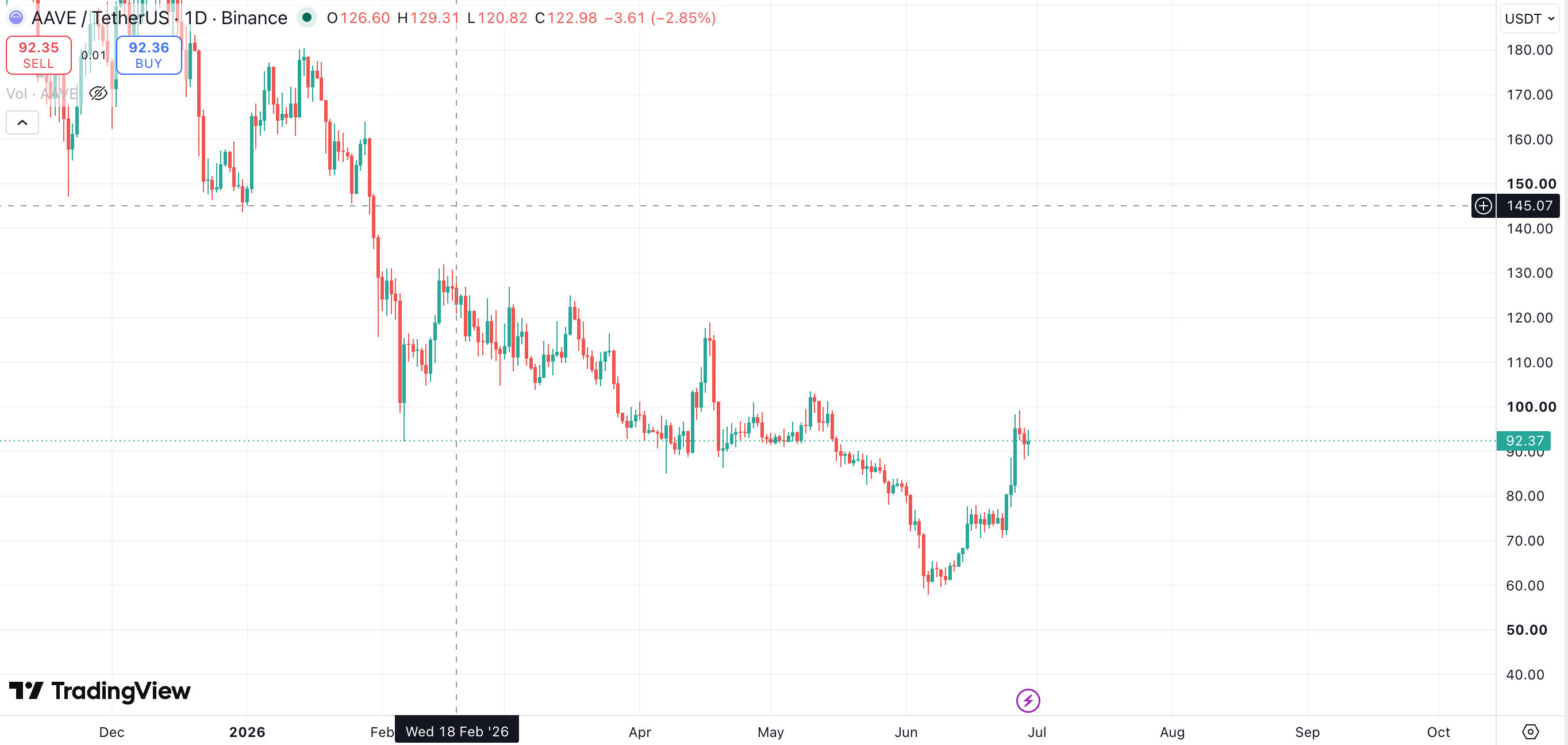
In the past week, the price of AAVE surged from around $70 to nearly $100, marking a rebound of over 30%.


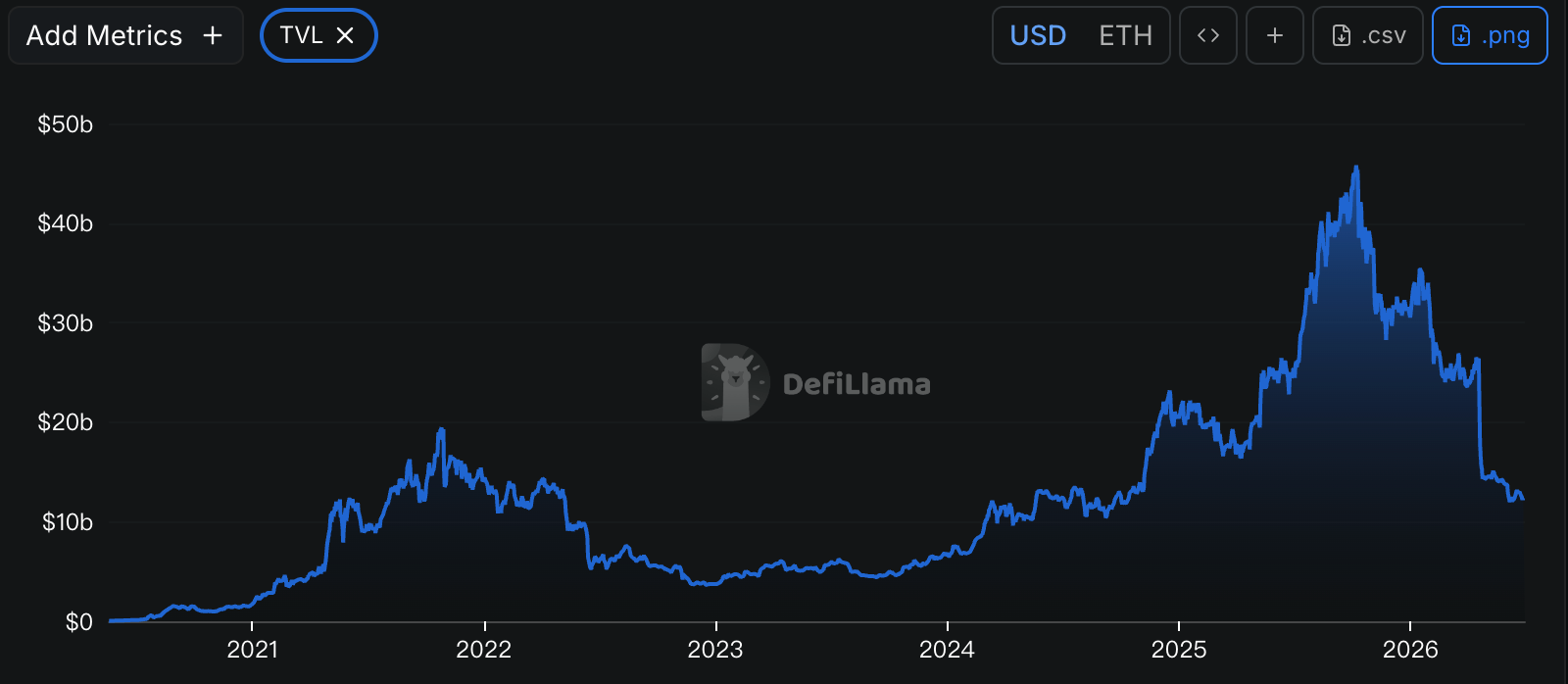
Looking solely at the TVL data, Aave still hasn't recovered from the Kelp DAO attack incident. In fact, its TVL has declined further compared to the panic-driven levels seen during that period.


Despite the underwhelming data, Aave continues to attract capital interest. In the early hours of June 26, CoinDesk, citing sources, reported that Kraken was in talks to acquire a stake in Aave. The potential deal involved exchanging 35,000 ETH for 250,000 AAVE tokens and 15% equity in Aave Group, valuing the entire transaction at $71 million.


This report from sources was quickly refuted by Aave founder Stani Kulechov, as the reported valuation would imply Kraken valuing Aave at less than one-third of its token's market capitalization. Stani denied any intention to "sell tokens at a 70% discount" but acknowledged that "multiple market participants have discussed directly or indirectly purchasing AAVE tokens held by Aave Labs through deeper, long-term partnerships."


The prospect of someone buying the dip naturally spurred others to front-run. Aave's price rose for three consecutive days on June 24, 25, and 26, with the peak gain on the 26th exceeding 20%. Beyond the acquisition rumors, Stani also revealed, while refuting the report, that research is underway for Tokenomics 3.0, which would introduce an automated buyback mechanism. Furthermore, on the evening of the 26th, he stated that Aave is expanding its target market from crypto assets to all asset classes through securities-backed lending and securities lending operations.


Standard Chartered Bank has given an extremely optimistic price prediction of $3,500 for Aave by 2030, citing bullishness on a future DeFi revival and the development of RWA tokenization. While more conservative, Grayscale also believes that, catalyzed by RWA tokenization, AAVE's price could reach $175 within a year.


Explicitly bearish views on Aave in the market are relatively few. However, reports released this year by Eco, Fensory, Coinstancy, among others, have pointed out that Morpho Blue surpasses Aave in rate optimization, capital efficiency, and custom market creation. Tiger Research went even further, suggesting that Morpho represents the "modular" trend, while Aave resembles a "traditional unified pool," lagging in flexibility.


From the initial source leak, to implicitly confirming the existence of potential AAVE token investors during the refutation, followed by successive revelations of protocol developments, the sequence carries a sense of strategic pacing. Setting these aside and looking purely at fundamentals, despite experiencing community division, security concerns, capital outflows, and other setbacks, Aave's TVL still firmly holds the top position among DeFi lending protocols. It is not only nearly double that of the second-place Morpho but also almost equal to the combined TVL of the 2nd, 3rd, and 4th place protocols.
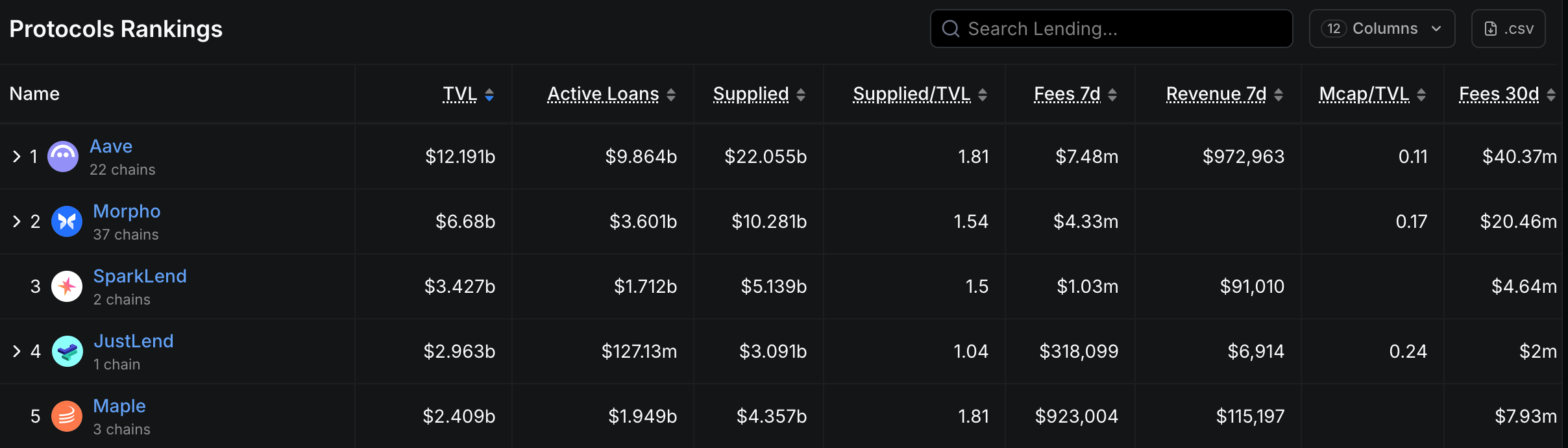


It's not just TVL; metrics like active borrowing, total supply, revenue, and fees also show significant leads. It has been nearly 9 years since ETHLend launched. Conflicts within the team and community, along with protocol risks, are not unforeseen, especially during an overall industry downturn. For a protocol whose code is immutable on-chain, as long as the protocol's core fundamentals haven't suffered a severe decline, the advantages accumulated over years are difficult to be fully eroded in a short period.


On the other hand, Morpho indeed shows a rising momentum. On June 9th, Morpho raised $175 million in a funding round led by Paradigm, Ribbit Capital, and a16z crypto, valuing the project at $2 billion, making it one of the largest single fundraising events in DeFi history. However, some also argue that Morpho and Aave have taken different paths, not competing directly on the same dimension, as each possesses core strengths that are difficult for the other to challenge.


Aave's lending depth makes it the preferred choice for whale users, and its not-high-but-stable yields are favored by many stablecoin holders—at least, this remained true before the Kelp DAO incident. Projects inevitably encounter bumps along the road. In a cryptocurrency market where quality investment targets are becoming increasingly scarce, projects that have withstood the test of time deserve sustained attention.


Criptos en tendencia

Preguntas relacionadas

QWhat is the main reason for the recent 30% price surge of AAVE, according to the article?

AThe main reason for the surge is reportedly a combination of rumors about a potential investment from Kraken and strategic announcements from the Aave team, such as working on Tokenomics 3.0 and expanding into securities-backed lending.

QWhat event significantly impacted Aave's TVL, and how is its TVL currently positioned compared to competitors?

AAave's TVL was significantly impacted by the Kelp DAO hack. Despite this, it remains the top DeFi lending protocol by TVL, holding nearly double the TVL of its closest competitor (Morpho) and almost the combined total of the second, third, and fourth places.

QHow did Aave founder Stani Kulechov respond to the Kraken acquisition rumors, and what key information did he confirm?

AStani Kulechov denied the specific details of the Kraken acquisition rumor, particularly the valuation at a 70% discount. However, he confirmed that discussions have been held with multiple market participants regarding potential long-term partnerships involving the purchase of AAVE tokens held by Aave Labs.

QWhat are the key future catalysts for AAVE's price mentioned by financial institutions in the article?

AFinancial institutions like Standard Chartered and Grayscale cite the revival of DeFi and the growth of Real World Asset (RWA) tokenization as key future catalysts for AAVE's price. Standard Chartered gave an extremely optimistic long-term target, while Grayscale provided a more conservative one-year target.

QWhat is the primary competitive challenge to Aave mentioned in the article, and how do their approaches differ?

AThe primary competitive challenge mentioned is Morpho. The article notes that reports highlight Morpho's advantages in interest rate optimization, capital efficiency, and custom markets. However, it also presents a view that Aave and Morpho operate on different dimensions: Aave excels in liquidity depth for large users, while Morpho represents a more flexible, 'modular' trend.

Lecturas Relacionadas

Opinion: AI Bubble Bursts, Bitcoin and Other Risky Assets Are the First to Be Impacted

BIS Warns AI Investment Boom Could Trigger Market Stress, Impacting Bitcoin First The Bank for International Settlements (BIS) warns that a potential bursting of the "AI bubble" could tighten liquidity and severely impact risk assets like Bitcoin in the near term. Major tech firms are projected to spend over $1 trillion on AI infrastructure in 2025-2026. The BIS cautions that if returns fail to meet expectations, a sudden withdrawal of financing could turn this investment boom into a prolonged bust, creating ripple effects across financial markets. While AI holds long-term economic promise, the current scale and speed of investment, coupled with intense competition and physical bottlenecks (e.g., semiconductors, power grids), mirror historical bubbles. The report highlights that the AI funding web—spanning corporate debt, private credit, and complex vendor agreements—makes systemic risks harder to see. A disappointment in AI adoption could transmit stress through this chain, widening credit spreads and pressuring weaker borrowers. For Bitcoin, the initial reaction to such a market shock would likely be defensive. As liquidity tightens, investors typically sell liquid assets first, and Bitcoin often trades in line with other risk assets during portfolio de-risking. Recent correlations, like Bitcoin's drop following a sharp decline in South Korea's stock market, support this view. However, the longer-term outcome for Bitcoin depends on the policy response. If an AI-driven credit crunch forces central banks to inject liquidity and ease policy eventually, it could reignite Bitcoin's narrative as a hedge against monetary debasement. Yet, traders betting on this outcome may first have to endure significant market volatility and potential price declines.

marsbitHace 9 min(s)

Opinion: AI Bubble Bursts, Bitcoin and Other Risky Assets Are the First to Be Impacted

marsbitHace 9 min(s)

South Korea Reaps Riches, America Turns Hostile

The US has filed a collective antitrust lawsuit in California against Samsung, SK Hynix, and US-based Micron, alleging they colluded to create a "RAMpocalypse" by slashing traditional DRAM production and raising prices 700% over four years amid the AI boom. This lawsuit targets the heart of the AI supply chain: High Bandwidth Memory (HBM), critical for Nvidia's GPUs. Currently, SK Hynix (57%), Samsung (22%), and Micron (21%) dominate global HBM production. The case highlights a deeper US concern: in the AI era, South Korea, through its HBM dominance, is capturing an estimated 35% of global AI profits, second only to the US (49%). SK Hynix's operating profit margin recently hit a record 72%. In response to the lawsuit, South Korea announced a massive $800 trillion won investment to build four new chip plants, doubling down on its strategic position. Analysts see the lawsuit not merely as a consumer price issue but as strategic pressure. It aims to support Micron's US manufacturing expansion (subsidized by the CHIPS Act) and secure America's share of AI profits by bringing more HBM production onshore. However, South Korea's rapid execution and massive cash flow from current HBM sales give it a significant speed advantage over US build-out timelines. The conflict underscores a fundamental shift: AI infrastructure like GPUs and HBM is becoming a new form of strategic national resource, akin to oil. While Nvidia and Korean memory giants are interdependent, the struggle over profit distribution and industrial sovereignty in this new landscape is just beginning. This lawsuit may be the first major skirmish in the AI resource wars.

marsbitHace 21 min(s)

South Korea Reaps Riches, America Turns Hostile

marsbitHace 21 min(s)

Real-life 'Black Mirror' Pumpfun Go: 40 Yuan to Lick Toilets, 14,000 USD for a Logo Tattoo on the Forehead

The article discusses the controversial new platform "Pumpfun Go," a bounty task platform launched by the meme coin platform Pump.fun. Its slogan is "Pay anyone to do anything." The platform allows users to anonymously post tasks with cryptocurrency rewards, which are held in escrow until completion and verification. The piece highlights extreme and disturbing tasks that have gained notoriety, such as licking a gas station toilet floor for roughly $5.63, eating live insects, getting a company logo tattooed on one's forehead for $14,000, and even a now-removed $700,000 bounty for suicide. These tasks are often linked to promoting specific meme coins by generating shocking, attention-grabbing content. While some tasks involve community-building or charity, critics, including New York Governor Kathy Hochul, condemn the platform for exploiting economic desperation and encouraging humiliating or dangerous behavior. They argue it mirrors dystopian narratives from shows like "Black Mirror" and movies like "Nerve," where online dares escalate for viewers' entertainment. Supporters and some participants counter that the platform provides much-needed income opportunities for the financially struggling. One user claimed the bounty money far exceeded his monthly salary. The article concludes by questioning the morality of a system where the wealthy pay for spectacle and the poor trade dignity for survival, reflecting a long history of public consumption of others' suffering. It suggests hope may lie in future technological abundance freeing people from such desperate choices.

marsbitHace 1 hora(s)

Real-life 'Black Mirror' Pumpfun Go: 40 Yuan to Lick Toilets, 14,000 USD for a Logo Tattoo on the Forehead

marsbitHace 1 hora(s)

Trading

Spot

Artículos destacados

Cómo comprar AAVE

¡Bienvenido a HTX.com! Hemos hecho que comprar Aave Protocol (AAVE) sea simple y conveniente. Sigue nuestra guía paso a paso para iniciar tu viaje de criptos.Paso 1: crea tu cuenta HTXUtiliza tu correo electrónico o número de teléfono para registrarte y obtener una cuenta gratuita en HTX. Experimenta un proceso de registro sin complicaciones y desbloquea todas las funciones.Obtener mi cuentaPaso 2: ve a Comprar cripto y elige tu método de pagoTarjeta de crédito/débito: usa tu Visa o Mastercard para comprar Aave Protocol (AAVE) al instante.Saldo: utiliza fondos del saldo de tu cuenta HTX para tradear sin problemas.Terceros: hemos agregado métodos de pago populares como Google Pay y Apple Pay para mejorar la comodidad.P2P: tradear directamente con otros usuarios en HTX.Over-the-Counter (OTC): ofrecemos servicios personalizados y tipos de cambio competitivos para los traders.Paso 3: guarda tu Aave Protocol (AAVE)Después de comprar tu Aave Protocol (AAVE), guárdalo en tu cuenta HTX. Alternativamente, puedes enviarlo a otro lugar mediante transferencia blockchain o utilizarlo para tradear otras criptomonedas.Paso 4: tradear Aave Protocol (AAVE)Tradear fácilmente con Aave Protocol (AAVE) en HTX's mercado spot. Simplemente accede a tu cuenta, selecciona tu par de trading, ejecuta tus trades y monitorea en tiempo real. Ofrecemos una experiencia fácil de usar tanto para principiantes como para traders experimentados.

336 Vistas totalesPublicado en 2024.12.11Actualizado en 2026.06.02

Cómo comprar AAVE

Discusiones

Bienvenido a la comunidad de HTX. Aquí puedes mantenerte informado sobre los últimos desarrollos de la plataforma y acceder a análisis profesionales del mercado. A continuación se presentan las opiniones de los usuarios sobre el precio de AAVE (AAVE).

活动图片