In 2026, Interactive Brokers took just three months to bring the low-cost, professional execution of traditional brokerage services to the crypto market.
Interactive Brokers, listed on NASDAQ in 2007, currently has a market capitalization of $113.7 billion. The brokerage platform is renowned for its low commissions, optimal execution prices, and advanced trading technology. It provides a unified platform for individual investors, active traders, and institutional clients, offering diversified trading services across more than 170 markets and over 200 countries and regions, including stocks, options, futures, forex, bonds, and funds.
Such a traditional U.S. stock market giant chose to open a new battlefield in the cryptocurrency space in 2026.

Interactive Brokers first blitzed the funding channel—stablecoins.
In January, Interactive Brokers launched a 24/7 stablecoin account funding service. Eligible clients can send USDC from their personal crypto wallets to a secure address provided by Zero Hash (supporting Ethereum, Solana, and Base networks). The funds are automatically converted to U.S. dollars and credited to the brokerage account within minutes, available around the clock, including weekends and holidays. Support for Ripple's RLUSD and PayPal's PYUSD will be added in the following weeks.
Interactive Brokers does not charge a deposit fee; only Zero Hash charges a low, tiered conversion fee, with clients only responsible for blockchain network fees.
This directly addresses the limitations of traditional wire transfers, such as bank operating hours and cross-border delays, allowing global investors to instantly inject dollar-value capital into their accounts and immediately engage in multi-asset trading.
Next, Interactive Brokers set its sights on BTC/ETH trading and deposits.
In February of this year, Interactive Brokers launched Coinbase Nano Bitcoin and Ethereum futures, enabling 24/7 trading. On March 25, users could directly transfer BTC/ETH from external wallets into their linked crypto accounts without having to sell or liquidate first.
This feature eliminates technical barriers, allowing investors to trade crypto assets with lower commissions on the same platform, enabling unified risk management for stocks, options, futures, and crypto.
Additionally, the company expanded its crypto footprint into the European market.
Through its Irish entity, Interactive Brokers opened crypto asset trading to eligible individual investors in the European Economic Area. Users can trade 11 mainstream crypto assets, including BTC, ETH, SOL, XRP, and DOGE, alongside stocks, options, futures, forex, bonds, and funds on the existing platform, with support for 24/7 trading.
This blitz into the crypto market is the latest example of Interactive Brokers, as a traditional brokerage, "embracing crypto without losing its essence."
As early as September 2021, when Bitcoin had just broken through $60,000 and crypto was still considered a high-risk, fringe asset, Interactive Brokers partnered with New York State-regulated Paxos Trust Company to pioneer spot trading for Bitcoin, Ethereum, Litecoin, and BCH. Clients did not need to open a separate crypto account; they simply applied for permissions in their existing brokerage account to trade 24/7 and withdraw to external wallets. This "low-cost + unified platform" model was aimed at serving professional investors from the start, rather than chasing retail speculation.
In the following years, Interactive Brokers steadily expanded its product line. In 2025, it added Avalanche, Cardano, Chainlink, Dogecoin, Ripple, Solana, Sui, and other tokens through Paxos or Zero Hash, supporting over 11 mainstream assets.
This path of "first steady progress, then accelerated integration" reflects the unique logic of traditional brokerages exploring Crypto. Unlike pure crypto platforms that pursue traffic and leverage, Interactive Brokers views crypto as an organic component of a multi-asset platform: stablecoins are no longer just "digital dollars" but efficient settlement rails that can be directly converted into trading capital, margin, or idle funds. The CEO team has repeatedly emphasized that the goal is to "make crypto trading as professional and low-cost as stock trading."
Perhaps Interactive Brokers' underlying intent is not hard to understand. Crypto assets are transitioning from early speculative narratives to an important part of institutional portfolio allocation. Clients increasingly need a unified, professional, and low-cost platform to simultaneously manage traditional securities, futures, options, and digital assets, enabling more efficient risk hedging, liquidity management, and capital allocation. If these services are not provided, some high-net-worth and institutional clients may shift their crypto-related business to pure crypto trading platforms, leading to reduced platform stickiness and capital diversion.
Through innovations such as 24/7 stablecoin funding, direct transfers from external wallets, and derivatives, Interactive Brokers has not only significantly reduced the friction costs of cross-border capital flows and asset migration but also transformed stablecoins into efficient settlement and margin tools, markedly enhancing the mobility and utilization efficiency of client funds. This strategy aligns precisely with the company's core strengths—advanced automated trading systems, seamless access to over 100 global markets, and ultra-low-cost execution.
In 2026, as the crypto market shifts from narrative-driven to institutionally allocated, this strategy is demonstrating its competitiveness—clients can monitor the impact of stock fluctuations on crypto positions on the same screen or use stablecoins to quickly capture global opportunities without switching between multiple apps.
The story of Interactive Brokers is essentially a microcosm of a Wall Street veteran brokerage reshaping its positioning with technology and execution.
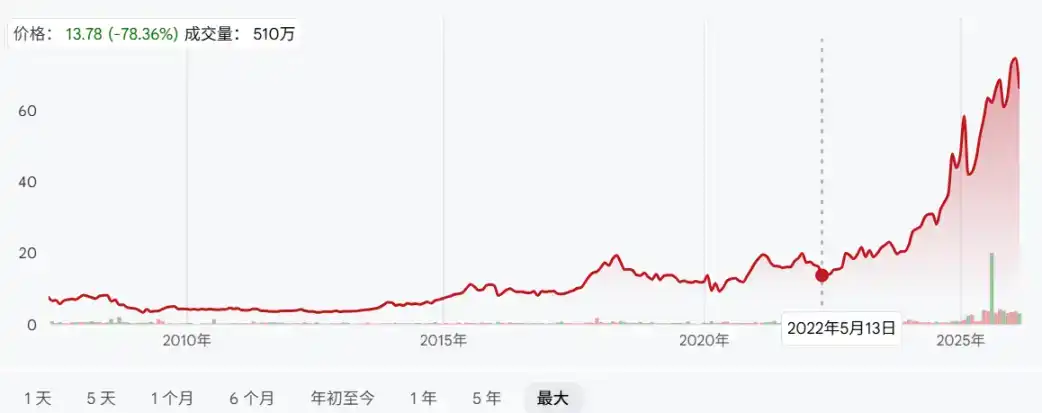
Since its founding by Thomas Peterffy in 1978, the company has focused on developing automated trading systems. According to the latest public Q4 2025 earnings report, Interactive Brokers' client account count reached 4.4 million, a 32% increase year-over-year. In 2025, net new client accounts exceeded 1 million for the year, setting an annual record. Full-year commission revenue was approximately $2.1 billion (+27%), and full-year net revenue was about $6.205 billion (+20%). Client average returns were strong (approximately 19.2% for individual clients and 28.91% for hedge fund clients).
These hardcore data points confirm the contribution of "low commissions + global access + one-stop platform" to long-term returns, and have also allowed Interactive Brokers to firmly establish itself at the intersection of TradFi and Crypto.