The 'True and False Prosperity' of Perpetual Contracts: Have You Seen Through It?

比推Publicado a 2026-02-11Actualizado a 2026-02-11

Resumen

The article "Perpetual Contracts: Real or Illusory Boom?" examines the explosive growth of perpetual futures (perps) markets, arguing that trading volume alone is a misleading metric. While perps have become dominant—growing from 44% to 75% of DEX spot volume since February 2025—this surge doesn't necessarily reflect meaningful capital deployment. Key insights include: - Total perp volume doubled to $14 trillion in just six months, even as crypto market cap fell 40%. - Open Interest (OI), which measures unrealized risk exposure, only grew ~50% in that period, indicating much of the volume is from rapid capital recycling rather than new committed capital. - The OI/Volume ratio (a measure of capital efficiency) rose from 0.33x to 0.49x over the past year, but with significant volatility, including a sharp drop after a major liquidation event in October. - Protocol-level analysis shows Hyperliquid leads in capital efficiency (OI/Vol >45%) and fee generation (~3.2 bps take rate), while others like Aster prioritize capital retention over fees. The conclusion: True market health is best read by combining volume with OI and fee data. Sustainable platforms will be those that optimize for "conviction" (long-term capital) rather than just incentivized volume.

Author: Prathik Desai

Original Title: Reading Perps Beyond Volume

Compiled and Edited by: BitpushNews


Just when you think finance is getting boring, it always has a way of surprising you. Lately, it seems like everyone is restructuring the financial system in ways few foresaw, even those from the entertainment and media industries.

Take Jimmy Donaldson (aka "MrBeast" on YouTube) for example. He not only has a snack empire but also acquired a banking app recently, aiming to promote financial literacy and money management among teenagers and young adults. Why? Perhaps nothing is more direct than monetizing his 466 million subscriber base with financial products.

This summer, the CME Group, the world's largest derivatives exchange, will launch single-stock futures, allowing users to trade futures on over 50 top U.S. stocks including Alphabet, NVIDIA, Tesla, and Meta.

These restructurings show us how people's ways of engaging with finance are changing. And nothing illustrates this better than the explosion of the Perpetual Markets (Perps) market over the past few years.

Perpetual Futures (or Perps) are a type of financial derivative contract that allows market participants to speculate on the price of an asset without an expiration date. Perps also allow people to express views on assets quickly and cheaply. They are more captivating than traditional markets because they offer instant access and leverage. Unlike traditional markets, they don't require broker onboarding processes, jurisdictional paperwork, or follow "traditional" market hours.

Furthermore, on-chain perpetual markets allow any asset (whether traditional or crypto) to be traded in a permissionless, highly leveraged manner. This makes speculation fun, especially when humans can't resist博弈 the trajectory of volatile assets outside traditional trading hours. This allows risk to be priced in real-time.

Think about what happened two weeks ago. When traditional and crypto markets crashed simultaneously, traders flocked to Hyperliquid, driving perpetual gold and silver trading into a frenzy. On January 31st, Hyperliquid alone accounted for 2% of the global daily trading volume in its Silver perpetual contract market, which had been live for less than a month.

This explains why dashboards of perpetual contract trading volume are increasingly dominating crypto communities and forums. Volume is an absolute value. It looks large, refreshes every few minutes, and is perfect for leaderboards. But it misses a key nuance: volume might reflect movement that lacks meaning. A market's high volume could be due to depth, but it could also be due to rewards and incentives encouraging higher frequency activity. This activity is often recursive and not very meaningful.

This week, I delved into other metrics of the perpetual trading market. When used in conjunction with volume, these metrics add more dimensions and tell a completely different story than volume alone.

Let's begin.

A Few Data Points

The user-friendly interface of perpetual markets makes them a low-barrier, default interface for expressing views across various markets and global assets. The wide selection of highly leveraged derivative trading on both traditional and crypto assets on a single platform has led to perpetual contract volumes surpassing spot trading volumes on decentralized exchanges. From 44% in February 2025, the share of perpetual contract volume has soared to around 75% today (relative to spot volume).

This growth has been particularly pronounced in the past few months:

  • As of July 31, 2025, the four-year cumulative perpetual trading volume across all platforms was $6.91 trillion.

  • In just the past six months, this volume has doubled, reaching $14 trillion.
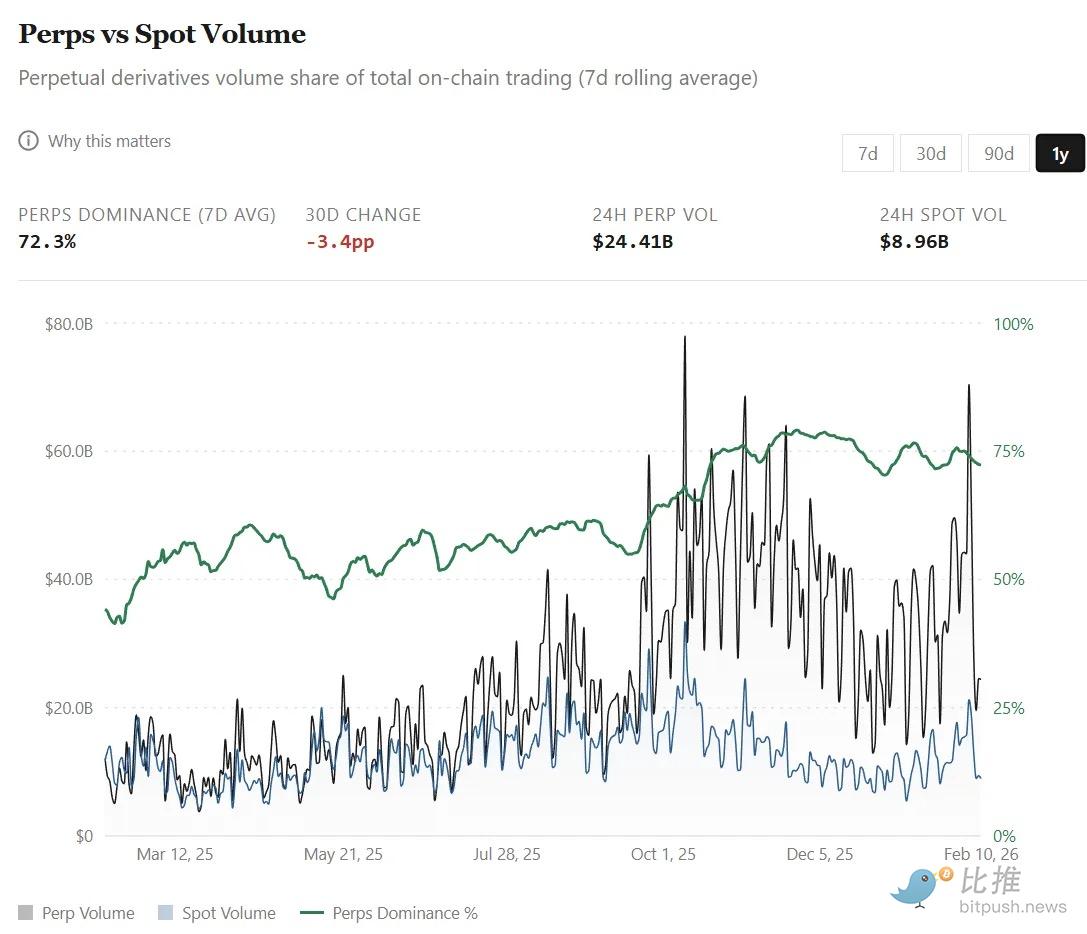
All this growth occurred against the backdrop of the total cryptocurrency market capitalization shrinking by nearly 40% between August 1, 2025, and February 9, 2026. This activity suggests traders are increasingly leaning towards derivative trading, hedging, and short-term positioning, especially when spot markets become highly volatile and bearish.

But there's a catch. With such massive activity, it's easy to misread volume metrics. Especially because perpetual trading isn't just about buying and holding assets long-term; it involves repeatedly adjusting bet sizes using leverage over shorter time frames.

So, when market turnover speeds up, a question inevitably arises: Do record-breaking volumes reflect more capital flowing in, or the same capital cycling faster?

This is where observing Open Interest (OI) becomes meaningful. If volume reflects capital flow, then OI measures outstanding risk exposure. On perpetual exchanges, OI refers to the total dollar value of active, unsettled long and short contracts held by traders.
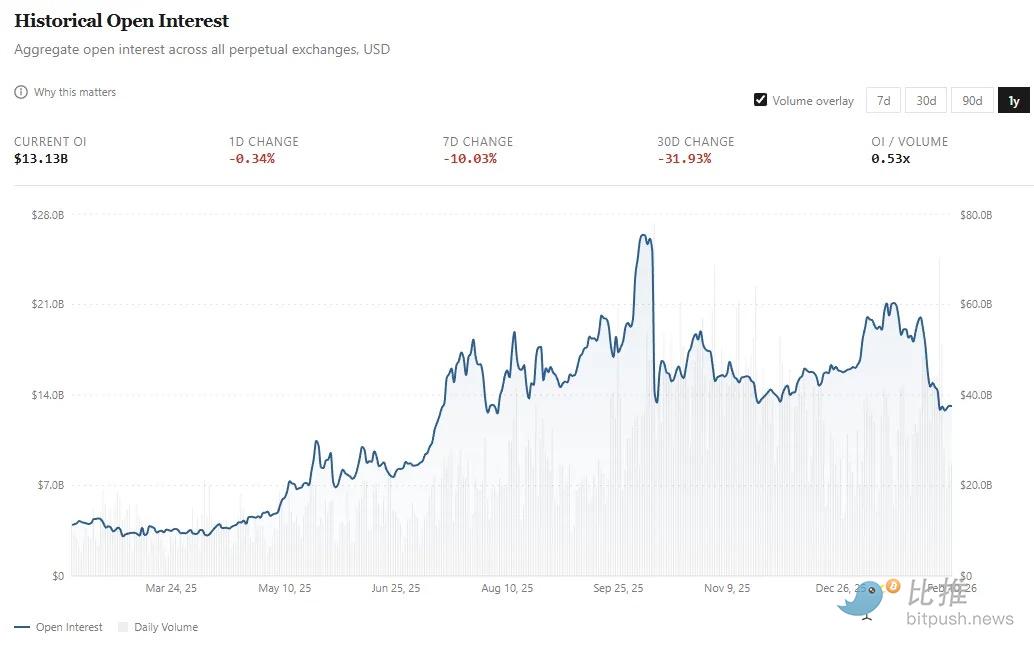
If perpetual trading is being adopted by the mass market, we would hope to see not only larger capital flows but also proportionally growing outstanding exposure.

  • Last February, OI averaged around $4 billion;

  • Now that number has more than tripled, to around $13 billion. In fact, the average for the entire month of January was around $18 billion before dropping about 30% in the first week of February.

While perpetual trading volume doubled in the past five months, OI grew by about 50% (from $13B to ~$18B, then back to ~$13B). To better understand this, I looked at the trend of Capital Efficiency (i.e., OI as a percentage of daily volume) over the past year.
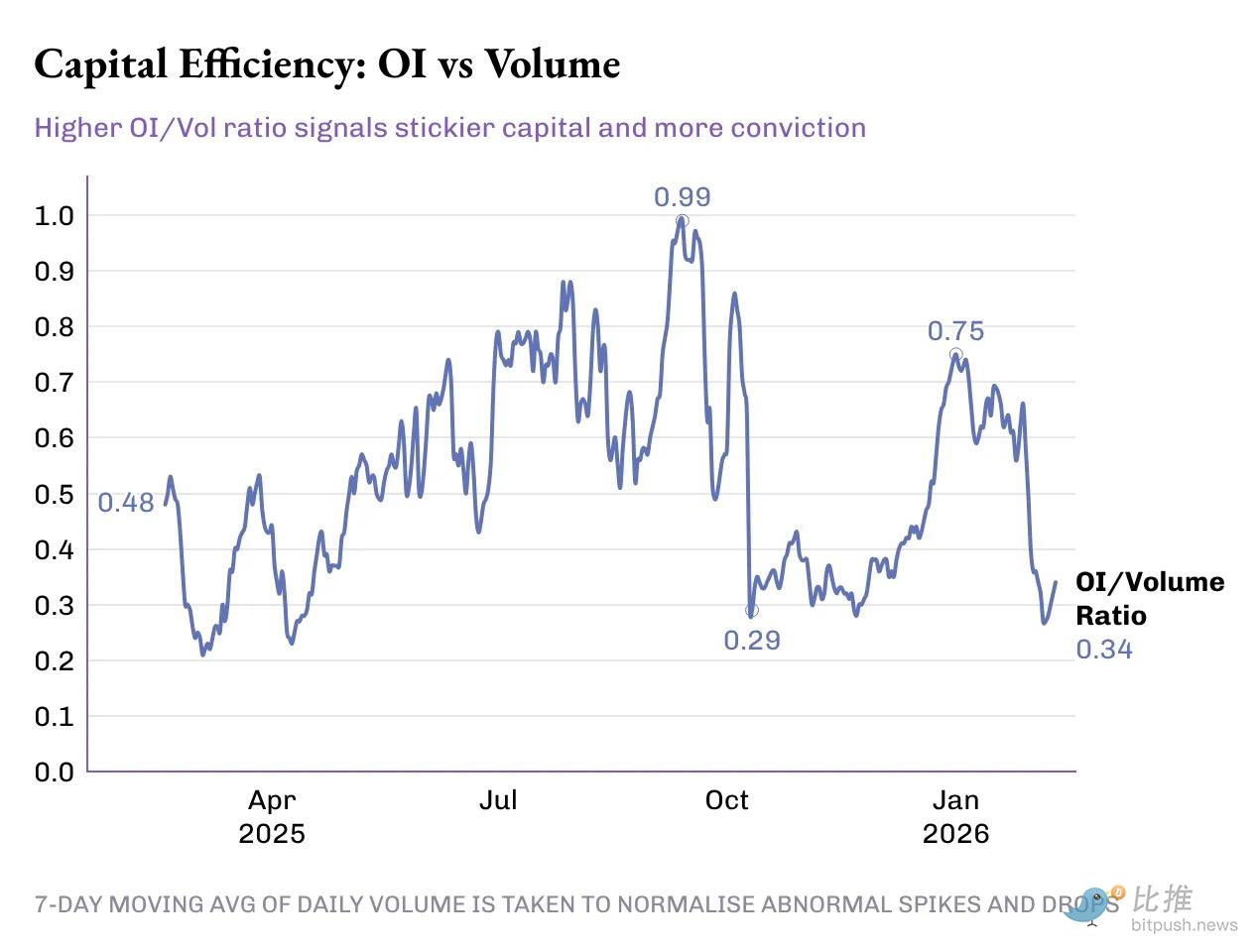
The OI/Volume ratio jumped 50% from 0.33x last year to 0.49x today. But this progress wasn't smooth; the 50 basis point growth in this ratio went through multiple peaks and troughs:

  1. Phase 1 (Feb-May 2025): Dormancy. The OI/Volume ratio averaged ~0.46x, with average OI of ~$4.8B and average daily volume of ~$11.5B.

  2. Phase 2 (June - Mid-Oct): Leap. The ratio averaged ~0.72x. During this period, average OI rose to $14.8B, and average daily volume was $23B. This marked not only record volume but also increased risk exposure and greater capital commitment to these derivatives.

  3. Phase 3: Market Reversal. This phase began around the massive liquidation on October 10th, which wiped out over $19B in leveraged positions within 24 hours. From mid-October to late December, the OI/Volume ratio fell to ~0.38x, driven primarily by volume growth while open interest largely stagnated. October, November, and December saw the highest three-month trading volumes of 2025, averaging over $1.2 trillion per month. Over the same period, OI averaged around $15B, slightly below the previous three-month average.

Protocol Level

Here, I want to add more dimensions at the protocol level for perpetual markets. This helps us understand how efficiently perpetual exchanges convert trading activity into "sticky capital" and revenue.

As of February 10th, here's how the top 5 perpetual exchanges by 24-hour volume performed:

  • Hyperliquid: Its OI to 7-day average daily volume ratio exceeds 45%, able to convert a large share of volume into lasting positions. This indicates that for every $10 traded on the platform, $4.5 is投入 (invested) in active positions. This is important because high OI rates lead to narrower spreads, deeper liquidity, and confidence in scaling trades without slippage.

    • Hyperliquid's fee revenue reinforces this story. Its Take Rate is ~3.2 basis points (bps), converting the largest share of 24-hour volume into fee income.

  • Aster: Currently ranked second, it maintains a decent capital efficiency (OI/Vol) of 34%, despite having almost half the volume of Hyperliquid. However, its monetization capability is notable – with a lower take rate (~1.6 bps), Aster clearly prioritizes capital retention on its platform over fee revenue maximization.
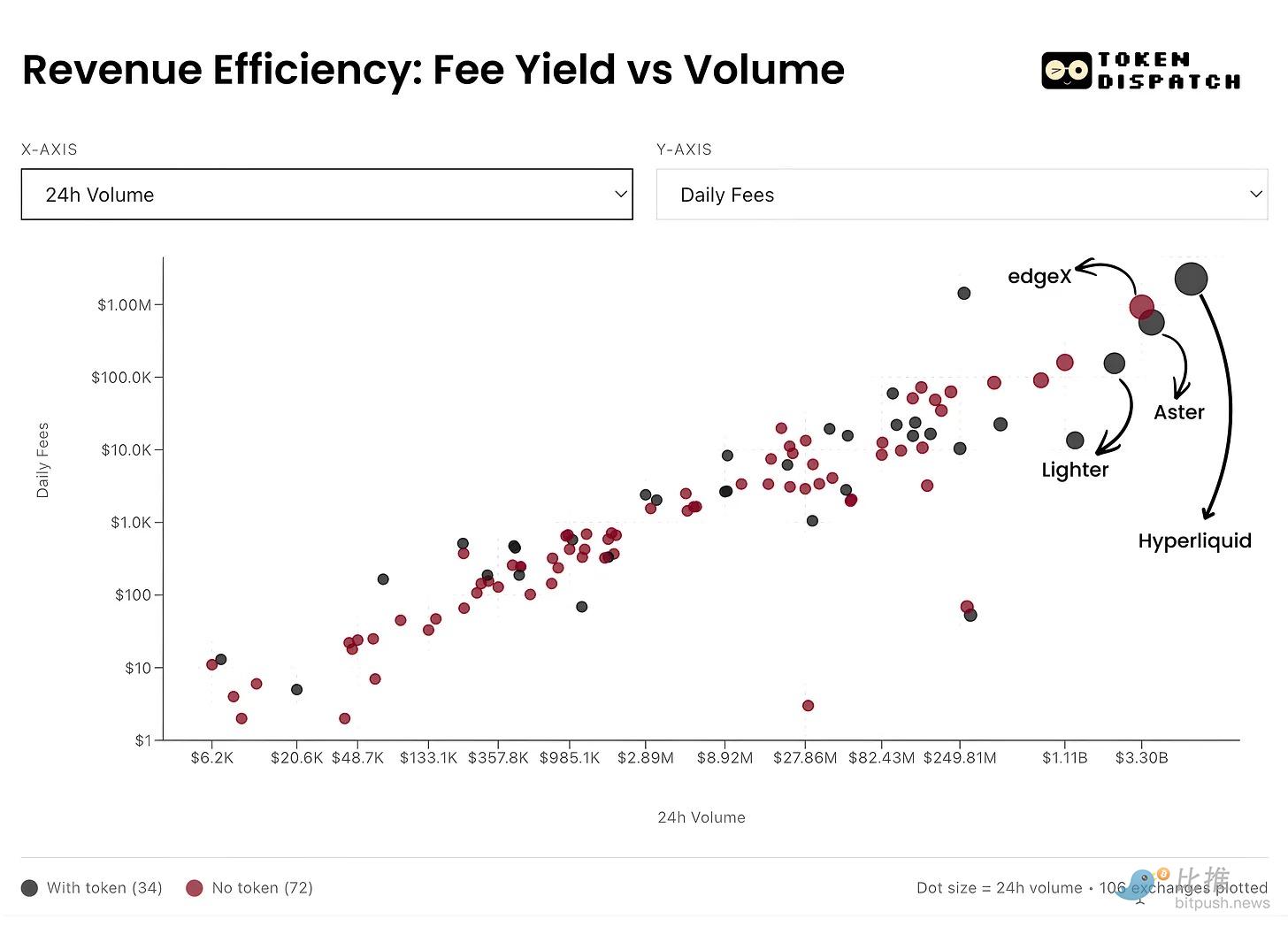

  • edgeX & Lighter: Both perform similarly on the capital efficiency ladder, with OI/Vol at 21%. However, edgeX's fee monetization is comparable to Hyperliquid's at 2.8 bps.

Summary

It's remarkable that the perpetual contract market today is no longer a simple growth story; it requires a nuanced reading of multiple metrics. At the macro level, volume has exploded: the growth in cumulative perpetual trading volume in six months exceeded the total of the previous four years. But the picture only becomes clear when OI and volume are read together.

A clearer victory lies in the growth of the OI/Volume ratio. This is a direct signal that "patient capital" is willing to trust and bet on the various products and markets emerging on perpetual trading exchanges.

What's even more值得关注 (worth watching) in the future is how individual players will evolve from here and what they choose to optimize. Over time, exchanges that can optimize for "Conviction" and achieve sustainable monetization will be far more important than those that merely rely on rewards and incentives to dominate volume leaderboards.


Twitter:https://twitter.com/BitpushNewsCN

Bitpush TG Discussion Group:https://t.me/BitPushCommunity

Bitpush TG Subscription: https://t.me/bitpush

Original article link:https://www.bitpush.news/articles/7611212

Preguntas relacionadas

QWhat are perpetual futures (Perps) and how do they differ from traditional futures contracts?

APerpetual futures (Perps) are financial derivative contracts that allow market participants to speculate on the price of an asset without an expiration date. Unlike traditional futures, they do not require broker onboarding, jurisdictional paperwork, and are not bound by traditional market hours. They also provide instant access and leverage, enabling fast and cheap expression of views on assets.

QAccording to the article, what key metric should be observed alongside trading volume to better understand the health of the perpetuals market?

AThe article states that Open Interest (OI) should be observed alongside trading volume. While volume reflects capital flow, OI measures the amount of outstanding, unsettled risk exposure (the total dollar value of active long and short contracts).

QWhat significant event in October 2025 caused a major shift in the OI/Volume ratio, and what was the consequence?

AA massive liquidation event on October 10, 2025, wiped out over $19 billion in leveraged positions within 24 hours. This event marked the start of a phase where the OI/Volume ratio dropped to ~0.38x, driven by growth in trading volume while open interest largely stagnated.

QWhich perpetual exchange, as of February 10th, had the highest capital efficiency (OI/Volume ratio) and what was its approximate ratio?

AAs of February 10th, Hyperliquid had the highest capital efficiency with an OI to 7-day average daily volume ratio of over 45%.

QWhat does the article suggest is a more important long-term goal for perpetual exchanges than simply topping volume leaderboards?

AThe article suggests that a more important long-term goal is for exchanges to optimize for 'trading conviction' and achieve sustainable monetization, rather than just relying on rewards and incentives to dominate volume rankings.

Lecturas Relacionadas

7 Months After the Collapse of Huiwang, Southeast Asia's Escrow Platforms Undergo a Major Reshuffle

Following the collapse of Huione Pay—dubbed the "Alipay of Southeast Asia"—seven months ago, the region's underground financial guarantee platform sector is undergoing a significant reshuffle. This power vacuum has been swiftly filled by emerging platforms such as XinBi, Tiger/Navigator, JinBei (renamed JinBo), Dali/Tiancheng, and FullyLight. These platforms, operating largely via Telegram and offering services like escrow for illicit transactions, have absorbed the vast user base and markets left behind by Huione. While positioning themselves as "trust intermediaries," their primary clientele consists of networks involved in online scams, money laundering, illegal gambling, and even human trafficking. For instance, the Tiger/Navigator platform explicitly provides "escrow" services for kidnapping-for-ransom operations ("强押车交易"). Data underscores the immense scale: Huione alone processed over $103 billion in cryptocurrency payments and facilitated over $31 billion through its escrow market before its downfall, linking it to Cambodia's notorious Prince Group. Since its collapse, competitors have seen explosive growth. For example, the XinBi platform has accumulated over $1.6 billion in total USDT revenue, while platforms like NewPay, OkPay (under Dali), and FullyLight Wallet collectively processed over $4.8 billion in USDT in a single year. This ecosystem thrives in regions like Cambodia and Myanmar, where regulatory gaps allow these platforms to act as critical financial infrastructure for sprawling cybercrime industries, from scam compounds to online casinos. The article concludes that the moniker "Southeast Asian Alipay" is a misnomer, obscuring the platforms' fundamental role in enabling serious criminal enterprises rather than representing legitimate financial innovation.

Odaily星球日报Hace 20 min(s)

7 Months After the Collapse of Huiwang, Southeast Asia's Escrow Platforms Undergo a Major Reshuffle

Odaily星球日报Hace 20 min(s)

The Changing Landscape: What Are Crypto VCs Experiencing?

Title: The Shifting Landscape of Crypto Venture Capital The era of dedicated crypto venture capital funds is undergoing a significant transformation. Once essential for navigating the sector's complexity and high risk, these specialized funds are now facing an identity crisis as the market matures. This shift mirrors historical patterns in other specialized investment classes like cleantech and SPACs, where initial information advantages dissipate as technologies become mainstream and integrated into existing industry frameworks. The article argues that crypto is reaching a critical inflection point, transitioning from a "building phase" to an "integration phase." Major players like Stripe, BlackRock, and Visa now engage with crypto not for its novel mechanics but as a foundational financial infrastructure. Their needs—regulatory compliance, banking partnerships, distribution channels—align with traditional fintech, a domain easily understood by large, generalist funds like Sequoia and Founders Fund. This evolution creates a "barbell effect" within the VC landscape. On one end are massive, diversified platforms that can incorporate crypto as one vertical among many. On the other are small, nimble funds focused on niche, experimental projects. The middle ground—medium-sized dedicated crypto funds—is being squeezed out. Their typical fund size makes it impossible to generate sufficient returns solely from early-stage crypto bets, yet they cannot compete with giants for later-stage deals. Consequently, leading crypto-native firms like Paradigm and Framework Ventures are expanding into AI, robotics, and other sectors, driven partly by LP pressure for better returns amid a broader VC DPI crisis. Others, like Dragonfly and a16z, have narrowed their crypto focus predominantly to financial infrastructure like stablecoins, reframing the sector's core narrative. For crypto entrepreneurs, this consolidation presents challenges. While generalist funds offer larger checks and broader resources, crypto projects now compete fiercely with AI for attention and capital within these firms. Furthermore, the long-term, non-commercial foundational work that built the ecosystem—funded by dedicated crypto VCs—is less likely to attract generalist capital focused on direct returns. The conclusion is that "crypto investor" as a standalone category is becoming obsolete, akin to "internet investor." Crypto is becoming a baseline infrastructure layer. The future will see a barbell structure: large-scale growth financing handled by generalist funds, while pioneering, speculative projects are funded by small, specialized vehicles. The dedicated crypto funds of the 2017-2021 boom, which incubated core infrastructure, are giving way to this new, bifurcated reality.

Foresight NewsHace 37 min(s)

The Changing Landscape: What Are Crypto VCs Experiencing?

Foresight NewsHace 37 min(s)

As Consensus Accelerates, What Are Young Investors Betting On?

Title: As Consensus Forms Faster, What Are Young Investors Betting On? In the rapid evolution of tech investment, a new generation of young investors is navigating a landscape where AI, robotics, commercial aerospace, and quantum computing are advancing simultaneously. Traditional investment logic based on financial models is giving way to a need for deep technical understanding and the ability to act before industry consensus forms. An analysis of trends from the "WAIC FUTURE TECH" list of young investment leaders reveals key shifts in focus. The first major trend is the movement of AI from the digital screen into the physical world. Investment is shifting from large language models and chatbots towards embodied AI, robotics, AI hardware, and edge computing. While demonstrations generate excitement, the real challenge lies in achieving scalable, reliable, and cost-effective delivery in complex real-world environments like factories and logistics. Success depends not just on algorithms but on the integration of sensors, actuators, and control systems. Second, the competitive focus for large models is moving beyond raw capability toward building an "intelligence flywheel." The goal is to create self-reinforcing systems where user interaction generates data, improving the model, which in turn enhances the user experience and attracts more engagement. Companies that successfully embed AI into workflows to create these closed-loop systems can build lasting value that isn't easily erased by the next model upgrade. Third, facing a potential bottleneck in high-quality human-generated data, investors are looking at new underlying technologies. Reinforcement learning and self-play, as demonstrated by AlphaGo Zero, offer paths for AI to generate its own experience. Scientific foundation models, which aim to build general AI capabilities for fields like life sciences and materials discovery, represent a non-consensus direction that could unlock new frontiers of knowledge and data. Finally, in deep-tech areas like quantum computing, commercial aerospace, and space-based infrastructure, patient capital is essential. These fields have long, uncertain development and validation cycles involving complex engineering, supply chains, and regulations. Investment here requires a long-term view, focusing on foundational team capabilities and the eventual emergence of market demand, even if commercial returns are distant. Collectively, these trends illustrate how young investors are adapting to a new era. They are learning to make earlier, technically-informed judgments, balance hype with real-world viability, and provide the patient capital needed to build the deep-tech foundations of the future.

marsbitHace 1 hora(s)

As Consensus Accelerates, What Are Young Investors Betting On?

marsbitHace 1 hora(s)

Trading

Spot
活动图片





