Author: Vaidik Mandloi
Translation: Luffy, Foresight News
Paradigm, one of the world's top pure-play crypto-focused funds, recently completed a $1.2 billion new fundraise, with capital to be invested in startups in AI, robotics, aerospace, and other fields. The firm has even removed all mentions of "cryptocurrency" from its official website entirely, reflecting a core investment thesis: crypto was merely the first frontier they tackled, and other current technological waves are equally unmissable.
Framework Ventures also raised a $400 million fund in June, initiating a cross-sector investment strategy, and they are far from the only firm making such adjustments. Over the past year, almost all leading crypto-specialist VCs have been broadening their investment horizons and adjusting their theses. In Q1 2026, only eight new pure-play crypto VC funds were established globally, the lowest number since 2020.
In this article, I will delve into whether crypto-focused venture capital funds are truly facing their demise. If the answer is yes, how will this industry shakeout affect the lifecycle of various funds? For crypto startups, what does it mean for their future, where they will compete for resources with other sectors within the portfolios of generalist funds?
The Development Cycle of Crypto-Specialist Funds
The emergence of crypto-specialist funds was fundamentally driven by their willingness to invest significant time in building informational moats within the industry, making them the only investors willing to bear the sector's high risk back then. In 2017, partners at generalist growth funds like Tiger Global couldn't even grasp the underlying logic of Solidity smart contracts, let alone establish deep working relationships with anonymous developers in Discord communities.
To gauge whether the crypto VC sector is heading towards a decline, one can reference the rise and fall patterns of other specialized investment categories in history. Similar industry iterations have played out repeatedly.
From 2006 to 2011, the cleantech sector became a major investment trend, with numerous firms launching dedicated clean energy funds. The underlying rationale mirrored that of early crypto VCs: investors believed they had caught an epoch-defining technological shift early and sought to build an exclusive investment footprint around it.
Cumulative capital invested in cleantech startups exceeded $25 billion, with over half of those investments ending in losses. Intriguingly, the underlying technology itself was viable; today's clean energy market is vast, and solar power costs fell by 85% during that period. However, VC firms made a fundamental miscalculation: they applied software company investment models, writing $5 million seed checks for startups that actually needed $200 million in project financing and 15 years to reach profitability.
A post-mortem analysis by MIT's Energy Initiative concluded that the traditional VC model was inherently ill-suited to the cleantech industry. Early specialist funds assumed technology development risk, funded foundational R&D, built sector credibility, and attracted large-scale industrial capital. But once the technology matured and infrastructure loans and project finance arrived, the informational moats unique to specialist funds vanished completely.
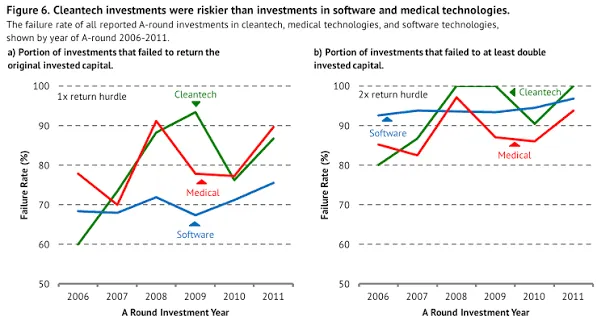
Source: Massachusetts Institute of Technology
Special Purpose Acquisition Companies (SPACs) followed a similar boom-and-bust trajectory. A SPAC is a blank-check company that raises funds via an IPO with no operational business, later merging with a private company to take it public faster than a traditional IPO. In 2020–2021, many investors viewed it as a replicable capital tool, with some even establishing funds entirely centered on SPACs.
Chamath Palihapitiya once raised a $1.6 billion fund dedicated to SPACs. But by 2022, two-thirds of SPACs that went public in 2021 failed to complete a merger, and Chamath ultimately had to return capital to investors. This market reversal within just two years illustrates how quickly an industry's structure can change once the informational advantages of a specialized niche disappear.
The same storyline recurring across different industries points to an underlying pattern. Analyzing 250 years of technological revolutions, Carlota Perez proposed the Techno-Economic Paradigm theory: each major technological revolution goes through an early niche phase where only insiders understand the technology, and deep-diving investors hold exclusive information, becoming the most valuable capital providers. As the technology matures, it gradually integrates into the traditional, existing industrial fabric.
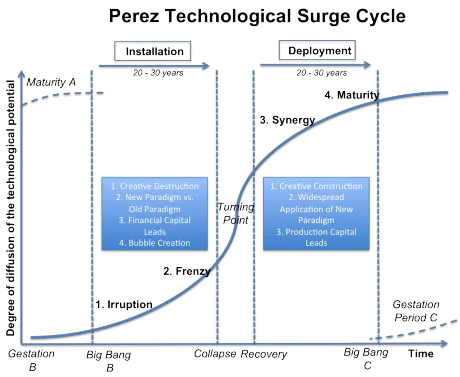
When it reaches this stage, the informational moats that sustained specialist funds cease to exist — generalist giants can now comprehend the asset class. Fred Wilson predicted this crypto inflection point early, writing in 2015 that the industry would reach a critical financial watershed, transitioning from Perez's "Installation Period" to the "Deployment Period."
This watershed has now arrived, with characteristics of the deployment phase visible everywhere: payments giant Stripe acquiring Bridge and launching its own stablecoin chain; asset managers like BlackRock and Fidelity issuing tokenized money market funds; traditional payment leaders like Visa and Mastercard building settlement networks on stablecoin rails.
These traditional giants don't need crypto-specialist funds to explain MEV extraction or validator economics; such exclusive industry knowledge holds little relevance for their business expansion. What they truly need is regulatory approval, distribution channels, and banking partnerships — resources identical to those required for scaling any fintech company. Today, investors at generalist funds like Sequoia and Founders Fund evaluate crypto projects using the same logic they apply to fintech ventures like Stripe or Plaid.
Polarization and Fund Sector Expansion
Given that the informational moats of crypto-specialist funds have eroded, what happens to funds built upon this advantage? Their ultimate fate is entirely determined by the capital logic dictated by their fund size.
The venture capital industry has long settled into a "barbell-shaped" polarization: On one end are giant, integrated investment platforms like a16z, Sequoia, and Founders Fund, which can absorb entire sectors as verticals within their portfolios. On the other end are small, boutique funds that bet on niche, cutting-edge projects based on deep investor insight, where a single breakout winner can return the entire fund. Medium-sized funds caught in the middle find their survival space entirely squeezed, and most crypto-specialist funds currently reside in this "death zone."
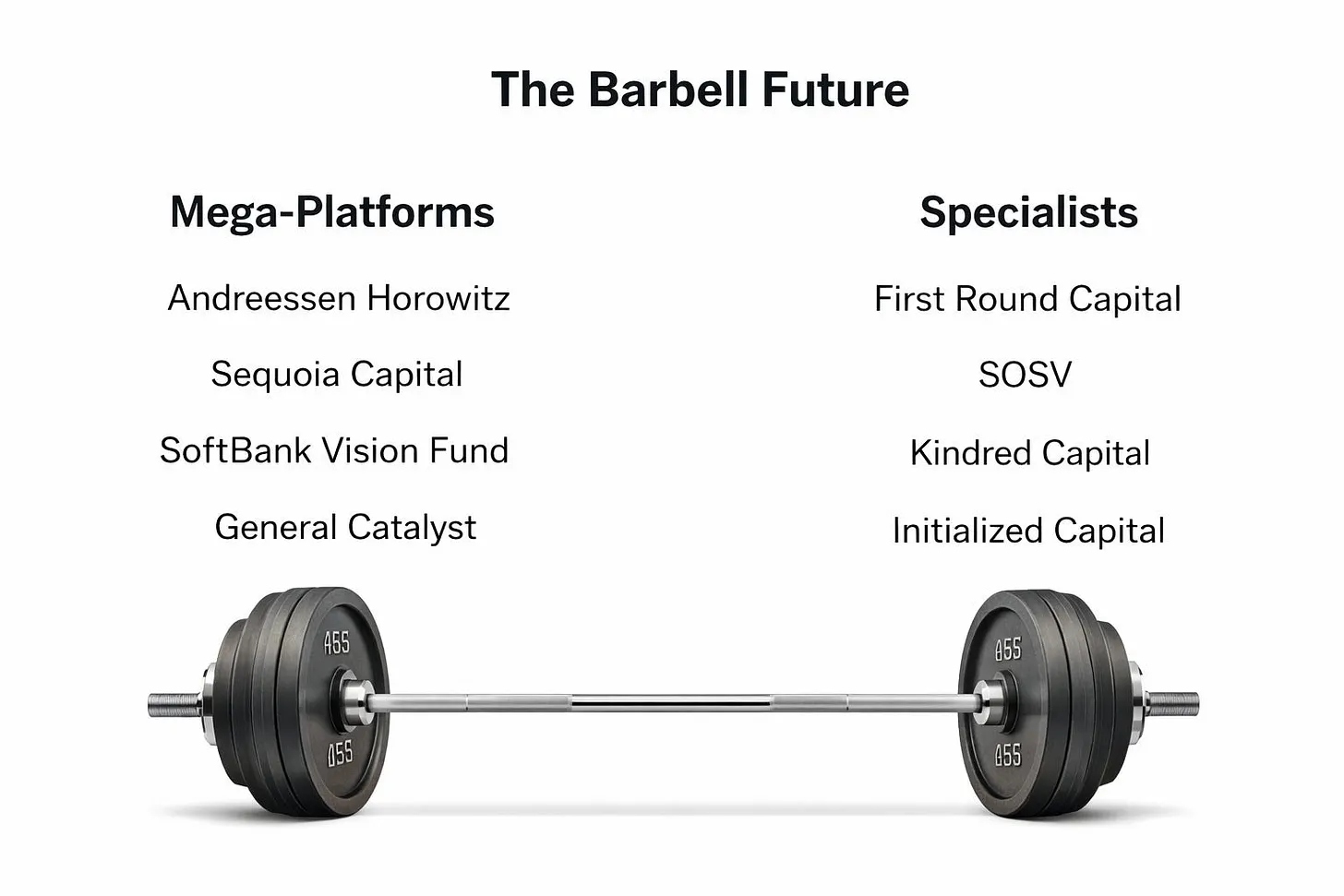
A $500 million fund needs a total exit value of $1.5 billion to deliver a 3x net return to its Limited Partners (LPs). This target is unattainable through seed-stage investments alone; a portfolio of only seed investments rarely yields enough large winners. Simultaneously, they cannot compete with $50 billion giants for growth-stage deals — the latter can casually write nine-figure checks. For perspective, in H1 2025, the fundraising total of Founders Fund alone equaled 1.7 times the combined total of all emerging small funds during the same period. Capital continues to concentrate at both ends of the industry.
While both Framework Ventures and Paradigm are broadening their investment scope, their underlying strategies differ fundamentally due to scale. Framework manages $400 million — too small to rely on a few seed bets for fund returns, yet insufficient to compete with mega-funds for growth-stage projects. The exit proceeds generated solely from the crypto sector cannot meet the fund's return requirements, forcing it to expand its boundaries. Paradigm, with $1.2 billion under management, has a scale substantial enough to transform into a cross-sector, generalist investment platform. Their strategic choices are inherently different. In short, fund size determines which end of the barbell a firm occupies and dictates its viable development path.
Even those VCs claiming to remain crypto-focused have thoroughly redefined what "crypto investing" means. Dragonfly raised $650 million in February, three times its initial target. However, the firm explicitly stated that the crypto application space detached from financial use cases has largely failed, and the fund will only bet on stablecoins and prediction markets. a16z raised a $2.2 billion crypto fund in May 2026, just half the size of its $4.5 billion fund in 2022. Moreover, partner Chris Dixon has shifted his core narrative: no longer framing crypto as a new computing paradigm, he now posits finance as the industry's foundational bedrock.

Today, what these firms call "pure crypto investing" is essentially investing in the financial infrastructure built upon blockchain rails — a category also heavily targeted by well-capitalized generalist funds.
Another core driver of this industry shift comes from the changing behavior of fund LPs. The VC industry broadly faces a DPI (Distributions to Paid-In Capital) crisis, with funds launched in 2021 averaging a mere 0.08x DPI. The 2022 crypto bear market caused significant losses for many LPs, while the AI sector now serves as a new outlet, absorbing ~70% of global private market capital. Faced with years of locked-up capital and witnessing AI projects deliver the promised high returns once associated with crypto, fund managers are compelled to venture into AI to meet LP demands.
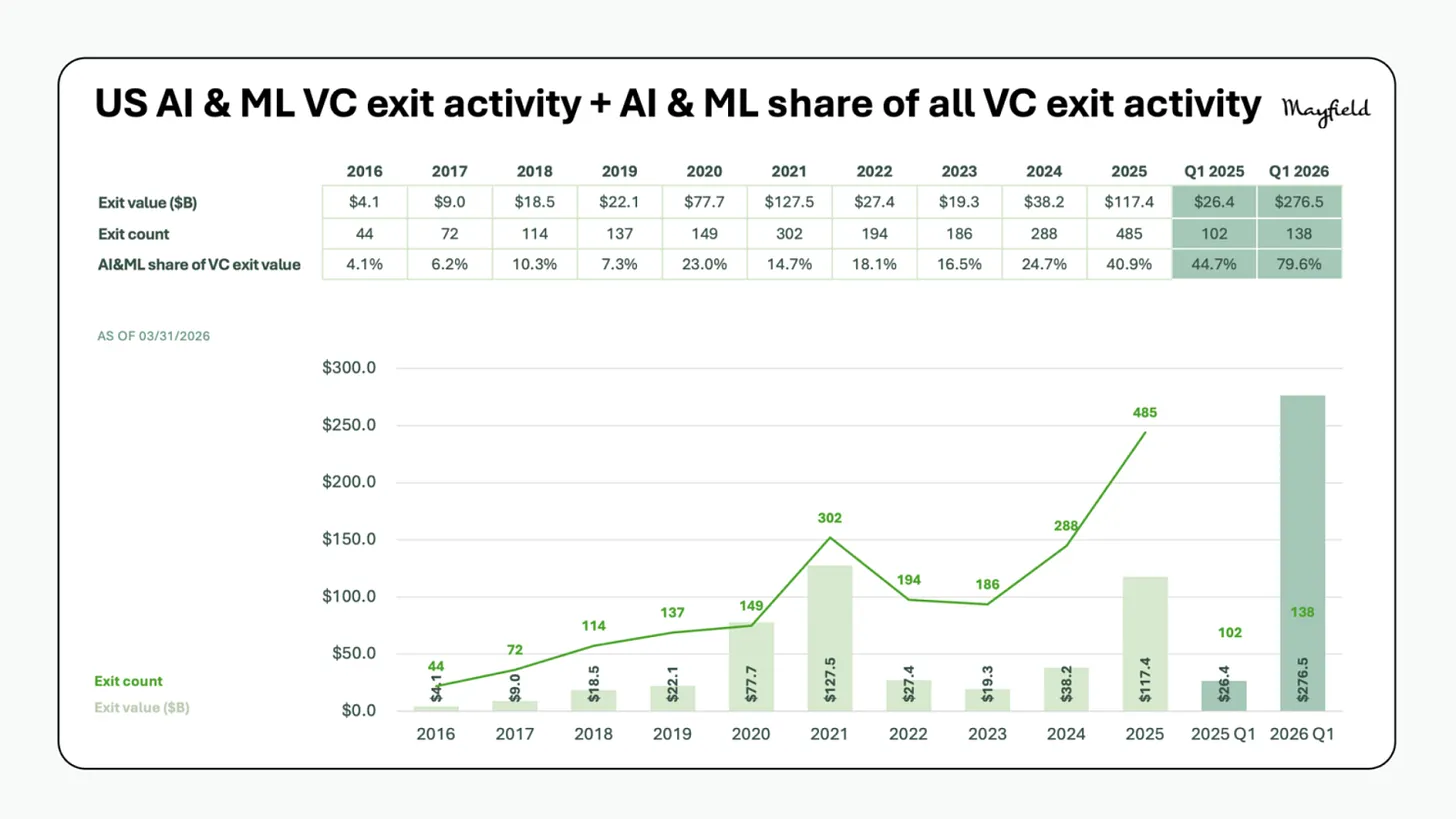
This trend is unfavorable for crypto entrepreneurs still dedicated to the space: the number of investors who truly understand crypto and are willing to double down is shrinking. Many would argue that entrepreneurs can simply raise from generalist funds, which seems plausible in theory — firms like Sequoia and Founders Fund can write larger checks and provide go-to-market resources that native crypto funds struggle to match.
However, two major hurdles exist in reality. First, the AI sector currently siphons off most attention and deal flow within generalist funds. Crypto projects internally compete for the investment team's focus against a flood of AI opportunities; only the most exceptional crypto projects make it to investment committee discussions, a vastly different competitive dynamic from pitching to a dedicated crypto fund. Second, the crypto ecosystem's development relies on the long-term, foundational investments made by specialist funds. Paradigm funding MEV-related academic research, Dragonfly supporting cross-chain developer tools — these investments may not generate commercial returns on a standalone project basis but build shared public infrastructure for the entire industry. Generalist funds will not touch such projects; they judge opportunities solely by standalone commercial returns.
I believe in a few years, the term "crypto investor" will sound as dated as "internet investor" does today. Crypto has become foundational infrastructure — a pipeline supporting various financial products. No one builds an entire investment thesis solely around the pipeline itself; investment value is created in the applications built on top. If Perez's technological cycle theory holds, the industry is precisely at this transition point: crypto is no longer a standalone investment sector but a foundational layer for various investable assets.
This doesn't mean crypto-specialist funds will vanish entirely. As new sub-categories like tokenization and on-chain securities continue to emerge, numerous niche, cutting-edge areas will arise that generalist funds are unwilling to touch. Each cycle will see small specialist funds form around these micro-verticals. What is truly facing decline are the current cohort of medium-to-large-sized pure-play crypto funds — the crypto niche alone cannot generate sufficient returns to meet their fund targets. The sector will continue to reconfigure along the barbell structure: large growth-stage investments handled by generalists, while frontier, experimental niche projects are left to small specialist funds.
Early specialist funds formed in 2017–2018 incubated core infrastructure like Uniswap, the Ethereum ecosystem, and stablecoin tooling. But times have changed. Leading crypto projects emerging in recent years, such as Hyperliquid and MegaETH, raised funds entirely through community efforts, completely bypassing VCs. Those early specialist funds gave crypto a coherent investment narrative, attracting generalist capital. Today, more entrepreneurs are realizing they can bootstrap projects successfully without relying on venture capital at all.


















