Tether To Terminate Offshore Yuan (CNH₮) Operations – Here’s Why

bitcoinistPublicado a 2026-02-22Actualizado a 2026-02-22

Resumen

Tether has announced it will discontinue its offshore Chinese Yuan stablecoin (CNH₮) due to a lack of market demand and operational inefficiency. Effective immediately, new issuance of CNH₮ has been halted. Existing users have one year to redeem their tokens before the stablecoin is permanently phased out. The company stated it will reallocate resources to products with stronger adoption, such as its flagship USDT, which has a market cap of $183.7 billion. In related news, a survey highlighted Nigeria and South Africa as leading markets for stablecoin adoption, with 80% of respondents in these countries holding stablecoins.

Stablecoin operator Tether has announced its decision to discontinue support for its offshore Chinese Yuan token CNH₮. The USDT operator has attributed this development to a lack of market demand, among other points.

Tether To Terminate CNH₮ Redemption In One Year

In a recent blog post, Tether shared a strategic update on its CNH₮, communicating a management decision to withdraw the stablecoin product from its offerings. This decision is based on multiple factors centered around demand and operational efficiency.

A statement from the announcement read:

Community interest and adoption are central to every product decision we make. When evaluating whether to maintain or introduce a Tether token, we assess market demand, operational sustainability, and broader ecosystem conditions that influence long-term usability. Our priority is to allocate resources where they can most effectively enhance security, reliability, and innovation across the digital asset landscape.

Tether explains that the CNH₮ recorded low interest, adoption, and community demand compared to their products, thereby failing to produce an acceptable return on technical and operational efforts.

As of this moment, all new issuance of CNH₮ has been halted. Meanwhile, CNH₮ users will have the next year to process any redemptions before the stablecoin is permanently phased out. The stablecoin operator will issue another reminder ahead of the redemption deadline. Following this development, Tether reiterates its commitment to stablecoin global growth and adoption.

The statement read:

Tether will continue to focus its efforts on stablecoins and infrastructure that demonstrate strong, organic adoption and long-term relevance. This includes advancing core stablecoin liquidity, expanding tokenization infrastructure, and supporting new financial tools that better serve global users and builders.

Tether remains the operator of the world’s largest stablecoin, USDT, which presently boasts a total market cap of $183.7 billion. In January, the stablecoin company launched USAT, designed specifically for American users.

Nigeria Leads Demand For Stablecoins

In other news, a recent survey by BVNK has revealed that Africa’s largest economies are leading the demand for stablecoins. This survey, done in collaboration with Coinbase, YouGov, and Artemis, involved 4658 adults across 15 countries. The results revealed that 80% of Nigerian and South African respondents presently hold stablecoin, while 75% aim to increase holdings as citizens seek a haven from their local fragile currencies.

At press time, the total stablecoin market cap is valued at $310 billion, with high expectations of future market expansion following the approval of the GENIUS Act last July.
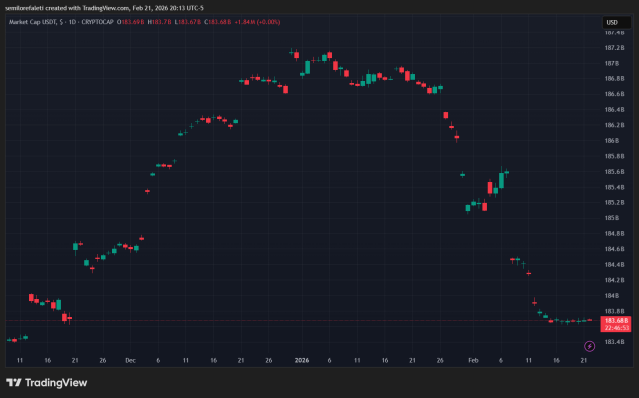
USDT market cap valued at $183.68 billion on the daily chart | Source: USDT chart on Tradingview.com

Preguntas relacionadas

QWhy is Tether discontinuing its offshore Chinese Yuan token (CNH₮)?

ATether is discontinuing CNH₮ due to a lack of market demand, low community interest and adoption, and the failure to produce an acceptable return on the technical and operational efforts required to maintain it.

QWhat is the timeline for users to redeem their CNH₮ tokens?

ACNH₮ users have one year to process any redemptions before the stablecoin is permanently phased out. Tether will issue another reminder ahead of the redemption deadline.

QWhat is the current market capitalization of Tether's USDT stablecoin?

ATether's USDT stablecoin currently has a total market capitalization of $183.7 billion.

QAccording to the article, which country is leading the demand for stablecoins?

AAccording to a survey by BVNK, Nigeria is leading the demand for stablecoins, with 80% of Nigerian respondents holding stablecoins.

QWhat will Tether focus on following the discontinuation of CNH₮?

ATether will continue to focus on stablecoins and infrastructure that demonstrate strong, organic adoption and long-term relevance, including advancing core stablecoin liquidity, expanding tokenization infrastructure, and supporting new financial tools.

Lecturas Relacionadas

Unlocking $100 Million in Liquidity? Pump.fun's New Policy Tests the 5-Minute Pump Technique

Pump.fun, a popular meme coin launchpad, has introduced a new standard mechanism called BOOST. It aims to address a significant capital efficiency issue: when a newly launched token graduates from its initial bonding curve to a liquidity pool (LP), roughly 20% of its liquidity becomes permanently locked as "dead liquidity," estimated to waste over $100 million annually. Instead of locking these funds permanently, BOOST repurposes them. Upon a token's migration, approximately 20% of the settlement funds (e.g., 17.6 SOL or ~$2516 USDC) are used to buy back the token on the open market over a 5-minute period via a Time-Weighted Average Price (TWAP) mechanism. All purchased tokens are immediately burned. This creates a brief, systematic buy pressure immediately after migration, potentially generating a short-term price surge ("pump") while permanently reducing the token's circulating supply. The goal is to enhance the immediate post-launch trading experience, potentially increasing trader retention and sustainable protocol revenue, which funds ongoing token buybacks. However, concerns exist that this artificial 5-minute boost could lower the barrier for launching low-quality tokens and lead to steeper price crashes once the buy pressure stops, if followed by large sell-offs. The feature automatically applies to tokens migrating after July 21, 2024, but not to previously migrated tokens or those launched via the Mayhem AI Agent lab.

marsbitHace 3 min(s)

Unlocking $100 Million in Liquidity? Pump.fun's New Policy Tests the 5-Minute Pump Technique

marsbitHace 3 min(s)

Podcast Notes | Conversation with GSR Asset Management Head: To Determine if This Crypto Rally is Real, Just Watch the Lending Rates on Aave

Podcast Summary: Dialogue with GSR's Head of Asset Management: To Determine if This Crypto Rally is Real, Just Check Lending Rates on Aave Andy Baehr, Managing Director of Asset Management at GSR, discusses the current crypto market, characterizing it as stuck in a state of "ambivalence" with short-lived, unsustainable rallies. He outlines a simple framework: the market moves between "ambivalence" and "conviction" (sustained upward momentum). Currently, every rally resembles a single-stage rocket booster that quickly fizzles out. Baehr identifies three key signals to watch: 1) DeFi lending rates, 2) the potential passage of the CLARITY Act, and 3) the market forming a consensus on the "Fed hawkish peak." He emphasizes that the most immediate indicator for the sustainability of the recent CPI-triggered rally is the USDC borrowing rate on Aave, currently around 3.75%—close to U.S. Treasury yields. The absence of a credit spread indicates low leverage demand and a lack of market energy. He explains that a healthy, sustained rally requires layered buying pressure. Last year's rally progressed from an ETH short squeeze to crypto-native trader influx and finally to ETF inflows. Currently, this structure is missing. Other potential structural buyers like Digital Asset Treasury (DAT) companies are absent, and ETF flows have proven transient. Baehr notes that while small-cap crypto tokens outperformed large caps in Q2—a potential sign of capitation in major assets—capital is also flowing to more exciting opportunities like AI stocks and tech IPOs, leaving crypto sidelined. Regarding DeFi, he highlights that platforms like Aave provide a clear, real-time signal of leverage demand through their supply/demand-driven interest rates. A significant, sustained rate increase would signal genuine market conviction. He also observes the quiet emergence of fixed-income-like products and vaults in DeFi. On regulation, the probability of the CLARITY Act passing before the August 7th deadline has dropped linearly from 75% to below 40% on Polymarket. Baehr suggests its passage would be treated as a bullish surprise, a potent driver for price movement. However, political hurdles, including ethical clause debates and disclosures about the First Family's crypto profits, remain significant obstacles. Ultimately, the market awaits clarity on the Fed's terminal rate under Chair Warsh. Until the "Fed Solstice"—the point where the market collectively understands the peak of hawkish policy—sustained conviction will be difficult to achieve.

marsbitHace 34 min(s)

Podcast Notes | Conversation with GSR Asset Management Head: To Determine if This Crypto Rally is Real, Just Watch the Lending Rates on Aave

marsbitHace 34 min(s)

Trading

Spot
活动图片