Artículos Relacionados con Shanghai

El Centro de Noticias de HTX ofrece los artículos más recientes y un análisis profundo sobre "Shanghai", cubriendo tendencias del mercado, actualizaciones de proyectos, desarrollos tecnológicos y políticas regulatorias en la industria de cripto.

Investors Walked 20,000 Steps in Shanghai

Investors logged over 20,000 steps at the Shanghai event as the 2026 World Artificial Intelligence Conference (WAIC) witnessed unprecedented crowds, a record exhibition space exceeding 100,000 square meters, and over 300 global product debuts. The intense FOMO (fear of missing out) among AI investors was palpable, with tickets being scalped at high prices. The conference highlighted a decisive shift from comparing technical parameters to demonstrating real-world applications and commercial deployment. The vast exhibition, spanning four venues, featured specialized zones for industry applications (H1), foundational computing power (H2), robotics (H3), and startups (H4). The robotics hall (H3) was the most popular, packed with over 200 companies showcasing embodied AI and prototypes, including humanoid robots capable of performing industrial tasks. Investors were omnipresent and exceptionally busy, shuttling between meetings, panels, and networking events organized by leading VC firms. The startup zone hosted over 160 young companies, with many investors hoping to spot the next unicorn. This frenzy mirrors the explosive investment in China's AI sector. In H1 2026 alone, the embodied intelligence segment raised over 90 billion yuan, a fivefold year-on-year increase. The broader AI sector attracted over 300 billion yuan in funding, accounting for half of the total venture capital invested in the period. A wave of companies have reached "unicorn" status with valuations exceeding $10 billion, and at least 20 embodied AI firms are now planning IPOs. Market leaders like Zhipu AI and DeepSeek have reached valuations in the hundreds of billions, with industry insiders predicting the imminent emergence of trillion-yuan AI giants in China. Investors are actively scouting the conference to map out and fund the next decade of technological evolution.

marsbit07/19 07:27

Investors Walked 20,000 Steps in Shanghai

marsbit07/19 07:27

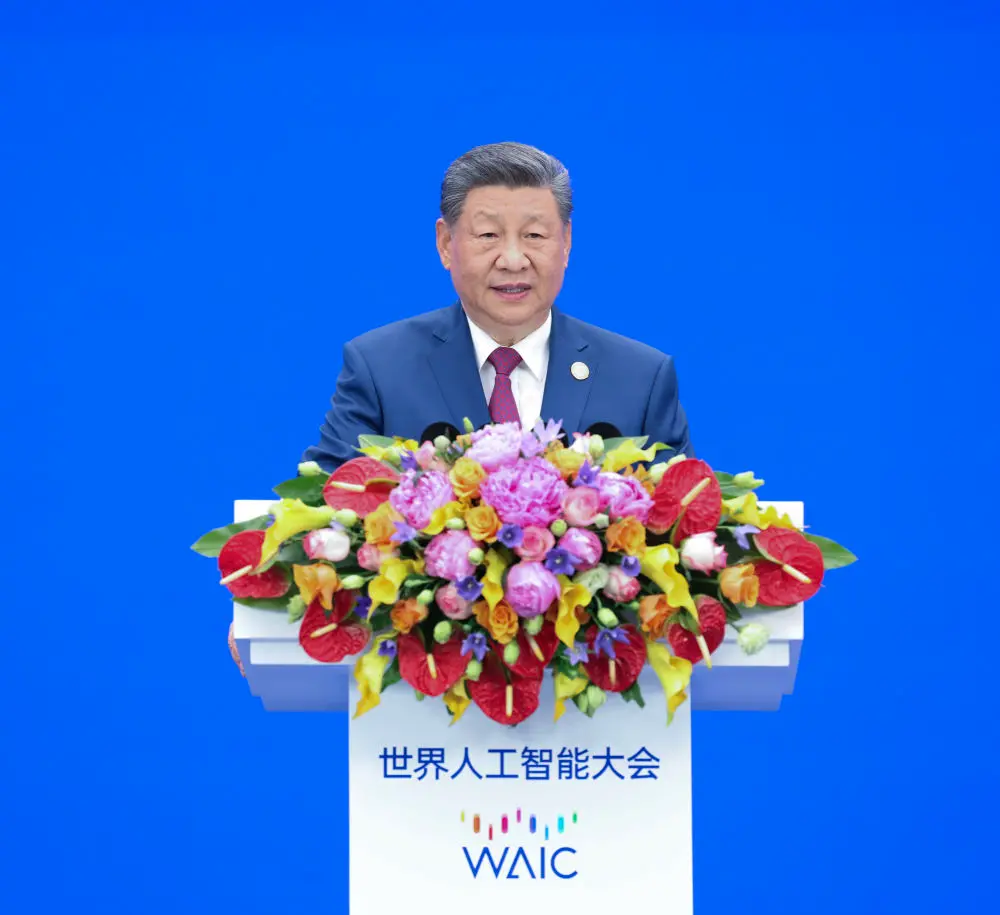
Xi Jinping Attends Opening Ceremony of World Artificial Intelligence Conference 2026 and High-Level Meeting on Global AI Governance, Delivers Keynote Speech

On July 17, 2026, Chinese President Xi Jinping delivered a keynote speech titled "Working Together to Build a Fair and Equitable Global Governance System on Artificial Intelligence" at the opening ceremony of the 2026 World Artificial Intelligence Conference and High-level Conference on Global AI Governance in Shanghai. President Xi pointed out that the rapid development of AI, alongside the accelerated global changes, presents both significant opportunities and governance challenges. He raised critical questions for humanity regarding human-machine coexistence, safety, ethics, and bridging divides. China advocates for a people-oriented, benevolent approach to AI, making it a force for common prosperity and security, and jointly building a fair and reasonable global AI governance system. Xi Jinping put forward a four-point proposal: 1. **Uphold Openness for Win-Win Cooperation and Drive Innovation:** Seize the historic opportunity by encouraging open-source collaboration and sharing to foster AI innovation, industry growth, and application, empowering all sectors. 2. **Enhance Risk Awareness and Ensure Security and Controllability:** Attach great importance to AI's inherent and derivative risks. Build systems for laws, technical monitoring, risk warning, and emergency response to safeguard security, prevent misuse, and ensure human control. Oppose the practice of politicizing national security in AI. 3. **Encourage Inclusiveness and Promote Cultural Exchange:** Shape AI's values with humanity's common values. Use AI to enhance understanding and tolerance between civilizations, fostering a garden of diverse cultures. 4. **Advocate Solidarity and Improve Global Governance:** Practice true multilateralism, leverage the UN's role, and strengthen coordination on AI development strategies, governance rules, and technical standards to form a widely accepted global governance framework. Assist Global South countries in capacity building to bridge the digital divide and avoid new historical inequities. Xi highlighted that as a responsible major country, China, in its 15th Five-Year Plan period, is committed to being a provider of international public goods in AI, contributing Chinese solutions. China has promoted an "AI Plus" initiative, with its core intelligent economy exceeding RMB 10 trillion. To support global AI development, China will provide 5,000 AI training opportunities for developing countries, establish international AI application cooperation centers with regional organizations, and deploy its "Mazu" meteorological AI warning system in 30 countries. The establishment of the World Artificial Intelligence Cooperation Organization in Shanghai marks a significant milestone. Leaders from Kazakhstan, Cambodia, Thailand, and the UN Secretary-General delivered speeches, commending China's contributions to global AI governance and echoing President Xi's proposals. They agreed that AI's opportunities and challenges are borderless, requiring cooperative, inclusive, and equitable international efforts to ensure a secure, prosperous future that leaves no country behind. The conference issued a Chair's Statement. President Xi and his wife hosted a welcome banquet for international dignitaries on July 16. Senior Chinese officials attended the events.

链捕手07/17 08:54

Xi Jinping Attends Opening Ceremony of World Artificial Intelligence Conference 2026 and High-Level Meeting on Global AI Governance, Delivers Keynote Speech

链捕手07/17 08:54

Aleo's First APAC Community Event to Land in Shanghai, Collaborating with OpenBuild to Build a Privacy Computing Developer Ecosystem

Aleo, in collaboration with the open-source developer community OpenBuild, will host its first Asia-Pacific (APAC) community event, "Aleo Shanghai Community Event," on July 26, 2026, in Shanghai. This event marks a key step in Aleo's APAC ecosystem expansion and aims to bring together developers, entrepreneurs, Web3 professionals, and AI enthusiasts to explore the trends in Zero-Knowledge (ZK) proofs, programmable privacy technology, and the innovative opportunities arising from the convergence of AI and privacy computing. Differing from traditional tech talks, the event emphasizes hands-on developer participation. Attendees will have the opportunity to experience Aleo's privacy infrastructure firsthand, engage in real on-chain interactions, and provide direct feedback to the Aleo team. The agenda will feature the official launch of Aleo's APAC Hackathon program, including details on competition mechanics, prizes, mentorship, and team formation. A core focus will be the theme "AI × Programmable Privacy," examining how privacy computing can serve as critical infrastructure for the next generation of the internet, particularly with the rise of AI Agents. A panel discussion titled "Do Agents Need Privacy by Default?" will delve into data security, identity privacy, and trusted interactions for AI Agents in future commercial applications. The event will also include product demonstrations, community networking, and free discussion sessions, designed to foster connections among local developers and advance the regional developer community. **Event Details:** * **Name:** Aleo Shanghai Community Event * **Date:** July 26, 2026 (Sunday), 13:30–18:00 * **Location:** Shengbang International Plaza, Shanghai * **Organizers:** Aleo × OpenBuild **About Aleo:** Aleo is a Layer-1 blockchain enabling programmable privacy, allowing developers to build decentralized applications that combine privacy with on-chain verifiability. It is backed by investors including a16z, Haun Ventures, Samsung Next, and SoftBank. **About OpenBuild:** OpenBuild is an open-source collaborative community for developers, focused on frontier technologies like Web3 and AI, supporting builders through the entire journey from idea to product realization.

marsbit07/16 05:54

Aleo's First APAC Community Event to Land in Shanghai, Collaborating with OpenBuild to Build a Privacy Computing Developer Ecosystem

marsbit07/16 05:54

Three Rounds in a Row, Shanghai Gives Birth to a $10 Billion Satellite Internet Unicorn

Shanghai-based semiconductor company Sixic has raised a new strategic investment round, securing backing from investors including Xinhuanet Venture Capital and Tongding Group, with continued support from existing investors. This marks the company's third disclosed financing this year, following a 1.5 billion RMB raise in February, officially cementing its status as a new Shanghai unicorn with a valuation exceeding 10 billion USD. The financing comes amid a dynamic period for China's commercial aerospace sector. Recent milestones include a successful controlled landing of a rocket first stage, signaling a path toward lower launch costs, and the establishment of a national Commercial Aerospace Innovation Consortium comprising 271 entities. Sixic stands out as the only 6G satellite internet baseband chip company within this consortium. The article highlights a market shift from a focus on rockets and satellites towards recognizing the value of the terminal and connectivity layer, essential for completing the commercial loop. Satellite internet, integral to 6G and commercial aerospace, is entering an industrial phase with clear policy support, including China's pioneering allocation of 6GHz spectrum for 6G R&D. Sixic specializes in 5G/6G satellite communication baseband chips, a highly complex segment. Unlike terrestrial communication, satellite chips must address challenges like high Doppler shift and signal loss. The company's technological validation is a key driver for investment. It has secured product certifications from leading global smartphone manufacturers, new energy vehicle makers, and communication module companies. A strategic partnership with ZTE was announced in March to collaborate on 6G NTN satellite internet. The company has achieved a full technical verification loop, from lab tests to in-orbit validation, including successfully demonstrating 5G NTN standard-based HD video calls via satellite in 2025. It maintains a 100% first-pass success rate for chip tape-outs and possesses full-stack in-house R&D capabilities. Sixic's strategy focuses on ASIC development for future commercial-scale, power-efficient consumer devices like smartphones. Its early and deep involvement in industry standards and constellation planning creates a significant competitive barrier. Looking ahead, Sixic's opportunity extends beyond chips into modules and terminal ecosystems. It has developed a full range of baseband SoC solutions and provides reference designs to help partners launch products quickly. The recent release of the CM7620 broadband satellite communication module at MWC Shanghai completes its "chip-module-terminal" portfolio. This latest funding round represents a strategic bet on the foundational communication capabilities that will underpin the next generation of 6G and satellite internet value chains.

marsbit07/14 05:25

Three Rounds in a Row, Shanghai Gives Birth to a $10 Billion Satellite Internet Unicorn

marsbit07/14 05:25

From Gatekeeper to Gravedigger: JPMorgan Bets on Physical Precious Metals, Shorts Dollar Credit

JPMorgan Chase, a long-standing guardian of the U.S. dollar-centric financial system, is reportedly shifting its core precious metals trading team to Singapore—a move interpreted as a strategic pivot away from Western dollar hegemony. The bank has reclassified approximately 169 million ounces of silver in COMEX vaults from “deliverable” to “non-deliverable,” effectively locking down nearly 10% of global annual supply. This signals a broader bet on physical metal accumulation and a loss of confidence in paper-based derivatives. The London and New York systems, built on leveraged paper contracts (with claims far exceeding physical metal), are showing strain. Central banks are accelerating gold repatriation, while industrial demand—especially for silver in green technology—is draining physical inventories. Extreme backwardation in silver and extended delivery wait times at the Bank of England suggest a structural rupture between paper markets and physical reality. Meanwhile, Shanghai has emerged as the world’s largest physical gold exchange, emphasizing full physical settlement and rejecting the Western paper-gold model. China’s industrial demand and central bank purchasing are pulling vast metal volumes eastward, reshaping global liquidity and pricing power. Singapore is positioning itself as a neutral hub with tax-free private vaults, attracting Western institutions like JPMorgan seeking a safe, politically acceptable base near Asian demand centers. Yet it remains caught between dollar liquidity and yuan-driven physical trade anchored in Shanghai. JPMorgan’s maneuver reflects a deeper shift: the end of financial alchemy based on unlimited paper leverage and the return to a tangible asset system where physical metal defines value and trust.

比推12/12 15:31

From Gatekeeper to Gravedigger: JPMorgan Bets on Physical Precious Metals, Shorts Dollar Credit

比推12/12 15:31

活动图片