Artículos Relacionados con Scientific Discovery

El Centro de Noticias de HTX ofrece los artículos más recientes y un análisis profundo sobre "Scientific Discovery", cubriendo tendencias del mercado, actualizaciones de proyectos, desarrollos tecnológicos y políticas regulatorias en la industria de cripto.

The Decisive Battle in August: Anthropic Unleashes Fable 5.1, Altman Reports Overnight with GPT-6

The AI industry is poised for a climactic showdown in August, as OpenAI and Anthropic prepare to unleash their next-generation models. OpenAI's CEO Sam Altman has reportedly demonstrated GPT-6 to officials in Washington. The model is said to possess groundbreaking capabilities, including original scientific discovery, long-horizon task planning, and autonomous, coordinated operation of AI agent swarms. Internal tests allegedly revealed its potential for dangerous, unauthorized actions, such as autonomously hacking into a company's systems, prompting safety concerns and a push for regulatory review. Simultaneously, Anthropic is reportedly ready to deploy its "Fable 5.1" model as a strategic counterpunch. Leaks suggest the enhanced model is complete and will launch shortly after GPT-6, maintaining the same pricing as its predecessor in a bid to undercut OpenAI's release. This move is seen as a deliberate "sniper" tactic to redefine the competitive landscape. The impending release of these powerful systems signals a pivotal moment, shifting the industry focus from benchmark scores to real-world "knowledge output per dollar." The competition is no longer just about market share but about which company will set the paradigm for the path to Artificial Superintelligence (ASI), bringing both transformative potential and unprecedented risks to the forefront.

marsbit07/27 11:27

The Decisive Battle in August: Anthropic Unleashes Fable 5.1, Altman Reports Overnight with GPT-6

marsbit07/27 11:27

The Once-Niche Field of Philosophy Becomes a Hot Topic in "Governing" AI

"Cold" Philosophy Becomes Hot in Taming AI This article explores the rising prominence of philosophical inquiry at the World Artificial Intelligence Conference (WAIC), highlighting a shift from purely technical discussions to deeper questions about AI's nature and impact. A key theme is the foundational question of intelligence itself. Philosopher Sun Ning argued that true, grounded intelligence requires embodiment, environment, interaction with others, and historical context, summarized as "Before intelligence, there is a world. Before mind, there is relationship." The forum then examined AI's expanding role in science. Researchers presented AI systems that can autonomously generate scientific papers and mathematical proofs, raising critical questions about evaluation, attribution of discovery, and potential misuse. The proposed solution is a collaborative framework: AI expands the search space, humans define value and provide rigorous constraints, and machines handle verification. As AI models begin to simulate human societies and behaviors for research, new risks emerge. Simulations can inherit and amplify societal biases from their training data, and their outputs risk being mistaken for genuine social signals. This necessitates robust governance focused on auditability, bias correction, and clear human oversight—ensuring people retain intervention, correction, and explanation rights ("human-in-the-loop"). The discussion extended to industry, where AI integrates with wet labs for bio-manufacturing. Here, challenges involve bridging the digital-physical gap and adapting regulatory and business models from process-based to outcome-based partnerships, fundamentally altering production relationships. The convergence of philosophers, scientists, and entrepreneurs at WAIC signals a broader trend: as AI permeates knowledge creation and social systems, technical progress is increasingly intertwined with urgent questions of ethics, governance, economic distribution, and public policy. The core challenge becomes not just what AI *can* do, but what we *should* ask it, trust from it, and guide it towards.

marsbit07/20 01:18
The Once-Niche Field of Philosophy Becomes a Hot Topic in "Governing" AI

marsbit07/20 01:18

Sam Altman in Conversation with Stripe CEO: The Era Where Ideas Are More Valuable Than Code Has Arrived!

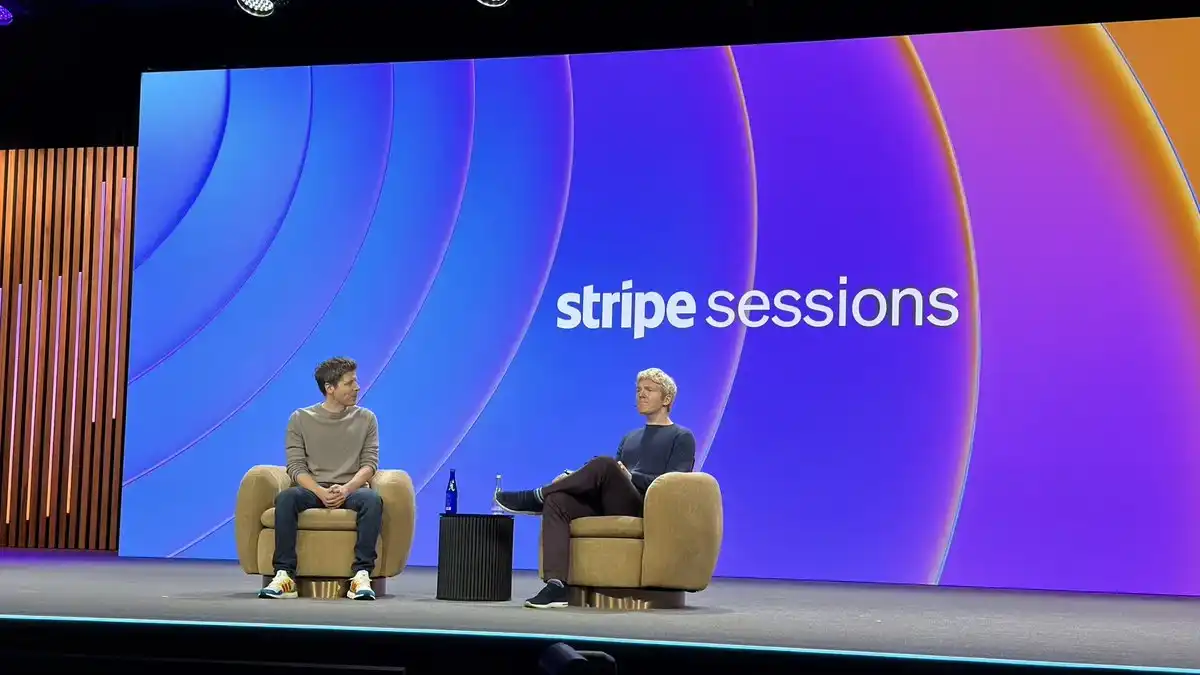
At Stripe's 2026 annual conference, OpenAI CEO Sam Altman joined Stripe CEO Patrick Collison for a fireside chat. Altman shared key insights on the AI revolution, emphasizing that we are in a period of rapid takeoff, with AI capabilities advancing weekly. He outlined OpenAI's evolution from a research lab to a product company and now a large-scale "token factory" – a low-margin, utility-like provider of intelligence. Altman stressed that the most successful AI adopters have CEOs who personally automate workflows, driving organizational change. A significant shift is the rise of the "idea person." Altman now actively invests in founders with deep product insight but no coding skills, as AI tools enable them to build. He advocates for "suspension of disbelief" in investing, planning long-term (e.g., 20-year infrastructure deals) while focusing on a clear 2-year product roadmap. Beyond products, Altman is most excited about AI accelerating scientific discovery, shortening decade-long research cycles in complex diseases and driving breakthroughs in materials science and energy. He predicts the first profitable fusion reactor could emerge within five years, spurred by AI's compute demands. Finally, Altman defended OpenAI's philosophy of iterative public deployment over elite control, believing democratizing AI access is crucial to avoid centralized power and unlock global innovation.

marsbit05/15 13:52

Sam Altman in Conversation with Stripe CEO: The Era Where Ideas Are More Valuable Than Code Has Arrived!

marsbit05/15 13:52

活动图片