AI has created a pair of gene scissors that never existed in nature.
And they work better than the pair honed by billions of years of evolution.
On July 16th, Nature published news that scientists used AI to create CRISPR enzymes never seen in nature, which cut genes more cleanly than the "natural version." The paper was published in Science on the same day.
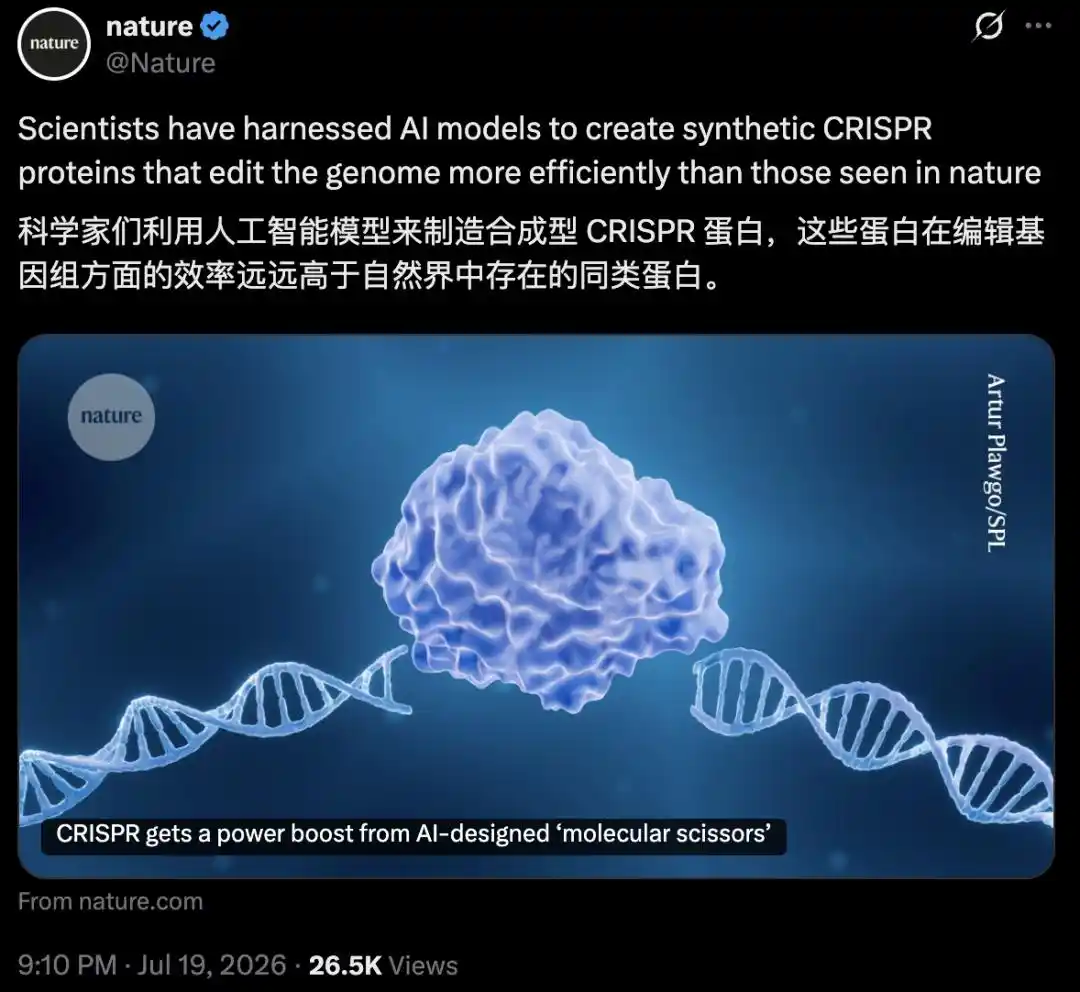
The project was led by Jennifer Doudna, who won the Nobel Prize in Chemistry in 2020 for CRISPR.
She once told Nature: proteins can be modified. But once you start, you find that after modification, it basically doesn't work anymore.
This problem has stumped humans for over a decade.
Then AI arrived, changing 30% of the protein sequence while keeping the enzyme functional.
And this is just one line of research.
On another front, the startup Profluent bypassed TnpB entirely and directly generated an entirely new Cas9.
The results were equally striking: it cuts the intended target more cleanly and barely touches unintended sites, with off-target editing rates approximately 95% lower than the most common SpCas9.
The tools produced by billions of years of evolution are being rewritten by AI in design space.
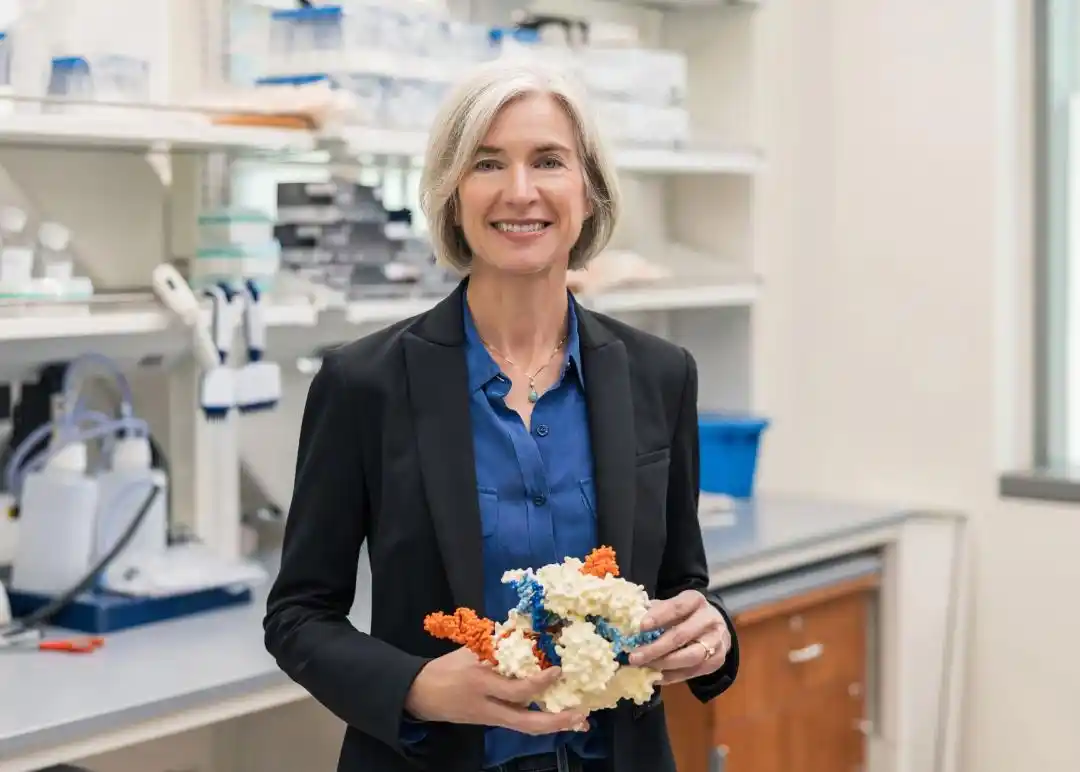
Jennifer Doudna, biochemist at UC Berkeley, 2020 Nobel Laureate in Chemistry, founder of the Innovative Genomics Institute. (Image source: Jussi Puikkonen/KNAW)
How Counterintuitive Is It to Remain Functional After 30% Modification?
CRISPR was not invented by humans.
Whether it's Cas9 or Cas12, they are all pre-existing "parts" borrowed from bacteria.
Bacteria use them to resist viral invasion. Humans took a liking to this mechanism, moved it into the lab, paired it with a guide RNA, and created "molecular scissors" that can precisely locate and cut a single position among 3 billion base pairs.
The Nobel Prize awarded to Doudna and Charpentier rewarded the "discovery" more than the "design."
But the problem lies here. Borrowed "parts" are not tailored to human needs in terms of size or behavior. To get smaller, more precise, less immunogenic, or capable of recognizing more targets, we could only rely on manual, incremental modifications.
But these things are notoriously difficult to modify.
Most Cas9 proteins are over 1000 amino acids long. The theoretical sequence space is 20 to the power of 1000: a number many orders of magnitude larger than the total number of atoms in the observable universe.
In such a vast space, viable solutions are extremely sparse, and the range humans can explore is pitifully small.
Therefore, in recent years, similar AI-assisted work has been done, but modification levels were generally kept timidly between 1% and 2%.
Modify a bit more, and it becomes useless.
AI's Two Moves
This time, Doudna's team didn't target Cas9. They chose a class of miniature nucleases called TnpB.
They are smaller and, evolutionarily speaking, are the ancestors of Cas12.
The team wanted to know: to what extent can this sequence be altered while still retaining its gene-editing capability.
The first step was handed to an AI model.
Researchers fed the model the target structure of a specific TnpB—what the protein should look like after folding—and then asked it the reverse question:
How should the amino acid sequence be modified so that the protein still folds into this shape.
The model spat out thousands of modifications.
But this step only solved "looking right." A correctly folded protein doesn't mean it's alive.
Hence the second step: train another model, feed it all the massive amounts of experimental data accumulated in labs over the years, and have it analyze the intricate interrelationships between various parts of the protein.
Specifically, which segments are untouchable vital points, where a single change destroys function.
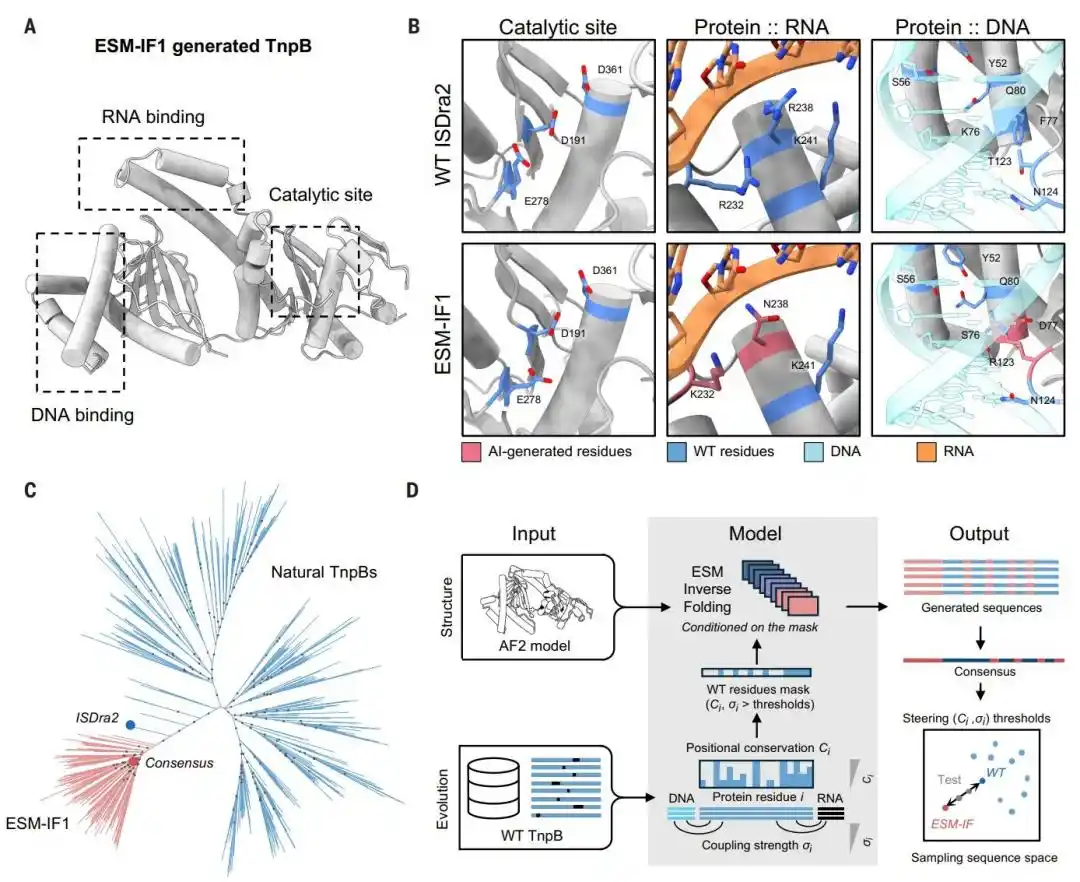
Doudna team's TnpB design process. Bottom left is the phylogenetic tree, blue represents naturally existing TnpBs, the red cluster represents AI-generated sequences, with little overlap. Bottom right shows the technical route: AF2 structure plus evolutionary constraint masking, fed into the ESM-IF1 model to generate new sequences. (Image source: Science 2026, DOI: 10.1126/science.aed6123)
The combination of the two models filtered out a small batch of synthetic nucleases.
Standard tests showed they could edit in bacteria, in plants, and in human cells.
The efficiency of inserting or deleting target fragments for some of them was even higher than their natural counterparts.
Doudna said of this result: quite exciting.
403 Mutations, These Scissors Have No Relatives in Nature
The first set of numbers was mentioned earlier: synthetic versions differ from the natural version by about 30% of their sequence, compared to 1%-2% modification in previous similar AI work.
The second set of numbers comes from protein design company Profluent, who took a different path: not modifying TnpB, but directly generating an entirely new Cas9.
They systematically mined 26TB of genomic and metagenomic data to build a database of 5.1 million CRISPR-Cas proteins, then used a protein language model to generate new sequences, achieving a diversity 4.8 times that of known natural levels.
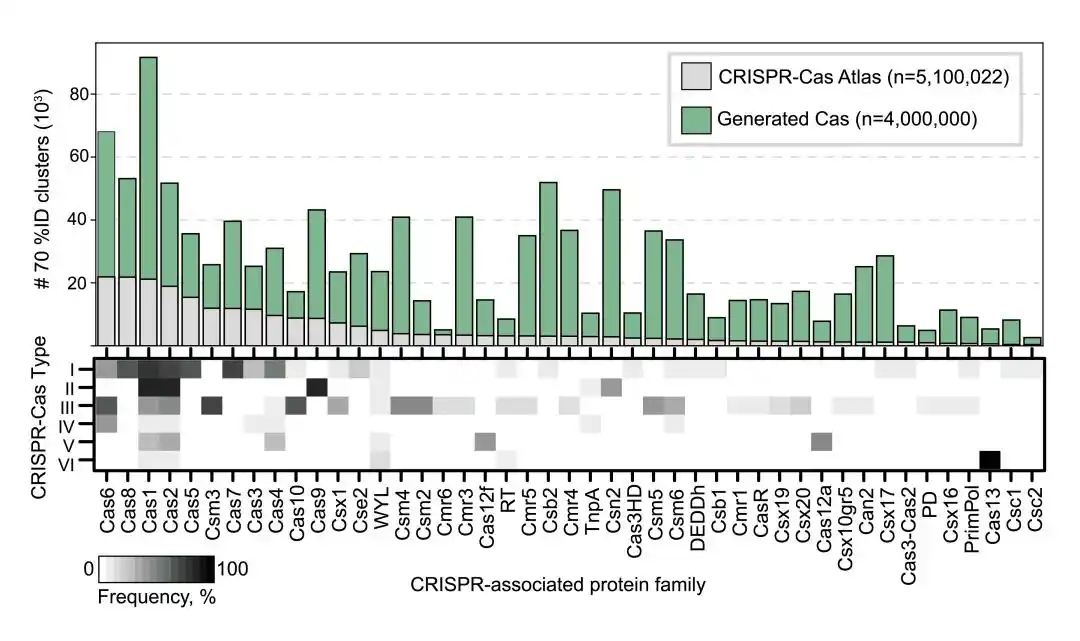
Diversity expansion of AI-generated sequences (light color) compared to natural CRISPR proteins (dark color), counted by protein cluster number. Heatmap shows distribution of protein families across different CRISPR-Cas systems. (Image source: Profluent)
They selected 48 sequences for functional validation in human cells. The best performer was named OpenCRISPR-1 and has been open-sourced.
Its report card looks like this:
On-target editing efficiency: 55.7% (SpCas9: 48.3%).
Off-target editing rate: 0.32% (SpCas9: 6.1%).
The latter represents a reduction of about 95%.
And this sequence has 403 mutations compared to SpCas9, and at least 182 mutations compared to any natural CRISPR protein in the database.
This is re-creating a "pair of scissors" from the concept itself, one that doesn't exist on Earth.
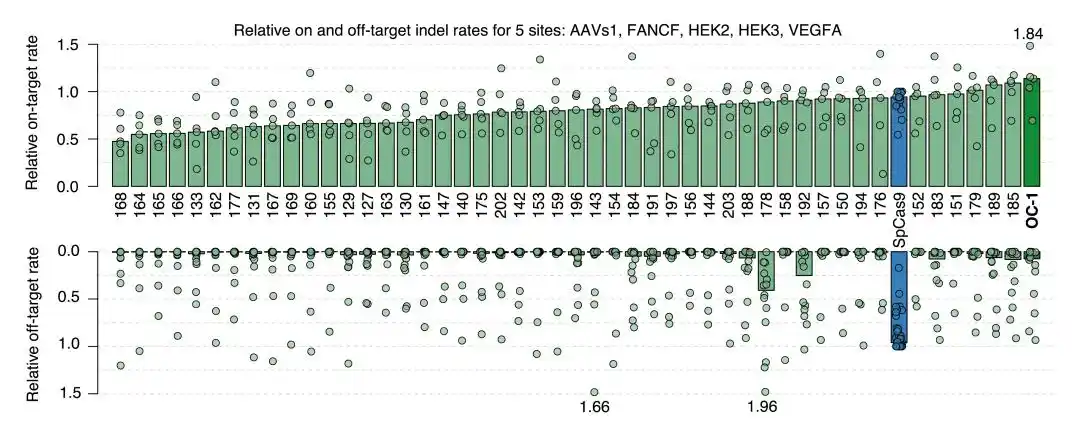
Multiple AI-generated nucleases (green, with dark green being OpenCRISPR-1) show on-target activity comparable to or higher than SpCas9 (blue), with significantly lower off-target activity. (Image source: Profluent)
The data for OpenCRISPR-1 comes from the company's own published research; independent replication will take more time.
The experiments from Doudna's line have undergone peer review by Science.
From "Discovering Nature" to "Creating Nature"
Looking at these two lines together reveals what is truly changing.
AlphaFold solved "what does this sequence look like": prediction, understanding.
Protein language models pushed further: what kind of sequence is alive, what are the patterns.
Now it's the third level: create a sequence never written by nature, and make it work in living cells.
Soeren Lienkamp, a molecular biologist at the University of Zurich, believes CRISPR allowed everyone to edit DNA as they wish, and AI-based protein design is now enabling everyone to create entirely new properties in protein space.
Those familiar with large language models might find this somewhat familiar: this approach is almost identical to how text models learn language.
Feed enough sequences, learn the internal grammar, then start generating sentences not in the corpus.
By comparison, how reliant on luck the old path was becomes clear.
Insulin was discovered in dogs, Cas9 was found in bacteria from a yogurt factory, botulinum toxin came from a food poisoning incident.
None of these tools were designed; almost all were found by chance. Now there's another path: starting from the desired function, design the molecule in reverse.
A Cas9 protein typically has over 1000 amino acids. The number of possible sequence combinations is 20^1000, far exceeding the total number of atoms in the observable universe.
Evolution groped through this space for billions of years; models can run through it in just hours.
This is the truly impactful part of this story.
Except, the AI that writes code runs its creations on computers; if it writes something bad, you delete and rewrite. The AI that writes proteins runs its creations in living cells. It alters real genetic information, not a run result that can be rolled back.
This is what makes it both more nerve-wracking and more exciting.
Can It Conquer Cancer or Delay Aging?
Not yet.
The achievements mentioned in the article currently stop at cell experiments; these validations are still in the laboratory stage.
Ahead lie animal trials, clinical trials, drug approvals—each hurdle can take years.
Has AI surpassed evolution?
A more appropriate statement is: some proteins generated by AI have exceeded specific natural versions in specific experimental metrics.
This is also not the first shot fired by AI protein design.
AlphaFold, RoseTTAFold, protein language models have been developing for five or six years now, and the preprint for OpenCRISPR-1 was posted on bioRxiv as early as April 2024.

One significant meaning is that an AI-designed protein entered a more complex living system and successfully completed the entire gene-editing process.
Le Cong from Stanford University, who helped develop some of the earliest CRISPR tools for gene therapy, shares Doudna's view: basic research using natural nucleases must continue.
AI models can run so fast precisely because of the data painstakingly accumulated in labs over the past few decades. Cut off the data supply, and the models hit their limit.
Doudna says this work demonstrates the future form of AI and biology: we need AI tools to help us run faster, but to extract the maximum value from such models, we still need people who truly understand molecular mechanisms.
References:
https://x.com/Nature/status/2078829713942822983
https://www.nature.com/articles/d41586-026-02217-w
https://www.nature.com/articles/d41586-025-02135-3
https://press.airstreet.com/p/profluent-opencrispr-1-nature-magazine
https://www.iongenomics.bio/p/doudna-lab-uses-ai-to-create-new
This article is from WeChat public account "Xin Zhi Yuan", author: ASI启示录