Artículos Relacionados con NAND

El Centro de Noticias de HTX ofrece los artículos más recientes y un análisis profundo sobre "NAND", cubriendo tendencias del mercado, actualizaciones de proyectos, desarrollos tecnológicos y políticas regulatorias en la industria de cripto.
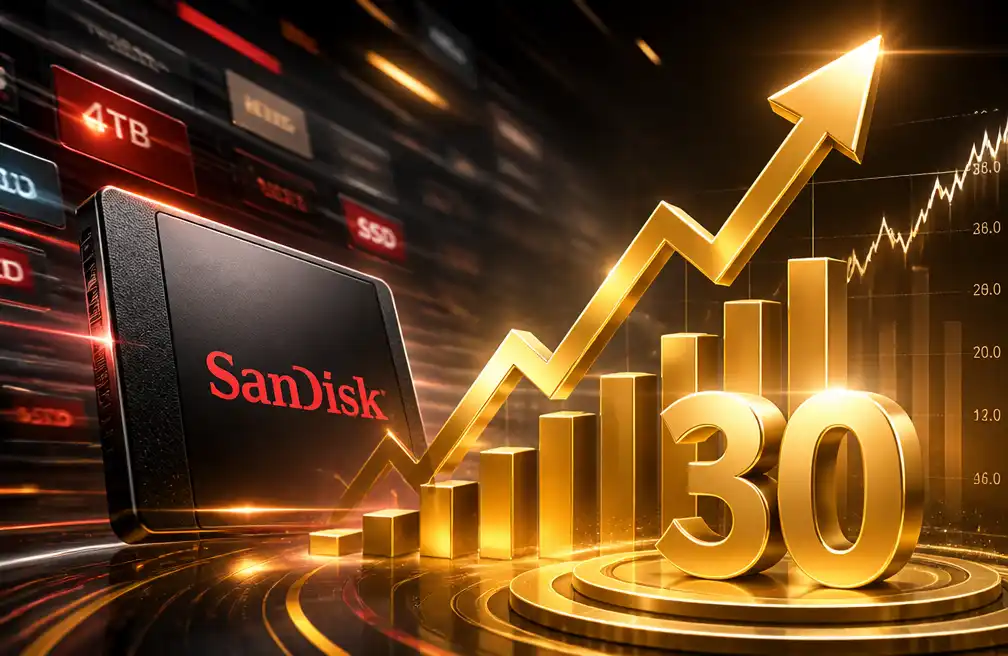
SanDisk Reports Record Earnings, Why Did It Still Plunge 8% After Hours?

SanDisk Reports Record Earnings, Yet Stock Plunges 8% After-Hours Despite announcing record-breaking Q4 and full-year fiscal 2026 results, SanDisk's stock fell sharply. Key figures were stellar: Q4 revenue surged 372% YoY to $8.97B, beating estimates, with adjusted EPS skyrocketing to $39.25. Full-year revenue hit $20.25B, with a dramatic swing from a $1.64B loss in FY2025 to an $11.43B GAAP profit, highlighting a powerful recovery driven by the NAND cycle and AI demand. The market's negative reaction stemmed from future guidance failing to meet elevated expectations. SanDisk's Q1 FY2027 revenue guidance of $10.3B-$10.8B (midpoint $10.55B) fell short of the $11.16B consensus, creating a roughly 5.5% gap. Investors are concerned not with past performance but with whether growth can accelerate further. Business segment analysis revealed a strategic shift. Data Center revenue was the standout, soaring nearly 13x YoY to $2.98B and becoming a key growth pillar at 33% of revenue. The larger Edge Computing segment also grew robustly by 392%. However, Consumer revenue declined 5% YoY, reflecting weak traditional electronics demand. Management highlighted strategic moves, including securing five new or expanded long-term supply agreements under its "New Business Model," aiming to lock in over half of FY2027 supply to smooth cyclical volatility. A new $14B stock buyback authorization signaled confidence but couldn't offset short-term guidance disappointment. The core issue is that the market is trading on the "acceleration of growth." While SanDisk's fundamentals remain strong—with record revenue and an 84.6% adjusted gross margin—the stellar performance was already priced in. The guidance, while still indicating high growth (~359% YoY), did not show further acceleration, causing a "sell the news" reaction as expectations had outpaced reality.

Odaily星球日报Hace 15 hora(s)

SanDisk Reports Record Earnings, Why Did It Still Plunge 8% After Hours?

Odaily星球日报Hace 15 hora(s)

Goldman Sachs Details Korea Memory "8 Key Focus Points": Valuation, Long-Term Agreements, Inventory, CXMT Impact, Buybacks, etc.

Goldman Sachs maintains a "Buy" rating on Samsung Electronics and SK Hynix, stating their recent sharp share price corrections reflect excessive market pessimism unsupported by fundamentals. The report addresses eight key market concerns: 1. **HBM Pricing:** GS forecasts HBM blended average prices for Samsung and SK Hynix to nearly double by 2027 due to persistent tight supply and a need to re-establish price premiums over standard DRAM. 2. **Long-Term Agreements (LTAs):** LTA terms are shifting in favor of suppliers, featuring longer terms, higher coverage targets (60-70% of capacity), "floor-price" protections, and significant upfront customer deposits. 3. **Inventory:** While module maker inventory is elevated, this represents a small portion of the overall market. Supplier and end-customer inventories remain healthy at low levels. 4. **NAND Supply:** Fears of a NAND oversupply are overblown. Strong enterprise SSD demand is expected to offset consumer weakness, with the supply-demand gap widening through 2027. 5. **Shareholder Returns:** GS expects both companies' actual dividends to exceed current market consensus. Share buybacks would be well-received, especially for SK Hynix to counter ADR-related dilution. 6. **SK Hynix ADR Premium:** The ADR's ~30% premium over the local share is likely persistent due to conversion constraints but aids long-term valuation re-rating by improving global investor access. 7. **SK Hynix Q2 '26 Results:** The earnings miss was due to one-time factors like slower HBM4 mix transition. Q3 is expected to see a strong recovery with higher volumes and better pricing/mix. 8. **CXMT Impact:** The competitive threat from China's CXMT is limited to the domestic market due to its technology lag and different product mix, posing minimal risk to the global supply-demand balance. GS concludes the current low valuations (approx. 3.5x 2027 P/E) imply an unrealistic lack of profit sustainability.

marsbitAyer 06:41

Goldman Sachs Details Korea Memory "8 Key Focus Points": Valuation, Long-Term Agreements, Inventory, CXMT Impact, Buybacks, etc.

marsbitAyer 06:41

Despite the sell-off, Goldman Sachs remains bullish on Samsung and SK Hynix. Here's why.

Goldman Sachs maintains "Buy" ratings on Samsung Electronics and SK Hynix despite recent stock declines. Its bullish view centers on three core arguments. Firstly, it expects HBM (High Bandwidth Memory) pricing to re-establish a premium over conventional DRAM by 2027, with a projected blended ASP of around $2.9/Gb. This is driven by tight supply-demand dynamics, increasing manufacturing complexity for newer HBM generations, and the need to restore its historical price premium. Secondly, the volatility of the memory cycle is expected to moderate due to widespread adoption of 3-5 year Long-Term Agreements (LTAs) with key customers. These contracts, covering a significant portion of planned capacity, feature mechanisms like price floors, prepayments, and penalties, reducing supplier risk and improving earnings visibility. Thirdly, inventory levels remain low at key suppliers and major customers, providing a buffer against a sharp downturn. Furthermore, robust demand from enterprise SSDs for AI servers is seen offsetting weakness in consumer segments like smartphones and PCs, preventing NAND markets from slipping into oversupply in the near term. While risks exist—such as potential weaker AI demand or aggressive capacity expansion—Goldman Sachs believes the combination of HBM repricing, LTAs, and low inventory underpins a more stable earnings outlook for the leading Korean memory makers.

marsbitAyer 04:11

Despite the sell-off, Goldman Sachs remains bullish on Samsung and SK Hynix. Here's why.

marsbitAyer 04:11

Kioxia's Profit Margin Approaches 80%, J.P. Morgan Raises Its Target Price to 155,000 Yen

According to a JP Morgan report, Kioxia's target price has been raised to ¥155,000, following record-breaking Q1 FY2026 results and the announcement of a framework for up to ¥800 billion in share buybacks. The bank's optimism is based on a convergence of data center SSD price increases, rising profitability, and shareholder returns, rather than simply higher NAND shipments. Kioxia's Q1 results showed revenue of approximately ¥1.77 trillion, up 415.5% year-on-year, with a non-GAAP operating margin of 75.0%. Even stronger, the Q2 guidance forecasts revenue of ~¥2.39 trillion and a non-GAAP operating margin of ~79.5%. This surge is primarily driven by significant ASP growth in enterprise and data center SSDs, fueled by generative AI-related demand, alongside improved product mix and advanced node adoption (e.g., BiCS 8 FLASH). The ¥155,000 target price is derived from FY2027 EPS estimates and a ~11x P/E multiple, above the historical sector average. This premium reflects reduced selling pressure from Bain Capital and the potential for long-term agreements to stabilize earnings. A key future catalyst is the potential for agentic AI to create new NAND workloads, supporting demand beyond the current cycle. While the massive share buyback plan signals capital return commitment and helps ease concerns about cyclical overspending, risks remain. The sustainability of SSD price hikes, the actual scale of incremental AI-driven demand, and the industry's ability to maintain capital discipline to avoid a new supply glut by 2027 are critical factors for the stock's continued re-rating.

marsbit08/03 08:51

Kioxia's Profit Margin Approaches 80%, J.P. Morgan Raises Its Target Price to 155,000 Yen

marsbit08/03 08:51

Global Market Share Survey: Japanese Firms Lead in Semiconductor Materials

Global Market Share Survey: Japanese Firms Lead in Semiconductor Materials According to the 2025 "Major Goods and Services Market Share Survey" by Nikkei, Japanese companies maintain strong positions in semiconductor-related materials. In silicon wafers, Shin-Etsu Chemical ranks first with a 26.3% share, followed by SUMCO at 17.8%. Together, they hold 44.1% of the market, widening their lead over competitors from Taiwan, Germany, and South Korea. In photoresists, Tokyo Ohka Kogyo, JSR, and Shin-Etsu Chemical occupy the top three spots, with a combined share of 60.5%. Despite their strength in materials, Japanese firms have a weaker presence in core semiconductor segments like DRAM and NAND flash memory, where South Korean and U.S. companies dominate. For instance, SK Hynix and Samsung lead in DRAM, while China’s CXMT doubled its share to 6% in 2025. The semiconductor market is projected to grow rapidly, with WSTS forecasting a 90% increase to $1.5112 trillion by 2026. Major players like Samsung, SK Hynix, and Micron are making massive investments to expand capacity. To maintain their edge in materials, Japanese companies must similarly commit to large-scale, risk-taking investments. In contrast, Japan’s automotive sector shows stagnation. Toyota remains the global leader but with only a slight share increase to 12.3%, while Japanese brands are absent from the top five in the EV market. In shipbuilding, Imabari Shipbuilding rose to third place globally with a 7.2% share, benefiting from large container ship deliveries. However, Chinese and South Korean firms dominate the sector, holding the top two positions. Japan aims to revitalize its shipbuilding industry through government and corporate efforts, targeting a near doubling of output by 2035. Addressing labor shortages and adopting advanced technologies like physical AI will be critical for competitiveness.

marsbit07/31 04:21

Global Market Share Survey: Japanese Firms Lead in Semiconductor Materials

marsbit07/31 04:21

SK Hynix Q2 Profit Soars Sixfold, Still 'Misses Expectations'; Secures Long-Term Agreements with 10 Clients, HBM4 to Accelerate Volume Ramp in Second Half

SK Hynix reported record-breaking Q2 2026 financial results, with operating profit soaring 557% year-over-year to 60.5 trillion won and revenue increasing 257% to 79.3 trillion won, driven by strong demand for AI server memory, HBM, and enterprise SSDs. The operating profit margin reached 76.3%. However, both figures fell short of analyst expectations, leading to a drop in its share price. The company attributed the earnings miss to three factors: a high sales mix of HBM, which limited upside from surging prices of general-purpose DRAM; a deceleration in memory price increases compared to Q1; and long-term supply agreements (LTAs) with major customers that lock in prices, reducing sensitivity to spot market gains. SK Hynix has signed LTAs with about 10 clients, covering roughly half of its sales. Despite the miss, the company remains optimistic about AI-driven demand. Its net profit of 93.9 trillion won was significantly boosted by a one-time gain from the partial sale of its Kioxia stake. Financially, it strengthened its cash position, ending the quarter with a net cash position of 69.4 trillion won. Looking ahead, SK Hynix plans capital expenditures at the high end of its 40-50 trillion won range for 2026 to expand capacity for HBM and advanced NAND products, including accelerating the mass production of HBM4 in the second half of the year.

marsbit07/29 01:47

SK Hynix Q2 Profit Soars Sixfold, Still 'Misses Expectations'; Secures Long-Term Agreements with 10 Clients, HBM4 to Accelerate Volume Ramp in Second Half

marsbit07/29 01:47

活动图片