Kioxia's Profit Margin Approaches 80%, J.P. Morgan Raises Its Target Price to 155,000 Yen

marsbitPublicado a 2026-08-03Actualizado a 2026-08-03

Resumen

According to a JP Morgan report, Kioxia's target price has been raised to ¥155,000, following record-breaking Q1 FY2026 results and the announcement of a framework for up to ¥800 billion in share buybacks. The bank's optimism is based on a convergence of data center SSD price increases, rising profitability, and shareholder returns, rather than simply higher NAND shipments. Kioxia's Q1 results showed revenue of approximately ¥1.77 trillion, up 415.5% year-on-year, with a non-GAAP operating margin of 75.0%. Even stronger, the Q2 guidance forecasts revenue of ~¥2.39 trillion and a non-GAAP operating margin of ~79.5%. This surge is primarily driven by significant ASP growth in enterprise and data center SSDs, fueled by generative AI-related demand, alongside improved product mix and advanced node adoption (e.g., BiCS 8 FLASH). The ¥155,000 target price is derived from FY2027 EPS estimates and a ~11x P/E multiple, above the historical sector average. This premium reflects reduced selling pressure from Bain Capital and the potential for long-term agreements to stabilize earnings. A key future catalyst is the potential for agentic AI to create new NAND workloads, supporting demand beyond the current cycle. While the massive share buyback plan signals capital return commitment and helps ease concerns about cyclical overspending, risks remain. The sustainability of SSD price hikes, the actual scale of incremental AI-driven demand, and the industry's ability to maintain capital dis...

According to a J.P. Morgan research report, Kioxia remains bullish with a target price of 155,000 yen, following its record-breaking Q1 profit and the company's announcement of establishing a framework for up to 800 billion yen in treasury stock acquisition. Compared to the stock price of approximately 46,500 yen at the time of the report, this target price suggests significant upside potential.

The core of this assessment is not simply betting on an increase in NAND shipments, but rather on the simultaneous occurrence of data center SSD price increases, improving profit margins, and enhanced shareholder returns.

Kioxia's FY2026 Q1 earnings report, released on July 31, showed that for the three months ended June 30, 2026, the company's revenue was approximately 1.77 trillion yen, a year-over-year increase of 415.5% and a sequential increase of 76.2%. Non-GAAP operating profit was about 1.33 trillion yen, a sequential increase of 121.4%, with a single quarter's profit already exceeding the full-year FY2025 non-GAAP operating profit of approximately 876.2 billion yen. The non-GAAP operating profit margin was about 75.0%.

The Q2 guidance is even more aggressive. The company expects revenue of about 2.39 trillion yen and non-GAAP operating profit of approximately 1.90 trillion yen, corresponding to a profit margin of about 79.5%, with revenue growing 35.2% sequentially. For a cyclical memory stock, this represents a window where price, profit margins, and capital returns are all being re-evaluated by the market.
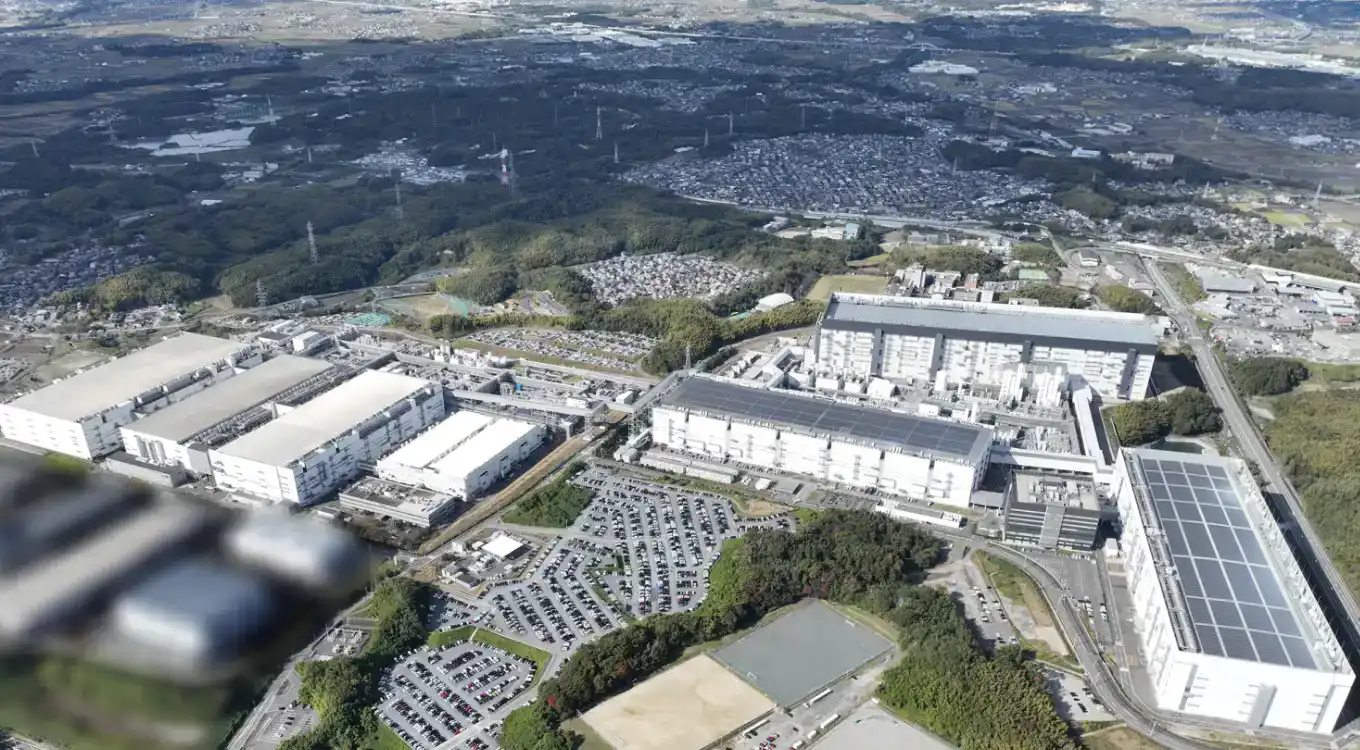
Kioxia's Yokkaichi Plant. The rebound in NAND prices, growth in enterprise SSD demand, and capital discipline are collectively impacting the company's earnings resilience.

155,000 Yen Target Price: First, Look at the Q1 Profit Surge

The most direct driver of Kioxia's recent earnings surge is enterprise SSD and data center customer demand.

The company mentioned in its earnings report that generative AI-related data center customer demand led to a significant increase in the average selling price, while bit shipments increased year-over-year. The research report further indicates that the SSD & Storage segment accounted for the majority of total revenue in Q1, with Datacenter & Enterprise being the most critical profit driver. The ASP for this segment rose approximately 70% sequentially, while bit shipment growth was only in the low single digits, with some orders slipping into Q2.

This is the primary explanation for the seemingly high target price of 155,000 yen. The improvement in profit margins is not solely dependent on volume expansion but is driven by a combination of enterprise SSD price increases, product mix improvement, and a higher proportion of advanced processes. Once price increases flow through to the income statement, operating leverage is amplified rapidly.

On the production side, the report mentions that the proportion of BiCS 8 FLASH has exceeded 50%, and lower-bit-cost technologies like QLC, along with the joint venture system with SanDisk, help support unit costs and investment efficiency. However, the more direct question for the stock price is not the technology roadmap itself, but whether Kioxia can translate this price cycle into more stable profits.

J.P. Morgan's valuation is based on FY2027 EPS and a P/E ratio of approximately 11x. This multiple is higher than the global memory manufacturers' 15-year average of around 9x. The premium justification includes reduced selling pressure from the Bain Capital consortium and the potential for long-term agreements to increase earnings stability.

But 155,000 yen is not a guaranteed return. It is built on the assumption that the NAND price cycle, enterprise SSD demand, and high profit margins can be sustained. If demand falls after price hikes, or if the industry accelerates capacity expansion again, this valuation framework will be re-examined.
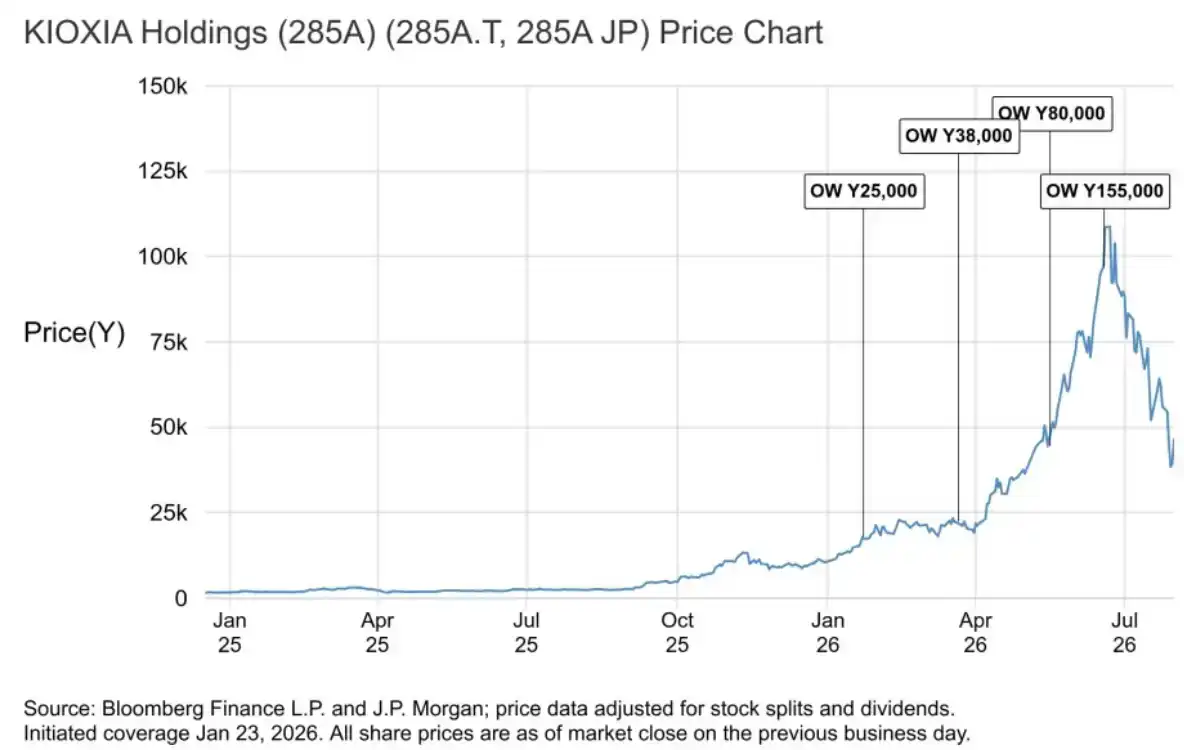
KIOXIA Stock Price Chart: The stock price has risen from around the 20,000 yen range in 2026 to approximately 46,500 yen at the time of the report, with multiple target price upgrades along the trajectory.

The Uptrend Continues in Q2, AI Storage Demand Becomes the New Narrative

Q2 guidance indicates that Kioxia's upward momentum did not stop in Q1.

The company expects Q2 revenue of about 2.39 trillion yen, a sequential increase of 35.2%, with the non-GAAP operating profit margin rising to approximately 79.5%. The earnings report attributes the growth primarily to data center customer demand and a significant increase in ASP. The research report's view is that Datacenter & Enterprise demand is strongest, with contributions from smartphones as well.

The longer-term focus is on 2027. Both management and the research report mention that CY2026 industry NAND bit demand may maintain high-teens growth, and CY2027 demand could potentially exceed supply. If this judgment holds, the NAND industry would not just be experiencing a traditional cyclical rebound but entering a phase of tight supply, providing more support for prices and profit margins.

AI is a new catalyst. Management sees agentic AI as a significant source of new NAND workloads alongside traditional server demand growth. Simply put, if AI applications expand from training and inference to more autonomous agent workflows, the amount of data servers need to process, cache, and store will increase, thereby expanding enterprise SSD demand.

However, this line of reasoning is not as directly visible as GPU orders. AI's pull on NAND depends more on cloud vendor procurement, enterprise customer deployments, and server architecture changes. In the short term, the market can already see enterprise SSD price increases and Kioxia's rising profit margins. In the medium to long term, it depends on how much new storage orders agentic AI can actually bring.

80 Billion Yen Buyback Boosts Sentiment, Cyclical Risks Remain

Kioxia also announced the establishment of a framework for acquiring up to 800 billion yen in treasury stock. For a cyclical memory stock, this move directly addresses market expectations for shareholder returns and stock price support.

The significance of the buyback is that during a phase of improving profits and cash flow, the company is not reserving funds solely for capacity expansion but is also signaling a commitment to shareholder returns. This helps alleviate market concerns about memory manufacturers' tendency to "expand capacity when they make money, leading to oversupply later."

The research report also mentions that the company reiterated its CY2028 long-term agreement sales coverage target of 50%. If long-term agreements can increase visibility on sales volume and price, Kioxia's profit volatility might be lower than that of traditional cyclical memory stocks, making it easier for the market to accept a valuation above the historical average.

However, a buyback is not the answer to all problems. Although the Q2 guidance is strong, it still fell short of some high market expectations. Additionally, some bit shipments from Q1 slipped into Q2. The research report also takes a more cautious short-term view regarding QLC penetration in the nearline HDD market, noting that the speed of SSD replacing HDD cannot be extrapolated linearly.

The bigger risk remains on the supply side. The NAND industry has historically seen multiple instances of capital expenditure expansion following price increases, ultimately leading to renewed supply-demand imbalance. If AI demand does not consistently exceed expectations, or if major manufacturers accelerate capacity expansion again, the judgment of "demand exceeding supply" in 2027 will come under pressure.
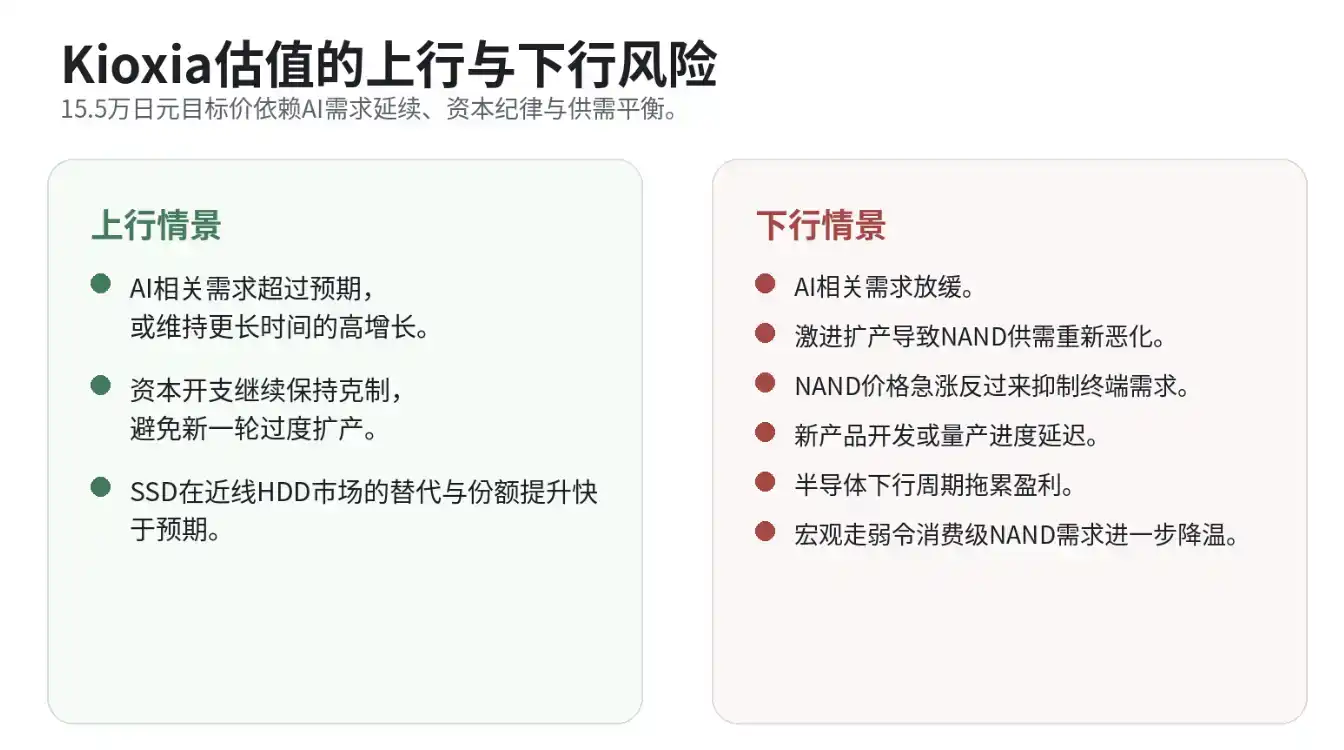
Upside and Downside Risk Scenarios: Upside includes AI demand, capital discipline, and SSD replacing HDD. Downside includes demand slowdown, excessive capacity expansion, and demand drop-off after rapid price increases.

Kioxia's market story is now clear: a Q1 profit margin of 75%, a Q2 guidance margin approaching 80%, a maximum 800 billion yen buyback providing sentiment support, and a 155,000 yen target price that incorporates both the NAND upturn cycle and AI storage demand into a higher valuation.

The next phase of this trend hinges on three specific questions: how long can enterprise SSD price increases last, how much of the new NAND demand driven by AI can be realized, and whether the industry can avoid another supply glut around 2027.

Preguntas relacionadas

QWhat is the core reasoning behind J.P. Morgan's raised target price of 155,000 yen for Kioxia?

AThe core reasoning is not simply betting on increased NAND shipments, but a combination of rising data center SSD prices, improving profit margins, and enhanced shareholder returns occurring simultaneously.

QWhat were Kioxia's key financial figures for its first quarter of FY2026?

AFor the first quarter of FY2026 (ending June 30, 2026), Kioxia's revenue was approximately 1.77 trillion yen, a 415.5% year-over-year increase. Non-GAAP operating profit was about 1.33 trillion yen, with a non-GAAP operating margin of approximately 75.0%. Notably, this single quarter's profit surpassed the full-year FY2025 non-GAAP operating profit of about 876.2 billion yen.

QWhat new market narrative is potentially driving storage demand beyond the current cycle, according to the article?

AThe article identifies AI, specifically agentic AI, as a new narrative. It is seen as a source of new NAND workloads and traditional server demand growth, potentially increasing the need for enterprise SSDs as AI applications expand from training/inference to more autonomous agent workflows.

QWhat shareholder return measure did Kioxia announce alongside its earnings, and what is its potential impact?

AKioxia announced a framework to acquire up to 800 billion yen worth of treasury stock (share buyback). This signals a commitment to shareholder returns, helps support the share price, and may alleviate market concerns that storage companies just reinvest profits into expansion, which can lead to future oversupply.

QWhat are the main potential downside risks highlighted for Kioxia's optimistic outlook?

AThe main downside risks include: 1) Demand slowing down if enterprise SSD price increases are not sustained. 2) The NAND industry historically tends to over-expand capacity when prices rise, which could lead to renewed oversupply and pressure the 'demand exceeding supply' forecast for 2027. 3) The actual scale of new storage demand from AI may not meet expectations.

Lecturas Relacionadas

Soaring 20% Then Dropping 5%: When Will the Bottom of the Korean Stock Market Be?

"South Korean stocks face a turbulent period as the KOSPI index, after a 20% surge, fell 5% to 6257 points. The market is grappling with severe issues: over 500,000 leveraged retail accounts have been liquidated, and more than 24 trillion won has flowed from stocks into bank deposits for safety. This reflects a significant loss of market liquidity and shaken investor confidence. In response, Korean financial regulators are taking action. They have tripled the minimum保证金 (margin) requirement for single-stock leveraged ETF trades to 30 million won and are considering granting themselves "emergency intervention" powers. These could include capping leverage ratios and setting investment limits on these ETFs, seen by many as amplifying market volatility. Initial results show a 75% drop in these products' trading volume post-regulation. The market downturn has political repercussions, pushing President Yoon Suk-yeol's approval rating to a new low. Meanwhile, foreign investors made a record net purchase of 7.18 trillion won during a recent rebound, while domestic retail investors sold off massively. Morgan Stanley has upgraded South Korean stocks to "overweight," citing the ongoing "leverage unwinding" and potential for a 36% upside, with giants like Samsung Electronics and SK Hynix providing valuation support. However, analysts caution that the market's structure remains vulnerable to foreign capital flows, and the current low may not be the bottom."

marsbitHace 4 min(s)

Soaring 20% Then Dropping 5%: When Will the Bottom of the Korean Stock Market Be?

marsbitHace 4 min(s)

Goldman Sachs Stakes a Clear Position: This Is the Largest Capital Demand Cycle in Human History, and the Fed Is Just an Observer

Goldman Sachs argues that the world is entering the most capital-intensive investment cycle in history, driven by concurrent massive demands from AI infrastructure, reindustrialization, defense reinvestment, power grid rebuilding, supply chain realignment, and sovereign debt financing. This structural competition for capital is pushing its cost higher, fundamentally altering investment paradigms. Goldman's Mark Wilson states that the Federal Reserve is merely a "passenger, not the driver" in this shift, with rising yields rooted in these real economy demands rather than just monetary policy. While major indices appeared calm in July, underlying market movements were historic, featuring extreme stock dispersion and a severe momentum factor crash, leading to significant de-risking by fund managers. Wilson cautions against expecting a quick reversal in August, citing ongoing digestion of higher rates, disrupted risk models, and typically muted market performance ahead of US midterm elections. Corporate fundamentals remain robust with strong earnings, though growth rates are peaking in the US while accelerating in Europe. Notably, hyperscale cloud companies like Amazon and Microsoft are announcing staggering capital expenditure projections for 2027-2028, justified by explosive AI-related revenue growth and high returns. Amazon revealed its AI revenue run-rate exceeds $25 billion, growing triple-digits annually, and expressed confidence that AWS could become a trillion-dollar revenue business. The report concludes that a transitional period is underway, marked by a growing tension between aggressively investing private tech giants and increasingly capital-constrained sovereign governments. The AI super-cycle continues, with August likely being a consolidation phase.

marsbitHace 9 min(s)

Goldman Sachs Stakes a Clear Position: This Is the Largest Capital Demand Cycle in Human History, and the Fed Is Just an Observer

marsbitHace 9 min(s)

Outflow of Stablecoins from South Korea Continues for 18 Consecutive Months, Exceeding $360 Million in June

In June 2026, South Korea experienced a net outflow of stablecoins to overseas crypto exchanges, amounting to 560.3 billion won ($367 million). This represents approximately 78% of the net value of foreign stocks purchased by Korean investors in the same period. According to the Financial Supervisory Service (FSS), this marks the 18th consecutive month of net outflows, a trend ongoing since January 2025. The FSS reported that 2.76 trillion won ($1.8+ billion) in stablecoins were withdrawn from the country's five major exchanges to foreign platforms in June, while 2.2 trillion won ($1.4 billion) flowed back in. The second quarter of 2026 saw a significant net outflow of 1.69 trillion won (~$1.1 billion), surpassing net sales of foreign stocks in the same period. Analysts cite access to unavailable domestic financial instruments as a primary driver. Foreign platforms offer crypto derivatives, spot and futures products tied to major Korean stocks like Samsung and Hyundai, along with RWA tokenization, DeFi, staking, and leveraged products. Lawmaker Lee Jong-wook warned that the stablecoin outflows constitute capital flight, exposing investors to risks on unregulated foreign platforms. He called for accelerated regulatory reform and enhanced investor protection measures. The government is reportedly working on a digital assets law to foster the blockchain sector.

cryptonews.ruHace 13 min(s)

Outflow of Stablecoins from South Korea Continues for 18 Consecutive Months, Exceeding $360 Million in June

cryptonews.ruHace 13 min(s)

Trading

Spot
活动图片