Artículos Relacionados con Marvell

El Centro de Noticias de HTX ofrece los artículos más recientes y un análisis profundo sobre "Marvell", cubriendo tendencias del mercado, actualizaciones de proyectos, desarrollos tecnológicos y políticas regulatorias en la industria de cripto.
Research Report Analysis: MRVL's Optical AI Booming, Why High Valuation Keeps Morgan Stanley's Star Analyst Sidelined?

Report Recap: MRVL Optical AI Boom - Why High Valuation Led Morgan Stanley's Star Analyst to Stay Neutral? Morgan Stanley analyst Joseph Moore maintained an "Equal-weight" (Neutral) rating on Marvell Technology (MRVL) on May 28, raising the price target from $172 to $195, below the trading price. This stance comes despite Marvell reporting a record quarter and significantly raising its full-year outlook (FY27 revenue ~$11.5B, up ~40%). Moore's neutral view is based on valuation. The $195 target implies ~40x CY2027 P/E. He contrasts MRVL with NVDA: both trade near ~$200, but Nvidia's forward EPS is more than double Marvell's. For MRVL's valuation to hold, it needs consistent earnings upgrades, proof of networking market share gains, or certainty on large-scale custom AI chip shipments—none of which are confirmed yet. Growth is driven by two pillars: **1) Optical Interconnect** (the faster runner): Moore raised FY27 growth expectations to >70%, with the optical module product line nearing a $1B annualized run rate. **2) Custom AI Chips** (the climber): Confidence in FY28 is growing, but a major new customer project only ramps in FY28, with no current revenue visibility. Key risks are the underperforming Storage, Enterprise, and legacy Networking segments. Moore acknowledges the real AI opportunity but believes the current price already reflects it. For the stock to work from here, investors need to see the optical business hit its targets, custom chips ramp as planned, and a recovery in the weaker business units.

marsbit06/17 11:39

Research Report Analysis: MRVL's Optical AI Booming, Why High Valuation Keeps Morgan Stanley's Star Analyst Sidelined?

marsbit06/17 11:39

The 'Chip' Challenge and Breakthroughs in China's Optical Industry Chain

China's Photonics Industry: Bottlenecks and Breakthroughs In the global AI race, computing chips dominate the narrative, but the underlying bottleneck increasingly defining the scale of AI clusters is light—or more specifically, optical connectivity. Optical modules, which translate electrical signals to light and vice versa, are crucial for connecting thousands of GPUs in AI data centers, preventing data congestion and ensuring efficient model training. High-speed modules (800G, 1.6T) are now standard, with performance hinging on advanced DSP (Digital Signal Processor) chips. This is where a critical dependency lies. Two US giants—Marvell and Broadcom—collectively dominate over 90% of the high-end DSP chip market. Chinese optical module leaders like Zhongji Innolight and Eoptolink rely on these chips to manufacture modules for overseas AI customers, primarily in North America. While this creates a supply chain vulnerability, complete decoupling is difficult. Marvell derives over half its revenue from Greater China, and the US firms depend on Chinese partners for chip packaging and optical components. The risk from laser chips (e.g., from Lumentum), another key component, is considered more manageable due to multiple global suppliers and faster progress in domestic alternatives from companies like YOFC and Accelink. To mitigate risks, China's industry is pursuing a multi-pronged strategy: diversifying supply chains and locking in long-term orders; fostering a domestic market ecosystem to adopt homegrown DSPs from firms like Huawei HiSilicon and CETC; accelerating R&D in high-speed DSPs and advanced packaging; and investing in next-gen technologies like silicon photonics and Co-Packaged Optics (CPO) to reduce reliance on discrete DSPs. The ultimate solution lies not in short-term博弈 but in persistent advancement of domestic high-end chip R&D and manufacturing. While challenges remain in performance, certification, and ecosystem building, China's vast domestic market and manufacturing base provide a crucial buffer, buying time for the industry to achieve greater technological independence.

marsbit06/17 04:47

The 'Chip' Challenge and Breakthroughs in China's Optical Industry Chain

marsbit06/17 04:47

After Marvell's 32% Surge, the Chinese Chip Family Behind It Emerges

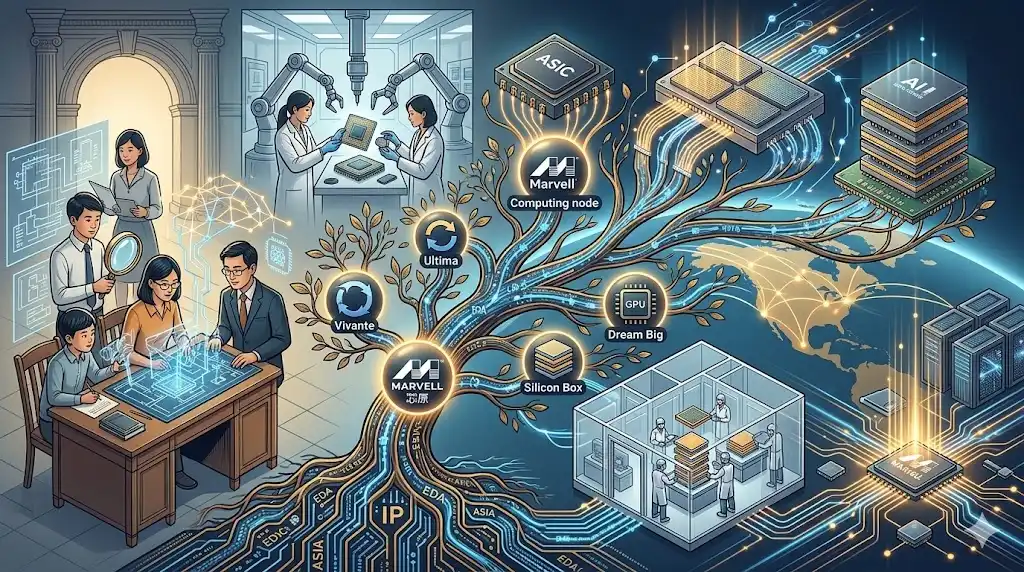
The stock price of Marvell Technology surged 32.5% on June 2nd, driven by NVIDIA CEO Jensen Huang highlighting its custom ASICs and optical interconnects as core to AI data center architecture. This event brought attention to the Chinese semiconductor family behind Marvell: the Dai siblings. The story centers on three siblings, all UC Berkeley graduates, whose three-decade entrepreneurial journey aligns with major semiconductor industry shifts. In 1995, youngest sister Dai Wei Li co-founded Marvell with her husband Sehat Sutardja and his brother, focusing on storage controllers. Eldest brother Dai Wei Min founded EDA company Ultima, later sold to Cadence, and later founded VeriSilicon (芯原) in China, becoming a leading semiconductor IP provider. Second brother Dai Wei Jin co-founded EDA firm Silicon Perspective (sold to Cadence) and GPU IP company Vivante, later acquired by VeriSilicon. The combined "Dai-Sutardja" family network extends beyond Marvell. Their ventures and investments form a comprehensive ecosystem for the post-Moore's Law, chiplet era. Key holdings include: Dream Big Semiconductor (AI SuperNICs, acquired by Arm), Alphawave (high-speed SerDes IP, acquired by Qualcomm), and Silicon Box (a chiplet advanced packaging foundry). VeriSilicon itself thrives on the AI ASIC and IP boom in China. Collectively, the family's AI infrastructure-related portfolio is estimated at over $22 billion. Their strategy represents a distinct path: building critical components for open standards and key manufacturing capacity in the chiplet era, rather than pursuing standalone AI chip dominance. While this path may not create the next NVIDIA, it has enabled repeated successful exits and sustained influence within the global semiconductor industry.

marsbit06/03 11:16

After Marvell's 32% Surge, the Chinese Chip Family Behind It Emerges

marsbit06/03 11:16

Huang Renxun and Marvell CEO Discuss on Stage: The Future of AI Competition is Not Computing Power but Connectivity, 'Use Copper Where You Can, Use Optics Only Where You Must'

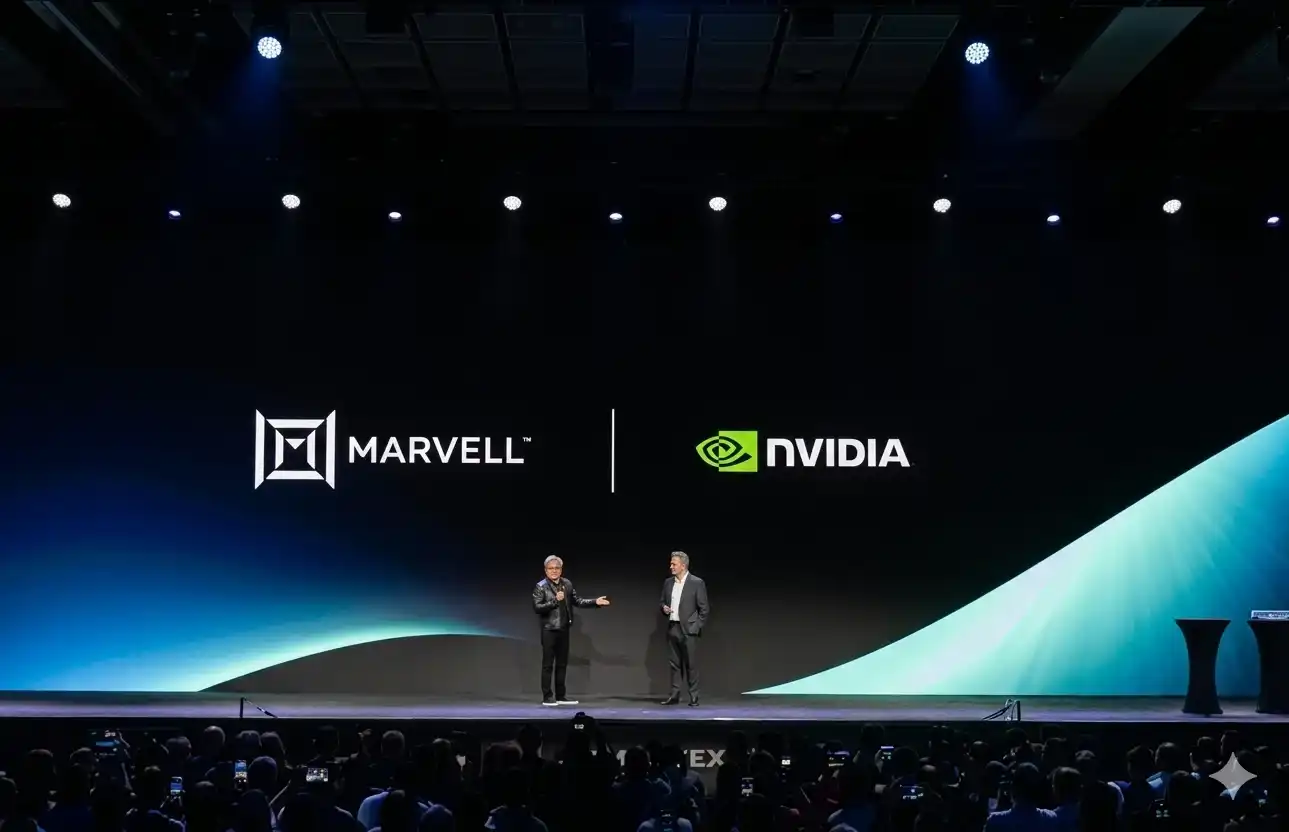
Summary: At Computex 2024, NVIDIA CEO Jensen Huang joined Marvell CEO Matt Murphy on stage, highlighting the strategic partnership between their companies. The core theme was that the next decisive battleground for AI infrastructure is not compute or memory, but connectivity. As AI models evolve into vast agent-based systems, the ability to connect millions of processors efficiently is becoming the critical bottleneck. Huang announced NVIDIA's strategic $20 billion investment in Marvell, reflecting the deep integration between their technologies for AI data centers. A key discussion point was the transition from copper to optical interconnects within racks. The guiding principle, articulated by Huang, is: "You use optics wherever you must, you use copper wherever you can." While copper remains cost-effective for short distances, its physical limits are being reached as bandwidth demands double. When moving to 400Gbps, copper can no longer fully connect an entire rack. This shift necessitates innovations like Co-Packaged Optics (CPO), which integrates optical engines directly into the chip package to solve density and power challenges. Marvell demonstrated its 51.2T CPO-based switch, eliminating copper traces on the PCB. The future vision is a "distance-free data center," where optical connectivity removes physical constraints. This allows for fully disaggregated, dynamic architectures where compute, memory, and storage pools can be combined on-demand based on workload requirements, rather than being limited by connection boundaries. Marvell, positioned as a neutral "Switzerland" in the ecosystem with a comprehensive portfolio across all connectivity distances, is central to enabling this next era of AI infrastructure.

marsbit06/02 09:41

Huang Renxun and Marvell CEO Discuss on Stage: The Future of AI Competition is Not Computing Power but Connectivity, 'Use Copper Where You Can, Use Optics Only Where You Must'

marsbit06/02 09:41

活动图片