The Ethereum Community Is in an Uproar! Who Stands to Lose with EIP-8363?

marsbitPublicado a 2026-08-05Actualizado a 2026-08-05

Resumen

The Ethereum community is deeply divided over the controversial EIP-8363 proposal, which aims to introduce a "tapered issuance burn" to curb the growth of ETH staking. Authored by researchers including Jérôme de Tychey and Justin Drake, the proposal would gradually reduce and eventually eliminate the consensus-layer issuance rewards for validators when the total staked ETH approaches 50% of the total supply (approximately 60.25 million ETH). This is intended to discourage excessive staking concentration among large institutional providers and reduce the dilution pressure on non-staking ETH holders, potentially strengthening native ETH as a neutral asset. Currently, even at 100% staking, validators have a theoretical minimum reward of about 1.5%. EIP-8363 would implement a burn mechanism based on the staking ratio, making net consensus rewards approach zero at the 50% threshold, though execution-layer rewards (priority fees, MEV) remain unaffected. At the current ~33% staking ratio, annual consensus yield would drop from ~2.6% to ~1.2%. An 18-month transition period is proposed to soften the impact. The community reaction has been largely negative. Critics, including Aave founder Stani Kulechov and ether.fi CEO Mike Silagadze, argue it undermines predictable cash flows for institutional investors, hurts solo stakers by making their operations less viable against fixed costs, and could destabilize the DeFi ecosystem built around Liquid Staking Tokens (LSTs). They also fear it...

Original author: KarenZ, Foresight News

Intuitively, the more ETH staked, the higher the economic cost to attack the network.

However, an increase in the staking scale does not necessarily bring an equivalent gain in security; if the new stakes primarily flow to a few large service providers, the validator ecosystem might instead become more centralized.

On August 4th, Jérôme de Tychey, founder of EthCC, Justin Drake from the Ethereum Foundation, and four other researchers jointly submitted the "Tapered Issuance Burn" proposal. It attempts to install a "revenue downslope" for the continuously growing staking ratio, and when the staked amount approaches 50% of the total ETH supply, the consensus-layer issuance rewards obtained by validators will be completely offset.

This proposal was initially released with the number EIP-8361, but as that number had already been assigned to another proposal, it was subsequently changed to EIP-8363. Although it is still in the early draft stage, it has rapidly become one of the most contentious topics in the Ethereum community.

What is this proposal actually trying to do?

Currently, Ethereum consensus-layer rewards decrease as the total amount staked increases. However, even if all ETH were staked, there still exists a theoretical lower bound of approximately 1.5% for the nominal consensus yield of an individual validator.

The authors of EIP-8363 argue that this means the protocol always provides positive incentives for more staking, without a real "stop button," which could drive ETH towards concentration among large custodians, exchanges, and staking derivatives.

Additionally, unstaked ETH is continuously diluted by new issuance. Liquid Staking Tokens (LSTs), because they come with yield, can more easily replace native ETH as collateral in DeFi and savings assets. The proposal authors hope to reduce this dilution pressure, allowing native ETH to become a more competitive neutral asset again.

The solution given by the proposal is not to prohibit new validators from entering, nor to rigidly lock the staking ratio at 50%, but to deduct and burn a portion of the validator's calculated reward after its normal calculation. The burn proportion depends on the total effective staked balance: calculated as "the ratio of the total effective staked balance to 60.25 million ETH raised to the power of 1.5," with an upper limit of 100%, i.e.:
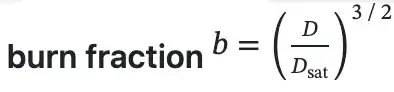
60.25 million ETH is approximately half of the current total ETH supply. As the staked amount approaches this value, the validator's net consensus-layer profit gradually approaches zero; upon reaching or exceeding this value, the consensus-layer issuance rewards earned by normally, fully performing validators will be completely offset by the new burn deductions. It should be added that 60.25 million ETH is a fixed value proposed to be written into the protocol at the hard fork.

There are two points easily misunderstood here:

First, 50% is not a staking cap, nor a target staking ratio. Validators can still continue to join; the proposal merely hopes the market will stop growing on its own before the reward is insufficient to cover liquidity, operational, slashing, and regulatory risks.

Second, the so-called "reward reaching zero" refers only to the net consensus-layer issuance reward. Execution-layer income such as priority fees and MEV is not affected by this proposal.
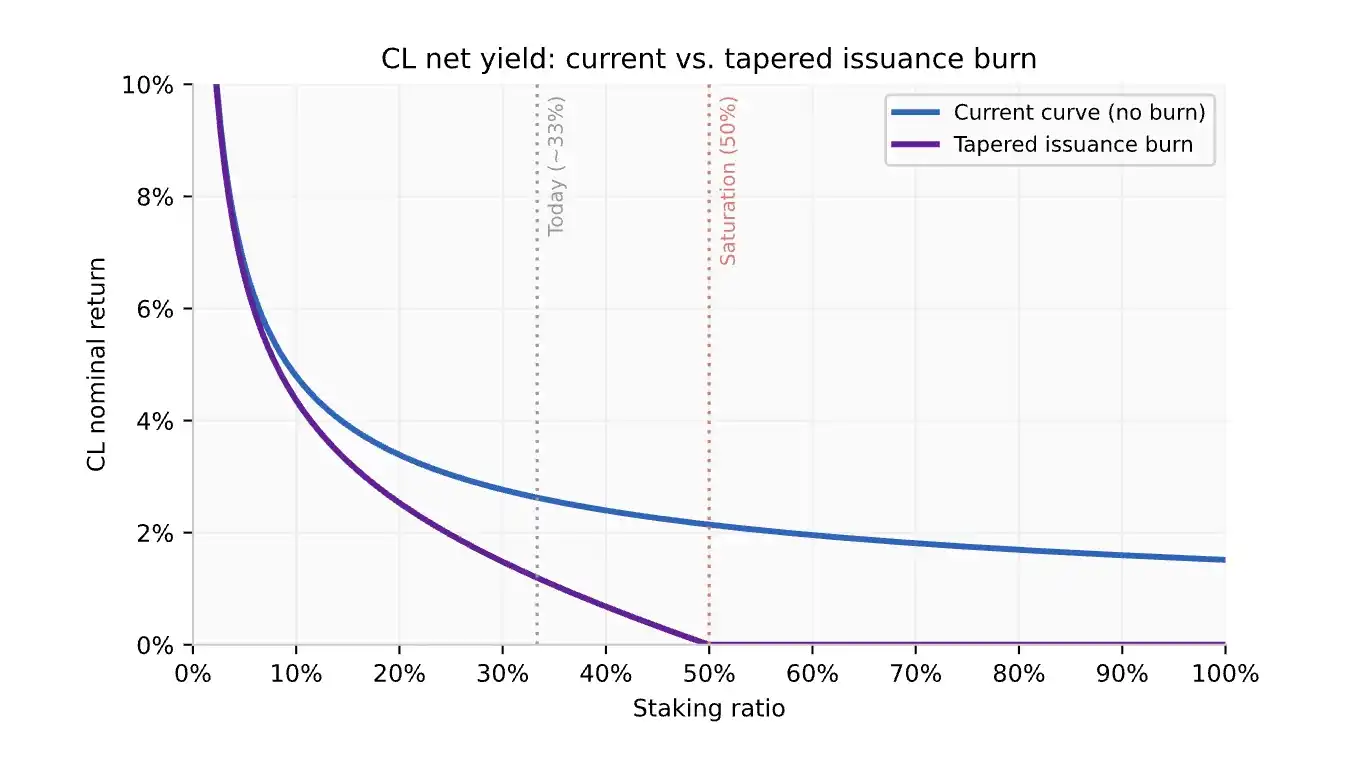
Net consensus-layer profit under the current issuance curve and the EIP-8363 curve

According to the proposal's curve, the annual consensus-layer issuance would peak near a staking ratio of about 19.8%, then decline as the staking ratio increases. Estimating with the current staking ratio of about 33%, if this curve were fully implemented at the fork, the consensus-layer yield would decrease from about 2.6% to about 1.2%.
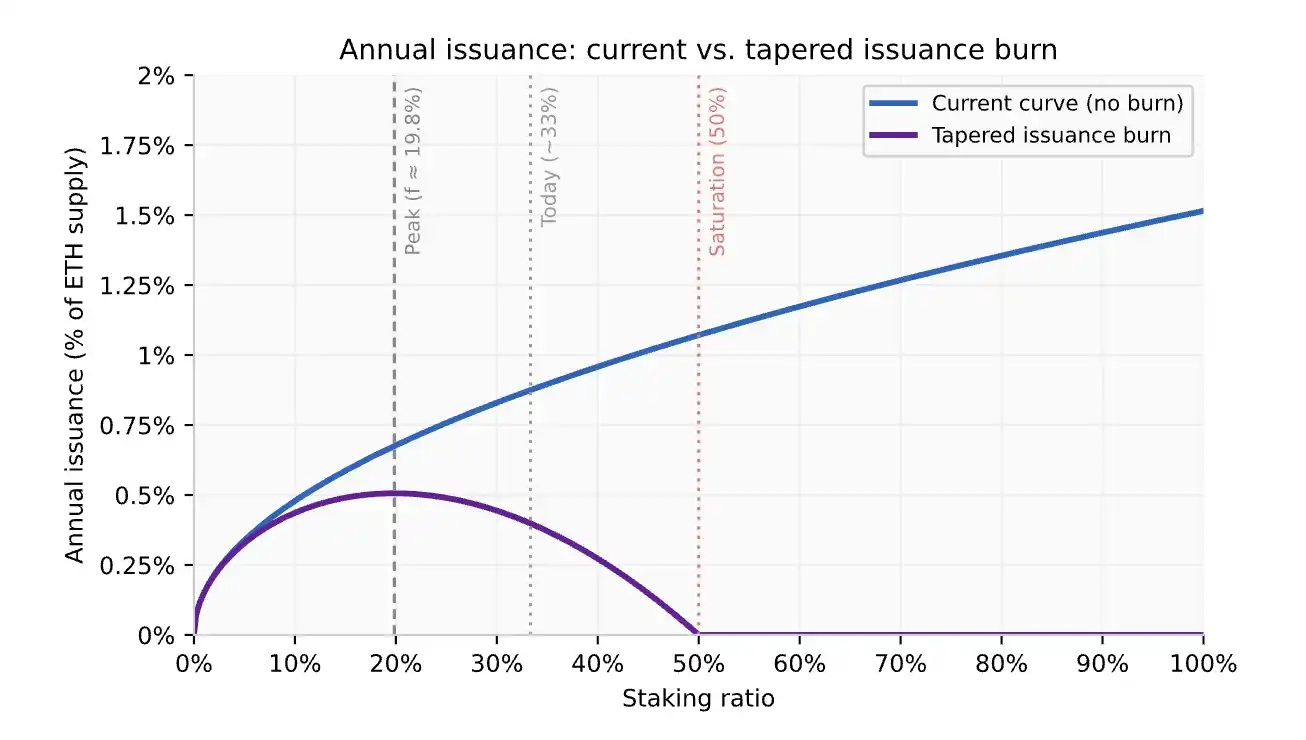
Annual issuance under the current issuance curve and the EIP-8363 curve

To avoid a sudden halving of rewards, the proposal designs an 18-month transition period: upon activation, the base reward factor will be temporarily increased from 64 to 128, then gradually reduced back to 64 over 65 steps, with each step lasting approximately 8.6 days. Therefore, the initial net profit upon activation would be close to current levels, then gradually decline. However, the rule of "providing no consensus-layer issuance incentive after 50%" takes effect from the first day of activation; it does not wait for 18 months.

Currently, this proposal is still an unmerged Core EIP draft, in the editing review and consensus assessment stage. The authors have separately submitted PR #12087, hoping to have it listed as Proposed for Inclusion for the Hegotá upgrade. This PR is also not yet merged; the current formal Hegotá Meta EIP does not include it.

Ethereum core developers plan to discuss Hegotá proposal cut-off items at the 184th ACDC meeting on August 6th. Even if it enters Proposed for Inclusion, it does not guarantee implementation; it would still need to go through subsequent stages of developer assessment, client implementation, testing, and Scheduled for Inclusion.

Community reaction is clearly negative

Jérôme de Tychey, one of the EIP-8363 authors, believes this is a "minimalist, market-driven" change. He also stated in a forum response that the issuance debate started back in 2023, and this proposal merely opens a formal feedback window; it does not equate to being confirmed for inclusion.

He also warned that if validator entries remain continuously full and exits are few, the staked amount could exceed 70 million ETH by early 2028, accounting for over 55% of the supply; reversing course then could lead to larger exit volumes and market disruptions.

The side supporting reduced issuance mainly cites three reasons:

  • Ethereum may be paying too high a cost for economic security that is already sufficiently abundant;
  • Unstaked holders are continuously diluted, forced to choose between "bearing dilution" and "undertaking staking risk";
  • LSTs, ETFs, and custodial services continuously lower staking friction, potentially ultimately allowing a few intermediaries to simultaneously control large amounts of ETH and validation rights.

However, opposition voices are more concentrated in the current public reaction.

Aave founder Stani Kulechov believes that consensus-layer staking rewards varying with the staking ratio and ultimately approaching zero would undermine the cash flow predictability valued by institutions when allocating ETH, and compress positive interest rate strategies like ETH lending and LST loop staking.

Obol co-founder Oisín Kyne points out that Ethereum's true security depends not only on how much ETH is staked, but also on whether the validation power is sufficiently decentralized. If rewards drop to extremely low levels, large institutions with low capital costs and low sensitivity to yield might have the ability to stay in the game long-term and squeeze out high-cost independent operators.

ether.fi CEO Mike Silagadze criticized the proposal for being submitted just before the Hegotá deadline, leaving insufficient lead time for ecosystem developers to discuss it; he worries that low yields will impact staking-related protocols and reduce institutional confidence in Ethereum's governance stability.

Ethereum community member Ryan Berckmans summarized that opponents at least include those worried about who will run validators under zero rewards, those unwilling to reduce staking yields, those opposed to modifying ETH monetary policy again, and those hoping to avoid escalating controversy disrupting ecosystem growth. He personally supports moderately reducing issuance but opposes letting rewards trend all the way to zero, also believing the current proposal is too divisive for the community.

A relatively neutral view comes from ARK Invest research director Lorenzo Valente. He frames this debate from the perspective of ETH's asset positioning. If one emphasizes ETH's "internet bond" attributes more, weakening staking yield indeed damages the lending market and yield curve; if one emphasizes ETH as a neutral currency and store of value more, then the base yield obtained through loop staking mainly comes from protocol issuance, at the cost of unstaked holders being diluted. Reducing issuance means reducing this transfer of yield from unstaked holders to stakers and their leverage strategies.

Who Benefits and Who Bears the Pressure?

If this proposal passes, Solo Stakers would be affected first.

The 18-month transition period spreads out the reward decline but does not reduce fixed costs like hardware, electricity, and operation/maintenance. The proposal maintains the current offline penalty intensity while lowering net rewards, so it would take longer for a single fault to be compensated by subsequent rewards. The proposal itself estimates that at the current ~33% staking ratio, the time needed to compensate for downtime losses could increase to about 3.8 times the current duration.

For large operators with backup power, disaster recovery, and 24/7 operations, such changes are relatively easier to absorb; for home validators, a few internet outages or device failures could significantly erode annual returns.

Tax treatment could also amplify this disparity. The EIP-8363 proposal notes that in some jurisdictions, it's currently unclear whether tax authorities would recognize income based on the pre-deduction reward. If the burned portion can only be recognized as a capital loss, a solo staker's post-tax earnings could be lower than the apparent net reward.

The impact would further transmit to LSTs. The base yield for products like stETH and rETH comes from the underlying validators; when consensus-layer issuance decreases, the yield gap between LSTs and native ETH would also narrow. Whether users are still willing to bear smart contract, governance, custody, and de-pegging risks for one or two percentage points of yield would become a new pricing question.

Loop strategies relying on LST yield would feel pressure sooner. The common approach is to borrow ETH, buy or mint LSTs, then use the LSTs as collateral to borrow more ETH. As staking yield gradually approaches borrowing costs, the positive interest rate spread of such trades would gradually disappear, and leveraged positions might contract voluntarily. Aave, Morpho, Pendle, and products built around LST yield might consequently face decreased ETH borrowing demand, capital utilization rates, and liquidity.

The impact would ultimately affect the entire DeFi interest rate system. Staking yield is an important base rate for ETH-denominated markets; LST lending, fixed income, yield splitting, and loop leverage are all priced around this benchmark.

Of course, LSTs would not lose all their utility because of this. What might truly change is LSTs' advantage relative to native ETH.

Looking further upstream, the staking income of ETFs, exchanges, custodians, and ETH treasury companies would also decline. For institutions relying on staking yield to enhance asset returns, ETH's predictable cash flow would weaken, potentially affecting their willingness for new allocations. Aave founder Stani Kulechov therefore believes this proposal would make it harder for institutions to evaluate ETH's yield and weaken ETH's competitiveness relative to other yield-bearing assets.

The actual impact on institutions may not be uniform. When base yields fall, high-cost participants might exit first, while the largest institutions least dependent on staking yield might instead be more capable of staying. This is precisely the reason opponents fear further validator centralization.

For ordinary ETH holders, the direction of impact is relatively clear. The burned issuance does not go to a specific protocol or fund but benefits all ETH holders collectively by reducing dilution.

However, reduced issuance does not mean ETH will necessarily become deflationary, nor can one deduce that the price will necessarily rise. The final supply change still depends on EIP-1559 fee burns, network usage, validator issuance, and market conditions. If lower yields simultaneously weaken institutional allocation, LST demand, and on-chain lending activity, demand-side changes could also offset some of the supply-side benefits.

Criptos en tendencia

Preguntas relacionadas

QWhat is the main objective of the EIP-8363 proposal, and what specific issue does it aim to address?

AThe main objective of EIP-8363, the 'Tapered Issuance Burn' proposal, is to install a "downward slope" for staking rewards as the total amount of staked ETH increases. It aims to address the concern that the protocol currently provides positive incentives for more staking indefinitely, potentially leading to excessive concentration of ETH and validator power among a few large custodians, exchanges, and staking derivatives (LSTs). It seeks to reduce the dilution pressure on non-staked ETH and make native ETH a more competitive neutral asset.

QHow does the EIP-8363 proposal technically achieve the reduction in consensus layer rewards for validators?

AThe proposal calculates validator rewards normally but then deducts and burns a portion of them. The burn ratio depends on the total effective staked balance relative to 60.25 million ETH (approximately half of the current supply). The formula uses the 1.5th power of this ratio, capped at 100%. As the staked amount approaches 60.25 million ETH, validators' net consensus layer rewards trend towards zero. At or above this threshold, the newly added burn would completely offset the consensus layer issuance rewards for fully performing validators. Execution layer income like priority fees and MEV remains unaffected.

QWhat are some of the key arguments raised by opponents of the EIP-8363 proposal?

AOpponents argue that: 1) It weakens the predictability of cash flows from staking, which is valued by institutions when allocating ETH. 2) Extremely low rewards could disproportionately squeeze out high-cost solo stakers, leaving capital-rich, yield-insensitive large entities in control, potentially increasing centralization. 3) It could negatively impact protocols built around staking yields (e.g., LSTs, lending markets, leverage strategies). 4) The proposal was submitted close to the Hegotá upgrade deadline, leaving insufficient time for community discussion. 5) It represents another contentious change to ETH's monetary policy that could disrupt ecosystem growth.

QAccording to the article, how might the EIP-8363 proposal disproportionately impact solo stakers compared to large institutional operators?

ASolo stakers (home validators) would be more severely impacted because the proposal lowers net rewards without reducing fixed costs like hardware, electricity, and maintenance. The offline penalty severity remains the same, so recovering from a downtime incident would take longer with lower subsequent rewards. Large operators with backup power, disaster recovery systems, and 24/7 operations can more easily absorb these changes. Furthermore, potential unfavorable tax treatments in some jurisdictions, where the burned portion might only be recognized as a capital loss, could further reduce solo stakers' after-tax income.

QWhat is the potential impact of EIP-8363 on Liquid Staking Tokens (LSTs) and the broader DeFi ecosystem?

AThe yield gap between LSTs and native ETH would narrow as the underlying consensus layer rewards decline. This could reduce the attractiveness of LSTs, as users may be less willing to take on smart contract, governance, and de-peg risks for a smaller yield premium. Strategies relying on LST yield, such as looping (borrowing ETH to buy/mint LST and re-collateralizing), would see their positive carry diminish and potentially unwind. This could lead to decreased ETH borrowing demand, lower utilization rates, and reduced liquidity in protocols like Aave, Morpho, and Pendle, ultimately affecting the entire ETH-denominated DeFi interest rate system.

Lecturas Relacionadas

Trading

Spot

Artículos destacados

Qué es ETH 2.0

ETH 2.0: Una Nueva Era para Ethereum Introducción ETH 2.0, conocido ampliamente como Ethereum 2.0, marca una actualización monumental para la blockchain de Ethereum. Esta transición no es solo una mejora superficial; busca mejorar fundamentalmente la escalabilidad, seguridad y sostenibilidad de la red. Con un cambio del mecanismo de consenso intensivo en energía Prueba de Trabajo (PoW) a una Prueba de Participación (PoS) más eficiente, ETH 2.0 promete un enfoque transformador para el ecosistema blockchain. ¿Qué es ETH 2.0? ETH 2.0 es un conjunto de actualizaciones interconectadas y distintivas centradas en optimizar las capacidades y el rendimiento de Ethereum. La reestructuración está diseñada para abordar desafíos críticos que el mecanismo actual de Ethereum ha enfrentado, particularmente en lo que respecta a la velocidad de transacción y la congestión de la red. Objetivos de ETH 2.0 Los objetivos principales de ETH 2.0 giran en torno a mejorar tres aspectos clave: Escalabilidad: Con el objetivo de aumentar significativamente el número de transacciones que la red puede manejar por segundo, ETH 2.0 busca superar la limitación actual de aproximadamente 15 transacciones por segundo, potencialmente alcanzando miles. Seguridad: Las medidas de seguridad mejoradas son fundamentales para ETH 2.0, particularmente a través de una mejor resistencia contra ciberataques y la preservación del ethos descentralizado de Ethereum. Sostenibilidad: El nuevo mecanismo PoS está diseñado no solo para mejorar la eficiencia, sino también para reducir drásticamente el consumo de energía, alineando el marco operativo de Ethereum con consideraciones ambientales. ¿Quién es el Creador de ETH 2.0? La creación de ETH 2.0 se puede atribuir a la Fundación Ethereum. Esta organización sin fines de lucro, que desempeña un papel crucial en el apoyo al desarrollo de Ethereum, es liderada por el notable cofundador Vitalik Buterin. Su visión de un Ethereum más escalable y sostenible ha sido la fuerza motriz detrás de esta actualización, involucrando contribuciones de una comunidad global de desarrolladores y entusiastas dedicados a mejorar el protocolo. ¿Quiénes son los Inversores de ETH 2.0? Si bien los detalles sobre los inversores de ETH 2.0 no se han hecho públicos, se sabe que la Fundación Ethereum recibe apoyo de varias organizaciones e individuos en el ámbito de blockchain y tecnología. Estos socios incluyen firmas de capital de riesgo, compañías tecnológicas y organizaciones filantrópicas que comparten un interés mutuo en apoyar el desarrollo de tecnologías descentralizadas e infraestructura blockchain. ¿Cómo Funciona ETH 2.0? ETH 2.0 se distingue por introducir una serie de características clave que lo diferencian de su predecesor. Prueba de Participación (PoS) La transición a un mecanismo de consenso PoS es uno de los cambios más destacados de ETH 2.0. A diferencia de PoW, que se basa en la minería intensiva en energía para la verificación de transacciones, PoS permite a los usuarios validar transacciones y crear nuevos bloques de acuerdo con la cantidad de ETH que apuestan en la red. Esto conduce a una mayor eficiencia energética, reduciendo el consumo en aproximadamente un 99.95%, convirtiendo a Ethereum 2.0 en una alternativa considerablemente más verde. Cadenas Shard Las cadenas shard son otra innovación crítica de ETH 2.0. Estas cadenas más pequeñas operan en paralelo con la cadena principal de Ethereum, lo que permite que múltiples transacciones sean procesadas simultáneamente. Este enfoque mejora la capacidad general de la red, abordando las preocupaciones de escalabilidad que han afectado a Ethereum. Cadena Beacon En el núcleo de ETH 2.0 se encuentra la Cadena Beacon, que coordina la red y gestiona el protocolo PoS. Funciona como un organizador de cierta manera: supervisa a los validadores, asegura que los shards permanezcan conectados a la red y monitorea la salud general del ecosistema blockchain. Cronología de ETH 2.0 El viaje de ETH 2.0 ha estado marcado por varios hitos clave que trazan la evolución de esta importante actualización: Diciembre 2020: El lanzamiento de la Cadena Beacon marcó la introducción de PoS, preparándose para la migración hacia ETH 2.0. Septiembre 2022: La finalización de “La Fusión” representa un momento crucial en el que la red Ethereum se trasladó exitosamente de un marco PoW a uno PoS, anunciando una nueva era para Ethereum. 2023: El lanzamiento esperado de cadenas shard tiene como objetivo mejorar aún más la escalabilidad de la red Ethereum, consolidando a ETH 2.0 como una plataforma robusta para aplicaciones y servicios descentralizados. Características Clave y Beneficios Escalabilidad Mejorada Una de las ventajas más significativas de ETH 2.0 es su escalabilidad mejorada. La combinación de PoS y cadenas shard permite que la red expanda su capacidad, permitiendo acomodar un volumen mucho mayor de transacciones en comparación con el sistema heredado. Eficiencia Energética La implementación de PoS representa un gran paso hacia la eficiencia energética en la tecnología blockchain. Al reducir drásticamente el consumo de energía, ETH 2.0 no solo disminuye los costos operativos, sino que también se alinea más estrechamente con los objetivos de sostenibilidad global. Seguridad Mejorada Los mecanismos actualizados de ETH 2.0 contribuyen a mejorar la seguridad en toda la red. El despliegue de PoS, junto con las medidas de control innovadoras establecidas a través de cadenas shard y la Cadena Beacon, asegura un mayor grado de protección contra posibles amenazas. Costos Más Bajos para los Usuarios A medida que la escalabilidad mejora, los efectos sobre los costos de transacción también serán evidentes. Se espera que una mayor capacidad y una menor congestión se traduzcan en tarifas más bajas para los usuarios, haciendo que Ethereum sea más accesible para transacciones cotidianas. Conclusión ETH 2.0 marca una evolución significativa en el ecosistema blockchain de Ethereum. A medida que aborda problemas fundamentales como la escalabilidad, el consumo de energía, la eficiencia en las transacciones y la seguridad general, la importancia de esta actualización no puede ser subestimada. La transición a la Prueba de Participación, la introducción de cadenas shard y el trabajo fundamental de la Cadena Beacon son indicativos de un futuro donde Ethereum puede satisfacer las crecientes demandas del mercado descentralizado. En una industria impulsada por la innovación y el progreso, ETH 2.0 se erige como un testimonio de las capacidades de la tecnología blockchain para allanar el camino hacia una economía digital más sostenible y eficiente.

268 Vistas totalesPublicado en 2024.04.04Actualizado en 2024.12.03

Qué es ETH 2.0

Qué es ETH 3.0

ETH3.0 y $eth 3.0: Un Examen Profundo del Futuro de Ethereum Introducción En el paisaje en rápida evolución de las criptomonedas y la tecnología blockchain, ETH3.0, a menudo denotado como $eth 3.0, ha surgido como un tema de considerable interés y especulación. El término abarca dos conceptos principales que merecen aclaración: Ethereum 3.0: Esto representa una posible actualización futura destinada a aumentar las capacidades de la blockchain existente de Ethereum, enfocándose particularmente en mejorar la escalabilidad y el rendimiento. ETH3.0 Meme Token: Este proyecto de criptomoneda distinto busca aprovechar la blockchain de Ethereum para crear un ecosistema centrado en memes, promoviendo la participación dentro de la comunidad de criptomonedas. Comprender estos aspectos de ETH3.0 es esencial no solo para los entusiastas de las criptomonedas, sino también para aquellos que observan tendencias tecnológicas más amplias en el espacio digital. ¿Qué es ETH3.0? Ethereum 3.0 Ethereum 3.0 se presenta como una actualización propuesta para la red de Ethereum ya establecida, que ha sido la columna vertebral de muchas aplicaciones descentralizadas (dApps) y contratos inteligentes desde su inicio. Las mejoras previstas se concentran principalmente en la escalabilidad, integrando tecnologías avanzadas como sharding y pruebas de conocimiento cero (zk-proofs). Estas innovaciones tecnológicas tienen como objetivo facilitar un número sin precedentes de transacciones por segundo (TPS), potencialmente alcanzando millones, abordando así una de las limitaciones más significativas que enfrenta la tecnología blockchain actual. La mejora no es meramente técnica, sino también estratégica; está destinada a preparar la red de Ethereum para su adopción generalizada y utilidad en un futuro marcado por una mayor demanda de soluciones descentralizadas. ETH3.0 Meme Token En contraste con Ethereum 3.0, el ETH3.0 Meme Token se aventura en un ámbito más ligero y juguetón al combinar la cultura de memes de internet con la dinámica de las criptomonedas. Este proyecto permite a los usuarios comprar, vender e intercambiar memes en la blockchain de Ethereum, proporcionando una plataforma que fomenta la participación comunitaria a través de la creatividad y los intereses compartidos. El ETH3.0 Meme Token tiene como objetivo demostrar cómo la tecnología blockchain puede intersectarse con la cultura digital, creando casos de uso que son tanto entretenidos como financieramente viables. ¿Quién es el Creador de ETH3.0? Ethereum 3.0 La iniciativa hacia Ethereum 3.0 es impulsada principalmente por un consorcio de desarrolladores e investigadores dentro de la comunidad de Ethereum, incluyendo notablemente a Justin Drake. Conocido por sus ideas y contribuciones a la evolución de Ethereum, Drake ha sido una figura prominente en las discusiones sobre la transición de Ethereum a una nueva capa de consenso, denominada “Beam Chain.” Este enfoque colaborativo para el desarrollo significa que Ethereum 3.0 no es el producto de un creador singular, sino más bien una manifestación de ingenio colectivo centrado en avanzar la tecnología blockchain. ETH3.0 Meme Token Los detalles sobre el creador del ETH3.0 Meme Token son actualmente inidentificables. La naturaleza de los tokens de memes a menudo conduce a una estructura más descentralizada y dirigida por la comunidad, lo que podría explicar la falta de atribución específica. Esto se alinea con la ética de la comunidad cripto más amplia, donde la innovación a menudo surge de esfuerzos colaborativos en lugar de individuales. ¿Quiénes son los Inversores de ETH3.0? Ethereum 3.0 El apoyo a Ethereum 3.0 proviene principalmente de la Fundación Ethereum junto con una entusiasta comunidad de desarrolladores e inversores. Esta asociación fundamental proporciona un grado significativo de legitimidad y mejora la perspectiva de una implementación exitosa, ya que aprovecha la confianza y credibilidad construidas a lo largo de años de operaciones en la red. En el clima cambiando rápidamente de las criptomonedas, el apoyo de la comunidad juega un papel crucial en impulsar el desarrollo y la adopción, posicionando a Ethereum 3.0 como un contendiente serio para futuros avances en blockchain. ETH3.0 Meme Token Si bien las fuentes actualmente disponibles no proporcionan información explícita sobre las fundaciones o organizaciones de inversión que respaldan el ETH3.0 Meme Token, es indicativo del modelo de financiamiento típico para tokens de memes, que a menudo depende del apoyo de base y la participación comunitaria. Los inversores en tales proyectos suelen consistir en individuos motivados por el potencial de innovación impulsada por la comunidad y el espíritu de cooperación que se encuentra dentro de la comunidad cripto. ¿Cómo Funciona ETH3.0? Ethereum 3.0 Las características distintivas de Ethereum 3.0 radican en su implementación propuesta de sharding y tecnología zk-proof. Sharding es un método de particionamiento de la blockchain en piezas más pequeñas y manejables o “shards,” que pueden procesar transacciones de manera concurrente en lugar de secuencial. Esta descentralización del procesamiento ayuda a prevenir la congestión y asegura que la red permanezca receptiva incluso bajo una carga pesada. La tecnología de prueba de conocimiento cero (zk-proof) contribuye con otra capa de sofisticación al permitir la validación de transacciones sin revelar los datos subyacentes involucrados. Este aspecto no solo mejora la privacidad, sino que también aumenta la eficiencia general de la red. También se habla de incorporar una Máquina Virtual de Ethereum de conocimiento cero (zkEVM) en esta actualización, amplificando aún más las capacidades y utilidad de la red. ETH3.0 Meme Token El ETH3.0 Meme Token se distingue al capitalizar la popularidad de la cultura de memes. Establece un mercado para que los usuarios participen en el comercio de memes, no solo por entretenimiento sino también por el posible beneficio económico. Al integrar características como staking, provisión de liquidez y mecanismos de gobernanza, el proyecto fomenta un entorno que incentiva la interacción y participación de la comunidad. Al ofrecer una mezcla única de entretenimiento y oportunidad económica, el ETH3.0 Meme Token tiene como objetivo atraer a una audiencia diversa, que abarca desde entusiastas de las criptomonedas hasta conocedores casuales de memes. Línea de Tiempo de ETH3.0 Ethereum 3.0 11 de noviembre de 2024: Justin Drake insinúa la próxima actualización de ETH 3.0, centrada en mejoras de escalabilidad. Este anuncio significa el comienzo de las discusiones formales sobre la futura arquitectura de Ethereum. 12 de noviembre de 2024: Se espera que la propuesta anticipada para Ethereum 3.0 se desvele en Devcon en Bangkok, preparando el escenario para una mayor retroalimentación de la comunidad y posibles próximos pasos en el desarrollo. ETH3.0 Meme Token 21 de marzo de 2024: El ETH3.0 Meme Token se lista oficialmente en CoinMarketCap, marcando su incursión en el dominio público de las criptomonedas y mejorando la visibilidad de su ecosistema basado en memes. Puntos Clave En conclusión, Ethereum 3.0 representa una evolución significativa dentro de la red de Ethereum, enfocándose en superar las limitaciones en términos de escalabilidad y rendimiento a través de tecnologías avanzadas. Sus actualizaciones propuestas reflejan un enfoque proactivo hacia las demandas y la usabilidad futura. Por otro lado, el ETH3.0 Meme Token encapsula la esencia de la cultura impulsada por la comunidad en el espacio de las criptomonedas, aprovechando la cultura de memes para crear plataformas atractivas que fomentan la creatividad y participación del usuario. Comprender los distintos propósitos y funcionalidades de ETH3.0 y $eth 3.0 es fundamental para cualquiera interesado en los desarrollos en curso dentro del espacio cripto. Con ambas iniciativas abriendo caminos únicos, subrayan colectivamente la naturaleza dinámica y multifacética de la innovación en blockchain.

283 Vistas totalesPublicado en 2024.04.04Actualizado en 2024.12.03

Qué es ETH 3.0

Cómo comprar ETH

¡Bienvenido a HTX.com! Hemos hecho que comprar Ethereum (ETH) sea simple y conveniente. Sigue nuestra guía paso a paso para iniciar tu viaje de criptos.Paso 1: crea tu cuenta HTXUtiliza tu correo electrónico o número de teléfono para registrarte y obtener una cuenta gratuita en HTX. Experimenta un proceso de registro sin complicaciones y desbloquea todas las funciones.Obtener mi cuentaPaso 2: ve a Comprar cripto y elige tu método de pagoTarjeta de crédito/débito: usa tu Visa o Mastercard para comprar Ethereum (ETH) al instante.Saldo: utiliza fondos del saldo de tu cuenta HTX para tradear sin problemas.Terceros: hemos agregado métodos de pago populares como Google Pay y Apple Pay para mejorar la comodidad.P2P: tradear directamente con otros usuarios en HTX.Over-the-Counter (OTC): ofrecemos servicios personalizados y tipos de cambio competitivos para los traders.Paso 3: guarda tu Ethereum (ETH)Después de comprar tu Ethereum (ETH), guárdalo en tu cuenta HTX. Alternativamente, puedes enviarlo a otro lugar mediante transferencia blockchain o utilizarlo para tradear otras criptomonedas.Paso 4: tradear Ethereum (ETH)Tradear fácilmente con Ethereum (ETH) en HTX's mercado spot. Simplemente accede a tu cuenta, selecciona tu par de trading, ejecuta tus trades y monitorea en tiempo real. Ofrecemos una experiencia fácil de usar tanto para principiantes como para traders experimentados.

4.5k Vistas totalesPublicado en 2024.12.10Actualizado en 2026.06.02

Cómo comprar ETH

Discusiones

Bienvenido a la comunidad de HTX. Aquí puedes mantenerte informado sobre los últimos desarrollos de la plataforma y acceder a análisis profesionales del mercado. A continuación se presentan las opiniones de los usuarios sobre el precio de ETH (ETH).

活动图片