Artículos Relacionados con Globalization

El Centro de Noticias de HTX ofrece los artículos más recientes y un análisis profundo sobre "Globalization", cubriendo tendencias del mercado, actualizaciones de proyectos, desarrollos tecnológicos y políticas regulatorias en la industria de cripto.


Why Are There Increasingly More Indian Executives in the Global Payments Circle?

Why are we seeing more Indian executives rising in the global payments industry? This article explores the phenomenon from the perspective of Chinese professionals working abroad. Contrary to perceptions of India as a complex and difficult market, a highly competitive and globalized cohort of Indian talent is excelling in international finance and tech hubs. These individuals represent a filtered elite, having undergone rigorous educational and professional selection. The article argues that the key advantage of many Indian leaders lies not in pure technical expertise, but in superior organizational and stakeholder management skills. In global payment networks—involving banks, regulators, card schemes, and partners—success often depends on the ability to align diverse interests, build consensus, and navigate complex bureaucracies. Indian executives frequently demonstrate strength in pre-emptively engaging stakeholders, managing expectations, and forming alliances. Furthermore, strong communication and presentation skills are reframed not as mere showmanship but as essential leadership tools for building visibility, securing resources, and creating organizational buy-in within large multinationals. The professional network or "ecosystem" cultivated by the Indian diaspora is another significant factor, creating long-term career momentum through mutual support, referrals, and partnerships across companies like JPMorgan, Visa, and Stripe. Singapore serves as a key regional amplifier for this talent in Asian finance. Many Indian entrepreneurs are also founding companies in payment infrastructure (e.g., cross-border payments, B2B solutions), leveraging their blended experience in technology, finance, and regulation. The conclusion posits that while Chinese payment talent possesses world-class executional and product skills from scaling massive markets like mobile payments, the next phase of global competition requires complementing this with "global organizational capability." This means shifting from individual execution to becoming enablers who can influence, connect, and lead complex, cross-cultural systems to action. The rise of Indian executives signals an evolution in the industry where the ability to get things done *through a global organization* is paramount.

链捕手07/27 10:03

Why Are There Increasingly More Indian Executives in the Global Payments Circle?

链捕手07/27 10:03

Dialogue with Jia Hang | Looking Back at Two Decades of Chinese Payment Going Global

**Summary: A Conversation with Jia Hang on Two Decades of China's Payment Globalization** Jia Hang, a veteran with over twenty years in payments, reflects on China's attempts to build a global payment network through three key phases: UnionPay (card networks), Alipay+ (digital wallets), and now, stablecoins. His journey began at UnionPay International, aiming to establish China's card network abroad. While successful in following Chinese tourists ("where Chinese go, UnionPay goes"), it struggled to achieve true global scale. The core lesson: card networks like Visa/Mastercard's unassailable advantage isn't just technical standards, but their deeply entrenched **governance and profit-sharing models** that create powerful network effects. Competing as the "same species" is nearly impossible. At Ant Group, he led Alipay+, a strategy to bypass card networks by interconnecting local e-wallets worldwide. While innovative, it faced a similar ceiling. Mobile QR payments and card swipes were essentially **the same species competing for the same pie**, lacking a disruptive value proposition for users or a sustainable new incentive model to replace the card networks' established flywheel. Today, at Singapore's DCS, Jia focuses on stablecoin-based payments. He argues stablecoins represent a fundamental shift. They are not competing with Visa for consumer payments but challenging the **traditional banking and account system for value movement**. Products like "U Cards" (stablecoin-linked payment cards) are transitional, leveraging existing card networks for acceptance while building new rails. The real potential lies in stablecoins enabling seamless, low-cost global value transfer, potentially reorganizing the financial infrastructure around **accounts rather than cards**. Jia believes stablecoin adoption for local retail payments, cross-border transactions, and as high-yield savings vehicles is becoming irreversible. This could gradually reduce reliance on traditional fiat channels, especially in regions with weak currencies or capital controls. The quest for the "next global payment network" continues, now centered on whether stablecoins can successfully bridge Web2 and Web3, establish new governance, and create compelling user value beyond mere cost reduction.

marsbit07/21 07:09

Dialogue with Jia Hang | Looking Back at Two Decades of Chinese Payment Going Global

marsbit07/21 07:09

Zhongji Innolight Leads Investment in a Tsinghua '90s Postgraduate

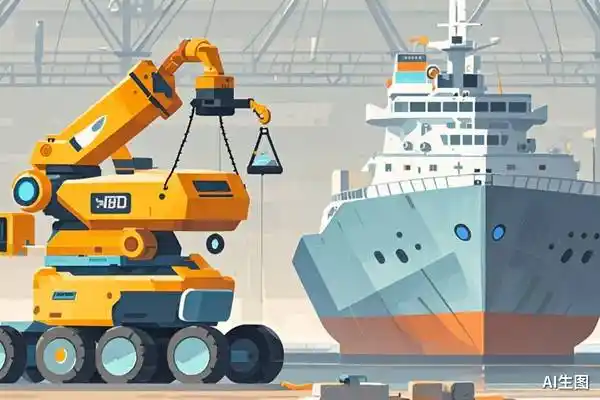
Shihe Robotics, a Chinese intelligent high-altitude robotics company, has completed a Series C financing round worth hundreds of millions of RMB. The round was jointly led by Qianggang Capital and Zhongji InnoLight, with participation from Guangxi Investment Capital, Guohai Securities, Junton Capital, and existing investor Fosun RuiZheng. Founded around 2015 by Xu Huayang, a Tsinghua University Ph.D. graduate, the company has spent nearly a decade focusing on robotics for high-risk, high-altitude maintenance work. Starting from a specific application in ship hull derusting, which has achieved a dominant market share in China, Shihe has expanded into a wider product matrix serving scenarios in petrochemical storage tank maintenance, energy facility inspection, bridge infrastructure, and building façade cleaning. CEO Xu Huayang emphasizes a hardware-first, commercialization-focused philosophy for the robotics industry. The company's strategy revolves around "one machine, multiple uses; complete process closure," aiming to deliver reliable value in real industrial settings rather than pursuing demos. It has served major domestic clients like COSCO, China State Shipbuilding Corporation, Sinopec, and Saudi Aramco. Shihe is building its technological edge by leveraging vast, high-fidelity industrial data collected during operations. It is developing a vertical "Industrial World Model" in collaboration with top university labs. This model is tailored for complex, hazardous industrial environments, enabling robots to progress towards greater autonomy in perception, decision-making, and task execution. In the context of the booming "embodied AI" field, Shihe positions its path as starting from structured, specialized industrial scenarios before moving to more complex environments. Concurrently, the company is accelerating its global expansion, with overseas revenue growing tenfold over two years. Xu aims for international markets to contribute half of the company's revenue within five years. The latest funding will support further technological development, product matrix expansion, and global market penetration.

marsbit07/21 02:42

Zhongji Innolight Leads Investment in a Tsinghua '90s Postgraduate

marsbit07/21 02:42

Raising $400 Million in Funding, Shenzhen's Embodied AI Unicorn is Heading for an IPO

LimX Dynamics, a leading Chinese humanoid robotics company based in Shenzhen, has raised nearly $4 billion in total funding following a $2 billion Pre-IPO round. This latest round, backed by prominent global investors including IDG Capital, Lens Technology, GGG Group, and Redstone VC, values the company at approximately 150 billion yuan. Founded in 2022 by Southern University of Science and Technology professor Zhang Wei, the company has developed a full-stack, self-developed "brain system" for humanoid robots. Its three-layer technical architecture (System 0 for locomotion, System 1 for specific skills, and System 2 for cognitive reasoning) powers a diverse product matrix, including the LimX Luna for commercial service and the LimX Oli R&D platform. Often compared to its American counterpart Figure, LimX Dynamics differentiates itself by focusing on "serving people, not processes" and prioritizing commercial service scenarios over factory applications first. The company has secured thousands of pre-orders, with over half coming from overseas markets, and has begun initial deliveries. With a distinctly global investor base and strategy, LimX Dynamics aims to leverage China's manufacturing advantages for worldwide competition. Having completed its shareholding reform in March 2026, the company is now steadily advancing its IPO plans, positioning itself as a key contender in the intensifying race to go public within the humanoid robotics sector.

marsbit07/14 01:44

Raising $400 Million in Funding, Shenzhen's Embodied AI Unicorn is Heading for an IPO

marsbit07/14 01:44

Silicon Valley 'Startup Guru' Steve Hoffman: Web3 + AI Could Be a Trap

Silicon Valley investor and "Godfather of Startups" Steve Hoffman warns that combining Web3 with AI is likely a trap, not a promising venture. In an interview, Hoffman argues that while AI is a foundational technology touching all industries, Web3 adds complexity, friction, and regulatory risk without solving mainstream consumer or business needs. He advises founders to focus on deep, specialized applications where startups can out-iterate giants, rather than on generic features easily replicated by large tech companies. Hoffman observes that Silicon Valley will lead foundational AI research, while China excels at rapid, large-scale application and commercialization, particularly in robotics. He stresses that AI-driven autonomous agents capable of collaborative, multi-step tasks are 2-4 years away, which will cause significant job displacement. The solution is not to slow AI but to redesign business models around human-AI collaboration and reform social systems like education and retraining. For startups, Hoffman recommends focusing on vertical, expertise-heavy domains to build defensibility. He sees major opportunities in AI fraud detection and cybersecurity. Key founder mindsets include systemic thinking over feature-focus, relentless customer centricity, building adaptive teams, and deeply understanding AI's capabilities and limits. Hoffman is also leading a non-profit initiative to establish university centers aimed at training future leaders in responsible, human-value-aligned AI innovation.

marsbit06/05 11:18

Silicon Valley 'Startup Guru' Steve Hoffman: Web3 + AI Could Be a Trap

marsbit06/05 11:18

Interpreting Investment Opportunities in the Age of Great Navigation, Invesco Great Wall Fund Releases '2026 Report on Chinese Enterprises Going Global'

Invesco Great Wall Fund has released its "2026 China Corporate Globalization Report," titled "The 'Great Navigation Era' of Chinese Enterprises." The report analyzes the new trends and investment opportunities as Chinese companies expand globally, moving from simple product exports to comprehensive overseas operations involving services, branding, and local production. Driven by factors like trade friction, the pursuit of higher profit margins abroad, and policy support, globalization is becoming essential for Chinese companies. The report outlines an evolution: from early product export ("Globalization 1.0") to the current "Globalization 2.0," characterized by overseas capacity, capital goods investment, consumer brand expansion, and service exports. Chinese firms' competitive advantages are highlighted, including a vast engineer talent pool, low-cost and robust infrastructure, and complete industrial clusters. Specific sectors with significant出海 potential are identified: * **Capital Goods** (e.g., engineering machinery, power equipment): Benefiting from global demand, especially in Belt & Road markets and the AI-driven power grid upgrade cycle. * **Consumer Brands**: Transitioning from cost to brand advantage, leveraging供应链 efficiency. * **Technology & Innovation**: Including AI applications, optical modules within global tech supply chains, and new energy vehicles focusing on local production. * **Pharmaceuticals**: Chinese biotech firms are becoming preferred partners for global pharma, with potential for breakthrough drugs in areas like oncology and weight loss. The report concludes that corporate globalization represents a sustained, core theme for China's capital markets, though companies must navigate challenges like geopolitics and localization.

marsbit06/04 11:20

Interpreting Investment Opportunities in the Age of Great Navigation, Invesco Great Wall Fund Releases '2026 Report on Chinese Enterprises Going Global'

marsbit06/04 11:20

Hurun Report Interview with Justin Sun: New Paradigms of Value Circulation under the Web3 Transformation Cycle

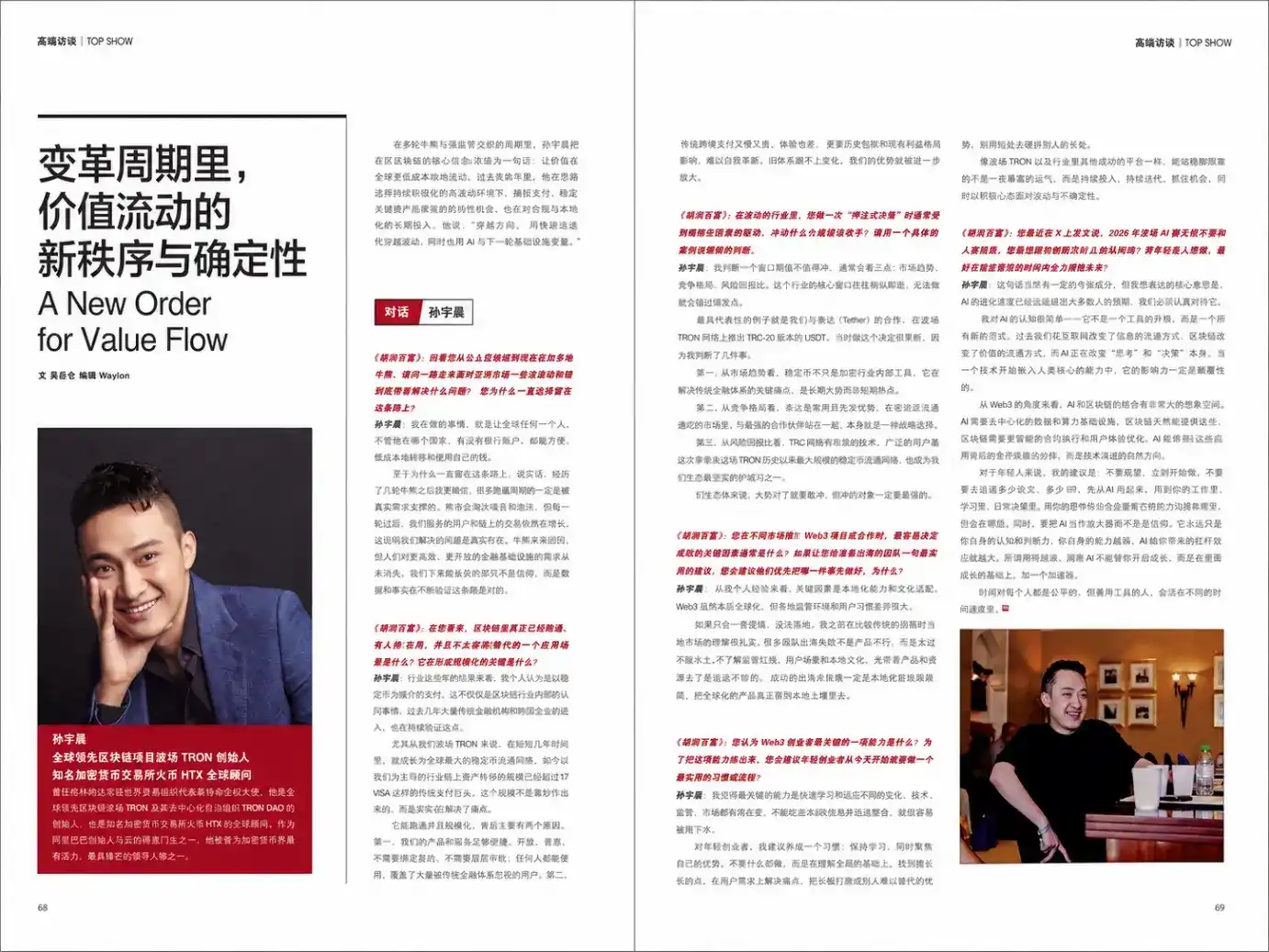
In a deep-dive interview with *Hurun Report*, Justin Sun, founder of TRON, outlines his vision for Web3's evolution from proof-of-concept to global adoption, emphasizing stablecoins as the cornerstone for building a new paradigm of value transfer. Sun defines the core mission as enabling low-cost, efficient global fund movement for anyone, anywhere, regardless of bank access. He argues that sustainable blockchain projects must be driven by genuine demand and usage, with stablecoin payments currently representing the most mature and scalable application. Citing TRON's position as a leading stablecoin network with over $86.3 billion in USDT circulation, he attributes this growth to real-world use in cross-border transfers, savings, and payments, viewing it as a "natural replacement" for traditional financial infrastructure's inefficiencies. On strategy, Sun advocates for a methodology combining data-driven iteration, rapid execution, and user-centricity. He highlights the pivotal decision to partner with Tether on TRC-20 USDT as a calculated move that capitalized on stablecoins' long-term trend and network effects. While Web3 is inherently global, Sun stresses the critical importance of local compliance and cultural adaptation for successful market entry. Looking ahead, Sun identifies the convergence of AI and blockchain as a key frontier. He sees AI as fundamentally reshaping thinking and decision-making, with blockchain providing decentralized infrastructure for AI, while AI enhances blockchain's intelligence and user experience. His advice to industry participants is to prioritize continuous learning, adaptability, and focused investment in building core, irreplaceable strengths within the broader Web3 landscape.

marsbit05/29 03:33

Hurun Report Interview with Justin Sun: New Paradigms of Value Circulation under the Web3 Transformation Cycle

marsbit05/29 03:33

Hurun Report Interview with Justin Sun: New Paradigm of Value Circulation in the Web3 Transformation Cycle

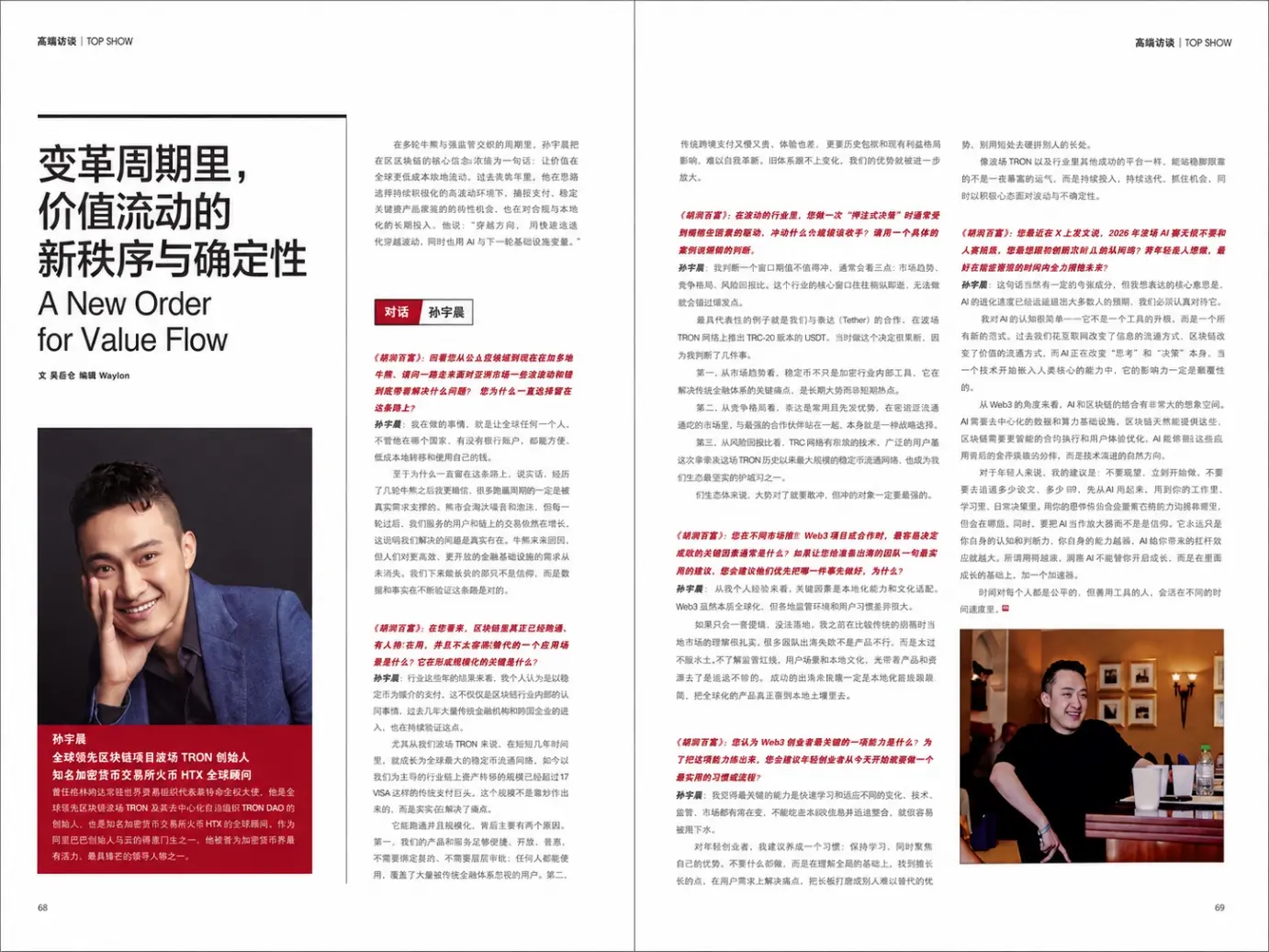
In an interview with *Hurun Report*, Justin Sun, founder of TRON, discussed the evolution of the Web3 industry as it transitions from early-stage exploration to large-scale adoption. He emphasized that the fundamental goal of blockchain technology is to build an open and inclusive internet of value, enabling low-cost, efficient fund transfer for anyone globally, regardless of location or access to banking. Sun highlighted stablecoins as the most mature and scalable application within Web3, noting that TRON has grown into one of the world's largest stablecoin networks, with over $86.3 billion in USDT circulation. He attributed this growth to genuine user demand in cross-border payments and daily transactions, reflecting a structural shift where blockchain's openness and efficiency are naturally supplementing traditional financial systems. Regarding strategy, Sun outlined a framework combining data-driven iteration, rapid execution, and user-centricity. He pointed to TRON's partnership with Tether for TRC-20 USDT as a key decision that leveraged market trends and network effects to build a competitive moat. He also stressed the importance of globalization, noting that success in different markets depends on deep local compliance, cultural adaptation, and partnership networks. Sun expressed strong interest in the convergence of AI and blockchain, viewing AI as a transformative force that can enhance blockchain's intelligence and user experience, while blockchain provides decentralized infrastructure for AI. For entrepreneurs, his advice was to focus on continuous learning, adaptability, and building irreplaceable core strengths in a rapidly evolving landscape. Overall, TRON's trajectory—from stablecoin scaling to AI integration and global expansion—illustrates the ongoing maturation of Web3 infrastructure toward widespread, real-world utility.

链捕手05/29 03:30

Hurun Report Interview with Justin Sun: New Paradigm of Value Circulation in the Web3 Transformation Cycle

链捕手05/29 03:30

活动图片