Artículos Relacionados con FOMC

El Centro de Noticias de HTX ofrece los artículos más recientes y un análisis profundo sobre "FOMC", cubriendo tendencias del mercado, actualizaciones de proyectos, desarrollos tecnológicos y políticas regulatorias en la industria de cripto.

Bitcoin's $66K Rebound Meets Warsh Moment: This Week's FOMC is the Crypto Market's Baton

Bitcoin Briefly Rebounded to $66,9K, Retreats as Focus Shifts to Fed's FOMC Meeting Bitcoin touched a high of $66,910 last Tuesday but later retreated, with its price movement closely tied to shifting expectations around the Federal Reserve's upcoming policy decision. The market's attention is firmly on the July FOMC meeting, Chair Warsh's second, where the statement and press conference will set the tone for the September path. CME FedWatch indicates a ~64% probability rates remain unchanged. Institutional flows were mixed. Spot Bitcoin ETFs saw their longest inflow streak since May end with net outflows later in the week, while spot Ethereum ETFs recorded a third consecutive week of net inflows. Over 2.52 million ETH is queued for staking, signaling strong structural demand for yield-bearing assets. Corporate holdings showed stability: Tesla maintained its 11,509 BTC position (recording an unrealized loss), while Sarcity (formerly MicroStrategy) held its 843,775 BTC but paused new purchases, boosting its cash reserves. Morgan Stanley filed for spot Ethereum and Solana staking ETFs with a low 0.14% fee, highlighting the growing competition in crypto yield products. The overarching narrative is one of cross-market linkage: crypto prices are increasingly driven by macro signals, with the Fed's guidance acting as a primary short-term directional catalyst.

marsbitHace 1 hora(s)

Bitcoin's $66K Rebound Meets Warsh Moment: This Week's FOMC is the Crypto Market's Baton

marsbitHace 1 hora(s)

To Hike or Not Tonight: Economists Unanimous on 'No', Markets Price in a 30% Chance

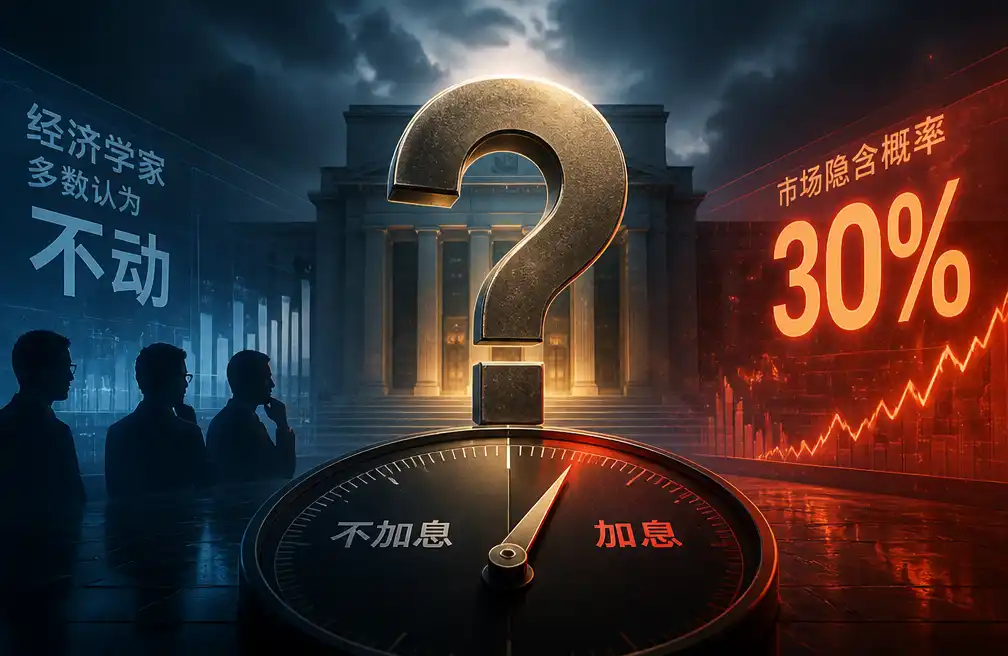
Federal funds futures are repricing ahead of the July FOMC decision, as traders pay a higher premium for the risk of a surprise rate hike or more hawkish signals. This contrasts with economists, where a Reuters survey of 104 analysts unanimously expects rates to remain unchanged at 3.50%-3.75%, with 78 foreseeing no change through year-end. Yet, futures markets have priced in about a 30% probability of a 25-basis-point hike. The core debate, especially under new Fed Chair Kevin Warsh, centers on how the Fed will respond to the oil price shock from Middle East tensions. The market is not necessarily predicting a hike tonight but is hedging against two tail risks: an immediate rate increase, or a hold combined with communication that seriously opens the door for a September hike. This hedging activity has driven up open interest in Fed funds futures. Analysts are divided on how to weight the oil price surge in the Fed's reaction function. Hawkish voices (e.g., BofA) worry that completely dismissing the price pressure could challenge the Fed's inflation credibility in Warsh's first major test. Dovish views (e.g., Citi) argue the shock is primarily supply-driven and that overreacting with rate hikes could unnecessarily hurt growth, unless clear signs of secondary inflation emerge. Warsh's new tenure amplifies policy path uncertainty, as markets lack a stable baseline for his communication style. This environment forces traders to price in a wider range of outcomes, explaining the divergence between unanimous economist forecasts and market hedging. The key focus will be on Warsh's post-meeting commentary. If he downplays the oil shock and stresses anchored long-term expectations, hawkish pricing may recede. If he emphasizes the risk of broader price spillovers and prioritizes returning to 2% inflation, the market will interpret this as reopening the door for a September hike. This would sustain support for the USD, keep pressure on JPY (testing intervention thresholds), and challenge risk assets like stocks and crypto through higher discount rates and weaker sentiment. The baseline remains no action in July, but the communication will determine how far this repricing extends.

marsbitHace 9 hora(s)

To Hike or Not Tonight: Economists Unanimous on 'No', Markets Price in a 30% Chance

marsbitHace 9 hora(s)

The Return of the Greenspan 'Conundrum'? Could Walsh Push Long-Term Rates Down by Raising Rates?

A resurgence of the "Greenspan Conundrum" is being discussed as a potential policy option for new Fed Chair Wash. Market logic suggests that by raising short-term interest rates, Wash could strengthen the Fed's anti-inflation credibility, thereby compressing the inflation premium embedded in long-term yields and ultimately lowering borrowing costs like mortgage rates—a key goal of the Trump administration. This theory is bolstered by historical precedent. In the mid-2000s, as then-Chair Alan Greenspan raised the federal funds rate, long-term bond yields and 30-year mortgage rates fell—a phenomenon later termed the "Greenspan Conundrum." Analysts note this reflects forward-looking market pricing, where credible rate hikes can lower inflation expectations and long-term rates. Since taking office in May, Wash has consistently signaled a hawkish stance. Following his recent Senate testimony where he emphasized his independence, the 10-year Treasury yield fell sharply, mirroring the conundrum dynamic. Historical analysis shows new Fed chairs often begin with hawkish moves to establish credibility. While an immediate rate hike this week is not the base case, several FOMC members have hinted at the potential need for further tightening. Even without an immediate move, the prevailing market view is that Wash is systematically building his inflation-fighting credibility, which in itself may be the most powerful precondition for pushing long-term rates lower.

marsbitAyer 16:21

The Return of the Greenspan 'Conundrum'? Could Walsh Push Long-Term Rates Down by Raising Rates?

marsbitAyer 16:21

Cardano Price Forecast: Can ADA Surpass $0.20 as Ark Invest and Hoskinson Debate Its Relevance?

Cardano (ADA) is trading at $0.1659 on July 27, compressed at the apex of a triangle pattern. This coincides with Ark Invest's Director of Research questioning the industry's continued focus on Cardano as newsworthy, prompting a rebuttal from founder Charles Hoskinson who called the criticism institutional bias. Technically, ADA is caught between a descending trendline from May's peak and an ascending line from June's low of ~$0.1386, with the 20-day EMA at $0.1669 adding resistance. Key support is the 0.236 Fibonacci level at $0.1618, with resistance at the 50-day EMA ($0.1750) and the 0.382 Fib level ($0.1762). Derivatives data shows extremely low options volume at $6.59K, similar to previous low-volatility compression phases before directional moves. Open interest and 24-hour volume have dropped significantly, and long/short positioning is nearly balanced, indicating trader caution ahead of the upcoming FOMC meeting. Price Forecast: * **Bullish Case:** An upward triangle breakout above the 20-day and 50-day EMAs could target the 0.382 Fib ($0.1762) and 0.618 Fib ($0.1995) levels, potentially fueled by a risk-on FOMC outcome and renewed attention from the Hoskinson-Ark debate. * **Bearish Case:** A breakdown below the 0.236 Fib support at $0.1618 could see ADA decline toward the June low of $0.1386, driven by the negative narrative from Ark and risk aversion from FOMC uncertainty.

cryptonews.ruHace 2 días 11:23

Cardano Price Forecast: Can ADA Surpass $0.20 as Ark Invest and Hoskinson Debate Its Relevance?

cryptonews.ruHace 2 días 11:23

活动图片