Artículos Relacionados con Budget

El Centro de Noticias de HTX ofrece los artículos más recientes y un análisis profundo sobre "Budget", cubriendo tendencias del mercado, actualizaciones de proyectos, desarrollos tecnológicos y políticas regulatorias en la industria de cripto.

GPT-5.6 Sol Suddenly Gets Dumber Overnight? Thinking Budget Slashed from 960 to 128, No More Fixed-Intelligence Models?

The article discusses widespread user reports that OpenAI's GPT-5.6 Sol model, specifically its "Max" reasoning tier, has become less capable at complex, deep reasoning tasks. Users noted faster but shallower responses. Community investigation revealed an unpublicized internal parameter called "juice value," representing computational budget for reasoning. Observations indicated this value for the Max tier dropped dramatically from 960 to 128. In response, OpenAI's Thibault Sottiaux stated there was no intentional reduction in model capability ("nerf"). He explained the changes were part of an experiment to investigate unexpected high token usage following GPT-5.6's launch, which introduced features like longer reasoning and larger context windows. The experiment temporarily adjusted the "juice" parameter and rolled back the context window from 372k to 272k tokens to diagnose the usage spike. Sottiaux asserted these settings have been reverted and highlighted ongoing optimizations. The controversy highlights a tension between AI as a reliable, fixed-capability tool and its reality as a cloud service where providers can adjust performance parameters. The article argues that for AI to be trusted enterprise infrastructure, providers need clearer, transparent guarantees about the specific performance boundaries associated with service tiers.

marsbit07/15 03:28

GPT-5.6 Sol Suddenly Gets Dumber Overnight? Thinking Budget Slashed from 960 to 128, No More Fixed-Intelligence Models?

marsbit07/15 03:28

After Laying Off 20% of Staff, What Are the Key Points of EF's New Structure?

Following the completion of a months-long organizational restructuring, the Ethereum Foundation (EF) announced a 20% workforce reduction (approximately 54 employees) on June 23rd. It reorganized its teams into five new core clusters: Protocol, Access, User, Community, and Institutional (plus Operations/Management support units). Officially, this move implements the EF's 2026 Mandate and 2025 Treasury Management Policy, aiming to create a more focused and "self-sovereign" organization. The restructuring prioritizes the CROPS principles—Censorship Resistance, Openness & Freedom, Privacy, and Security—as foundational organizational tenets. The Protocol cluster will focus on core protocol R&D, including MEV reduction and zkEVM. The Access cluster emphasizes preserving user "zero option" for non-custodial, permissionless interaction. The User, Community, and Institutional clusters will manage external engagement, with the latter handling institutional and regulatory matters. While offering enhanced severance and transition support for affected employees, the EF did not disclose budget allocations or specific KPIs for the new clusters. This has led to market uncertainty about the impact on project funding and development priorities. Analysts note the announcement's positive tone of mission focus contrasts with a backdrop of recent EF leadership changes and broader ecosystem pressures. The true impact—whether this signifies strategic realignment or reactive contraction—will become clearer as the new structure's resource allocation and project prioritization are revealed in the coming months.

marsbit06/24 05:32

After Laying Off 20% of Staff, What Are the Key Points of EF's New Structure?

marsbit06/24 05:32

Token Budget Wars: Enterprise AI Enters the 'Accounting Era'

Token Budget Wars: Enterprise AI Enters the "Accounting Era" Enterprise AI is shifting from the question of "whether to adopt" to "how to account for it." As AI inference costs evolve from experimental budgets into ongoing operational expenses, CEOs and CFOs are demanding proof of value: what tangible results does each dollar spent on tokens deliver? The core of "Token Budget Wars" is not simply about reducing AI bills, but about intelligently allocating compute resources. It involves determining which business processes warrant more computational power, which tasks can use cheaper models, which can be outsourced or handled manually, and which are merely inefficient consumption. A key insight is that AI usage (token consumption) does not equal value. While SaaS usage indicated software adoption, AI token usage only indicates the "meter is running." The same workflow can cost vastly different amounts due to factors like prompt quality, context, model choice, and retries. The critical metric for scaling is "marginal token utility"—the business value created per additional dollar of inference cost. However, this is difficult to measure due to challenges like the long tail of retries, context inflation (where costs can scale quadratically with context length), and inefficient model routing (defaulting to the most powerful model for all tasks). The competition for token allocation is intensifying because, in the AI era, influence is tied to how much intelligence one can command, not just team size. AI spending is essentially competing with labor costs, whether for replacing external BPOs, internal staff, or generating new revenue. BPO contracts provide a clearer benchmark as they are priced per completed unit. The missing layer is attribution from tokens to business outcomes. Companies need a system that connects inference spending to completed work and results, capturing the agent's decision trajectory—what it saw, retrieved, tried, and why it succeeded or failed. This recorded rationale becomes a valuable asset. Ultimately, those who master token-to-outcome attribution will control the allocation of AI resources within enterprises, deciding which workflows get more compute, which are capped, or which revert to humans. The first phase of enterprise AI proved models could do the work. The next phase will determine how much of that work is worth paying for.

marsbit05/28 12:13

Token Budget Wars: Enterprise AI Enters the 'Accounting Era'

marsbit05/28 12:13

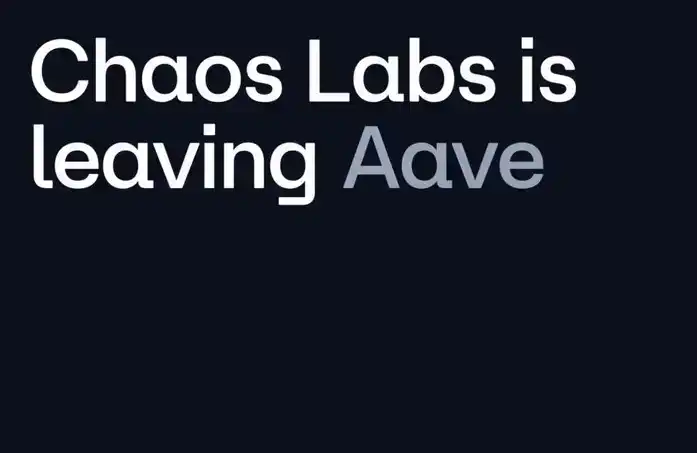
Chaos Labs Exits, Who Will Take Over Aave's Risk?

Chaos Labs, the core risk management provider for Aave V2 and V3 markets, has announced its decision to terminate its partnership with Aave. Despite Aave Labs increasing the budget to $5 million to retain them, Chaos Labs chose to leave due to fundamental disagreements on how risk should be managed. Key reasons for the departure include: the loss of core Aave contributors increasing operational risk, the expanded scope and complexity introduced by Aave V4 (which requires rebuilding risk infrastructure from scratch), and the fact that Chaos Labs operated at a financial loss even with increased budgets. They estimate that proper risk management for both V3 and V4 should cost at least $8 million annually (≈5.6% of protocol revenue), closer to traditional banking standards, rather than the previous 2%. Chaos Labs emphasized that Aave’s reputation and institutional adoption rely heavily on its risk management track record. They also highlighted unquantified costs like legal liability and operational security risks. The exit occurs as Aave plans its V4 upgrade and expands into institutional markets. Chaos Labs warns that migrating to V4 while maintaining V3 will double, not halve, the workload, and that accumulated operational experience cannot be easily transferred. The decision reflects a principled stance: Chaos Labs only attaches its name to work that meets its high-risk standards, even at significant financial sacrifice.

marsbit04/07 03:36

Chaos Labs Exits, Who Will Take Over Aave's Risk?

marsbit04/07 03:36

A 140% Surge in Valuation in One Year: Who's Writing Checks for Defense AI?

In March 2026, military AI company Shield AI raised $2 billion in funding round, led by Advent International and J.P. Morgan, with additional participation from Blackstone. Its valuation surged 140% to $12.7 billion within a year. Similarly, competitor Anduril is reportedly seeking new funding at a $60 billion valuation. Both companies have seen valuations grow fourfold in just over two years, far outpacing revenue growth, indicating that the market is pricing them based on future platform potential rather than current earnings. This trend is mirrored in the public market, where Palantir’s market cap grew to over $420 billion by late 2025. Shield AI’s products include the MQ-35 V-BAT drone and the upcoming X-BAT autonomous fighter, while its Hivemind AI engine was selected by the U.S. Air Force for the Collaborative Combat Aircraft (CCA) program. A key driver is the structural shift in defense tech funding. Private equity firms like Advent, KKR, and Carlyle are increasingly investing in long-term defense infrastructure, moving beyond traditional venture capital. In 2025, global defense tech VC deals reached $49.1 billion, with 87% going to late-stage companies. The U.S. Department of Defense’s FY2026 budget request allocated $13.4 billion specifically for AI and autonomous systems, with $9.4 billion dedicated to aerial drones—directly aligning with Shield AI and Anduril’s offerings. This clear demand signal, combined with institutional capital moving into defense infrastructure, marks a shift from speculative investment to asset-level allocation in the defense AI sector.

marsbit03/27 07:52

A 140% Surge in Valuation in One Year: Who's Writing Checks for Defense AI?

marsbit03/27 07:52

活动图片