Stablecoins are leaving exchanges – and traders aren’t buying the dip

ambcryptoPublicado a 2025-12-23Actualizado a 2025-12-23

Resumen

Stablecoins are being withdrawn from cryptocurrency exchanges at the fastest rate in the current market cycle, signaling a sharp decline in short-term risk appetite among traders. Despite a growing overall stablecoin supply—largely backed by U.S. Treasuries—investors are choosing to hold capital off exchanges rather than deploy it during the market downturn. This cautious behavior is evident in the significant outflows from major exchanges like Binance, which saw nearly $1.9 billion in net outflows over 30 days. While Bitcoin has corrected roughly 36% from its October highs, traders have been unwinding leverage, with open interest falling more than 40%. However, stablecoins aren't exiting the crypto ecosystem entirely. Instead, they are migrating to safer blockchain networks like TON, Ethereum, and Polygon, while trading-focused chains such as Solana and Tron experience outflows. The shift reflects a defensive strategy: investors are prioritizing safety and yield offered by stablecoins—which function like low-risk money market instruments—over exposure to volatile assets. This trend is likely to persist until market confidence returns.

Stablecoins are moving off crypto exchanges at the fastest pace this cycle. Instead of putting capital to work, investors are choosing to wait.

This is happening even as stablecoin supply continues to grow, backed largely by U.S. Treasuries. Everyone’s staying liquid, but holding back until market conditions improve.

Traders take a step back

The speed at which stablecoins are being pulled has caused a drop in short-term risk appetite.

While Bitcoin’s correction fell further (now down roughly 36% from its early October highs), traders have been unwinding leverage. OI has fallen more than 40%.

Source: CryptoQuant

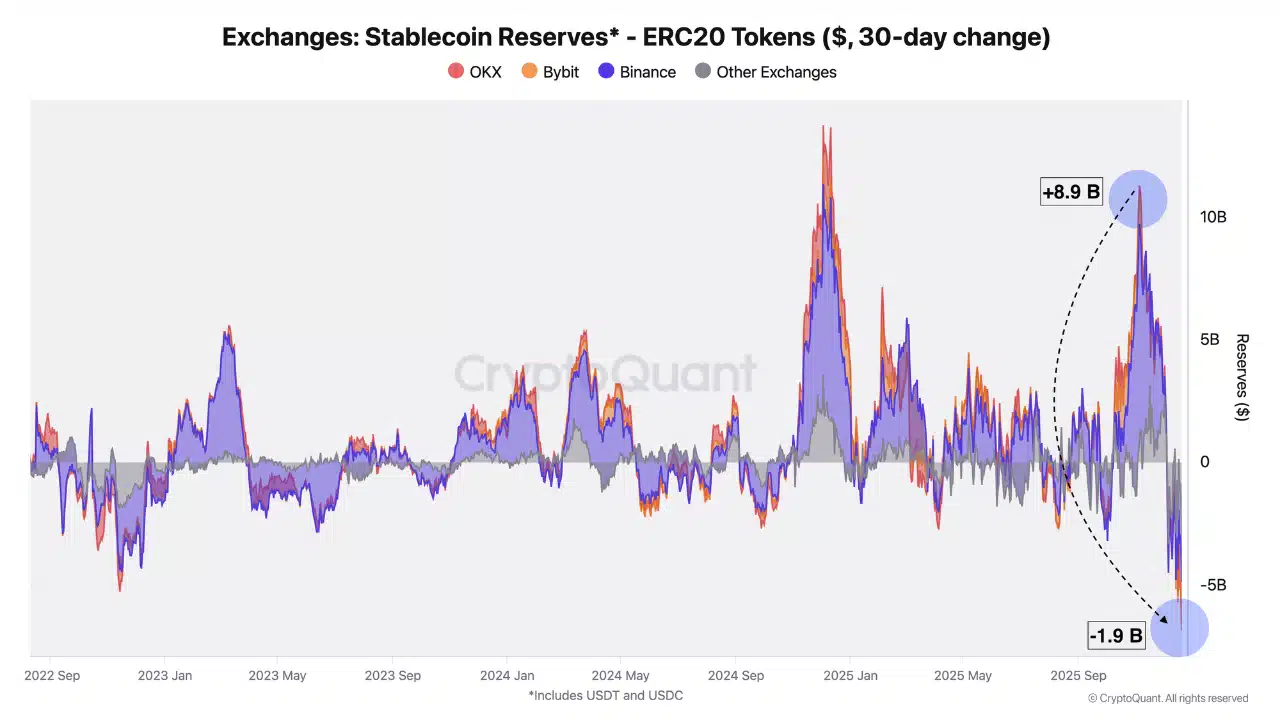
December was the steepest decline in ERC-20 stablecoin reserves across major exchanges in this cycle. These tokens are usually on exchanges ready to be deployed.

This time, they are being pulled out instead. The change is easily visible on Binance, where an inflow trend flipped into nearly $1.9 billion in net outflows over 30 days. This is an obviously cautious move.

Stablecoins aren’t quitting crypto altogether though

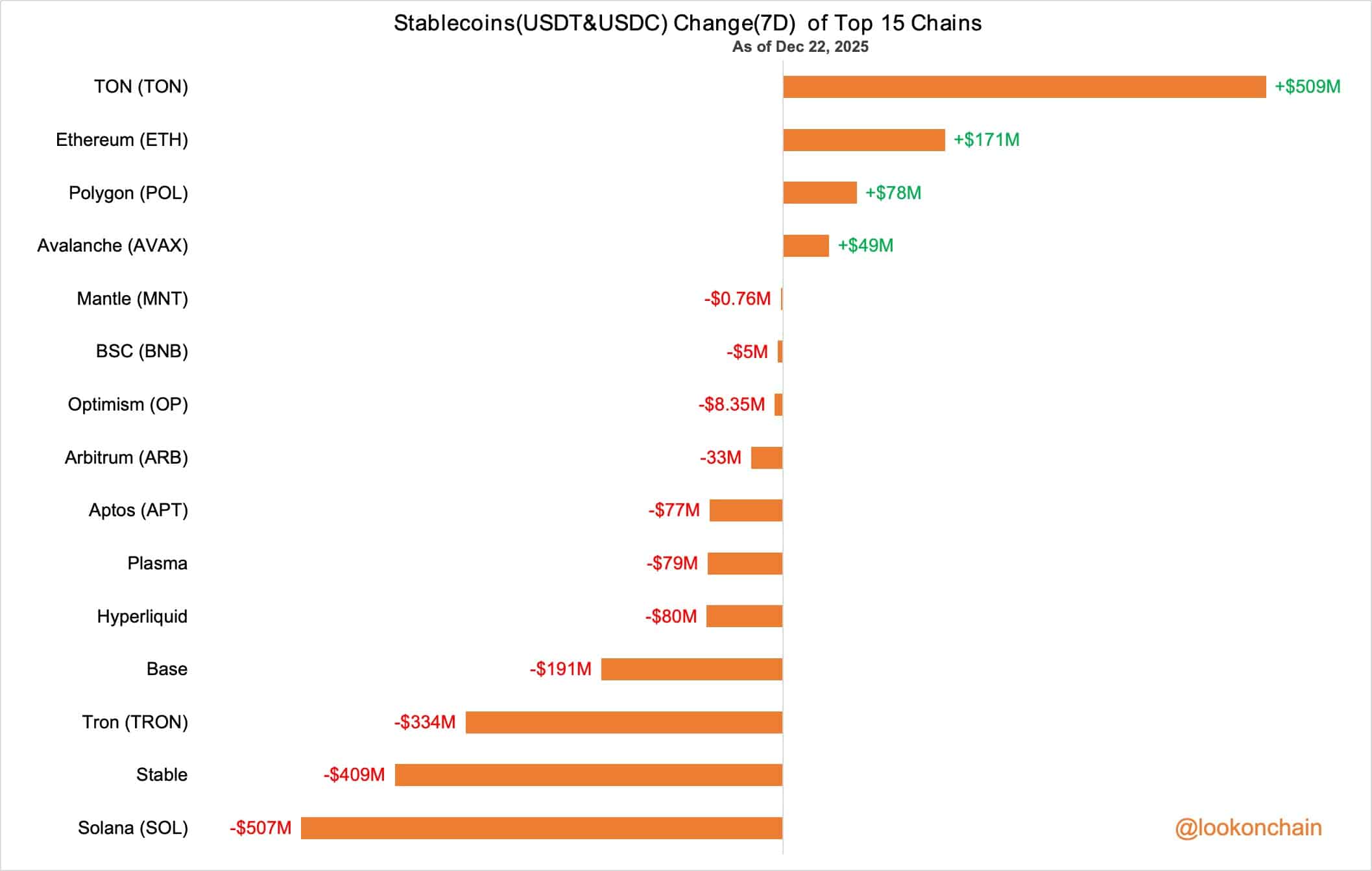
They are simply shifting across networks instead of being on exchanges. Over the past week, total stablecoin supply still grew by about $509 million.

Source: Lookonchain

The biggest inflows were seen on TON, which added over $500 million, followed by Ethereum and Polygon. In contrast, networks tied more closely to trading activity, such as Solana and Tron, saw large outflows.

Investors aren’t taking any new risks, and are simply waiting for clear signs before committing.

Defensive, not disappearing

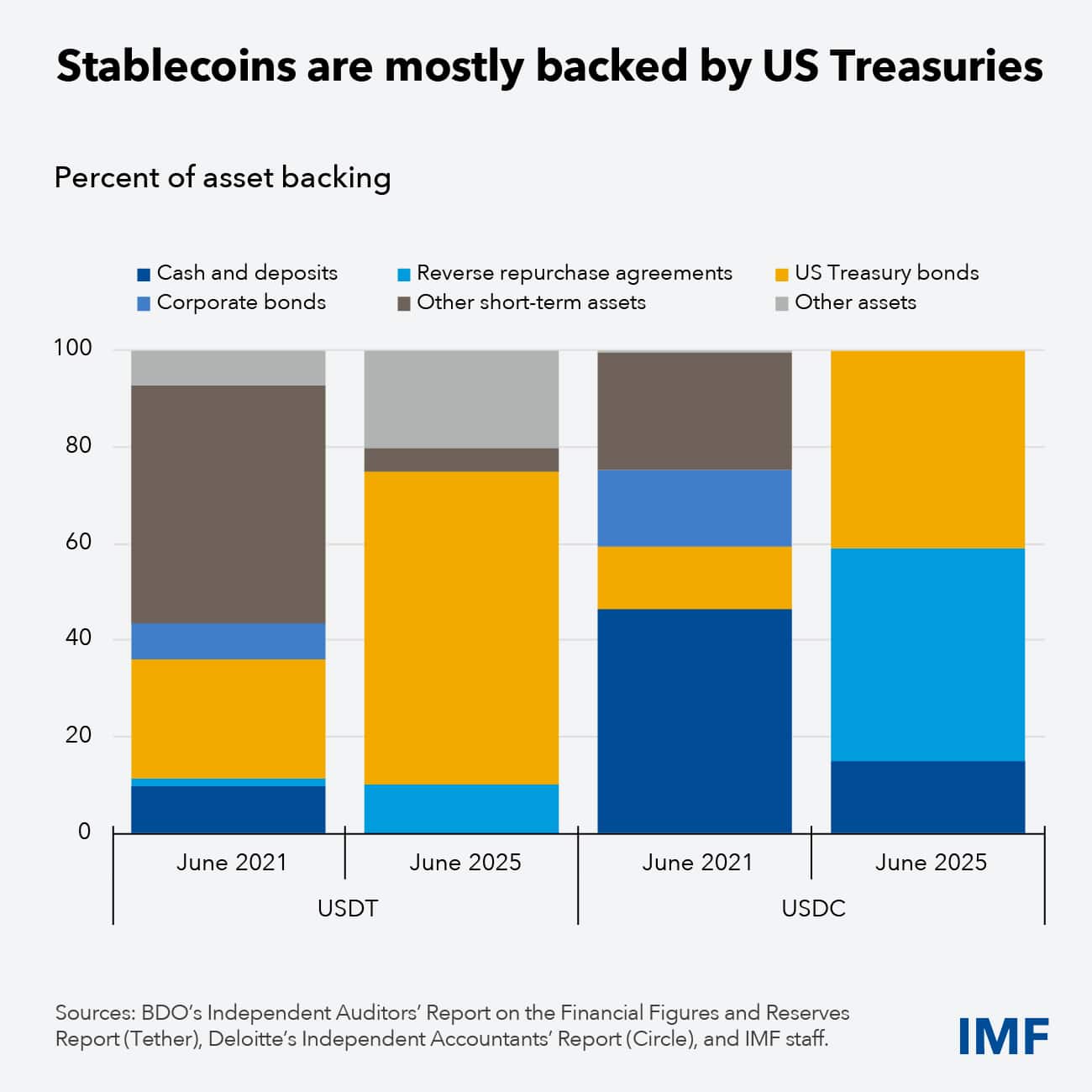
Today, most major stablecoins are backed largely by U.S. Treasuries and other short-term government assets, making them more or less low-risk money market instruments.

Source: IMF

This explains why capital is staying in stablecoins even as it leaves exchanges. Investors are choosing safety and yield over chaos. Until confidence returns, this defensive positioning is likely to persist.


Final Thoughts

  • Stablecoins are leaving exchanges at record speed as traders cut risk.
  • Capital is on safer chains until confidence returns.
Next: Solana: Short-term pain, long-term hope? SOL faces liquidation test
Share
  • Share
  • Tweet

Preguntas relacionadas

QWhat is the main trend observed with stablecoins on crypto exchanges in the current cycle?

AStablecoins are moving off crypto exchanges at the fastest pace this cycle, with investors choosing to hold liquid assets rather than deploying capital.

QHow has the withdrawal of stablecoins affected market activity and trader behavior?

AThe rapid withdrawal of stablecoins has caused a drop in short-term risk appetite, leading traders to unwind leverage, with open interest falling more than 40%.

QWhich blockchain networks saw the largest inflows of stablecoins, and what does this indicate?

ATON saw the largest inflows, adding over $500 million, followed by Ethereum and Polygon, indicating a shift to safer chains rather than those tied to active trading like Solana and Tron.

QWhy are investors choosing to hold stablecoins even as they leave exchanges?

AInvestors are opting for safety and yield, as stablecoins are largely backed by U.S. Treasuries and short-term government assets, making them low-risk money market instruments.

QWhat was notable about Binance's stablecoin flows in December?

ABinance experienced a significant shift from inflows to nearly $1.9 billion in net outflows over 30 days, reflecting a cautious move by investors.

Lecturas Relacionadas

Who Will Define the Rules of the AI Era? Anthropic Discusses the 2028 US-China AI Landscape

This article, based on Anthropic's analysis, outlines the intensifying systemic competition between the U.S./allies and China for AI leadership by 2028. It argues that access to advanced computing power ("compute") is the critical bottleneck, where the U.S. currently holds a significant advantage through chip export controls and allied innovation. However, China's AI labs remain competitive by exploiting policy loopholes—via chip smuggling, overseas data center access, and "model distillation" attacks to copy U.S. model capabilities—keeping them close to the frontier. The piece presents two contrasting scenarios for 2028. In the first, decisive U.S. action to tighten compute controls and curb distillation locks in a 12-24 month AI capability lead, cementing democratic influence over global AI norms, security, and economic infrastructure. In the second, policy inaction allows China to achieve near-parity through continued access to U.S. technology, enabling Beijing to promote its AI stack globally and integrate advanced AI into its military and governance systems, altering the strategic balance. Anthropic contends that maintaining a decisive U.S. lead is essential for shaping safe AI development and governance. The core recommendation is for U.S. policymakers to urgently close compute and model access loopholes while promoting global adoption of the U.S. AI technology stack to secure a lasting strategic advantage.

marsbitHace 1 hora(s)

Who Will Define the Rules of the AI Era? Anthropic Discusses the 2028 US-China AI Landscape

marsbitHace 1 hora(s)

“Why Didn’t You Buy 2x Long SK Hynix?”

The article discusses the immense popularity of the "2x Long SK Hynix ETF" (07709.HK) in Hong Kong, which became the world's largest single-stock leveraged ETF by May 2026. Launched in October 2025, the ETF's net value soared over 1000% in seven months, significantly outperforming the 324% gain of SK Hynix's underlying stock, driven by the AI boom and a critical shift in industry demand from computing power to memory. It highlights the mechanics and risks of daily-rebalanced leveraged ETFs. In a smooth bullish market, they generate amplified returns, but during volatile periods—exemplified by market swings during geopolitical tensions in the Strait of Hormuz in March-April 2026—they suffer severe "volatility decay," where choppy price action can cause losses far exceeding twice the drop of the underlying asset. The piece frames SK Hynix, as NVIDIA's primary HBM supplier, within the classic cycle of the memory chip industry—a commoditized sector prone to boom-and-bust cycles of shortage, price hikes, overcapacity, and crashes. While current AI-driven demand and high margins (Q1 2026毛利率~79%) create a "super cycle," the article questions its sustainability. It warns that extreme profits will inevitably tempt competitors like Samsung and Micron to ramp up HBM production, potentially eroding scarcity. Furthermore, the entire narrative remains tethered to the massive AI capital expenditure of tech giants. In conclusion, the ETF's trajectory symbolizes the accelerated, all-in nature of the current AI revolution, where timeframes are compressed and market moves are extreme. However, it also underscores that while industry trends define ultimate returns, macro-geopolitical risks dictate the volatile and uncertain path to get there.

marsbitHace 1 hora(s)
“Why Didn’t You Buy 2x Long SK Hynix?”

marsbitHace 1 hora(s)

a16z Crypto: A Guide to the CLARITY Act for Crypto Entrepreneurs

The CLARITY Act, a bipartisan crypto market structure bill, has advanced through the Senate Banking Committee, marking a potential historic shift in U.S. digital asset regulation. For years, a lack of clear rules has stifled innovation, pushed development overseas, and exposed consumers to risk. This bill aims to establish a comprehensive framework, providing long-needed regulatory clarity for blockchain networks and digital assets. It builds upon previous legislative efforts like FIT21 and the House version of CLARITY, which gained strong bipartisan support. CLARITY is crucial because it recognizes that blockchain networks are fundamentally different from traditional companies. Networks operate through decentralized, shared rules rather than centralized control. Applying corporate legal frameworks to networks forces them into a centralized model, concentrating power and value. In contrast, decentralized blockchain networks can function as user-owned public infrastructure, distributing value more equitably among participants. The bill seeks to enable the safe launch of networks in the U.S., clarify regulatory jurisdiction between the SEC and CFTC, oversee crypto exchanges, and enhance consumer protections. Its passage would align U.S. law with the nature of decentralized technology, allowing builders to operate transparently and fund projects domestically without structural compromises due to regulatory uncertainty. Similar to the positive impact seen after the stablecoin-focused GENIUS Act, CLARITY could unlock a new wave of innovation, helping the U.S. reclaim leadership in the crypto space while combating fraud and abuse.

链捕手Hace 1 hora(s)

a16z Crypto: A Guide to the CLARITY Act for Crypto Entrepreneurs

链捕手Hace 1 hora(s)

Trading

Spot
Futuros

Artículos destacados

Cómo comprar T

¡Bienvenido a HTX.com! Hemos hecho que comprar Threshold Network Token (T) sea simple y conveniente. Sigue nuestra guía paso a paso para iniciar tu viaje de criptos.Paso 1: crea tu cuenta HTXUtiliza tu correo electrónico o número de teléfono para registrarte y obtener una cuenta gratuita en HTX. Experimenta un proceso de registro sin complicaciones y desbloquea todas las funciones.Obtener mi cuentaPaso 2: ve a Comprar cripto y elige tu método de pagoTarjeta de crédito/débito: usa tu Visa o Mastercard para comprar Threshold Network Token (T) al instante.Saldo: utiliza fondos del saldo de tu cuenta HTX para tradear sin problemas.Terceros: hemos agregado métodos de pago populares como Google Pay y Apple Pay para mejorar la comodidad.P2P: tradear directamente con otros usuarios en HTX.Over-the-Counter (OTC): ofrecemos servicios personalizados y tipos de cambio competitivos para los traders.Paso 3: guarda tu Threshold Network Token (T)Después de comprar tu Threshold Network Token (T), guárdalo en tu cuenta HTX. Alternativamente, puedes enviarlo a otro lugar mediante transferencia blockchain o utilizarlo para tradear otras criptomonedas.Paso 4: tradear Threshold Network Token (T)Tradear fácilmente con Threshold Network Token (T) en HTX's mercado spot. Simplemente accede a tu cuenta, selecciona tu par de trading, ejecuta tus trades y monitorea en tiempo real. Ofrecemos una experiencia fácil de usar tanto para principiantes como para traders experimentados.

587 Vistas totalesPublicado en 2024.12.10Actualizado en 2025.03.21

Cómo comprar T

Discusiones

Bienvenido a la comunidad de HTX. Aquí puedes mantenerte informado sobre los últimos desarrollos de la plataforma y acceder a análisis profesionales del mercado. A continuación se presentan las opiniones de los usuarios sobre el precio de T (T).

活动图片