Reflections from the Co-founder of Bitlayer: After Helping 600 People Find Jobs in 15 Years, I Decided to Stop Doing Recruitment

marsbitPublicado a 2026-01-28Actualizado a 2026-01-28

Resumen

After 15 years of helping over 600 people find jobs, Bitlayer co-founder Kevin He reflects on his journey from being a passionate recruiter to pivoting toward a new vision: AI-powered "digital co-founders." He initially launched COCO AI in mid-2025 to optimize recruitment using AI, but soon realized traditional hiring was becoming less relevant. Companies were hiring less, and skill gaps persisted despite matching tools. A turning point came when his team built zylos, an AI system that handled tasks like social media, coding, and data processing—enabling one person to do the work of a team. This, combined with the rise of digital employees (like Claude Code and the success of Manus, acquired by Meta), shifted his perspective. He now believes the future lies in empowering individuals with organizational-level capabilities through AI, rather than optimizing job matching. COCO 2.0 is now focused on building “digital co-founders”—AI agents that help people start and run businesses alone, without needing to hire or be hired. The essay ends with an open question: In an era where AI augments individual potential, can one person become a company?

Author: Kevin He, Co-founder of Bitlayer

1. A Programmer and "Recruitment" for 15 Years

I am Kevin, an AI × Crypto entrepreneur, co-founder of Bitlayer, previously at Huobi, and a Peking University graduate.

From programmer to technical management, and then to entrepreneur, I have changed industry tracks several times over 15 years, always passionately engaged in recruitment-related work.

Over these 15 years, I have helped over 600 people successfully secure jobs. Some were formal recruitments, but more often, it was helping friends—finding jobs, introducing employees.

There are two stories I always keep in mind.

The first is helping a 35+ brother find a job. He has two children and was under great pressure. The moment he told me he received an offer, I was even more excited than he was.

The second is helping a startup team quickly build a R&D team. From zero to operational, it took less than two months. Watching the product launch, I felt I had participated in that creation.

This is why I love this work: achieving resource matching and genuinely helping people.

But recently, I started rethinking the premise of this work.

2. COCO 1.0: From Passion to Doubt

In June 2025, with support from various parties, I formed a small team and started incubating COCO AI.

The initial idea was simple: use AI to realize career advisors and career intermediaries. Make recruitment more efficient, help more people find good jobs.

The product evolved: resume optimization → AI job matching → AI corporate recruitment.

We created two products:

  • Job seeker end: job.coco.xyz

  • Enterprise end: company.coco.xyz

We invested significantly in technology, and the product was built.

But the Go-To-Market (GTM) wasn't as smooth as imagined.

I started reviewing and discovered several realities:

  • Companies' recruitment needs are decreasing: Due to the economic environment and improved organizational efficiency, many companies are no longer hiring on a large scale as before.

  • There is a gap between job seekers' skills and company requirements: AI can help with matching, but the gap itself won't disappear.

  • Job seekers' skills themselves need updating: Many people's abilities have fallen behind in the rapidly changing market.

I started doubting myself.

Was it a product problem? A market problem? Or—was the direction itself problematic?

I didn't have an answer at the time.

3. The Great Changes in the External World

The second half of 2025, the external world changed.

Claude Code began to be widely applied across various industries. Not just for writing code, but truly capable of completing complex tasks. More and more people around me started discussing a term: digital employees.

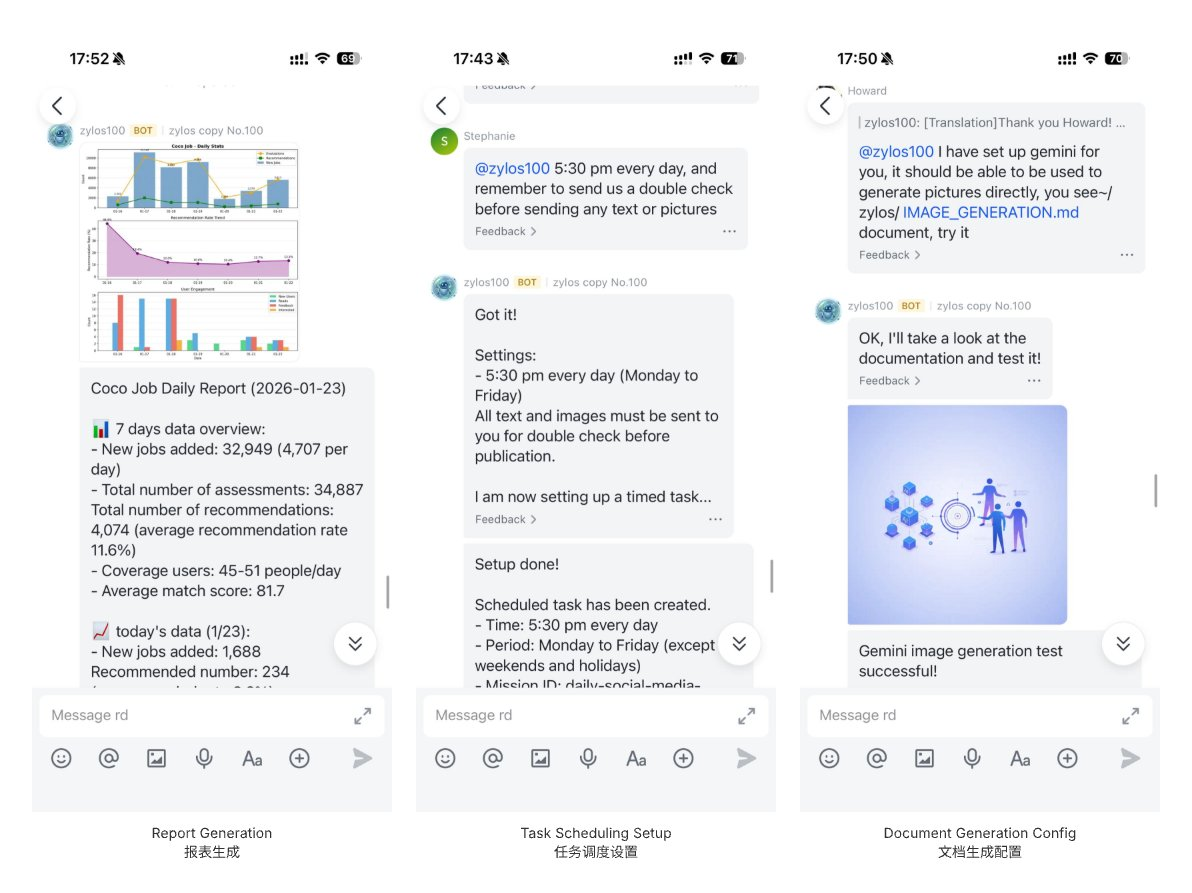
In December, we internally built a system called zylos, attempting to have AI handle daily work.

Tasks included:

  • Daily data reporting

  • Social media management

  • Code writing and testing

  • Data processing

  • Etc.

The results shocked me.

Tasks that previously required multiple people of different roles to complete could now be done just by assigning the task.

A specific example: social media operations.

Before, it required a dedicated person spending an hour daily: finding material, writing copy, formatting, publishing, replying to comments.

Now? Tell zylos, "Post one at 12:30 PM daily, content around XX theme, confirm with me before posting," and it's done in minutes.

From needing a dedicated person to needing none, from an hour daily to minutes.

The feeling was complex. Shock, excitement, but also a tinge of unease—what did this mean for the business I was building?

Around the same time, another piece of news arrived: Manus was acquired by Meta for billions of dollars.

Manus's annual revenue had already exceeded $100 million. This wasn't a concept, not a demo, but real commercial success.

I listened to Jiyichao's final podcast interview before the sale. One sentence he said impressed me deeply:

Digital employees aren't about replacing people, but enabling one person to do the work of a team.

This statement completely matched our experience testing zylos.

4. Cognitive Update

"One-Person Company" is not a new concept.

I had heard of it before and thought it made sense. But it always felt distant, too idealistic.

Until I saw zylos handle a large volume of tasks with my own eyes.

It didn't replace one specific person; it enabled me, as one person, to possess the capabilities of a small team.

In that moment, I decided to pivot.

I rethought what I had done over these 15 years.

  • Old cognition was: Talent is a scarce resource; helping companies find talent has value.
  • New cognition is: Capability enhancement is more important than talent matching. Helping individuals acquire organizational-level capabilities holds greater value.

This isn't negating the past 15 years. Those moments of helping people find jobs were still real and meaningful.

But I saw a new possibility:

  • Old paradigm: Individuals依附于(attach to) organizations; organizations acquire capabilities through hiring.

  • New paradigm: Individuals acquire organizational-level capabilities through AI, becoming independent units of creation.

The future trend is the era of one-person companies, not being employed by others.

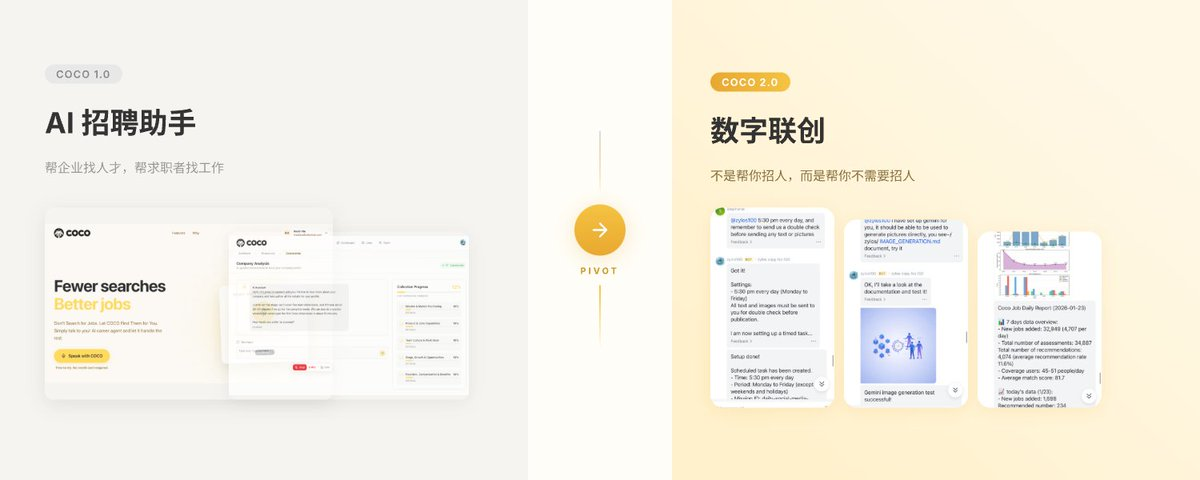
5. COCO 2.0: Digital Co-founder

After figuring this out, the direction of COCO 2.0 changed.

Not helping you hire people, but helping you not need to hire people.

Not helping you find a job, but helping you create work.

What we are building is a "Digital Co-founder"—your AI联合创始人(Co-founder).

It has several core features:

  • Self-learning evolution: Not a fixed tool, but a partner that can continuously evolve based on your needs.

  • Secure and controllable: Your data, your business logic, all under your control.

  • Truly capable of doing things: Not a chat bot, but a digital employee that can complete complex tasks.

The specific product form is still being refined. But the direction is clear.

6. An Ongoing Story

As I write this article, the transition is still in progress.

Startups rarely publicize their pivots. Because of uncertainty, fear of being questioned, because there's no success yet to prove it.

But I feel this process itself is worth sharing.

When technology enables individuals to possess organizational capabilities, how will employment relationships evolve?

This is the question I am pondering, and the direction I am practicing.

If you are also thinking about these things:

  • If you didn't need to hire, what could you do?

  • If you didn't need to find a job, what would you want to do?

  • Can one person become a company?

This is an ongoing story.

I don't know how it will end either. But I know: Don't do things that go against the direction of the times.

15 years helping people find jobs. Next, helping people become companies.

Related reading: Interview with Bitlayer Co-founder Charlie: The Bull Market Ambition of Institutional-Grade Bitcoin Financial Infrastructure


Preguntas relacionadas

QWhat was the author's initial motivation for starting COCO AI, and what did they learn from its first iteration?

AThe author's initial motivation was to use AI to make recruitment more efficient, helping more people find good jobs. From the first iteration (COCO 1.0), they learned that the market had fundamental challenges: companies' hiring demands were decreasing, there was a significant skills gap between job seekers and company requirements, and many job seekers' skills were outdated.

QWhat key external event in late 2025 fundamentally changed the author's perspective on the future of work?

AThe widespread application of Claude Code across various industries and the rise of 'digital employees' was the key external event. This was further solidified by the multi-billion dollar acquisition of Manus by Meta, proving the commercial success of the digital employee model.

QWhat was the pivotal internal experiment the author's team conducted, and what was its surprising result?

AThe team built an internal system called 'zylos' to handle daily work tasks like data reporting, social media management, and coding. The surprising result was that tasks which previously required multiple people from different roles could now be accomplished simply by assigning the task to the AI, demonstrating that one person could possess the capabilities of a small team.

QHow did the author's core belief about the value of recruitment shift after their 'cognitive update'?

AThe author's core belief shifted from the old认知 (cognition) that 'talent is a scarce resource, and helping companies find talent is valuable' to the new认知 that 'capability enhancement is more important than talent matching. Helping individuals acquire organizational-level capabilities holds greater value.'

QWhat is the new mission and product direction for COCO 2.0, as described by the author?

AThe new mission for COCO 2.0 is to help people not need to hire others and to help people create work instead of find it. The product direction is to build a 'Digital Co-Founder'—an AI partner that is self-learning, secure, controllable, and capable of performing complex tasks to empower individuals to become their own companies.

Lecturas Relacionadas

Will the Fed Still Cut Interest Rates? Tonight's Data Is Crucial

The core debate surrounding the Federal Reserve's potential interest rate cuts is intensifying amid geopolitical conflict and rebounding inflation. The key question is whether high energy prices will cause persistent inflation or weaken consumer demand enough to force the Fed to cut rates. Citigroup presents a bullish case for cuts, arguing that oil supply disruptions from the Strait of Hormuz are temporary and will not lead to lasting inflationary pressure. They point to receding bond yields and oil prices as evidence the market is pricing in a short-lived shock. Citi's data also shows tightening financial conditions, a stabilizing labor market, and healthy tax returns, supporting their view that the path to lower rates remains open. Conversely, Deutsche Bank offers a starkly contrasting, more hawkish outlook. They argue the Fed's current policy is already neutral and expect rates to remain unchanged indefinitely. Their view is based on stalled disinflation progress and a shift toward more hawkish rhetoric from key Fed officials like Waller, who cited risks from prolonged Middle East conflict and tariffs. Other officials, including Williams and Hammack, signaled rates would likely stay on hold for a "considerable time." The market pricing has shifted dramatically, now forecasting zero cuts in 2026. The imminent release of the March retail sales "control group" data is highlighted as a critical test. This metric, which excludes gas station sales, will reveal if high gasoline prices are eroding consumer spending in other areas. A weak reading could support the case for imminent rate cuts, while a strong one would bolster the argument for the Fed to hold steady. This data is pivotal for determining the near-term policy path.

marsbitHace 3 min(s)

Will the Fed Still Cut Interest Rates? Tonight's Data Is Crucial

marsbitHace 3 min(s)

The Second Half of Macro Influencer Fu Peng's Career

Fu Peng, a prominent Chinese macroeconomist and former chief economist of Northeast Securities, has joined Hong Kong-based digital asset management firm Bitfire Group (formerly New Huo Group) as its chief economist. This move, announced in April 2026, triggered an 11% surge in Bitfire's stock price. Fu, known for his accessible macroeconomic commentary and large social media following, will focus on integrating digital assets into global asset allocation frameworks, particularly combining FICC (fixed income, currencies, and commodities) with cryptocurrencies for institutional clients. His career includes roles at Lehman Brothers and Solomon International, with significant influence gained through public communication. However, in late 2024, Fu faced temporary social media bans after a controversial private speech at HSBC on China's economic challenges, though he denied regulatory sanctions. He later left Northeast Securities citing health reasons. Bitfire, a licensed virtual asset manager serving high-net-worth clients, seeks to build trust and attract traditional capital through Fu’s expertise and credibility. The partnership represents a strategic shift for both: Fu enters the crypto sector after a traditional finance peak, while Bitfire aims to leverage his macro framework for institutional adoption. Outcomes remain uncertain regarding capital inflows and compatibility within corporate structure.

marsbitHace 1 hora(s)

The Second Half of Macro Influencer Fu Peng's Career

marsbitHace 1 hora(s)

Trading

Spot
Futuros

Artículos destacados

Cómo comprar PEOPLE

¡Bienvenido a HTX.com! Hemos hecho que comprar ConstitutionDAO (PEOPLE) sea simple y conveniente. Sigue nuestra guía paso a paso para iniciar tu viaje de criptos.Paso 1: crea tu cuenta HTXUtiliza tu correo electrónico o número de teléfono para registrarte y obtener una cuenta gratuita en HTX. Experimenta un proceso de registro sin complicaciones y desbloquea todas las funciones.Obtener mi cuentaPaso 2: ve a Comprar cripto y elige tu método de pagoTarjeta de crédito/débito: usa tu Visa o Mastercard para comprar ConstitutionDAO (PEOPLE) al instante.Saldo: utiliza fondos del saldo de tu cuenta HTX para tradear sin problemas.Terceros: hemos agregado métodos de pago populares como Google Pay y Apple Pay para mejorar la comodidad.P2P: tradear directamente con otros usuarios en HTX.Over-the-Counter (OTC): ofrecemos servicios personalizados y tipos de cambio competitivos para los traders.Paso 3: guarda tu ConstitutionDAO (PEOPLE)Después de comprar tu ConstitutionDAO (PEOPLE), guárdalo en tu cuenta HTX. Alternativamente, puedes enviarlo a otro lugar mediante transferencia blockchain o utilizarlo para tradear otras criptomonedas.Paso 4: tradear ConstitutionDAO (PEOPLE)Tradear fácilmente con ConstitutionDAO (PEOPLE) en HTX's mercado spot. Simplemente accede a tu cuenta, selecciona tu par de trading, ejecuta tus trades y monitorea en tiempo real. Ofrecemos una experiencia fácil de usar tanto para principiantes como para traders experimentados.

383 Vistas totalesPublicado en 2024.12.12Actualizado en 2025.03.21

Cómo comprar PEOPLE

Discusiones

Bienvenido a la comunidad de HTX. Aquí puedes mantenerte informado sobre los últimos desarrollos de la plataforma y acceder a análisis profesionales del mercado. A continuación se presentan las opiniones de los usuarios sobre el precio de PEOPLE (PEOPLE).

活动图片