Private Credit in US Dollar

marsbitPublicado a 2026-07-09Actualizado a 2026-07-09

Resumen

Stablecoins are evolving into a new type of money market fund, channeling crypto deposits into the $2 trillion private credit market. This mirrors the 1970s innovation where money market funds pooled small deposits to buy high-yield government securities, bypassing bank restrictions. Today, platforms like Apollo's ACRED tokenized fund and Figure's on-chain lending system allow stablecoin holders to access institutional private credit strategies with no minimum investment, offering yields of 8-12%. On-chain tokenization enables greater liquidity and DeFi composability (e.g., using tokens as collateral for leveraged positions) compared to traditional, locked-up private credit funds. Consequently, on-chain private credit has grown 15x in a year to $5.87 billion, though it remains a tiny fraction (0.3%) of the global market. However, this model carries significant risks, as illustrated by the failure of Goldfinch. Launched in 2021, it directed crypto deposits to motorcycle loans in Kenya and Nigeria. Critical issues included a lack of local oversight, leading to unauthorized fund transfers and borrower defaults. With $56 million now trapped in non-performing loans, its collapse highlights that while blockchain streamlines capital transfer, the essential 90% of lending—underwriting, monitoring, and recovery—remains a costly, localized challenge. Success requires robust, traditional credit infrastructure, not just on-chain execution.

Written by: Vaidik Mandloi

Compiled by: Block unicorn

In the 1970s, Bruce Bent and Henry Brown created the first-ever money market fund. The idea was remarkably simple. Due to a regulation from the Great Depression era, the interest rate on savings at U.S. banks was capped at 4.5%. Although U.S. Treasury yields were over 9% at the time, the minimum investment to purchase Treasuries was as high as $10,000. Bent and Brown decided to pool small deposits, buy Treasuries on a large scale, and return the profits to investors. Today, money market funds have reached a scale of approximately $8 trillion.

Stablecoins are engaging in a similar practice, only this time the assets are private credit, a market worth $2 trillion where a minimum of $1 million is required to enter. Yield-bearing stablecoins are being used to pool small deposits and channel them into the credit space.

Today, I will delve into how this is happening and how Goldfinch (the first-ever attempt to conduct such operations with real funds) collapsed, resulting in $56 million of depositor funds being trapped in Kenyan motorcycle loans.

How Stablecoins Became Money Market Funds for Private Credit

In the 1990s, U.S. banks provided about half of the debt capital to businesses and consumers, but today that figure is around 20%. This is because after 2008, new capital rules took effect, making it too costly for banks to hold leveraged loans. Consequently, banks entirely withdrew from the mid-market lending business, and private credit funds took their place.

Apollo, Blackstone, and KKR raised funds from pension funds and insurance companies and began lending to companies abandoned by banks, charging high premiums because these borrowers had no alternative.
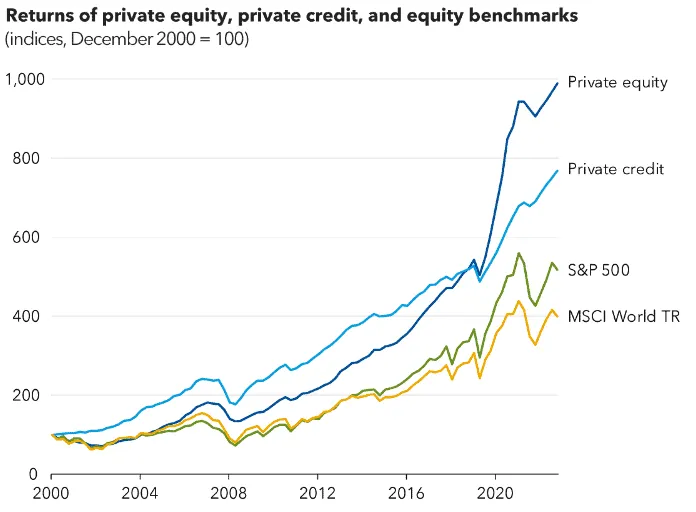
The market has grown from less than $200 billion in 2008 to over $2 trillion today, and almost all of this capital comes from institutional investors writing checks of $5 million or more.

One of the main reasons for the million-dollar minimum threshold in private credit loans is their high management complexity. Each transaction requires due diligence, restructuring, and monitoring over several years. Managing a fund with ten institutional limited partners (LPs) each contributing $50 million is far easier than managing a fund with retail investors each contributing $500, and even then, scaling investments can often be unprofitable. This is why, over the past decade, only pension funds and insurance companies could access such yields, typically ranging from 8% to 12%.

It is at this point that yield-bearing stablecoins have changed the game, just as Bent and Brown opened access to Treasuries in the 1970s. Although the paperwork is still handled by institutions, with funds like Apollo underwriting and managing the risks, now tokenized sub-funds can accept deposits of any size and channel them into institutional strategies without having to manage thousands of individual investors.

Apollo recently launched the tokenized fund ACRED, whose diversified credit fund has attracted $109 million in inflows. Investors can even use it as collateral on the Morpho platform for margin lending and re-investment, thereby achieving leveraged yields.
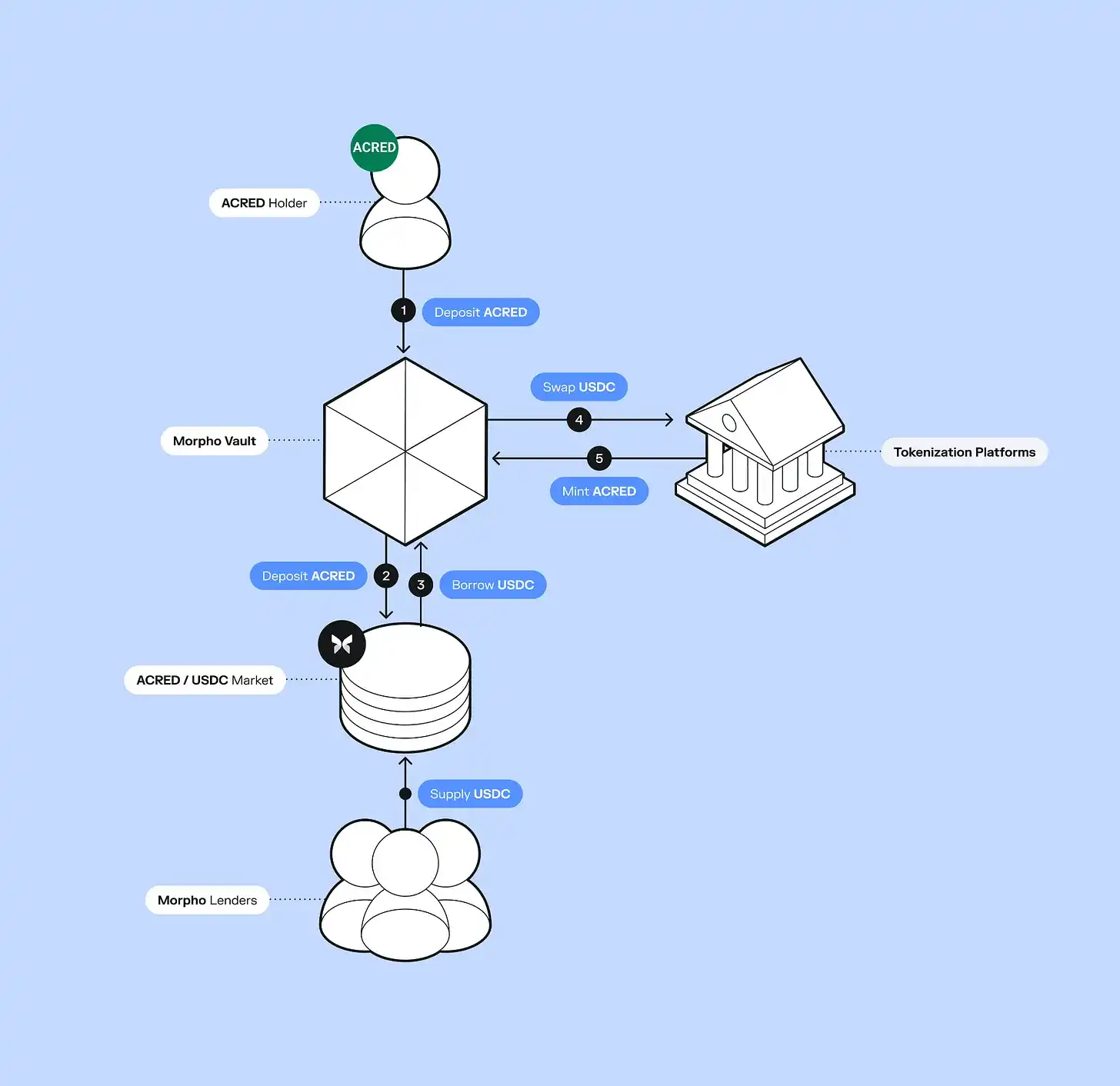
Figure has built an entire on-chain lending system, has issued $21 billion in loans, successfully listed on Nasdaq, and launched YLDS—a yield-bearing stablecoin with a circulating supply of $376 million. Other protocols, such as Pyse and Glow, go even further by tokenizing solar projects, allowing investors to fund solar installations in developing countries with a few hundred dollars and earn an annual percentage yield (APY) from monthly electricity fees.

This does not mean that the minimum investment requirement for the fund itself disappears. The ACRED fund still requires a direct investment of $5 million. However, once the fund is tokenized, its tokens can be traded on secondary markets with no minimum investment limit, and they can interoperate with DeFi (Decentralized Finance) systems in ways that traditional fund shares cannot match.

In traditional private credit, your funds are locked for years, with quarterly redemptions capped at 5%. On-chain, however, funds can be flexibly combined and are liquid 24/7. For companies like Apollo and Figure, this allows them to access a $315 billion pool of stablecoin capital actively pursuing yield. By tokenizing funds, they can directly tap into this capital pool, opening new distribution channels without having to build retail infrastructure from scratch.

A year ago, the total on-chain private credit was just $400 million; today, it stands at $5.87 billion, a 15-fold increase in 12 months. However, this still represents only 0.30% of the $2 trillion global private credit market. Half of all new stablecoin supply in the first quarter of 2026 came from yield-bearing stablecoins, meaning most new stablecoin capital is now chasing active yield, not just a dollar peg.
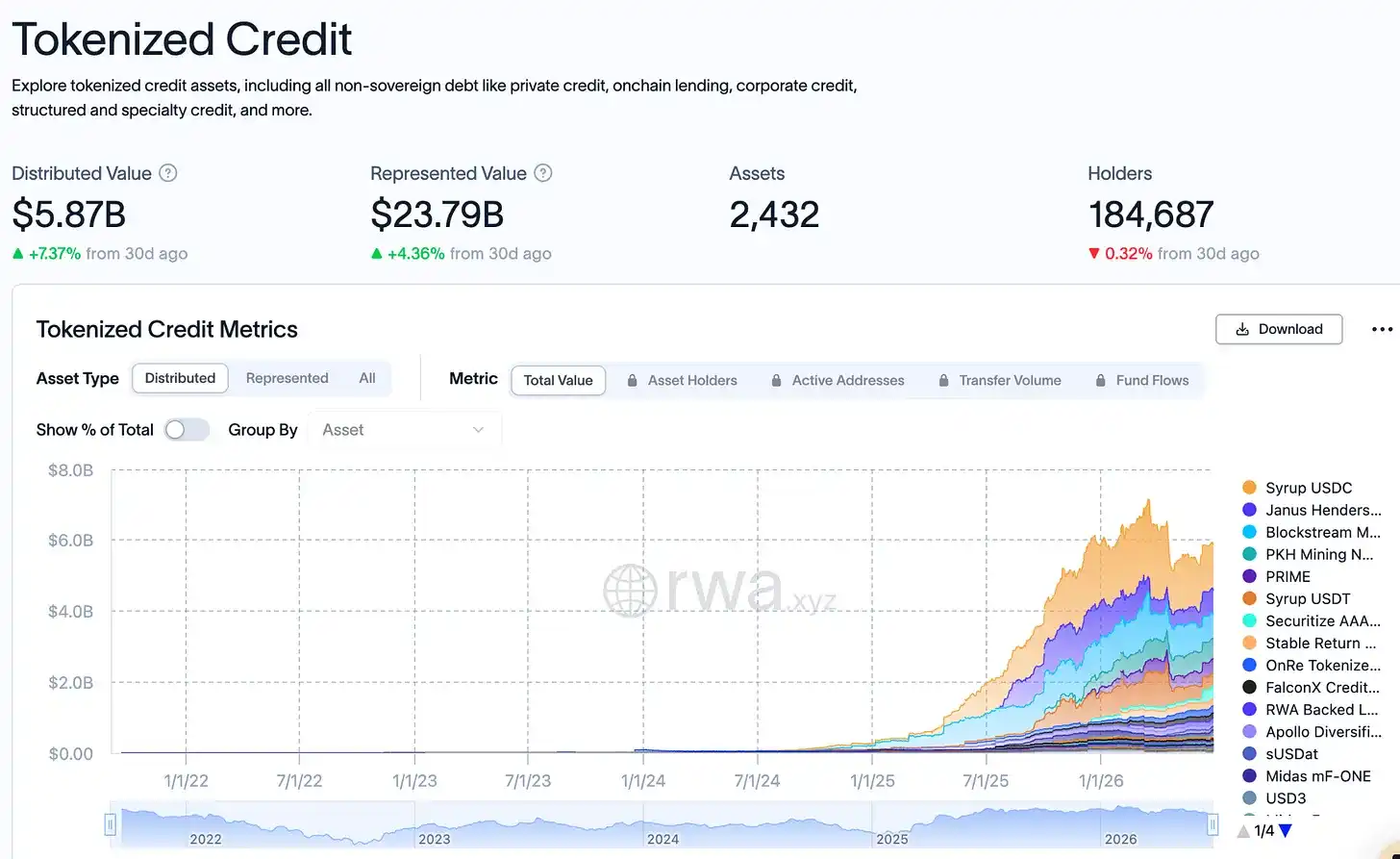
Moreover, because every dollar of on-chain credit can be used as collateral and recycled through DeFi protocols, the actual financial activity it generates is a multiple of the dollar amount.

Take ACRED as an example. An investor deposits $10,000 on Morpho, borrows $7,000 in USDC using this deposit as collateral, then uses this USDC to purchase more ACRED and deposits it again as collateral. This way, a single deposit can generate over $17,000 in credit exposure. In contrast, traditional private credit: the same $10,000 would sit idle in a fund for 5 years, earning no yield. On-chain, this compounding effect occurs simultaneously across multiple layers, which is why the ACRED market is growing faster than its raw dollar size suggests. However, it also means that if the underlying loan defaults, losses propagate through every layer of the cycle.

Tokenization does not mean the underlying risks are reduced. Often, these risks are overlooked as capital continuously flows in, providing enough funds to cover redemptions. But as inflows slow, the gap between token promises and actual loan values begins to show. Investors try to exit, but liquidity is insufficient, or the token price becomes disconnected from its intrinsic value.

Something similar happened with Goldfinch; it was one of the first protocols to put private credit on-chain when launched in 2021, but recently had to shut down with $56 million of depositor funds stuck in Kenya and Nigeria.

What Went Wrong with Goldfinch?

Goldfinch raised $25 million from a16z in 2021 to channel cryptocurrency funds, which at the time were only yielding 2% to 3% in DeFi lending pools, to businesses across Africa and Southeast Asia. Borrowers in these regions had to pay interest rates of 15% to 25% because local banks were unwilling to serve them.

The concept was to allow anyone holding USDC to deposit into Goldfinch pools, and then smart contracts would allocate funds to respective borrower accounts within seconds. However, underwriting a loan for a motorcycle financing company in Nairobi meant someone had to understand the Kenyan transportation economy, personally verify the borrower's accounts, and potentially visit the borrower's office in person if repayments stopped.
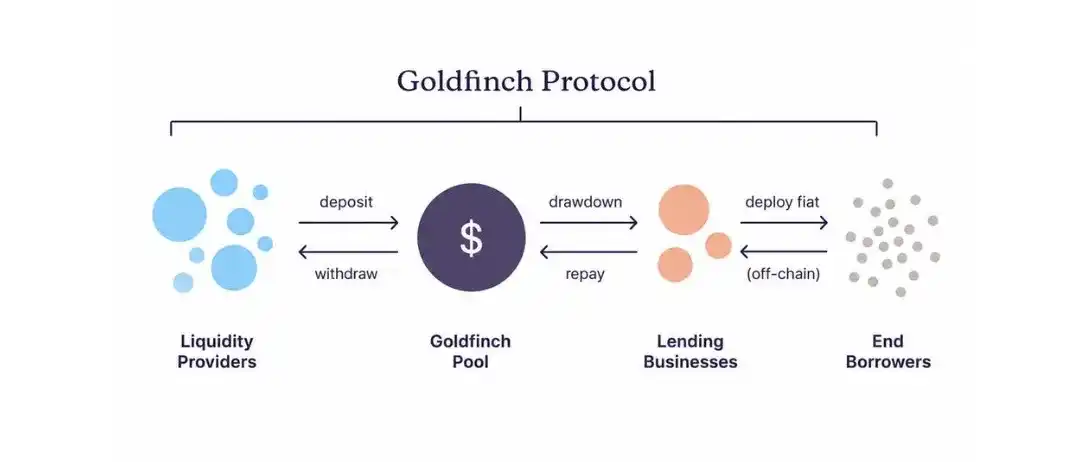
But on the blockchain, none of these things are possible. Once USDC is converted into Kenyan shillings and invested in a loan book, depositors have no way of knowing how their funds are being used, the financial status of the borrower, or even whether the loan terms are being honored. All critical information related to loan performance has left the blockchain and is in the hands of borrowers in countries most depositors have never visited.

This is why it took months for anyone to notice that Tugende Kenya, without authorization, transferred $1.9 million of its $5 million loan facility to Tugende Uganda in 2022. Nearly 40% of the loan was diverted to another legal entity in another country. Meanwhile, depositors continued to receive what they believed was 10% to 12% interest, completely unaware that the principal backing their yields had gone to a place never mentioned in the loan agreement.

If a traditional private credit firm discovered such a severe breach, it would recall the loan and force a restructuring within days. But Goldfinch depositors learned about this through posts on the company's governance forum, with their only option being to vote on a proposal that held neither legal authority to seize assets nor to audit the remaining assets.

By 2023, Tugende had completely defaulted and vanished. Over its $113.3 million lifespan, Goldfinch issued 24 asset pools, of which only 13 were fully repaid. The remaining 8 pools have $53.82 million in outstanding loans, and none are performing under the original terms. Most pools are undergoing restructuring, with repayments of less than $51,000 per month per pool, meaning recovering the full $53.82 million would take 8 to 15 years at this rate.

Goldfinch took on all the risks of emerging market currency volatility and limited credit history, yet possessed almost none of the infrastructure that traditional lenders spent decades building and managing to mitigate these risks. For example, banks offering loans in Kenya have local offices and regulatory relationships, giving them greater leverage when deals go wrong.

But Goldfinch funneled funds from anonymous global wallets to the same type of borrowers without any such supporting structures. This made the information gap between lenders and borrowers even larger than in traditional transactions and left depositors with almost no ability to intervene when things fell apart.

On-chain fund transfers constitute only about 10% of the processes required for lending. The remaining 90% is underwriting and fund recovery, which is highly localized and costly. Such underwriters need to establish a baseline of credibility for the entire asset class, which itself is still fighting for its right to exist. Every dollar lost in underwriting makes it harder for the next institutional partner to go on-chain and degrades the credibility of the entire asset class. The difficulty in credit has nothing to do with on-chain operations, and anyone building in this space without understanding this is essentially building the next 'Goldfinch.'


Preguntas relacionadas

QAccording to the article, how do yield-bearing stablecoins function similarly to the first money market fund, and what market do they currently aim to access?

ASimilar to the first money market fund, which pooled small deposits to access large-denomination, high-yield U.S. Treasury bonds, yield-bearing stablecoins pool small deposits (in stablecoins) to access the private credit market, a sector that traditionally requires a minimum investment of $1 million or more. They open access to this high-yield asset class for smaller investors.

QWhat is the primary reason for the high minimum investment threshold in traditional private credit funds, and how does tokenization address this issue?

AThe primary reason for the high minimum investment threshold (e.g., $1 million) in traditional private credit is the high cost and complexity of managing loans, which involves due diligence, restructuring, and long-term monitoring. It is inefficient to manage thousands of small investors. Tokenization addresses this by allowing a fund (like Apollo's ACRED) to sell its tokenized shares on secondary markets with no minimum investment, enabling access for smaller investors while the fund itself still manages a consolidated pool of capital from institutional LPs.

QWhat are the key advantages of having private credit tokens on-chain, compared to traditional private credit fund shares?

AKey on-chain advantages include: 1) No minimum investment for token purchasers. 2) 24/7 liquidity and the ability to trade tokens, unlike traditional shares which have long lock-up periods (e.g., 5 years) and limited quarterly redemptions (e.g., 5%). 3) Composability with DeFi protocols, allowing tokens to be used as collateral for loans and generating leveraged returns, multiplying financial activity beyond the initial capital.

QWhat was the fundamental failure of the Goldfinch protocol according to the analysis, and what specific example illustrates this failure?

AThe fundamental failure of Goldfinch was that it handled the easy 10% of the lending process (on-chain fund transfer) but failed to manage the crucial 90% (off-chain loan underwriting, monitoring, and recovery), which is highly localized, costly, and requires specialized infrastructure. This is illustrated by the case of Tugende Kenya, which diverted $1.9 million of a $5 million loan to Tugende Uganda without authorization—a major breach that went unnoticed for months by remote depositors who lacked the legal authority or local presence to effectively intervene or recover the assets.

QWhat major risk is highlighted regarding the use of DeFi leverage with tokenized private credit assets like ACRED?

AThe major risk is the amplification of losses in case of a default in the underlying loans. For example, an investor could deposit $10,000 in ACRED as collateral, borrow $7,000 against it to buy more ACRED, and repeat the process. This creates over $17,000 of credit exposure from the initial $10,000. If the underlying loans default, the losses cascade through every layer of this leveraged cycle, affecting not just the initial capital but also the borrowed funds across the DeFi ecosystem.

Lecturas Relacionadas

Just Now, Sam Altman Blasts Dario Amodei as 'Anti-Human', Secret Model Exposed the Same Day

Just now, Sam Altman strongly criticized Dario (Amodei, co-founder of Anthropic), denouncing his "doomsday marketing" as "anti-human dictator rhetoric." This came alongside the accidental exposure of OpenAI's next-generation model, codenamed "gpt-nathree," hinting at the imminent release of GPT-6 Astra. The leak occurred when an OpenAI employee's public GitHub commit mentioned the codename. Combined with previous leaks of "gpt-mewfour," it suggests these are iterative checkpoints for OpenAI's upcoming agent model, Astra. Astra is known for multi-agent collaboration and long-duration task handling, having reportedly solved previously unsolved mathematical problems. Meanwhile, two new Anthropic model codenames, "claude-marshmallow-eap" and "claude-melon-eap," were also exposed but are believed to be iterations of the Claude 5 series, not a new flagship. In a wide-ranging podcast interview, Altman admitted he was wrong about the speed of AI-driven disruption, acknowledging societal inertia slows adoption. He fiercely criticized rivals' marketing that simultaneously promises immense benefits (like curing cancer) and warns of existential risk, calling it a dangerous "benevolent dictator" narrative that seeks to concentrate power. He emphasized that people are the ultimate purpose of AI. Altman also revealed OpenAI's unconventional, consensus-defying path: spending four and a half years in the "dark" without a public product before ChatGPT's breakthrough, driven by scaling laws rather than early customer feedback. He concluded that even with superintelligent AI, genuine human connection will remain irreplaceably valuable.

marsbitHace 20 min(s)

Just Now, Sam Altman Blasts Dario Amodei as 'Anti-Human', Secret Model Exposed the Same Day

marsbitHace 20 min(s)

The 'Saving U.S. Treasuries' Baton Pass: Bessent Fumbled Last Week, This Week It's Wash's Turn

"Rescuing US Treasuries" Relay: After Bessent's Miss, All Eyes Are on Walsh Last week, US Treasury Secretary Bessent's announcement to at least double long-term Treasury buybacks failed to sustainably lower yields, which quickly rebounded. The market response saw a drop in the dollar alongside surges in gold and Bitcoin, interpreted as a "pressure release valve" for anxiety. The focus now shifts to Fed Chairman Walsh's upcoming Jackson Hole speech. Markets are highly sensitive to his message, seeking clarity on the Fed's policy response to stubborn inflation and worsening fiscal conditions. Analysts warn that a lack of new guidance could disappoint markets and worsen the sell-off in long-dated bonds. Analysts question the scale of Bessent's operations, noting they are too small relative to the overall debt market and do not constitute quantitative easing. A key issue is the Fed's massive holdings of long-term bonds, which distorts the market. With the Fed holding low-yielding short-term bonds that are losing money relative to its policy rate, discussion is growing around a potential Fed-led "Operation Twist." This would involve selling short-term bonds to buy long-term ones, aiming to lower long-end yields without expanding the balance sheet. The upcoming PCE inflation data will set the stage for Walsh's speech. However, the window for action is narrowing amid political pressures. A critical threshold is the 30-year yield at 5%; holding above it could increase stress on the dollar and leveraged sectors. Overall, the article suggests that without coordinated Fed action to anchor inflation expectations, Treasury interventions may ultimately fail, with investors increasingly looking to assets like gold as hedges.

marsbitHace 50 min(s)

The 'Saving U.S. Treasuries' Baton Pass: Bessent Fumbled Last Week, This Week It's Wash's Turn

marsbitHace 50 min(s)

Hyperliquid's Compliance Journey: From Permissionless to Permissioned via HIP-3

Hyperliquid’s Compliance Path: From Permissionless to Permissioned HIP-3 Hyperliquid currently blocks U.S. access because its permissionless, on-chain infrastructure conflicts with U.S. market structure laws, which restrict futures trading to registered exchanges, clearinghouses, and brokers. Through its Hyperliquid Policy Center (HPC), the project is advocating for regulatory modernization, proposing that regulated entities be allowed to build products on HyperCore (its exchange and clearing layer) while fulfilling their compliance obligations. The platform’s modular stack separates roles like a traditional exchange (DCM), clearinghouse (DCO), and broker (FCM), but reconstructs them on-chain with code. This enables permissionless access, self-custody, and 24/7 global trading, but clashes with U.S. rules requiring KYC, specific margin models, and custodial arrangements. To resolve this, HPC is engaging with U.S. regulators (CFTC, SEC) to seek clarity that deploying on-chain software does not itself trigger licensing, and to establish exemptions allowing non-custodial wallets to route users to regulated derivatives. Recent political signals suggest openness to this approach. On the technical side, Hyperliquid Labs has introduced permissioned HIP-3 deployers on testnet. These allow regulated entities to launch markets, perform KYC, and whitelist compliant users. While these create separate order books, whitelisted market makers can bridge liquidity between them, ensuring deep, shared liquidity across the same L1. Features like payload-based “PA” permissions enable DEX-level account controls (e.g., reduce-only orders), mirroring traditional broker authorities. The strategy is not to open the native, permissionless front-end to U.S. users, but to position Hyperliquid as neutral infrastructure that U.S. regulated firms can use while meeting their legal duties. This paves a compliant path for U.S. investor access while preserving the protocol’s core, permissionless nature.

marsbitHace 1 hora(s)

Hyperliquid's Compliance Journey: From Permissionless to Permissioned via HIP-3

marsbitHace 1 hora(s)

Two Funding Rounds in Three Months: The Chinese Version of Palantir is on Fire

Investment Community AI has learned that Beijing Zhongshu Ruizhi Technology Co., Ltd., a domestic industrial-grade causal intelligence and high-reliability decision-making AI company, has recently completed a strategic financing round worth hundreds of millions of RMB. This round saw participation from China Internet Investment Fund, Suzhou Chuangtou National Social Security Fund, Financial Street Capital, ICBC Capital, Kunlun Capital, among others, with existing shareholders also increasing their investment. This follows a Series B funding round in the hundreds of millions completed just three months prior. The rapid succession of two major funding rounds signifies strong market recognition of the company's underlying original technology and scaled commercial implementation. Often referred to as the "Chinese version of Palantir," Zhongshu Ruizhi is entering a new phase of accelerated technological iteration, widespread scenario replication, and scaled performance release, mirroring the explosive growth of China's AI market. Founded in April 2020 by Dr. Han Han, a Tsinghua University Ph.D. and former core drafter of national AI policies, the company is mission-driven to "move AI from the digital world to the physical world." It focuses on the high-reliability, strong-decision industrial AI track and enterprise-grade AI Agent full-stack infrastructure. The team tackles the challenge of applying AI to China's vast and complex industrial and energy systems by developing a new intelligent operating system from scratch. Its core technological breakthrough lies in three proprietary底层 technologies: meta-causal cognitive theory, causal models, and a dynamic ontology engine. These address critical pain points of generative large models in industrial settings—such as AI hallucinations, insufficient reasoning, lack of temporal logic, unverifiable decisions, and multi-source rule conflicts—thereby providing trustworthy, explainable, and executable智能决策 capabilities. Commercially, Zhongshu Ruizhi has achieved scaled deployment, serving over 50 central state-owned enterprises and industrial groups in sectors like power, petroleum, and aerospace, with implementations in more than 800 highly complex production scenarios. The company reported doubled revenue in 2025, demonstrating strong self-sufficiency and a viable business model—a rarity among new-generation AI firms. The latest funds will be allocated towards advancing foundational theoretical research, replicating successful application models to expand market presence (including overseas), and attracting top-tier talent. Lead investor China Internet Investment Fund highlighted that in the current shift from general AI capability contests to deep industrial empowerment, industrial-grade causal intelligence is crucial for building China's modern digital foundation and fostering new quality productive forces. They expressed support for the company's efforts to define decision-making paradigms and trustworthy standards for industrial intelligence, aiming to secure a rule-making voice in the global physical AI arena.

marsbitHace 1 hora(s)

Two Funding Rounds in Three Months: The Chinese Version of Palantir is on Fire

marsbitHace 1 hora(s)

Trading

Spot
活动图片