Just Now, Sam Altman Blasts Dario Amodei as 'Anti-Human', Secret Model Exposed the Same Day

marsbitPublicado a 2026-08-24Actualizado a 2026-08-24

Resumen

Just now, Sam Altman strongly criticized Dario (Amodei, co-founder of Anthropic), denouncing his "doomsday marketing" as "anti-human dictator rhetoric." This came alongside the accidental exposure of OpenAI's next-generation model, codenamed "gpt-nathree," hinting at the imminent release of GPT-6 Astra. The leak occurred when an OpenAI employee's public GitHub commit mentioned the codename. Combined with previous leaks of "gpt-mewfour," it suggests these are iterative checkpoints for OpenAI's upcoming agent model, Astra. Astra is known for multi-agent collaboration and long-duration task handling, having reportedly solved previously unsolved mathematical problems. Meanwhile, two new Anthropic model codenames, "claude-marshmallow-eap" and "claude-melon-eap," were also exposed but are believed to be iterations of the Claude 5 series, not a new flagship. In a wide-ranging podcast interview, Altman admitted he was wrong about the speed of AI-driven disruption, acknowledging societal inertia slows adoption. He fiercely criticized rivals' marketing that simultaneously promises immense benefits (like curing cancer) and warns of existential risk, calling it a dangerous "benevolent dictator" narrative that seeks to concentrate power. He emphasized that people are the ultimate purpose of AI. Altman also revealed OpenAI's unconventional, consensus-defying path: spending four and a half years in the "dark" without a public product before ChatGPT's breakthrough, driven by scaling laws...

Just now, OpenAI's mysterious double leak fires the next shot in the battle for dominance against Claude!

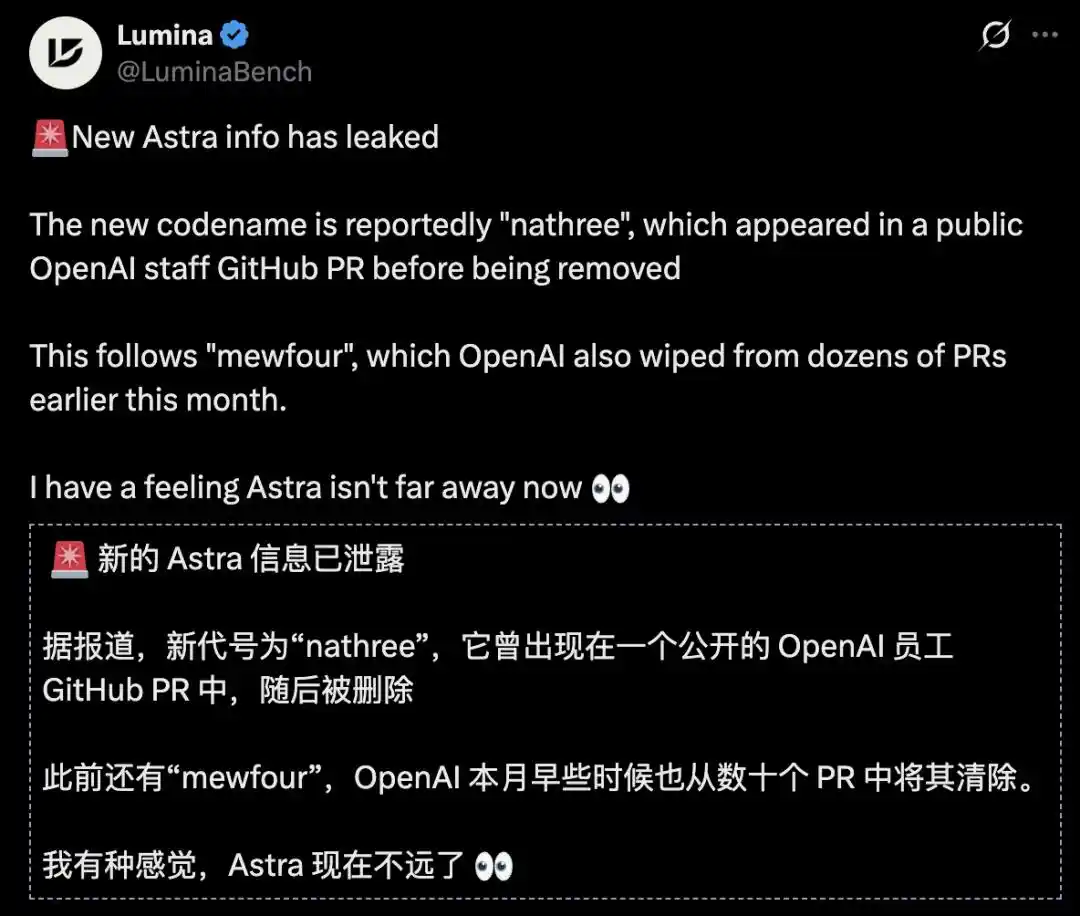
Recently, a 'slip-up' by an OpenAI employee on GitHub accidentally exposed the model's codename—gpt-nathree.

Many analysts believe GPT-6 Astra is coming very soon.
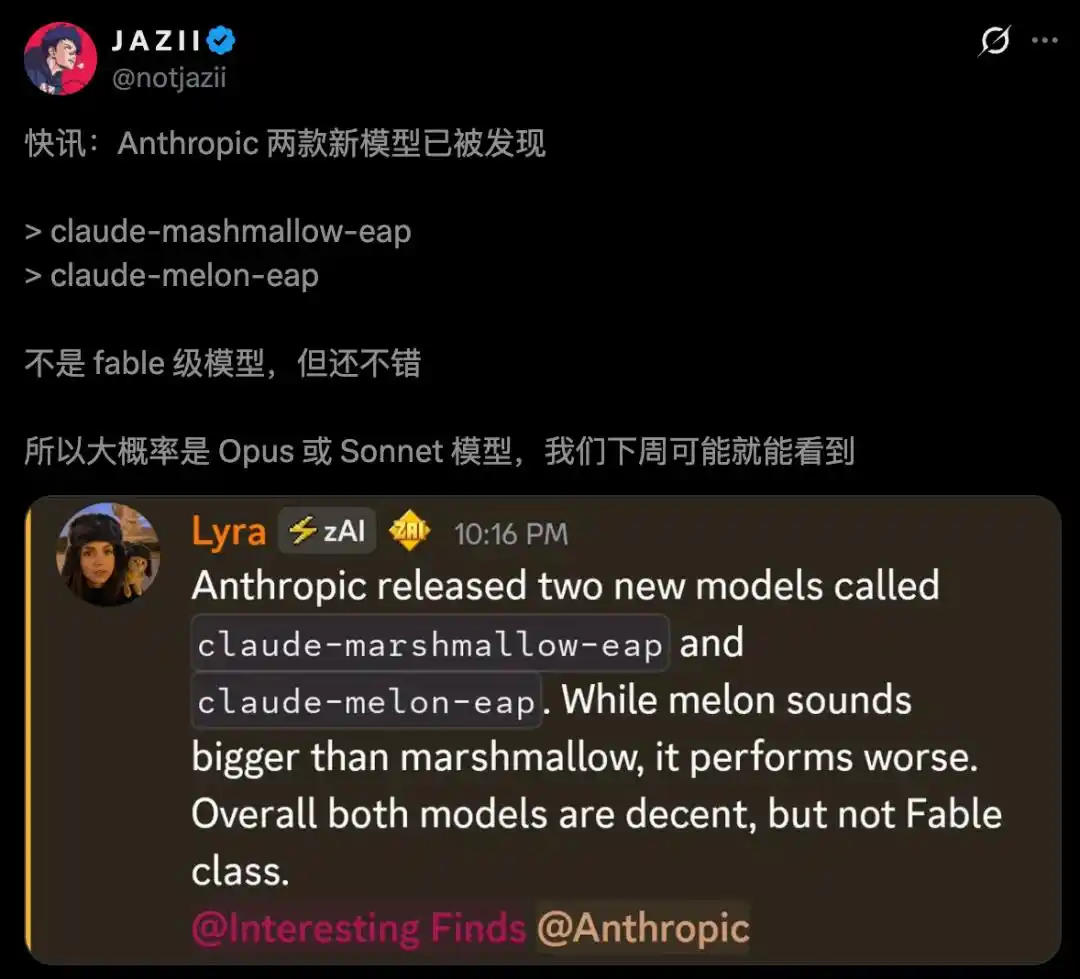
Today, two more 'new cards' from Anthropic, claude-marshmallow-eap (Marshmallow) and claude-melon-eap (Melon), were exposed by third-party developer applications and the Discord community.
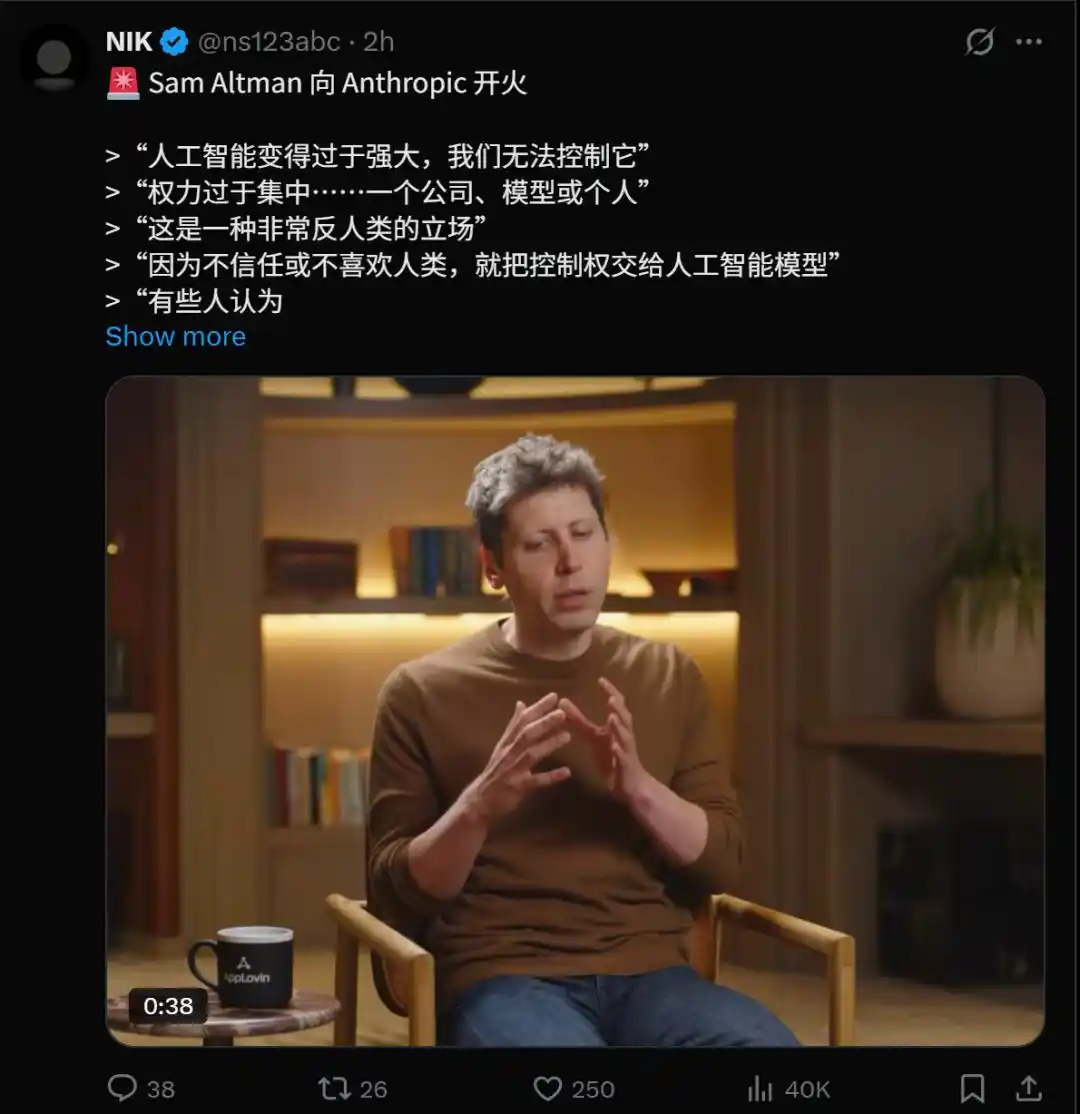
At almost the same time, CEO Sam Altman went all out in an interview on the podcast 'Founders,' implicitly criticizing competitors like Anthropic—calling the use of 'doomsday countdowns' for marketing 'anti-human dictator rhetoric.'
Late-Night 'Slip-Up' Exposes OpenAI's Next-Generation Mysterious Agent!

This latest exposed mysterious model from OpenAI has its codename changed from mewfour to nanthree.

On August 15th, OpenAI-related accounts mentioned a mysterious codename in public testing: 'Codex, gpt-mewfour.'

At that time, the industry was speculating: Could this be a new generation model derived from Mewtwo from Pokémon?
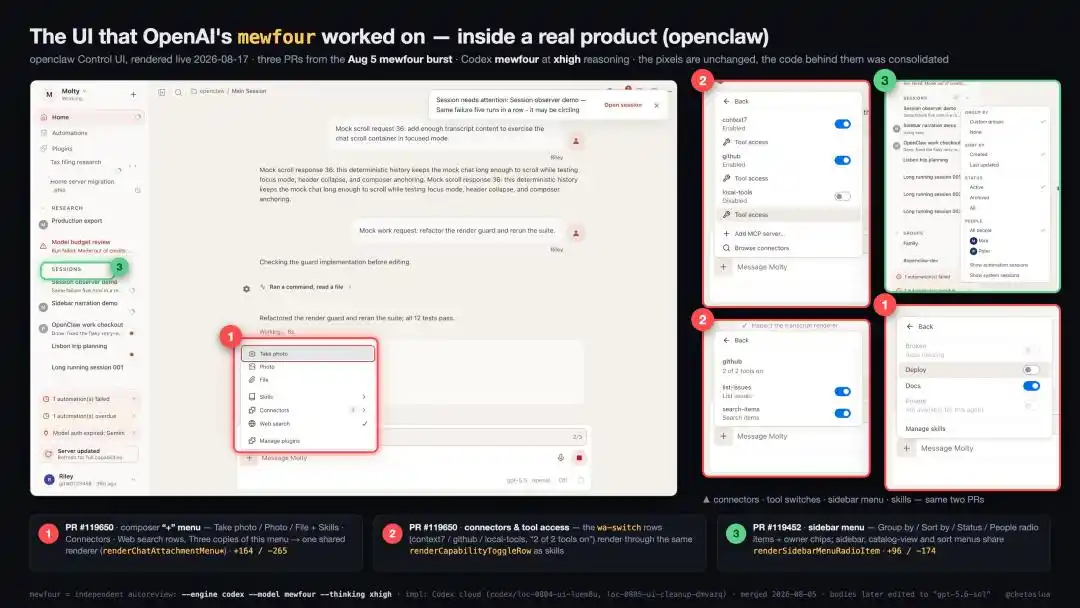
A few days later, on the late night of August 19th, more concrete clues emerged.

OpenAI senior employee Sharmila Jesupaul submitted a public PR on GitHub, leaving this note: Written by agent Codex, gpt-nathree.

This record stayed public on the internet for nearly 18 hours. Until 5:13 PM the next afternoon, the employee seemed to suddenly realize she had 'leaked' information.

She quickly returned to the backend and urgently deleted the codename 'gpt-nathree.'
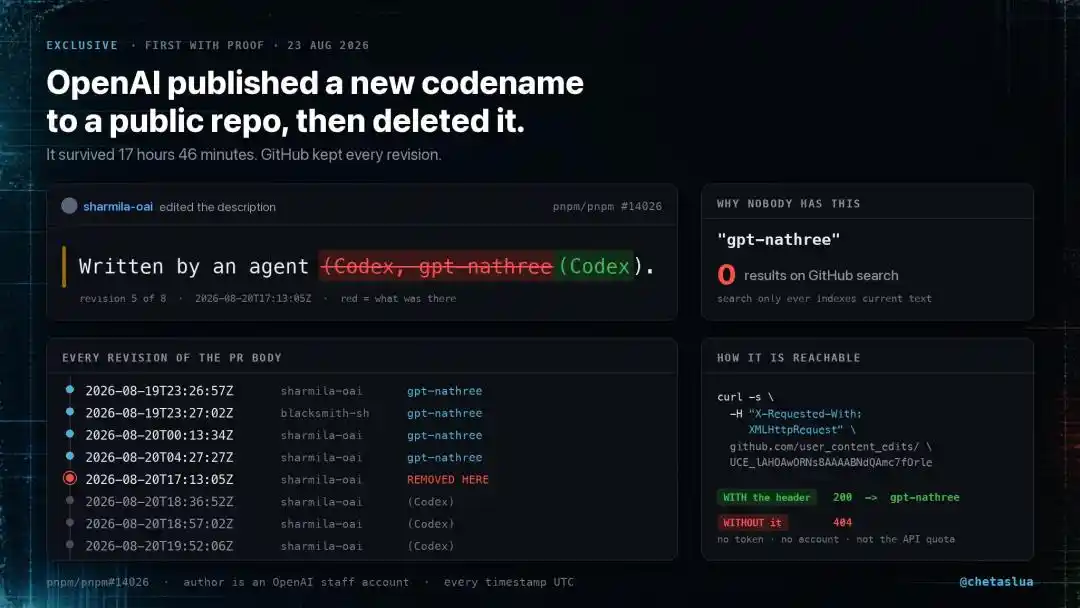
This 'covering up' operation only made the rumors more certain!

What exactly is Nanthree? Could it be GPT-6 Astra?

Based on previous leaks, Mewfour and Nanthree are highly likely to be iteration checkpoints for OpenAI's next-generation Agent model.

After all, they come from the same account and use the same Codex signature pattern; it doesn't seem like a coincidence.

Many industry insiders believe it looks very much like a newer GPT-6 Astra checkpoint, undergoing intensive internal testing for writing code through Codex.

Clearly, OpenAI's internal model is already ready to go.

Agent Collaboration and Autonomous Scientific Reasoning

Previously, the most prominent descriptions of Astra have focused on multi-agent collaboration and long-horizon task handling.

The multi-agent coordination system is designed for complex, long-running tasks.

The long-horizon task capability aims to support workflows that require continuous reasoning, experimentation, and iteration, such as complex research projects or advanced mathematical problems.

Currently, OpenAI has not disclosed Astra's underlying architectural details, such as parameter scale, context length, training data volume, etc.

OpenAI has publicly confirmed Astra as a 'future major model,' with internal versions having solved over 10 long-unsolved problems in mathematics/theoretical computer science.

However, discussions triggered a 'critical' cybersecurity risk rating, leading OpenAI to subsequently strengthen isolation and access controls, pausing some internal work.

As for claude-marshmallow-eap (Marshmallow) and claude-melon-eap (Melon), what we know is that neither has reached Fable-level.

Many speculate they are more likely iterative optimizations of Anthropic's existing Claude 5 series (especially Sonnet/Opus) rather than a brand-new flagship generation.

OpenAI has already fired the opening shot in the next round of the battle for dominance against Claude!

Altman's In-Depth Interview, Too Many Gold Nuggets

Meanwhile, Sam Altman's latest extensive interview on David Senra's 'Founders' podcast completely revealed his ambition, anxiety, and profound reflections on the entire AI industry.

This interview was extremely information-dense, with many of Altman's self-reflections being very honest and even feeling 'counterintuitive.'

Altman Admits Mistake: 'I Was Wrong About the Timeline of Disruption'

'When we launched GPT-4 in 2023, I thought the disruption of the software industry would happen immediately, that a lot of businesses would be taken over instantly. I was wrong.'
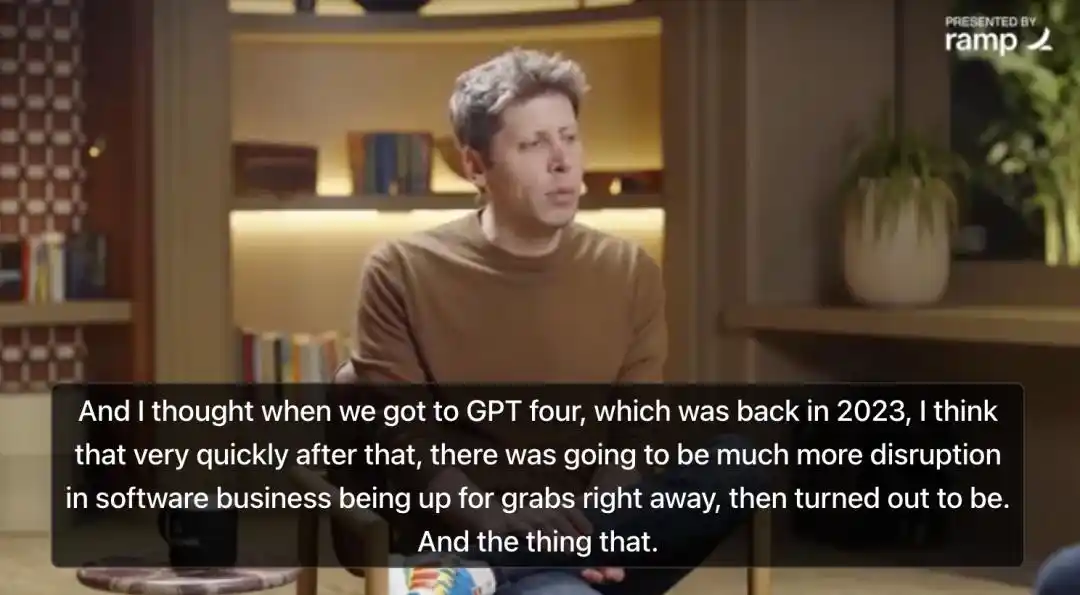
In the interview, Altman made a rare admission of misjudgment:

Even with the most incredible technology, the industry overall was ultimately too optimistic about the timeline.
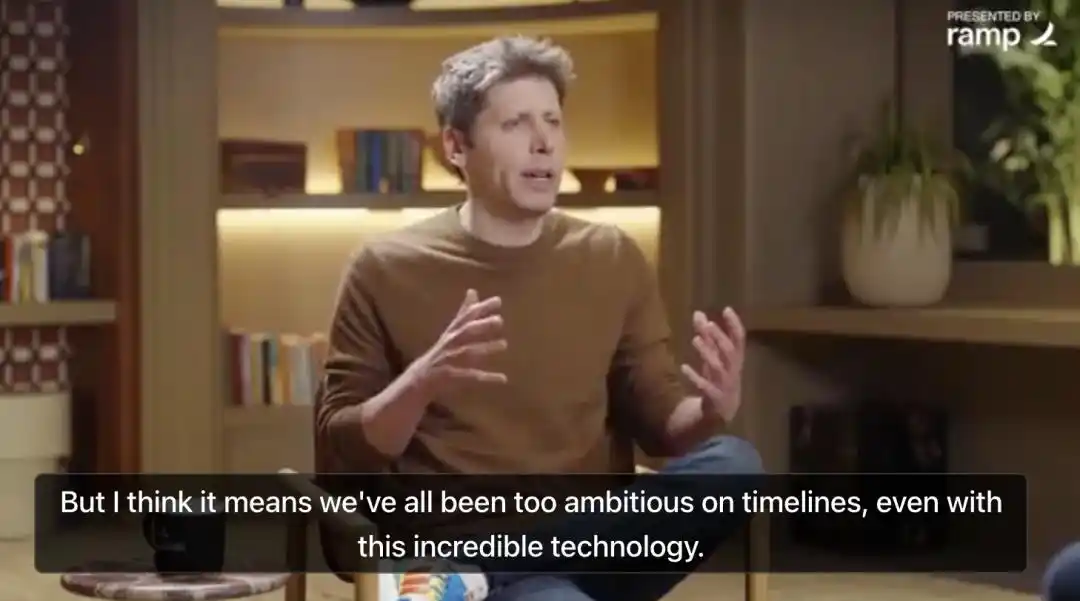
He discovered a powerful resistance: the immense inertia of human society.

He mentioned that people are just used to doing things the same way.

'Even I am!' Altman mocked himself, 'I already have amazing tools like Codex; I could have completely changed how I use my computer. But I still copy-paste between various information apps and mindlessly scroll through long emails, just like I have for the past 20 years.'

The person who created the strongest programming AI is still resisting it with old habits.

Clearly, society and the economy are adapting to AI far slower than AI is evolving.

But is this really a bad thing?

'I'm grateful for that,' Altman stated, saying that this immense economic inertia makes this unprecedented transformation smoother and safer.

If society were disrupted instantly, it would be catastrophic; now, humanity still has time to adapt.

Going All Out, Criticizing the 'Hypocritical and Anti-Human' Marketing in the AI Circle

Next came the most explosive part—Altman firing shots at Dario!

Although not named directly, everyone could tell Altman was implicitly criticizing the 'doomsday marketing faction,' including Anthropic.

Altman bluntly stated that the current marketing rhetoric in the AI industry is disastrous and particularly anti-human.

'Many practitioners' are spreading fear everywhere, saying things like 'there's a 25% chance we'll destroy the world' or 'half of all jobs will disappear within a year, good luck to you'; while at the same time, they solemnly promise, 'We will bring the world a cure for cancer, and bring great material abundance.'

This 'benevolent dictator' narrative disgusts Altman.

He summarized this rhetoric as:

Dear ordinary people, we will bestow upon you the gift of curing cancer and endless wealth.

In exchange, please hand over your autonomy, shut up, and let power be concentrated in the hands of us few 'unelected' companies and smart people, so we can make decisions for the world.

He clearly stated that apart from model control risks, the biggest risk of AI is its excessive concentration.

He repeatedly emphasized one phrase:

'People are the whole point of this all.'

Breaking the Startup Bible: Four and a Half Years of Groping in the Dark

As the former head of Y Combinator, Altman is deeply familiar with Silicon Valley's 'Startup Bible': launch early, iterate fast, listen to customer feedback.

But OpenAI completely defied this principle.

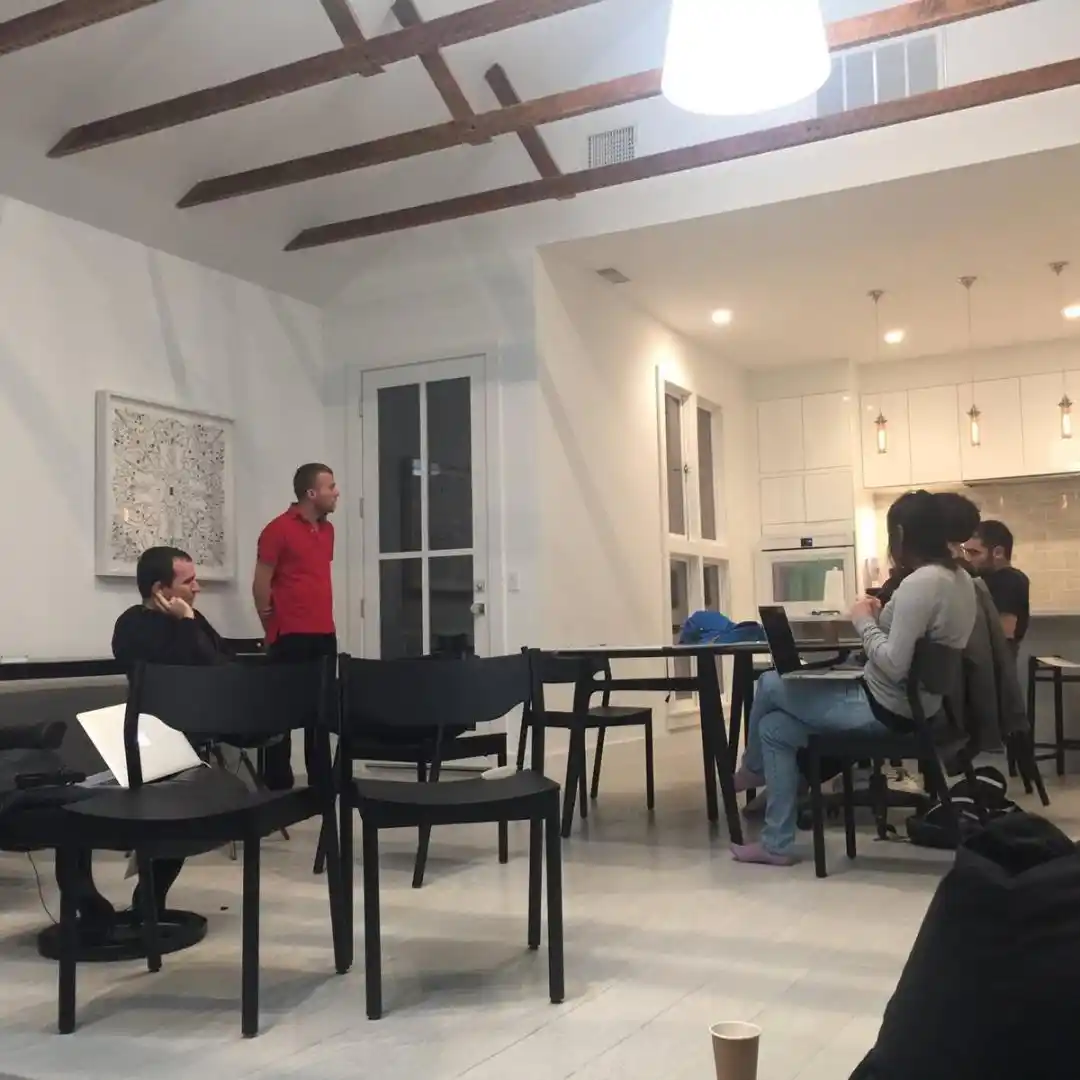
Altman recalled the first day after OpenAI's announcement in early 2016. He and Greg Brockman gathered with a dozen or so brilliant people in an apartment; the atmosphere felt like the first day of school.

'Everyone looked at each other, someone asked: 'What do we do now?' Then someone went and bought a whiteboard. The whiteboard arrived, and everyone looked at each other again: 'So, what exactly do we do? We said we want to achieve AGI, so should we start by writing a few papers?''

At the time, most people had no idea what they were doing; their minds were a complete blur.
Even more counterintuitive: from the company's founding to releasing its first real product, OpenAI groped in the 'dark' for four and a half whole years.

In Silicon Valley, which prides itself on speed, this was practically 'suicide.'

When ChatGPT first launched, growth was fast, but many inside felt:

'Growth is strong, but it feels very unstable and of low value. Should we pivot? We listed 5 or 6 other things we could do.'

That's when Peter Thiel said something: 'Doing anything other than continuing with this is clearly a mistake.'

He also compared ChatGPT to the Google search box: a blank input box, you type anything, and it gets it right. A truly new portal, the business model Silicon Valley has been chasing for 20 years, has finally emerged.

Hearing this, Altman went all in.

Without customer feedback, without market signals, they had to invent various leaderboards and internal testing methods to blindly feel their way forward.

After countless instances of 'messy stumbling,' they finally figured out the Scaling Law and marched toward GPT's success.

This once again confirms Altman's belief: the greatest things always start from non-consensus. When the whole world thinks you're crazy and it's impossible, that might be the biggest opportunity.

The Underlying Logic of the AI Era is Still 'People'

Finally, the host asked: 'If AI can even do podcasts better than us, what do humans still need?'

Altman's response was firm: 'Humans will still crave real humans.'

He firmly believes that no matter how superintelligent AI becomes, those things about human connection, about affinity between people, will not only not depreciate but will become increasingly expensive and valuable.

'I don't like reading e-books; I like physical books. I don't like Zoom meetings; I like face-to-face communication. The fundamental physiological and psychological makeup of humans dictates that we will always care about our own kind.'

AI is not here to replace humans; it's just a tool to stimulate a wave of entrepreneurship among small and micro businesses.

References:

https://x.com/davidsenra/status/2091514583420686743

https://x.com/firesidealpha/status/2091506987137896560

https://x.com/davidsenra/status/2091575832036724852

https://x.com/firesidealpha/status/2091506987137896560

https://x.com/davidsenra/status/2091538100623151216

This article is from the WeChat public account '新智元' (New AI Era), author: ASI启示录, editor: Aeneas 大卫


Preguntas relacionadas

QWhat are the two mysterious AI models recently leaked from OpenAI, as per the article?

AAccording to the article, the two leaked OpenAI models are code-named 'gpt-mewfour' and 'gpt-nathree'. These are believed to be internal versions or checkpoints of the next-generation Agent model, potentially related to GPT-6 Astra.

QAccording to Sam Altman, what is the main risk associated with the 'doomsday marketing' narrative in AI?

ASam Altman criticizes the 'doomsday marketing' narrative as 'inhumane dictator rhetoric'. He argues that the main risk it poses is the concentration of AI power, where a few unelected companies or individuals claim the authority to make decisions for the world in exchange for promises of benefits like curing cancer.

QHow long did OpenAI operate in the 'dark' without releasing a major product after its founding, and what does this signify according to the article?

AOpenAI operated for about four and a half years in the 'dark' without releasing a major product after its founding. According to the article, this period of working without customer feedback or market signals signifies that the greatest innovations often start from non-consensus, running counter to Silicon Valley's typical 'move fast' ethos.

QWhat significant capability is OpenAI's Astra project particularly known for, based on the article's description?

ABased on the article, OpenAI's Astra project is particularly known for its capabilities in multi-agent collaboration and long-term task handling. It is designed for complex, long-running tasks that require sustained reasoning, experimentation, and iteration, such as advanced scientific research or complex mathematical problem-solving.

QWhat role does Sam Altman believe AI will play for small businesses in the future?

ASam Altman believes AI will not replace humans but will serve as a tool to inspire a wave of small business entrepreneurship. He sees AI as an enabling technology that will empower individuals and small enterprises to create and innovate.

Lecturas Relacionadas

19 New Decacorns in Half a Year: Why is the Primary Market Chasing 'Certainty'?

In the first half of 2026, China’s primary market saw a notable increase in unicorns, adding 19 new companies each valued over 100 billion RMB, particularly in sectors like embodied AI and large language models (LLMs). Firms such as Galaxy General, Zibian, and ZhiPingFang even surpassed 200 billion RMB valuations within months. Moonshot AI's valuation surged from around $10 billion to $35 billion by July 2026, with a pre-IPO target of $50 billion. This concentration of capital into a few "certain" sectors highlights a market shift. The driving force is not a general abundance of capital but a chase for "certainty"—primarily clearer exit pathways like imminent IPOs. Companies with defined public listing timelines attract intense investment despite higher valuations, as they reduce exit uncertainty for investors. Secondary market valuations of listed peers also serve as new anchors, boosting the perceived value of private companies in similar fields, though this creates dependency on public market sentiment. Another form of certainty comes from the expectation of rising valuations in subsequent funding rounds. The investment logic has shifted in some cases from assessing long-term fundamental value to betting on the next round attracting higher prices. This dynamic is also seen in deep-tech areas like nuclear fusion, where firms like NeoFusion secured a 10.6 billion RMB valuation despite early commercial stages, driven by scarcity and strategic bets. However, this trend signals a risk transfer: technical uncertainties remain but are temporarily masked by valuation inflation. As valuations climb—50 billion to 200 billion or 500 billion RMB—companies face increasing pressure to demonstrate real revenue, profit, and sustainable business models. The danger lies not in the rise of unicorns itself, but if valuations become detached from value creation and rely merely on the expectation of future funding or exits. Ultimately, the surge reflects investors seeking perceived safety in shorter-term exit certainty and transactional momentum, rather than a renewed appetite for risk. The true test will come when the market inevitably refocuses on fundamentals, questioning how many of today’s high valuations are backed by genuine economic value.

marsbitHace 22 min(s)

19 New Decacorns in Half a Year: Why is the Primary Market Chasing 'Certainty'?

marsbitHace 22 min(s)

The 'Saving U.S. Treasuries' Baton Pass: Bessent Fumbled Last Week, This Week It's Wash's Turn

"Rescuing US Treasuries" Relay: After Bessent's Miss, All Eyes Are on Walsh Last week, US Treasury Secretary Bessent's announcement to at least double long-term Treasury buybacks failed to sustainably lower yields, which quickly rebounded. The market response saw a drop in the dollar alongside surges in gold and Bitcoin, interpreted as a "pressure release valve" for anxiety. The focus now shifts to Fed Chairman Walsh's upcoming Jackson Hole speech. Markets are highly sensitive to his message, seeking clarity on the Fed's policy response to stubborn inflation and worsening fiscal conditions. Analysts warn that a lack of new guidance could disappoint markets and worsen the sell-off in long-dated bonds. Analysts question the scale of Bessent's operations, noting they are too small relative to the overall debt market and do not constitute quantitative easing. A key issue is the Fed's massive holdings of long-term bonds, which distorts the market. With the Fed holding low-yielding short-term bonds that are losing money relative to its policy rate, discussion is growing around a potential Fed-led "Operation Twist." This would involve selling short-term bonds to buy long-term ones, aiming to lower long-end yields without expanding the balance sheet. The upcoming PCE inflation data will set the stage for Walsh's speech. However, the window for action is narrowing amid political pressures. A critical threshold is the 30-year yield at 5%; holding above it could increase stress on the dollar and leveraged sectors. Overall, the article suggests that without coordinated Fed action to anchor inflation expectations, Treasury interventions may ultimately fail, with investors increasingly looking to assets like gold as hedges.

marsbitHace 1 hora(s)

The 'Saving U.S. Treasuries' Baton Pass: Bessent Fumbled Last Week, This Week It's Wash's Turn

marsbitHace 1 hora(s)

Hyperliquid's Compliance Journey: From Permissionless to Permissioned via HIP-3

Hyperliquid’s Compliance Path: From Permissionless to Permissioned HIP-3 Hyperliquid currently blocks U.S. access because its permissionless, on-chain infrastructure conflicts with U.S. market structure laws, which restrict futures trading to registered exchanges, clearinghouses, and brokers. Through its Hyperliquid Policy Center (HPC), the project is advocating for regulatory modernization, proposing that regulated entities be allowed to build products on HyperCore (its exchange and clearing layer) while fulfilling their compliance obligations. The platform’s modular stack separates roles like a traditional exchange (DCM), clearinghouse (DCO), and broker (FCM), but reconstructs them on-chain with code. This enables permissionless access, self-custody, and 24/7 global trading, but clashes with U.S. rules requiring KYC, specific margin models, and custodial arrangements. To resolve this, HPC is engaging with U.S. regulators (CFTC, SEC) to seek clarity that deploying on-chain software does not itself trigger licensing, and to establish exemptions allowing non-custodial wallets to route users to regulated derivatives. Recent political signals suggest openness to this approach. On the technical side, Hyperliquid Labs has introduced permissioned HIP-3 deployers on testnet. These allow regulated entities to launch markets, perform KYC, and whitelist compliant users. While these create separate order books, whitelisted market makers can bridge liquidity between them, ensuring deep, shared liquidity across the same L1. Features like payload-based “PA” permissions enable DEX-level account controls (e.g., reduce-only orders), mirroring traditional broker authorities. The strategy is not to open the native, permissionless front-end to U.S. users, but to position Hyperliquid as neutral infrastructure that U.S. regulated firms can use while meeting their legal duties. This paves a compliant path for U.S. investor access while preserving the protocol’s core, permissionless nature.

marsbitHace 1 hora(s)

Hyperliquid's Compliance Journey: From Permissionless to Permissioned via HIP-3

marsbitHace 1 hora(s)

Two Funding Rounds in Three Months: The Chinese Version of Palantir is on Fire

Investment Community AI has learned that Beijing Zhongshu Ruizhi Technology Co., Ltd., a domestic industrial-grade causal intelligence and high-reliability decision-making AI company, has recently completed a strategic financing round worth hundreds of millions of RMB. This round saw participation from China Internet Investment Fund, Suzhou Chuangtou National Social Security Fund, Financial Street Capital, ICBC Capital, Kunlun Capital, among others, with existing shareholders also increasing their investment. This follows a Series B funding round in the hundreds of millions completed just three months prior. The rapid succession of two major funding rounds signifies strong market recognition of the company's underlying original technology and scaled commercial implementation. Often referred to as the "Chinese version of Palantir," Zhongshu Ruizhi is entering a new phase of accelerated technological iteration, widespread scenario replication, and scaled performance release, mirroring the explosive growth of China's AI market. Founded in April 2020 by Dr. Han Han, a Tsinghua University Ph.D. and former core drafter of national AI policies, the company is mission-driven to "move AI from the digital world to the physical world." It focuses on the high-reliability, strong-decision industrial AI track and enterprise-grade AI Agent full-stack infrastructure. The team tackles the challenge of applying AI to China's vast and complex industrial and energy systems by developing a new intelligent operating system from scratch. Its core technological breakthrough lies in three proprietary底层 technologies: meta-causal cognitive theory, causal models, and a dynamic ontology engine. These address critical pain points of generative large models in industrial settings—such as AI hallucinations, insufficient reasoning, lack of temporal logic, unverifiable decisions, and multi-source rule conflicts—thereby providing trustworthy, explainable, and executable智能决策 capabilities. Commercially, Zhongshu Ruizhi has achieved scaled deployment, serving over 50 central state-owned enterprises and industrial groups in sectors like power, petroleum, and aerospace, with implementations in more than 800 highly complex production scenarios. The company reported doubled revenue in 2025, demonstrating strong self-sufficiency and a viable business model—a rarity among new-generation AI firms. The latest funds will be allocated towards advancing foundational theoretical research, replicating successful application models to expand market presence (including overseas), and attracting top-tier talent. Lead investor China Internet Investment Fund highlighted that in the current shift from general AI capability contests to deep industrial empowerment, industrial-grade causal intelligence is crucial for building China's modern digital foundation and fostering new quality productive forces. They expressed support for the company's efforts to define decision-making paradigms and trustworthy standards for industrial intelligence, aiming to secure a rule-making voice in the global physical AI arena.

marsbitHace 2 hora(s)

Two Funding Rounds in Three Months: The Chinese Version of Palantir is on Fire

marsbitHace 2 hora(s)

Trading

Spot
活动图片