Author: Claude, Shenchao TechFlow
Shenchao Summary: Blockworks Research data shows that over the past 30 days, Pons($PONS) ranked 13th in revenue generation among crypto tokens, yet with a 0.7x FDV/Revenue multiple, it became the lowest valued token among the top 15 high-revenue tokens. In comparison, Pump.fun related tokens had approximately 7.7x, Aave about 45x, and Chainlink as high as 212x. Pons is a token issuance platform on the Robinhood Chain, with the protocol allocating about 80% of its revenue for buyback and burning.
The supply of $PONS has been cumulatively reduced by nearly 30%. Despite the impressive revenue data, the market remains cautious about the quality and sustainability of this revenue.
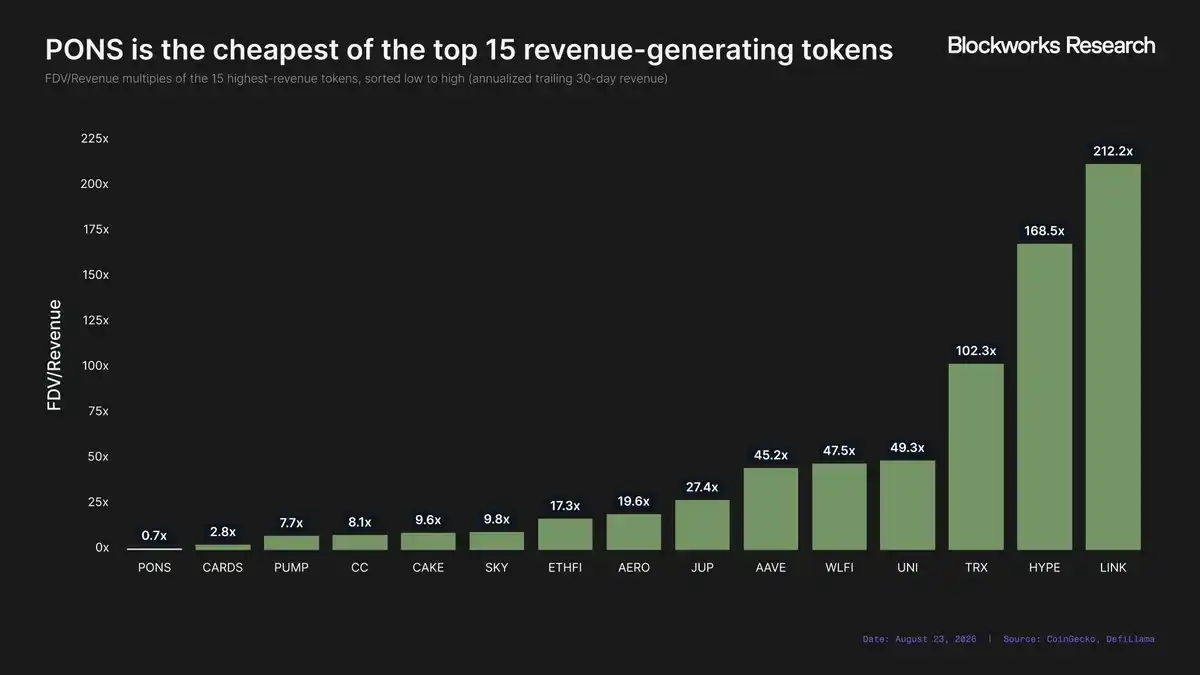
On August 23, Blockworks Research analyst AJC(@AvgJoesCrypto) released data indicating that over the past 30 days, $PONS ranked 13th among revenue-generating tokens, but among the top 15, it had the lowest FDV/Revenue multiple at just 0.7x.
Specific comparisons are as follows (calculated based on annualized revenue from the past 30 days, data sourced from CoinGecko and DefiLlama):
- $PONS: 0.7x
- $CARDS: 2.8x
- Pump.fun related tokens: 7.7x
- $CC: 8.1x
- $CAKE: 9.6x
- $SKY: 9.8x
- $ETHFI: 17.3x
- $AERO: 19.6x
- $JUP: 27.4x
- $AAVE: 45.2x
- $WLFI: 47.5x
- $UNI: 49.3x
- $TRX: 102.3x
- $HYPE: 168.5x
- $LINK: 212.2x
From a purely numerical perspective, there is a clear discrepancy between the valuation level of $PONS and its revenue ranking.
What is Pons: A Token Issuance Platform on Robinhood Chain
Pons (pons.family) is a non-custodial token issuance platform deployed on the Robinhood Chain. Users can quickly create tokens with a fixed supply, with trading starting from the first block. The platform is often compared to "pump.fun" on this chain.
Compared to its earlier version, after completing the V2 upgrade in July 2026, Pons adopted a bonding curve for pricing, after which tokens graduate into permanently locked Uniswap V4 liquidity pools. A portion of the protocol fees goes to the creator, while another portion becomes protocol revenue. According to public information, the protocol allocates about 80% of its revenue to repurchase and burn $PONS.
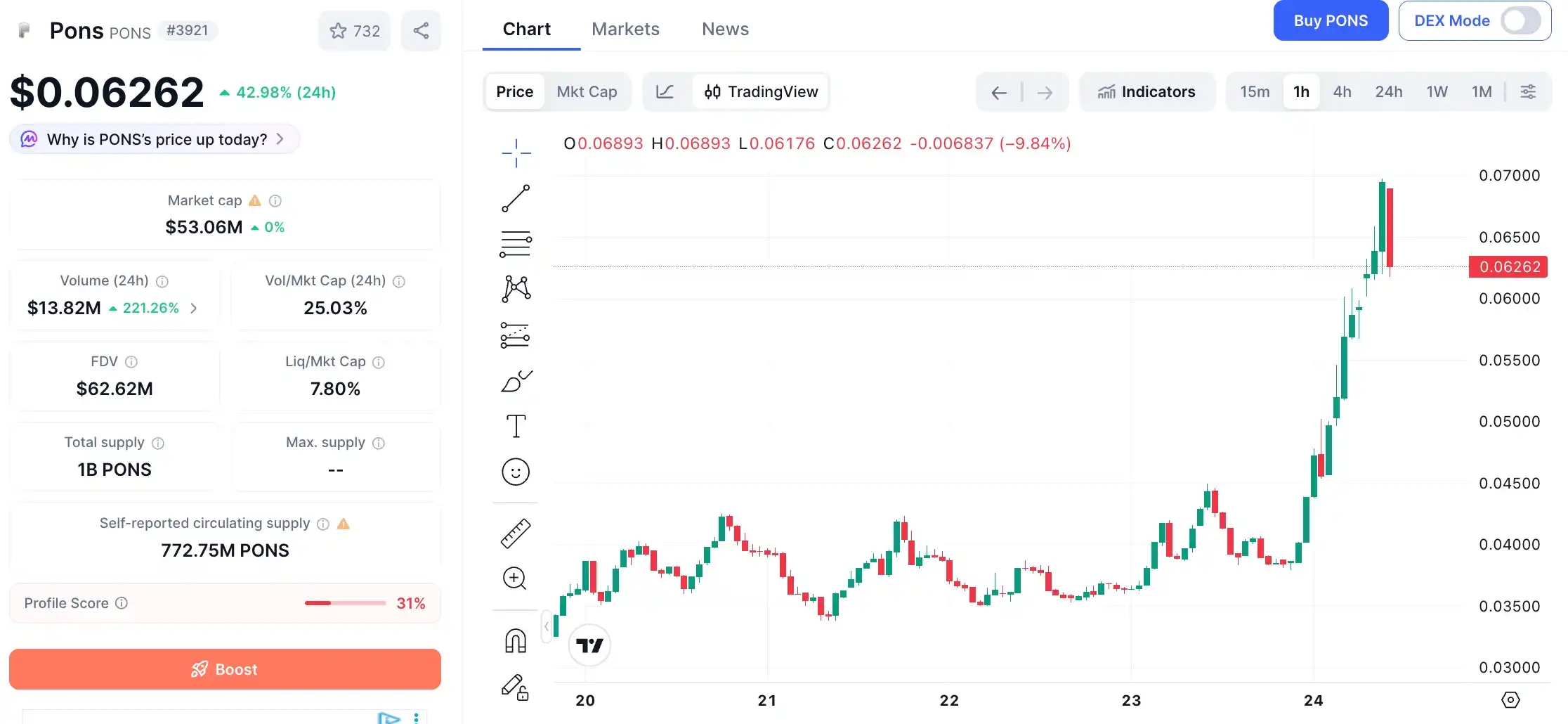
Over the past month or so, the platform's cumulative trading volume has reached the billions of dollars level, with the burned $PONS supply approaching 30% of the total supply. The buyback and burn mechanism is the core narrative supporting its "low valuation."
Ranking High in Revenue, But Market Pricing is Extremely Conservative
AJC's data placed $PONS in the 13th position for revenue over the past 30 days, yet assigned it the lowest FDV/Revenue multiple in the group at 0.7x. This implies that, if simply annualizing the current revenue, the market has given almost no premium for its revenue-generating ability, even applying a significant discount.
As a comparison, tokens related to Pump.fun, also in the issuance platform sector, are around 7.7x, while more mature DeFi protocols like Aave and Uniswap reach 45x and 49x respectively. Chainlink stands at the highest with 212x.
This discrepancy can be understood in two directions: first, the market may doubt the sustainability of Pons' revenue, thus assigning an extremely low multiple; second, the supply contraction from buybacks and burns has not yet been fully priced in.
Market Questions Revenue Quality, Wash Trading Suspicions Remain
Questions quickly arose in the post's comments. Some users pointed out that if potentially inflated or wash trading volumes were excluded, the actual effective revenue could be significantly lower than the surface numbers, possibly less than half. This specific skepticism has not yet been cross-verified with further on-chain data, but it reflects the reservations some market participants hold towards the "high revenue, low valuation" narrative.
In fact, since Pons launched, researchers like AJC have repeatedly published similar analyses of its revenue and buyback multiples. In early data, the price/buyback multiple for $PONS was once below 1x. Later, with price increases and revenue fluctuations, the multiple changed but remained at relatively low levels compared to its peers.
Supply Continues to Shrink, But Valuation Recovery Takes Time
Key known variables include: whether protocol revenue can be maintained at high levels, whether buyback and burns truly translate into significant circulating supply reduction, and whether the activity level of the Robinhood Chain itself can be sustained.
Based on available public data, the supply of $PONS is indeed continuously contracting, and the protocol is converting most of its revenue into buying pressure for its own token. However, the 0.7x valuation assigned by the market indicates that these positive factors have not yet been widely recognized as sustainable moats.
Moving forward, the market will focus on two points: first, the true substance and sustainability of the protocol's revenue, and second, whether the burning progress continues to accelerate. Only when the quality of revenue is validated by more data is it possible for the valuation multiple to align closer to that of comparable projects.