OpenMind, the Leader in the Robotics Track, is About to TGE: Is the $400 Million Valuation New Token Sale Worth Participating In?

Odaily星球日报Publicado a 2026-01-25Actualizado a 2026-01-25

Resumen

OpenMind, a leading robotics company, is set to conduct a Token Generation Event (TGE) for its native token ROBO on the Kaito platform. With a fully diluted valuation (FDV) of $400 million, the token sale aims to raise $2 million, representing 0.5% of the total token supply. The public sale begins on January 26 at 8 PM Beijing Time, with a per-address investment limit of $1,000 to $250,000 and tokens fully unlocked at TGE. Founded by Stanford professor Jan Liphardt, OpenMind is developing a universal operating system and decentralized network for intelligent machines, enabling global collaboration between robots. It has received backing from major investors like Pantera Capital, Coinbase Ventures, and DCG, and was recognized among the top 100 robotics startups of 2025. Notably, NVIDIA's Robotics division has shared OpenMind's content, indicating close ties. The project operates alongside the Fabric Foundation, an independent entity managing the protocol’s governance and ecosystem. The ROBO token sale includes a 40% priority allocation for partner communities, with the remaining 60% open to the general public. However, the $400 million FDV is considered high compared to similar AI and robotics projects like Virtuals ($540M), Sentient ($200M), and Grass ($127M). Concerns include unclear tokenomics and potential sell pressure from early investors if institutional tokens are unlocked at TGE, making the offering less attractive despite strong backing.

Original | Odaily Planet Daily (@OdailyChina)

Author | Asher (@Asher_ 0210)
On January 23, the official Foundation account of OpenMind, the leader in the robotics track, Fabric Foundation, posted on platform X that its native token ROBO will soon undergo a token sale on the Kaito platform.

Below, Odaily Planet Daily will take you through understanding the robotics track leader OpenMind, its relationship with the Fabric Foundation, and the details of the new token sale.

OpenMind: Building a Universal Operating System for Intelligent Machines and a Decentralized Collaboration Network

OpenMind was founded by Stanford University Professor Jan Liphardt. It is dedicated to building a universal operating system for intelligent machines and a decentralized collaboration network, enabling robots from different manufacturers and of different forms to securely trust each other, share information, and collaborate on a global scale. Furthermore, OpenMind was successfully selected as one of the Top 100 Global Robotics Startups in 2025.

It is worth mentioning that NVIDIA Robotics' official account reposted a robot testing video from OpenMind, and the two parties have close business dealings.
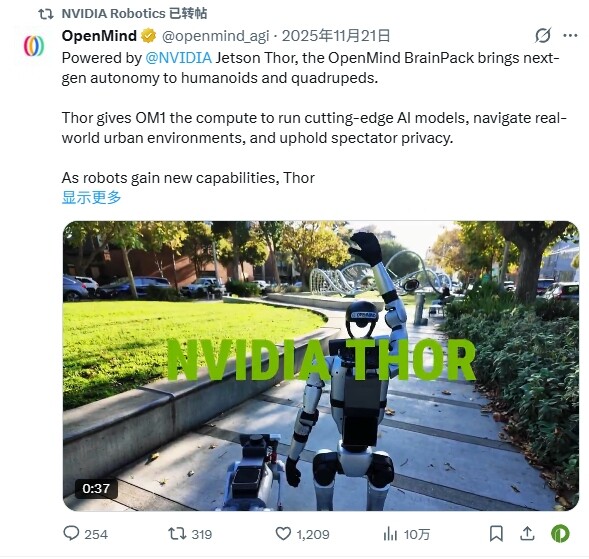
NVIDIA Robotics official account reposts OpenMind's tweet

In early August this year, OpenMind announced the completion of a $20 million funding round, led by Pantera Capital, with participation from Ribbit, Sequoia, Coinbase Ventures, DCG, Lightspeed Faction, Anagram, Pi Network Ventures, Topology, Primitive Ventures, Amber Group, and several other institutions and renowned angel investors.

The Relationship Between OpenMind and Fabric

OpenMind is the founding team and core developer of the Fabric protocol, and also a core contributor and initiator of the Fabric Foundation. Fabric was initially designed and developed by the OpenMind team, responsible for the core technical architecture and early implementation of the protocol.

As the project developed, to prevent the protocol from being controlled by a single company and to achieve a more open and neutral governance structure, OpenMind spun off the governance, economic model, and community coordination functions of Fabric to establish an independent non-profit organization, the Fabric Foundation. This foundation is responsible for the long-term maintenance, standard setting, ecosystem incentives, and global coordination of the protocol, promoting the sustainable development of Fabric.

Currently, OpenMind continues to participate in the construction of the Fabric protocol as a core contributor. Its official introduction also clearly states "We’re a core contributor of @FabricFND". Meanwhile, the community branding has been unified towards Fabric, including the renaming of Discord and the unified narrative of the protocol and the ROBO token, further strengthening Fabric's position as the main brand.
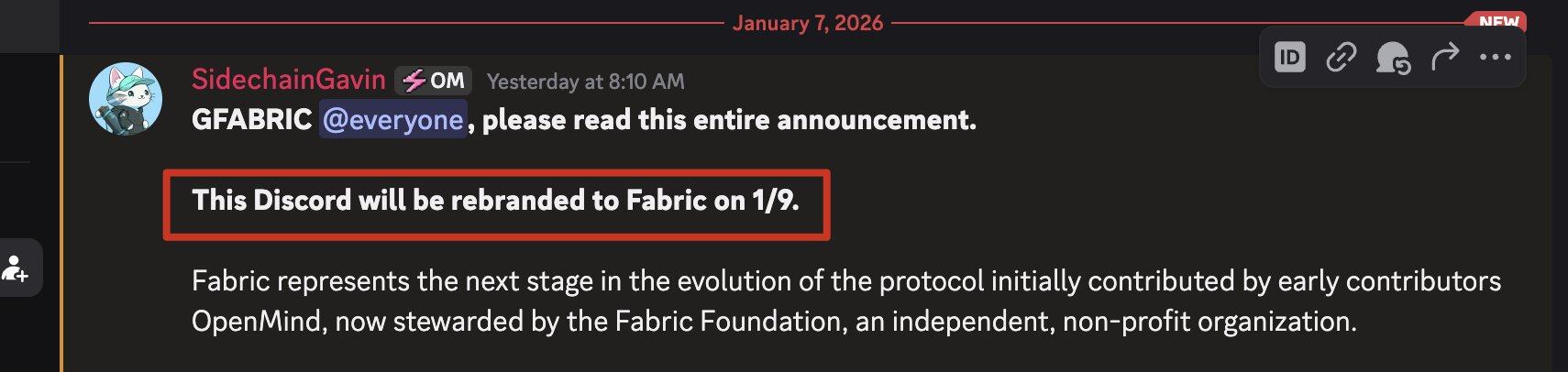
OpenMind's official Discord renamed to Fabric

Fabric New Token Sale Details

According to official information, the native token of the Fabric protocol, ROBO, will undergo a token sale on the Kaito platform. The specific details for participation are as follows:

  • Sale Start Time: January 26th, 8:00 PM Beijing Time;
  • Valuation: $400 million FDV;
  • Fundraising Target: $2 million;
  • Sale Proportion: 0.5% of the total supply of ROBO tokens;
  • Unlock Situation: 100% unlocked at TGE;
  • Single Address Subscription Limit: Minimum $1,000, Maximum $250,000;
  • Expected TGE Time: Q1 2026 (specific date not announced).

Additionally, 40% of the total public sale allocation on the Kaito platform is Priority Allocation, dedicated to partner communities:

  • Fabric Foundation community (based on past participation, holders of Platinum/Emerald/Diamond tier, OG, Developer, Backpack, Researcher badges, etc.): 15%;
  • Kaito AI community (sKAITO holders, etc.): 10%;
  • Virtuals community (holders of >100 veVIRTUAL): 5%;
  • Surf AI community (Pro/Max annual subscribers or NFT Pass holders): 5%;
  • Other Kaito referral programs: 5%.

The remaining 60% of the new token sale allocation is the public portion (for general eligible users).

The $400 Million Valuation for the New Sale Offers Less Than Ideal Value

From a valuation comparison perspective, OpenMind's token ROBO is priced at a $400 million FDV, significantly higher than the reasonable range for comparable projects in the same track that have already issued tokens. For reference, among related projects in the AI robotics sector, Virtuals currently has a market cap of approximately $540 million, Sentient around $200 million, and Grass around $127 million. ROBO's starting valuation is already on the high side.

Although OpenMind has backing from top-tier investment firms like Pantera Capital, Coinbase Ventures, and DCG, providing some endorsement for the project, the detailed token economics for ROBO have not yet been released. Particularly, the unlock ratio for institutional investors at TGE remains unclear.

If institutions have liquid supply at TGE, combined with the 100% unlock of the public sale portion, it could create significant dual selling pressure, putting pressure on the early price trend. Given this uncertainty, the pricing of the new sale at a $400 million FDV offers less than ideal overall value.


Preguntas relacionadas

QWhat is OpenMind and what does it aim to build?

AOpenMind is a leader in the robotics sector, founded by Stanford Professor Jan Liphardt. It aims to build a universal operating system and a decentralized collaboration network for intelligent machines, enabling robots from different manufacturers to securely share information and work together globally.

QWhat is the relationship between OpenMind and the Fabric Foundation?

AOpenMind is the founding team and core developer of the Fabric protocol. To avoid centralized control and promote open governance, OpenMind spun off the protocol's governance and economic model to form the independent, non-profit Fabric Foundation. OpenMind remains a core contributor to the ongoing development of the Fabric protocol.

QWhat are the key details of the ROBO token sale on the Kaito platform?

AThe ROBO token sale on Kaito has a fully diluted valuation (FDV) of $400 million. It aims to raise $2 million, representing 0.5% of the total token supply. The sale begins on January 26th at 8 PM Beijing Time. Tokens are 100% unlocked at TGE, with a per-address purchase limit of $1,000 to $250,000. The TGE is expected in Q1 2026.

QWhy does the article suggest the $400 million FDV valuation offers suboptimal value for participants?

AThe article suggests the $400 million FDV is suboptimal because it is significantly higher than the current market capitalizations of comparable projects in the AI and robotics sector, such as Virtuals ($540M), Sentient (~$200M), and Grass (~$127M). Furthermore, the lack of transparency regarding the tokenomics and the potential for early selling pressure from both the publicly sold tokens (100% unlocked) and possibly institutional investors could negatively impact the token's early price action.

QWhich major investors participated in OpenMind's funding round?

AOpenMind raised $20 million in a funding round led by Pantera Capital. Other participants included Ribbit, Sequoia Capital, Coinbase Ventures, DCG, Lightspeed Faction, Anagram, Pi Network Ventures, Topology, Primitive Ventures, and Amber Group.

Lecturas Relacionadas

Unlocking $100 Million in Liquidity? Pump.fun's New Policy Tests the 5-Minute Pump Technique

Pump.fun, a popular meme coin launchpad, has introduced a new standard mechanism called BOOST. It aims to address a significant capital efficiency issue: when a newly launched token graduates from its initial bonding curve to a liquidity pool (LP), roughly 20% of its liquidity becomes permanently locked as "dead liquidity," estimated to waste over $100 million annually. Instead of locking these funds permanently, BOOST repurposes them. Upon a token's migration, approximately 20% of the settlement funds (e.g., 17.6 SOL or ~$2516 USDC) are used to buy back the token on the open market over a 5-minute period via a Time-Weighted Average Price (TWAP) mechanism. All purchased tokens are immediately burned. This creates a brief, systematic buy pressure immediately after migration, potentially generating a short-term price surge ("pump") while permanently reducing the token's circulating supply. The goal is to enhance the immediate post-launch trading experience, potentially increasing trader retention and sustainable protocol revenue, which funds ongoing token buybacks. However, concerns exist that this artificial 5-minute boost could lower the barrier for launching low-quality tokens and lead to steeper price crashes once the buy pressure stops, if followed by large sell-offs. The feature automatically applies to tokens migrating after July 21, 2024, but not to previously migrated tokens or those launched via the Mayhem AI Agent lab.

marsbitHace 7 min(s)

Unlocking $100 Million in Liquidity? Pump.fun's New Policy Tests the 5-Minute Pump Technique

marsbitHace 7 min(s)

Podcast Notes | Conversation with GSR Asset Management Head: To Determine if This Crypto Rally is Real, Just Watch the Lending Rates on Aave

Podcast Summary: Dialogue with GSR's Head of Asset Management: To Determine if This Crypto Rally is Real, Just Check Lending Rates on Aave Andy Baehr, Managing Director of Asset Management at GSR, discusses the current crypto market, characterizing it as stuck in a state of "ambivalence" with short-lived, unsustainable rallies. He outlines a simple framework: the market moves between "ambivalence" and "conviction" (sustained upward momentum). Currently, every rally resembles a single-stage rocket booster that quickly fizzles out. Baehr identifies three key signals to watch: 1) DeFi lending rates, 2) the potential passage of the CLARITY Act, and 3) the market forming a consensus on the "Fed hawkish peak." He emphasizes that the most immediate indicator for the sustainability of the recent CPI-triggered rally is the USDC borrowing rate on Aave, currently around 3.75%—close to U.S. Treasury yields. The absence of a credit spread indicates low leverage demand and a lack of market energy. He explains that a healthy, sustained rally requires layered buying pressure. Last year's rally progressed from an ETH short squeeze to crypto-native trader influx and finally to ETF inflows. Currently, this structure is missing. Other potential structural buyers like Digital Asset Treasury (DAT) companies are absent, and ETF flows have proven transient. Baehr notes that while small-cap crypto tokens outperformed large caps in Q2—a potential sign of capitation in major assets—capital is also flowing to more exciting opportunities like AI stocks and tech IPOs, leaving crypto sidelined. Regarding DeFi, he highlights that platforms like Aave provide a clear, real-time signal of leverage demand through their supply/demand-driven interest rates. A significant, sustained rate increase would signal genuine market conviction. He also observes the quiet emergence of fixed-income-like products and vaults in DeFi. On regulation, the probability of the CLARITY Act passing before the August 7th deadline has dropped linearly from 75% to below 40% on Polymarket. Baehr suggests its passage would be treated as a bullish surprise, a potent driver for price movement. However, political hurdles, including ethical clause debates and disclosures about the First Family's crypto profits, remain significant obstacles. Ultimately, the market awaits clarity on the Fed's terminal rate under Chair Warsh. Until the "Fed Solstice"—the point where the market collectively understands the peak of hawkish policy—sustained conviction will be difficult to achieve.

marsbitHace 38 min(s)

Podcast Notes | Conversation with GSR Asset Management Head: To Determine if This Crypto Rally is Real, Just Watch the Lending Rates on Aave

marsbitHace 38 min(s)

Trading

Spot
活动图片




