OpenAI's Partnership with U.S. Department of Defense Sparks 300% Surge in ChatGPT Uninstallations on Announcement Day

marsbitPublicado a 2026-03-04Actualizado a 2026-03-04

Resumen

On February 28th, the number of ChatGPT app uninstalls by U.S. users surged by 295% compared to the previous day, following the announcement of OpenAI's partnership with the U.S. Department of Defense (referred to as the "Department of War" during the Trump administration). Data from Sensor Tower indicates this was a significant deviation from ChatGPT’s average 30-day uninstall rate of 9%. In contrast, downloads of Claude, the AI app from OpenAI competitor Anthropic, increased by 51% on the same day. This shift in user behavior is attributed to Anthropic’s public refusal to collaborate with the Defense Department due to ethical concerns, including potential use of AI for citizen monitoring and autonomous weapons. ChatGPT’s download numbers fell by 13% on Saturday and a further 5% on Sunday. User sentiment was reflected in app reviews, with 1-star ratings for ChatGPT increasing by 775% on Saturday. Meanwhile, Claude rose to the top of the U.S. App Store’s free apps chart and also led charts in several other countries. Data from Appfigures and Similarweb corroborated these trends, noting Claude’s rapid growth in the U.S. and internationally.

Author: TechCrunch / Sensor Tower

Compiled by: Deep Tide TechFlow

Deep Tide Insight: News of OpenAI's collaboration with the U.S. Department of Defense (renamed the "Department of War" under the Trump administration) has triggered strong backlash among users.

Meanwhile, Anthropic gained user trust by refusing to cooperate, with Claude's daily downloads surging and topping the App Store. This data directly quantify the practical impact of AI ethics stances on user behavior.

Full Text:

On February 28 (Saturday), the number of U.S. users uninstalling the ChatGPT mobile app increased by 295% compared to the previous day. This reaction was directly triggered by the news of OpenAI's partnership with the U.S. Department of Defense (DoD)—a department renamed the "Department of War" during the Trump administration.

This data comes from market research firm Sensor Tower. Compared to ChatGPT's average 9% daily uninstallation rate over the past 30 days, the 295% single-day spike is a significant anomaly.

At the same time, downloads of Claude, developed by OpenAI's competitor Anthropic, saw a reverse trend in the U.S. On February 27 (Friday), downloads increased by 37% compared to the previous day, and on February 28 (Saturday), they rose by another 51%. Earlier, Anthropic announced its refusal to collaborate with the U.S. Department of Defense, citing an inability to agree on terms—Anthropic expressed concerns that AI would be used for surveilling U.S. citizens and deployed in fully autonomous weapon systems lacking safety capabilities.

The data indicates that a significant portion of users support Anthropic's stance on this issue.

ChatGPT's download numbers were also affected. On the Saturday following the announcement of the partnership, its U.S. downloads decreased by 13% compared to the previous day. The decline continued into Sunday, with another 5% drop. In contrast, on the Friday before the announcement, the app had recorded a 14% day-over-day growth in downloads.

These rapid changes were also reflected in Claude's App Store ranking. On Saturday, Claude climbed to the top of the U.S. App Store's free app chart, maintaining this position as of March 2 (Monday). This represents a rise of over 20 spots compared to about a week earlier (February 22, 2026).

Users also expressed their opinions on OpenAI's decision through app ratings. Sensor Tower data shows that on Saturday, the number of 1-star reviews for ChatGPT surged by 775%, with a further 100% increase on Sunday. Meanwhile, 5-star reviews decreased by 50% during the same period.

Other third-party data providers corroborated Sensor Tower's findings.

For example, Appfigures noted that on Saturday, Claude's total daily downloads in the U.S. surpassed ChatGPT's for the first time. The agency also observed an increase in Claude's U.S. downloads, though its estimates were higher: an 88% day-over-day increase on Saturday.
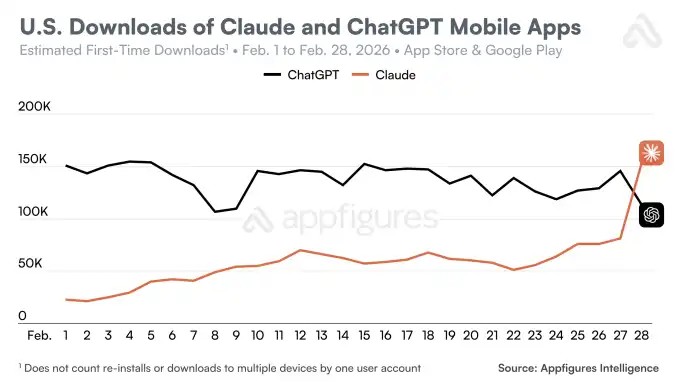
Appfigures also noted that Claude has now topped the free iPhone app charts in six countries outside the U.S., including Belgium, Canada, Germany, Luxembourg, Norway, and Switzerland.

A third market research firm, Similarweb, reported that Claude's U.S. downloads over the past week were approximately 20 times higher than in January. However, the agency cautioned that this may not be entirely due to political factors and could involve other reasons.


Preguntas relacionadas

QWhat was the 295% surge in ChatGPT mobile uninstallations on February 28th a direct reaction to?

AThe 295% surge in ChatGPT mobile uninstallations on February 28th was a direct reaction to the news of OpenAI signing a cooperation agreement with the U.S. Department of Defense (DoD).

QWhich competitor's app saw a significant increase in downloads and topped the U.S. App Store charts following its refusal to work with the Department of Defense?

AAnthropic's Claude app saw a significant increase in downloads and topped the U.S. App Store charts after it announced its refusal to cooperate with the Department of Defense.

QWhat were Anthropic's stated reasons for refusing to cooperate with the U.S. Department of Defense?

AAnthropic refused to cooperate due to concerns that AI would be used for surveillance of U.S. citizens and for fully autonomous weapon systems that do not yet have safety capabilities.

QHow did the user ratings for ChatGPT change, specifically the number of 1-star and 5-star reviews, after the news of the DoD partnership?

AAfter the news, the number of 1-star reviews for ChatGPT surged by 775% on Saturday and increased by another 100% on Sunday, while 5-star reviews decreased by 50% during the same period.

QAccording to the data, in how many countries outside the U.S. did Claude's app top the free iPhone application chart?

AClaude's app topped the free iPhone application chart in six countries outside the U.S.: Belgium, Canada, Germany, Luxembourg, Norway, and Switzerland.

Lecturas Relacionadas

Who Will Define the Rules of the AI Era? Anthropic Discusses the 2028 US-China AI Landscape

This article, based on Anthropic's analysis, outlines the intensifying systemic competition between the U.S./allies and China for AI leadership by 2028. It argues that access to advanced computing power ("compute") is the critical bottleneck, where the U.S. currently holds a significant advantage through chip export controls and allied innovation. However, China's AI labs remain competitive by exploiting policy loopholes—via chip smuggling, overseas data center access, and "model distillation" attacks to copy U.S. model capabilities—keeping them close to the frontier. The piece presents two contrasting scenarios for 2028. In the first, decisive U.S. action to tighten compute controls and curb distillation locks in a 12-24 month AI capability lead, cementing democratic influence over global AI norms, security, and economic infrastructure. In the second, policy inaction allows China to achieve near-parity through continued access to U.S. technology, enabling Beijing to promote its AI stack globally and integrate advanced AI into its military and governance systems, altering the strategic balance. Anthropic contends that maintaining a decisive U.S. lead is essential for shaping safe AI development and governance. The core recommendation is for U.S. policymakers to urgently close compute and model access loopholes while promoting global adoption of the U.S. AI technology stack to secure a lasting strategic advantage.

marsbitHace 1 hora(s)

Who Will Define the Rules of the AI Era? Anthropic Discusses the 2028 US-China AI Landscape

marsbitHace 1 hora(s)

“Why Didn’t You Buy 2x Long SK Hynix?”

The article discusses the immense popularity of the "2x Long SK Hynix ETF" (07709.HK) in Hong Kong, which became the world's largest single-stock leveraged ETF by May 2026. Launched in October 2025, the ETF's net value soared over 1000% in seven months, significantly outperforming the 324% gain of SK Hynix's underlying stock, driven by the AI boom and a critical shift in industry demand from computing power to memory. It highlights the mechanics and risks of daily-rebalanced leveraged ETFs. In a smooth bullish market, they generate amplified returns, but during volatile periods—exemplified by market swings during geopolitical tensions in the Strait of Hormuz in March-April 2026—they suffer severe "volatility decay," where choppy price action can cause losses far exceeding twice the drop of the underlying asset. The piece frames SK Hynix, as NVIDIA's primary HBM supplier, within the classic cycle of the memory chip industry—a commoditized sector prone to boom-and-bust cycles of shortage, price hikes, overcapacity, and crashes. While current AI-driven demand and high margins (Q1 2026毛利率~79%) create a "super cycle," the article questions its sustainability. It warns that extreme profits will inevitably tempt competitors like Samsung and Micron to ramp up HBM production, potentially eroding scarcity. Furthermore, the entire narrative remains tethered to the massive AI capital expenditure of tech giants. In conclusion, the ETF's trajectory symbolizes the accelerated, all-in nature of the current AI revolution, where timeframes are compressed and market moves are extreme. However, it also underscores that while industry trends define ultimate returns, macro-geopolitical risks dictate the volatile and uncertain path to get there.

marsbitHace 1 hora(s)

“Why Didn’t You Buy 2x Long SK Hynix?”

marsbitHace 1 hora(s)

a16z Crypto: A Guide to the CLARITY Act for Crypto Entrepreneurs

The CLARITY Act, a bipartisan crypto market structure bill, has advanced through the Senate Banking Committee, marking a potential historic shift in U.S. digital asset regulation. For years, a lack of clear rules has stifled innovation, pushed development overseas, and exposed consumers to risk. This bill aims to establish a comprehensive framework, providing long-needed regulatory clarity for blockchain networks and digital assets. It builds upon previous legislative efforts like FIT21 and the House version of CLARITY, which gained strong bipartisan support. CLARITY is crucial because it recognizes that blockchain networks are fundamentally different from traditional companies. Networks operate through decentralized, shared rules rather than centralized control. Applying corporate legal frameworks to networks forces them into a centralized model, concentrating power and value. In contrast, decentralized blockchain networks can function as user-owned public infrastructure, distributing value more equitably among participants. The bill seeks to enable the safe launch of networks in the U.S., clarify regulatory jurisdiction between the SEC and CFTC, oversee crypto exchanges, and enhance consumer protections. Its passage would align U.S. law with the nature of decentralized technology, allowing builders to operate transparently and fund projects domestically without structural compromises due to regulatory uncertainty. Similar to the positive impact seen after the stablecoin-focused GENIUS Act, CLARITY could unlock a new wave of innovation, helping the U.S. reclaim leadership in the crypto space while combating fraud and abuse.

链捕手Hace 1 hora(s)

a16z Crypto: A Guide to the CLARITY Act for Crypto Entrepreneurs

链捕手Hace 1 hora(s)

Trading

Spot
Futuros
活动图片




