NVIDIA Starts Selling the Method of Making Shovels

marsbitPublicado a 2026-04-15Actualizado a 2026-04-15

Resumen

NVIDIA is accelerating its own GPU design process with AI tools, reducing tasks that took 8 engineers 1010 months to a single GPU running overnight, while achieving better results. However, it is not using AI to fully design GPUs yet. Instead, it is embedding its technology across the chip industry. A key move is its $2020 billion investment in Synopsys, a leading EDA (Electronic Design Automation) tool provider, and partnerships with Cadence and Siemens. This integrates NVIDIA’s hardware acceleration into essential chip design software, making its GPUs the fastest platform for EDA tools. Competitors like AMD and Intel now face a dilemma: use slower tools or rely on NVIDIA’s hardware to design competing chips. Chinese GPU firms, despite high market valuations, struggle with massive losses and dependence on restricted foreign EDA tools. NVIDIA’s strategy extends from AI-enhanced design to manufacturing, creating a self-reinforcing cycle where its hardware becomes essential for developing faster chips—even for those aiming to compete with it.

Author: Ada, Deep Tide TechFlow

San Francisco, San Jose Convention Center, GTC live.

NVIDIA's Chief Scientist Bill Dally sat on stage, facing Google's Jeff Dean. Halfway through their conversation, Dally dropped a number: "Previously, migrating a standard cell library containing about 2500 to 3000 units required a team of 8 engineers taking about 10 months."

He paused.

"Now it only takes a single GPU card, running overnight."

There were no gasps from the audience, because those who understood the statement knew what it meant. The work of 8 engineers over 10 months was devoured overnight by a GPU produced in-house. And Dally added: the results matched or even exceeded human design in the three key metrics of area, power consumption, and latency.

The next day, news outlets interpreted it as "NVIDIA uses AI to design GPUs."

But the truth of the matter is far more intriguing than the headline.

What is NVIDIA running internally?

What NVIDIA runs internally isn't a black box either; it's a set of toolchains refined over several years.

NB-Cell is a reinforcement learning-based program, specifically tackling the grueling work of standard cell library migration. Prefix RL aims to solve the long-standing research challenge of placement in the lookahead stage of carry-lookahead chains. Dally stated that the layouts generated by this system are something "humans could never have conceived of," with key metrics improving by about 20% to 30% compared to human design.

Then there are the two internal LLMs, Chip Nemo and Bug Nemo. NVIDIA fed these two large models with the RTL code, architecture documents, and design specifications of every GPU in its history. According to Dally's description, this is equivalent to distilling NVIDIA's twenty years of muscle memory from G80 to Blackwell into an internal model. New hires essentially interface directly with a senior engineer possessing twenty years of experience.

So, can "AI design GPUs" now?

Quite the opposite. Dally's exact words were: "I would love to one day just say 'design me a new GPU,' but we are still far from that step."

NVIDIA did not use AI to design a GPU. But it did something else that will make the entire industry unable to function without it.

$2 Billion Entry into the Heart of EDA

On December 1, 2025, NVIDIA invested $2 billion in Synopsys, one of the three EDA giants. The two parties signed a joint development agreement to embed NVIDIA's accelerated computing stack into Synopsys's entire EDA workflow. Blackwell and the next-generation Rubin GPU are to be deeply integrated with Synopsys.ai.

Synopsys's position needs some explanation. Nearly every advanced process chip globally—Apple's M-series, AMD's MI-series, Google's TPU—runs on toolchains from either Synopsys or Cadence during the design phase. These two, plus Siemens EDA, monopolize the underlying tools for chip design. You might not use Qualcomm's chips, you might not use TSMC's production lines, but you cannot escape the software from these three companies.

Three months after the investment in Synopsys, NVIDIA brought Cadence, Siemens, and Dassault on board, announcing that they are all developing AI-driven chip design tools based on NVIDIA GPUs.

The benchmark data released by NVIDIA is quite staggering: Synopsys PrimeSim is 30x faster on Blackwell, Proteus is 20x faster, Sentaurus achieves a 12x speedup on B200 compared to CPU. MediaTek used H100 to accelerate Cadence Spectre by 6x. Astera Labs used Synopsys + NVIDIA to accelerate chip verification by 3.5x.

One detail is worth highlighting separately: Cadence's Millennium M2000 platform is labeled as "exclusively based on NVIDIA Blackwell, specifically built for the EDA market."

The word "exclusively" is most telling. This means that EDA tools, which previously ran on CPUs (Intel, AMD could play), now require buying NVIDIA cards if you want the fastest EDA.

The True Shape of the Flywheel

NVIDIA's flywheel, as most people understand it, goes like this: sell GPUs to AI companies, AI companies train large models, large models prove GPUs are irreplaceable, more people buy GPUs.

This flywheel is scary enough. But there's another layer beneath it.

NVIDIA uses its own tools to design the next generation of GPUs, creating a generational gap in design efficiency, while simultaneously tying the entire industry's EDA toolchain to its own hardware. Competitors want to catch up, but even the tools for catching up must be rented from NVIDIA's ecosystem.

The anxiety hidden behind AMD's earnings report that caused its stock to plunge is precisely this. Even though NVIDIA and Synopsys ostensibly say the "investment does not carry any obligation to purchase NVIDIA hardware," the market understands: accelerated EDA features debut first on NVIDIA hardware. AMD and Intel can only rely on a path "optimized for their biggest competitor's platform."

Imagine an AMD engineer in the future wanting to design a chip to rival Blackwell. They open Synopsys's tool, which runs fastest on NVIDIA GPUs. So, they either endure a design cycle twice as long, or buy a bunch of NVIDIA cards to design the chip meant to defeat NVIDIA.

The shovels are still being sold. But the way they are sold has changed.

The Real Situation of Domestic GPUs

At this point, it's necessary to present some sobering numbers.

In the same fiscal year 2025 that NVIDIA's net profit exceeded $70 billion, the domestic GPU "Four Little Dragons"—Moore Threads, MetaX, Biren, and Enflame—were queuing up before the IPO window.

Moore Threads' prospectus shows that from 2022 to 2024, the cumulative net loss was 5 billion yuan, with another 271 million yuan loss in the first half of 2025. As of June 30, the accumulated uncovered loss was 1.478 billion yuan. The company's management itself estimates that achieving consolidated profitability will be possible no earlier than 2027. MetaX is slightly better, with cumulative losses exceeding 3 billion yuan over three years. The worst is Biren, with losses exceeding 6.3 billion yuan over three and a half years. Its revenue in the first half of 2025 was only 58.9 million yuan, not even a fraction of Moore Threads' 702 million yuan during the same period.

Look at the R&D intensity. Moore Threads' R&D expenses as a percentage of revenue were 2422.51% in 2022, and still as high as 309.88% in 2024. The money spent on R&D in a year is more than three times the revenue. This isn't business operation; it's life support, sustained by continuous输血 (transfusions) from the primary market and the recently opened Sci-Tech Innovation Board (STAR Market) window.

The tool situation is even more卡脖子 (a chokehold). Empyrean Technology's (Huada Jiutian) 2022 IPO prospectus showed its tools only partially support 5nm advanced processes. Primarius Technologies (Gailun Electronics) can cover 7nm/5nm/3nm nodes, but only makes point tools, far from a full flow.

Empyrean founder Liu Weiping was very candid: "Domestic EDA still has obvious deficiencies in supporting advanced processes, especially current ones like 7nm, 5nm, 3nm. Currently, domestic EDA can achieve 14nm level. Although 7nm process technology is mastered, the deep integration of 7nm with practical applications still requires协同发力 (collaborative effort) from the entire industry chain."

In other words, full-flow EDA for advanced processes is basically unusable domestically. Domestic GPU companies still use Synopsys and Cadence to design chips. In 2025, Trump once announced export controls on all critical software. Although not substantially implemented, EDA tools for advanced processes below 7nm remain under strict control. When the license gets cut off, the switch is in someone else's hands.

The capital market's reaction is surreal enough. On its listing day, MetaX's stock closed at 829.9 yuan, a single-day increase of 692.95%. After Moore Threads went public, its stock price once rose to become the third highest in the A-share market,仅次于 (only behind) Kweichow Moutai and Cambricon. Some media calculated its total market capitalization at about 359.5 billion yuan based on the stock price at the time.

The real business behind the numbers is this: a group of companies that are still burning money and losing, still reliant on controlled foreign toolchains to continue designing chips, are being priced in the secondary market as the successors to the "domestic NVIDIA."

And the set of tools these companies use to design chips is becoming part of the NVIDIA ecosystem. NVIDIA's $2 billion binding with Synopsys, Cadence Millennium M2000's "exclusively based on NVIDIA Blackwell" label, make the act of catching up itself a paradox.

A Complete Chain from Design to Manufacturing

Back to that GTC conversation.

Dally was very humble throughout. "AI is still far from designing chips on its own"—NVIDIA has been saying this for four or five years. But the phrasing changes every year. Four years ago it was "AI can assist design," three years ago it was "AI can automate certain steps," this year it's "does the work of 8 people in 10 months overnight." Pushing forward a step every year, leaving behind a "still far from the ultimate goal" each time. Looking back three years later, the previous "still far" has been achieved, and the new "still far" is defined at a place all competitors still cannot reach.

What NVIDIA has done in the past twelve months is essentially one thing: applying AI to the most valuable, deepest moat segments of the chip industry chain, and then selling these tools layer by layer to the entire industry.

The front end of chip design is being taken over by internal LLMs like Chip Nemo; the mid-design tasks like standard cell library migration and layout optimization are being taken over by NB-Cell and Prefix RL; the entire EDA toolchain is being tied to its own GPUs through the $2 billion deal with Synopsys and Cadence's "exclusively based on Blackwell"; the computational lithography on the manufacturing end is being taken over by cuLitho, which TSMC is already using.

From design to manufacturing, every segment has been re-done by NVIDIA using AI. Every segment ultimately leads to the same conclusion: if you want the fastest tools, you have to buy NVIDIA's cards.

For all opponents who want to build a chip that can defeat Blackwell, the most awkward thing has already happened. The EDA tools needed to design this chip have their fastest versions running on NVIDIA GPUs; the computational lithography needed to manufacture this chip has its fastest algorithm library provided by NVIDIA; the compute power used to train the design AI is still NVIDIA's cards.

The one you want to defeat is now renting you all the tools needed to defeat it. The rent is paid yearly, and the contract price increases annually.

Criptos en tendencia

Preguntas relacionadas

QWhat was the key achievement of NVIDIA's AI tool NB-Cell as described in the article?

ANB-Cell, a reinforcement learning-based program, automated the migration of standard cell libraries, completing in one night on a single GPU what previously took 8 engineers 10 months, with results matching or exceeding human designs in area, power, and latency metrics.

QHow did NVIDIA strengthen its position in the EDA (Electronic Design Automation) industry through its partnership with Synopsys?

ANVIDIA invested $2 billion in Synopsys, integrating its accelerated computing stack into Synopsys's entire EDA workflow, and later collaborated with Cadence and Siemens to develop AI-driven chip design tools primarily optimized for NVIDIA GPUs, making NVIDIA hardware essential for the fastest EDA performance.

QWhat is the financial and operational situation of China's domestic GPU companies like Moore Threads and Biren as highlighted in the article?

AChina's GPU 'four dragons'—Moore Threads, Biren,沐曦(Muxi), and燧原(Suray)—face significant losses: Moore Threads had a cumulative net loss of RMB 5 billion over three years, while Biren lost over RMB 6.3 billion in three and a half years, with R&D costs far exceeding revenues and reliance on foreign EDA tools under export control risks.

QWhat broader strategy is NVIDIA employing across the chip design and manufacturing chain according to the article?

ANVIDIA is using AI to optimize every critical stage of the chip industry—from front-end design with tools like Chip Nemo, to mid-design automation with NB-Cell and Prefix RL, EDA tool integration via partnerships, and manufacturing with cuLitho for computational lithography—ensuring that the fastest tools require NVIDIA GPUs, creating a self-reinforcing ecosystem.

QWhat paradox does the article highlight for competitors like AMD or Intel trying to challenge NVIDIA's dominance?

ACompetitors must use EDA tools and design workflows that are fastest on NVIDIA GPUs (e.g., Cadence's Millennium M2000 exclusively on Blackwell) to design chips intended to outperform NVIDIA, meaning they either accept slower development cycles or buy NVIDIA hardware to compete against NVIDIA, embedding dependency into their own R&D process.

Lecturas Relacionadas

Company Managing $2.8 Billion in Bitcoin Makes Optimistic Statement About BTC!

Dylan LeClair, CFO of MetaPlanet, commented on the recent sharp sell-offs in crypto markets and growing criticism towards Bitcoin-holding companies. He compared the current pessimism to the 2022 crash, suggesting price corrections and liquidations have set the stage for Bitcoin's next growth phase. LeClair acknowledged that the recent BTC price drop created negative perceptions of corporate balance sheet holdings but called this a cyclical phenomenon. He referenced similar criticism faced by MicroStrategy in 2021/22, noting that while such companies can underperform BTC during downturns due to leveraged structures, the long-term trend reverses. He argued that for Bitcoin to reach a multi-trillion-dollar asset class, integration with traditional capital markets is essential, and retail "cold storage" alone is insufficient. Addressing criticism from some Bitcoin purists, LeClair defended the use of equities and debt instruments as necessary bridges to attract institutional capital with varying risk tolerances. LeClair suggested the market may have bottomed, citing institutional funds rotating from Bitcoin-related assets into AI stocks at the end of Q2, creating artificial selling pressure. He downplayed exaggerated fears like quantum computing threats, predicting that once sellers are exhausted, Bitcoin will surge sharply without significant news catalysts.

cryptonews.ruHace 39 min(s)

Company Managing $2.8 Billion in Bitcoin Makes Optimistic Statement About BTC!

cryptonews.ruHace 39 min(s)

Capital is Moving from Cryptocurrency Speculation to Tokenized RWA Assets

In 2026, tokenized real-world assets (RWA) became one of the fastest-growing areas in crypto. Investors, weary of market volatility, are shifting capital from speculative crypto trading towards assets offering stable yield. These include tokenized government bonds (e.g., T-bills), private credit, real estate income, commodities, and money market funds. Data shows a clear preference for transparent, regulated products. Deposits into RWA protocols more than tripled year-on-year, reaching $7.4 billion in Q2, while spot trading activity surged 220%. The total on-chain value of tokenized RWAs exceeded $30 billion in 2026, more than doubling from the previous year, and approached $38 billion by August. RWA acts as a bridge between traditional finance and blockchain, not a replacement. It allows banks and asset managers to launch regulated products on public blockchains, while DeFi users gain access to previously unavailable real-world assets. Blockchain provides 24/7 settlements, transparency, programmability, and lower fees, while traditional finance contributes capital, regulation, and proven products. Tokenized private credit remains the largest RWA category (over $7 billion on-chain), benefiting from blockchain's cost reduction and transparency. Treasury bills are the fastest-growing institutional segment, driven by higher interest rates. Tokenized commodities, especially gold, are expanding, combining asset safety with blockchain trading ease. Real estate, though smaller, is also growing steadily. Tokenization is increasingly viewed as core financial infrastructure.

cryptonews.ruHace 59 min(s)

Capital is Moving from Cryptocurrency Speculation to Tokenized RWA Assets

cryptonews.ruHace 59 min(s)

Lone Bitcoin Miner Defies All Odds, Hits $200,000 Jackpot with Block Reward

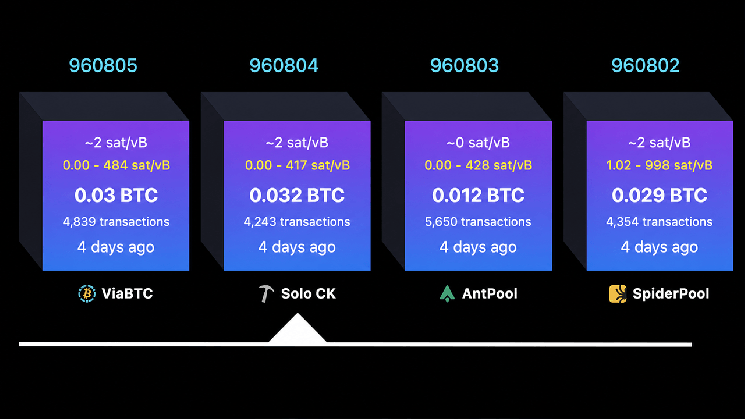
A solo Bitcoin miner, contrary to all predictions, won a $200,000 jackpot as a block reward. The payment went to an address linked to CKPool, a solo-mining service. This was the 317th solo block found by the pool. The reward consisted of the 3.125 BTC fixed subsidy and about 0.032 BTC in transaction fees from 4,243 transactions. CKPool operator Dr -ck (Con Kolivas) confirmed the win, noting the miner's hashrate was "extremely volatile, presumably rented," peaking at 100 PH/s. This represented about 0.011% of Bitcoin's total network hashrate. At that level, a miner could statistically expect to find a block roughly every 64 days, far more likely than for a typical small home setup. Solo mining differs from pool mining, where rewards are shared based on contributed work. In solo mining, a miner gets nothing unless they personally find a block, but then receives the entire reward. CKPool charges a ~2% fee on blocks found. Dr -ck noted the hashrate pattern suggested rented computing power, a practice making solo wins more accessible. He also highlighted this was the first mainnet block mined after integrating Stratum V2 code into ckpool, though the block itself was found using the older Stratum V1 protocol. Against a backdrop of mining concentration in large industrial pools, such solo finds remain rare but demonstrate that anyone with sufficient hashrate can claim a full reward without corporate or government permission. The block subsidy will remain 3.125 BTC until the next halving around April 2028. The miner's identity remains unknown, as is typical. Bitcoin's mining difficulty is due for an adjustment, and network hashrate has declined from late 2025 peaks, partly due to competition for power and hardware from AI data centers.

cryptonews.ruHace 1 hora(s)

Lone Bitcoin Miner Defies All Odds, Hits $200,000 Jackpot with Block Reward

cryptonews.ruHace 1 hora(s)

Blackrock Leads with $305 Million Inflow into Bitcoin and Ether ETFs

Money continued to flow rapidly into the largest cryptocurrency ETFs. Bitcoin and Ethereum ETFs collectively attracted over $305 million in inflows, with BlackRock again leading the charge, marking the third consecutive session of strong institutional demand. The broader market picture was mixed. Hyperliquid ($HYPE) ETFs finally saw renewed buying interest, while XRP ($XRP) ETFs faced outflows, and Solana-based products remained stagnant. In a strong session, Bitcoin ETFs recorded a net inflow of $244.42 million across five funds. BlackRock's IBIT dominated with $196.83 million, followed by ARK 21Shares' ARKB at $37.63 million and Fidelity's FBTC at $11.28 million. Vaneck's HODL was the sole fund to see an outflow (-$14.67 million), barely impacting the category's overall positive trend. Total trading volume reached $1.58 billion. Ethereum ETFs also continued their positive run, attracting $60.86 million. BlackRock's ETHA led with $50.34 million. The staking-oriented ETHB and Fidelity's FETH followed. No Ethereum ETF saw outflows. Among smaller tokens, Hyperliquid ETFs saw a minor but notable inflow of ~$966,690, potentially signaling easing selling pressure. Conversely, XRP ETFs experienced a $3.58 million outflow. Solana ETFs saw no net activity. The session solidified Bitcoin and Ethereum as the focal point for institutional capital, with BlackRock as the dominant source of demand, while activity in altcoin ETFs remained volatile.

cryptonews.ruHace 1 hora(s)

Blackrock Leads with $305 Million Inflow into Bitcoin and Ether ETFs

cryptonews.ruHace 1 hora(s)

Trading

Spot

Artículos destacados

Cómo comprar ADA

¡Bienvenido a HTX.com! Hemos hecho que comprar Cardano (ADA) sea simple y conveniente. Sigue nuestra guía paso a paso para iniciar tu viaje de criptos.Paso 1: crea tu cuenta HTXUtiliza tu correo electrónico o número de teléfono para registrarte y obtener una cuenta gratuita en HTX. Experimenta un proceso de registro sin complicaciones y desbloquea todas las funciones.Obtener mi cuentaPaso 2: ve a Comprar cripto y elige tu método de pagoTarjeta de crédito/débito: usa tu Visa o Mastercard para comprar Cardano (ADA) al instante.Saldo: utiliza fondos del saldo de tu cuenta HTX para tradear sin problemas.Terceros: hemos agregado métodos de pago populares como Google Pay y Apple Pay para mejorar la comodidad.P2P: tradear directamente con otros usuarios en HTX.Over-the-Counter (OTC): ofrecemos servicios personalizados y tipos de cambio competitivos para los traders.Paso 3: guarda tu Cardano (ADA)Después de comprar tu Cardano (ADA), guárdalo en tu cuenta HTX. Alternativamente, puedes enviarlo a otro lugar mediante transferencia blockchain o utilizarlo para tradear otras criptomonedas.Paso 4: tradear Cardano (ADA)Tradear fácilmente con Cardano (ADA) en HTX's mercado spot. Simplemente accede a tu cuenta, selecciona tu par de trading, ejecuta tus trades y monitorea en tiempo real. Ofrecemos una experiencia fácil de usar tanto para principiantes como para traders experimentados.

1.6k Vistas totalesPublicado en 2024.12.10Actualizado en 2026.06.02

Cómo comprar ADA

Discusiones

Bienvenido a la comunidad de HTX. Aquí puedes mantenerte informado sobre los últimos desarrollos de la plataforma y acceder a análisis profesionales del mercado. A continuación se presentan las opiniones de los usuarios sobre el precio de ADA (ADA).

活动图片