Following primary loss, crypto PACs invest $1.5M in 3 US state races

cointelegraphPublicado a 2026-08-06Actualizado a 2026-08-06

Resumen

Following a primary loss in Michigan, cryptocurrency-linked Super PACs affiliated with Fairshake invested over $1.5 million in three U.S. state races. The funds, spent by groups Defend American Jobs and Protect Progress, support both Republican and Democratic congressional candidates in Alaska, Florida, and Wyoming. Many of the backed candidates previously voted for crypto-friendly legislation like the CLARITY Act. This spending surge follows a $2 million loss in a Michigan primary. Overall, Fairshake-aligned groups have reportedly spent over $170 million in the 2024 election cycle, aiming to influence the makeup of Congress. The crypto industry's support is tied to lawmakers' stances on digital asset bills, with future votes potentially impacting the 2026 midterm elections.

Two groups affiliated with the cryptocurrency company-backed political action committee (PAC) Fairshake disclosed spending more than $1.5 million on media to support House of Representatives and Senate candidates in Florida, Alaska and Wyoming after suffering a primary loss in Michigan on Tuesday.

According to Federal Election Commission (FEC) filings as of Thursday, Fairshake PAC affiliates Defend American Jobs and Protect Progress spent a combined $1.5 million on ads for Republican and Democratic candidates, many of whom voted in favor of the Digital Asset Market Clarity (CLARITY) Act while serving in Congress.

In Alaska’s at-large congressional district, scheduled to hold a primary on Aug. 18, Defend American Jobs spent more than $500,000 on media supporting the re-election of Representative Nick Begich. The Super PAC spent about the same amount on Republican candidate Sydney Gruters in Florida’s 16th district, and Representative Harriet Hageman, running for the soon-to-be-vacant Wyoming Senate seat now occupied by Cynthia Lummis. Both US states will also hold primaries on Aug. 18.

The reported expenditures follow a primary loss for a Protect Progress-supported candidate in Michigan’s 13th Congressional District. On Tuesday, Democratic incumbent Shri Thanedar lost a primary to State Representative Donavan McKinney after the Super PAC poured more than $2 million into media supporting the former. The final day of Thanedar’s current term in Congress will be in January 2027.

Related: US Senate will vote on CLARITY crypto bill ‘without any question’ this week: Tim Scott

On the Democratic side, Protect Progress reported spending more than $50,000 for the re-election of Lois Frankel in Florida’s 23rd district. Frankel, Begich and Hageman all voted in favor of the GENIUS Act and CLARITY Act while serving in Congress, while Gruters did not appear to have made any public statements on crypto or blockchain, with the exception of saying she supported the crypto market structure bill in a questionnaire conducted by the advocacy organization Stand With Crypto.

The expenditures were the latest examples of Fairshake and cryptocurrency industry-aligned groups attempting to influence US elections through media. The Super PAC reported spending more than $170 million in the 2024 US election cycle on House and Senate races, potentially changing the makeup of the current Congress.

CLARITY votes to influence 2026 midterms?

While it was still uncertain as of Thursday whether the US Senate would hold a vote on the CLARITY Act before the chamber broke for a month-long recess, how lawmakers cast their ballots could affect whether the crypto industry actively supports or opposes their re-election bids. All 435 House seats are up for grabs in 2026, as are 33 seats in the US Senate.

In January, Stand With Crypto said that its “primary goal” in 2026 was getting crypto market structure legislation through Congress. The organization’s community director, Mason Lynaugh, told Cointelegraph in November that how lawmakers vote on the bill could impact their re-election chances. Stand With Crypto rates political candidates on a scale of “strongly supports crypto” to “strongly against crypto” depending on their voting records and public statements, which may be used by PACs and organizations deciding where to allocate funds.

Magazine: 10 weirdest things ever tokenized... including farts

Preguntas relacionadas

QAccording to the article, which political action committee (PAC) and its affiliates are spending money on US state races, and what was the total amount disclosed?

AThe political action committee is Fairshake. Its affiliates, Defend American Jobs and Protect Progress, disclosed spending a combined total of more than $1.5 million on media for candidates in Florida, Alaska, and Wyoming.

QWhich specific candidates and races did the Defend American Jobs super PAC support with its reported spending?

ADefend American Jobs spent over $500,000 supporting Representative Nick Begich's re-election in Alaska's at-large district, a similar amount for Republican candidate Sydney Gruters in Florida's 16th district, and for Representative Harriet Hageman, who is running for the Wyoming Senate seat.

QWhat recent event prompted this reported spending by the crypto-aligned PACs, as mentioned in the article?

AThe expenditures followed a primary loss for a Protect Progress-supported candidate, Democratic incumbent Shri Thanedar, in Michigan’s 13th Congressional District, where the Super PAC had invested over $2 million.

QWhat common legislative action links most of the candidates supported by these crypto PAC expenditures?

AMost of the supported candidates, including Nick Begich, Harriet Hageman, and Lois Frankel, voted in favor of the CLARITY Act (Digital Asset Market Clarity Act) while serving in Congress.

QHow does the organization Stand With Crypto plan to influence the 2026 midterm elections, according to the article?

AStand With Crypto's primary goal for the 2026 midterms is to get crypto market structure legislation passed. The organization rates candidates based on their crypto stance, and these ratings may guide PACs and organizations in allocating campaign funds, potentially impacting re-election chances.

Lecturas Relacionadas

Company Managing $2.8 Billion in Bitcoin Makes Optimistic Statement About BTC!

Dylan LeClair, CFO of MetaPlanet, commented on the recent sharp sell-offs in crypto markets and growing criticism towards Bitcoin-holding companies. He compared the current pessimism to the 2022 crash, suggesting price corrections and liquidations have set the stage for Bitcoin's next growth phase. LeClair acknowledged that the recent BTC price drop created negative perceptions of corporate balance sheet holdings but called this a cyclical phenomenon. He referenced similar criticism faced by MicroStrategy in 2021/22, noting that while such companies can underperform BTC during downturns due to leveraged structures, the long-term trend reverses. He argued that for Bitcoin to reach a multi-trillion-dollar asset class, integration with traditional capital markets is essential, and retail "cold storage" alone is insufficient. Addressing criticism from some Bitcoin purists, LeClair defended the use of equities and debt instruments as necessary bridges to attract institutional capital with varying risk tolerances. LeClair suggested the market may have bottomed, citing institutional funds rotating from Bitcoin-related assets into AI stocks at the end of Q2, creating artificial selling pressure. He downplayed exaggerated fears like quantum computing threats, predicting that once sellers are exhausted, Bitcoin will surge sharply without significant news catalysts.

cryptonews.ruHace 1 hora(s)

Company Managing $2.8 Billion in Bitcoin Makes Optimistic Statement About BTC!

cryptonews.ruHace 1 hora(s)

Capital is Moving from Cryptocurrency Speculation to Tokenized RWA Assets

In 2026, tokenized real-world assets (RWA) became one of the fastest-growing areas in crypto. Investors, weary of market volatility, are shifting capital from speculative crypto trading towards assets offering stable yield. These include tokenized government bonds (e.g., T-bills), private credit, real estate income, commodities, and money market funds. Data shows a clear preference for transparent, regulated products. Deposits into RWA protocols more than tripled year-on-year, reaching $7.4 billion in Q2, while spot trading activity surged 220%. The total on-chain value of tokenized RWAs exceeded $30 billion in 2026, more than doubling from the previous year, and approached $38 billion by August. RWA acts as a bridge between traditional finance and blockchain, not a replacement. It allows banks and asset managers to launch regulated products on public blockchains, while DeFi users gain access to previously unavailable real-world assets. Blockchain provides 24/7 settlements, transparency, programmability, and lower fees, while traditional finance contributes capital, regulation, and proven products. Tokenized private credit remains the largest RWA category (over $7 billion on-chain), benefiting from blockchain's cost reduction and transparency. Treasury bills are the fastest-growing institutional segment, driven by higher interest rates. Tokenized commodities, especially gold, are expanding, combining asset safety with blockchain trading ease. Real estate, though smaller, is also growing steadily. Tokenization is increasingly viewed as core financial infrastructure.

cryptonews.ruHace 1 hora(s)

Capital is Moving from Cryptocurrency Speculation to Tokenized RWA Assets

cryptonews.ruHace 1 hora(s)

Lone Bitcoin Miner Defies All Odds, Hits $200,000 Jackpot with Block Reward

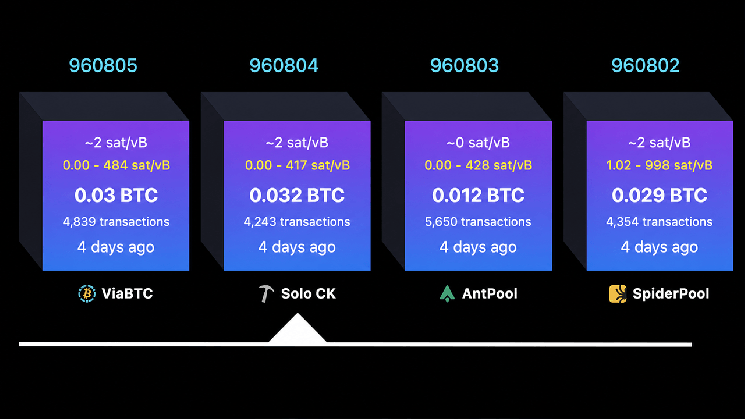
A solo Bitcoin miner, contrary to all predictions, won a $200,000 jackpot as a block reward. The payment went to an address linked to CKPool, a solo-mining service. This was the 317th solo block found by the pool. The reward consisted of the 3.125 BTC fixed subsidy and about 0.032 BTC in transaction fees from 4,243 transactions. CKPool operator Dr -ck (Con Kolivas) confirmed the win, noting the miner's hashrate was "extremely volatile, presumably rented," peaking at 100 PH/s. This represented about 0.011% of Bitcoin's total network hashrate. At that level, a miner could statistically expect to find a block roughly every 64 days, far more likely than for a typical small home setup. Solo mining differs from pool mining, where rewards are shared based on contributed work. In solo mining, a miner gets nothing unless they personally find a block, but then receives the entire reward. CKPool charges a ~2% fee on blocks found. Dr -ck noted the hashrate pattern suggested rented computing power, a practice making solo wins more accessible. He also highlighted this was the first mainnet block mined after integrating Stratum V2 code into ckpool, though the block itself was found using the older Stratum V1 protocol. Against a backdrop of mining concentration in large industrial pools, such solo finds remain rare but demonstrate that anyone with sufficient hashrate can claim a full reward without corporate or government permission. The block subsidy will remain 3.125 BTC until the next halving around April 2028. The miner's identity remains unknown, as is typical. Bitcoin's mining difficulty is due for an adjustment, and network hashrate has declined from late 2025 peaks, partly due to competition for power and hardware from AI data centers.

cryptonews.ruHace 1 hora(s)

Lone Bitcoin Miner Defies All Odds, Hits $200,000 Jackpot with Block Reward

cryptonews.ruHace 1 hora(s)

Blackrock Leads with $305 Million Inflow into Bitcoin and Ether ETFs

Money continued to flow rapidly into the largest cryptocurrency ETFs. Bitcoin and Ethereum ETFs collectively attracted over $305 million in inflows, with BlackRock again leading the charge, marking the third consecutive session of strong institutional demand. The broader market picture was mixed. Hyperliquid ($HYPE) ETFs finally saw renewed buying interest, while XRP ($XRP) ETFs faced outflows, and Solana-based products remained stagnant. In a strong session, Bitcoin ETFs recorded a net inflow of $244.42 million across five funds. BlackRock's IBIT dominated with $196.83 million, followed by ARK 21Shares' ARKB at $37.63 million and Fidelity's FBTC at $11.28 million. Vaneck's HODL was the sole fund to see an outflow (-$14.67 million), barely impacting the category's overall positive trend. Total trading volume reached $1.58 billion. Ethereum ETFs also continued their positive run, attracting $60.86 million. BlackRock's ETHA led with $50.34 million. The staking-oriented ETHB and Fidelity's FETH followed. No Ethereum ETF saw outflows. Among smaller tokens, Hyperliquid ETFs saw a minor but notable inflow of ~$966,690, potentially signaling easing selling pressure. Conversely, XRP ETFs experienced a $3.58 million outflow. Solana ETFs saw no net activity. The session solidified Bitcoin and Ethereum as the focal point for institutional capital, with BlackRock as the dominant source of demand, while activity in altcoin ETFs remained volatile.

cryptonews.ruHace 1 hora(s)

Blackrock Leads with $305 Million Inflow into Bitcoin and Ether ETFs

cryptonews.ruHace 1 hora(s)

Trading

Spot
活动图片