Nasdaq Plans to Launch 23-Hour Trading, Paving the Final Stretch for On-Chain Stocks and Tokenized Assets

marsbitPublicado a 2025-12-17Actualizado a 2025-12-17

Resumen

Nasdaq has submitted a proposal to the SEC to extend U.S. stock trading hours to 23 hours per day, effectively formalizing overnight trading. This move is seen as a step toward preparing the market infrastructure for future 24/7 on-chain stock trading and asset tokenization. Key implications include: - Improved accessibility for retail investors, enabling trading across more time zones without waiting for traditional market hours. - Enhanced performance for on-chain stock platforms (e.g., Ondo Finance, StableStock), as their broker-mediated transactions will align with extended market hours, ensuring smoother and more liquid operations. - Stronger support for DeFi protocols, as near-24-hour official pricing improves oracle reliability for lending, derivatives, and other decentralized applications. - Better risk management for brokers and market makers, who can hedge positions throughout most of the day, leading to smoother pricing and deeper on-chain liquidity. This shift signals accelerating momentum toward on-chain equities and tokenized assets.

Just saw a very interesting piece of news:
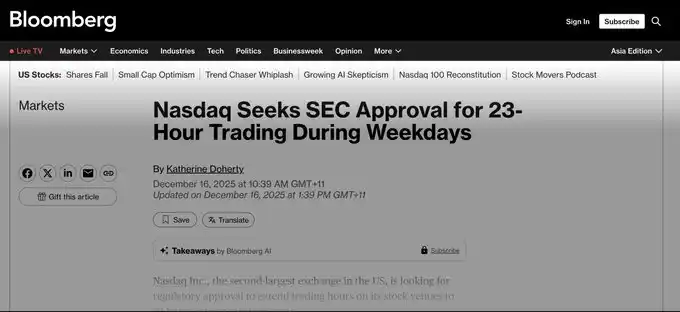
A few hours ago, Nasdaq officially filed documents with the SEC, planning to extend U.S. stock trading hours to 23 hours per day, formally incorporating the "night session" into the official trading system.

Hmm? Are you trying to set the stage for the 7x24 "on-chain stocks" and "tokenized assets" market two years from now, starting with 5x23?

Simply put, it currently looks like the image above. If approved, it will change to the image below.
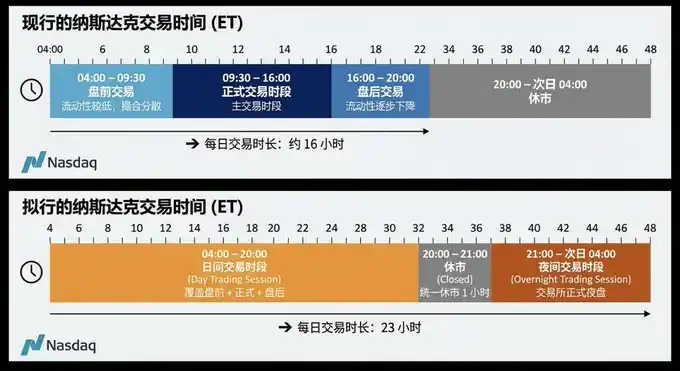
If it really gets approved, the impact will be significant:

1. Retail Investors - First and foremost, the experience for retail investors will improve. No more staying up late waiting for the market to open; they can buy and sell during the day too.

And this enhanced experience isn’t limited to Futu and Tiger Brokers. It applies equally if you’re using on-chain U.S. stocks like Ondo Finance or StableStock. This is because, fundamentally, your buying and selling are executed through their brokers acting as intermediaries. This is also the underlying mechanism for "on-chain U.S. stocks having no slippage and infinite liquidity," as they are backed by the NYSE and Nasdaq. As long as broker transactions become smoother, your on-chain actions will naturally become smoother too.

2. DeFi - Previously, the low liquidity and trading volume in pre-market and after-hours sessions affected the composability of on-chain U.S. stocks in DeFi, as the price discovery mechanism was in a "downgraded mode" during non-trading hours. Now, with nearly 24-hour official markets, it will provide the most authoritative and uninterrupted "price oracle" for future DeFi protocols (such as lending and derivatives).

3. Brokers/MMs for On-Chain U.S. Stocks - These brokers and market makers will now be able to hedge in the U.S. stock market for 23 hours, making the price curve smoother. Market makers can provide deeper liquidity on-chain around the clock without worrying about extreme risks. Unlike before, where a major event or black swan during the pre-market hours left prices unreflected and nowhere to run, forcing everyone to wait for the market to open.

The era of on-chain U.S. stocks and the tokenization of everything is undeniably drawing closer.

Preguntas relacionadas

QWhat is Nasdaq's plan for extending trading hours, as mentioned in the article?

ANasdaq has submitted a proposal to the SEC to extend U.S. stock trading hours to 23 hours per day, effectively incorporating overnight trading into the official system.

QHow would extended trading hours benefit retail investors according to the article?

ARetail investors would have a better experience as they wouldn't need to wait for the market to open, allowing them to trade during their daytime hours more conveniently.

QWhat impact would near-24-hour trading have on DeFi protocols?

AIt would provide a more authoritative and continuous price oracle for DeFi protocols (like lending and derivatives), improving price discovery mechanisms during previously low-liquidity periods.

QHow do on-chain U.S. stock platforms like Ondo Finance achieve 'slippage-free' and 'infinite liquidity'?

AThey achieve this through brokers who execute buy/sell orders on their behalf, connecting to traditional exchanges like NYSE and Nasdaq, so extended trading hours make on-chain actions smoother.

QWhy is the extended trading window beneficial for brokers and market makers in the on-chain stock space?

AIt allows them to hedge in the U.S. stock market for 23 hours, leading to smoother price curves and deeper on-chain liquidity without worrying as much about extreme risks during off-hours.

Lecturas Relacionadas

OpenAI Post-Training Engineer Weng Jiayi Proposes a New Paradigm Hypothesis for Agentic AI

OpenAI engineer Weng Jiayi's "Heuristic Learning" experiments propose a new paradigm for Agentic AI, suggesting that intelligent agents can improve not just by training neural networks, but also by autonomously writing and refining code based on environmental feedback. In the experiment, a coding agent (powered by Codex) was tasked with developing and maintaining a programmatic strategy for the Atari game Breakout. Starting from a basic prompt, the agent iteratively wrote code, ran the game, analyzed logs and video replays to identify failures, and then modified the code. Through this engineering loop of "code-run-debug-update," it evolved a pure Python heuristic strategy that achieved a perfect score of 864 in Breakout and performed competitively with deep reinforcement learning (RL) algorithms in MuJoCo control tasks like Ant and HalfCheetah. This approach, termed Heuristic Learning (HL), contrasts with Deep RL. In HL, experience is captured in readable, modifiable code, tests, logs, and configurations—a software system—rather than being encoded solely into opaque neural network weights. This offers potential advantages in explainability, auditability for safety-critical applications, easier integration of regression tests to combat catastrophic forgetting, and more efficient sample use in early learning stages, as demonstrated in broader tests on 57 Atari games. However, the blog acknowledges clear limitations. Programmatic strategies struggle with tasks requiring long-horizon planning or complex perception (e.g., Montezuma's Revenge), areas where neural networks excel. The future vision is a hybrid architecture: specialized neural networks for fast perception (System 1), HL systems for rules, safety, and local recovery (also System 1), and LLM agents providing high-level feedback and learning from the HL system's data (System 2). The core proposition is that in the era of capable coding agents, a significant portion of an AI's learned experience could be maintained as an auditable, evolving software system.

marsbitHace 55 min(s)

OpenAI Post-Training Engineer Weng Jiayi Proposes a New Paradigm Hypothesis for Agentic AI

marsbitHace 55 min(s)

Your Claude Will Dream Tonight, Don't Disturb It

This article explores the recent phenomenon of AI companies increasingly using anthropomorphic language—like "thinking," "memory," "hallucination," and now "dreaming"—to describe machine learning processes. Focusing on Anthropic's newly announced "Dreaming" feature for its Claude Agent platform, the piece explains that this function is essentially an automated, offline batch processing of an agent's operational logs. It analyzes past task sessions to identify patterns, optimize future actions, and consolidate learnings into a persistent memory system, akin to a form of reinforcement learning and self-correction. The article draws parallels to similar features in other AI agent systems like Hermes Agent and OpenClaw, which also implement mechanisms for reviewing historical data, extracting reusable "skills," and strengthening long-term memory. It notes a key difference from human dreaming: these AI "dreams" still consume computational resources and user tokens. Further context is provided by discussing the technical challenges of managing AI "memory" or context, highlighting the computational expense of large context windows and innovations like Subquadratic's new model claiming drastically longer contexts. The core critique argues that this strategic use of human-centric vocabulary does more than market products; it subtly reshapes user perception. By framing algorithms with terms associated with consciousness, companies blur the line between tool and autonomous entity. This linguistic shift can influence user expectations, tolerance for errors, and even perceptions of responsibility when systems fail, potentially diverting scrutiny from the companies and engineers behind the technology. The article concludes by speculating that terms like "daydreaming" for predictive task simulation might be next, continuing this trend of embedding the idea of an "inner life" into computational processes.

marsbitHace 57 min(s)

Your Claude Will Dream Tonight, Don't Disturb It

marsbitHace 57 min(s)

Trading

Spot
Futuros

Artículos destacados

Cómo comprar CC

¡Bienvenido a HTX.com! Hemos hecho que comprar CC(Canton) (CC) sea simple y conveniente. Sigue nuestra guía paso a paso para iniciar tu viaje de criptos.Paso 1: crea tu cuenta HTXUtiliza tu correo electrónico o número de teléfono para registrarte y obtener una cuenta gratuita en HTX. Experimenta un proceso de registro sin complicaciones y desbloquea todas las funciones.Obtener mi cuentaPaso 2: ve a Comprar cripto y elige tu método de pagoTarjeta de crédito/débito: usa tu Visa o Mastercard para comprar CC(Canton) (CC) al instante.Saldo: utiliza fondos del saldo de tu cuenta HTX para tradear sin problemas.Terceros: hemos agregado métodos de pago populares como Google Pay y Apple Pay para mejorar la comodidad.P2P: tradear directamente con otros usuarios en HTX.Over-the-Counter (OTC): ofrecemos servicios personalizados y tipos de cambio competitivos para los traders.Paso 3: guarda tu CC(Canton) (CC)Después de comprar tu CC(Canton) (CC), guárdalo en tu cuenta HTX. Alternativamente, puedes enviarlo a otro lugar mediante transferencia blockchain o utilizarlo para tradear otras criptomonedas.Paso 4: tradear CC(Canton) (CC)Tradear fácilmente con CC(Canton) (CC) en HTX's mercado spot. Simplemente accede a tu cuenta, selecciona tu par de trading, ejecuta tus trades y monitorea en tiempo real. Ofrecemos una experiencia fácil de usar tanto para principiantes como para traders experimentados.

158 Vistas totalesPublicado en 2026.04.21Actualizado en 2026.04.21

Cómo comprar CC

Cómo comprar BLEND

¡Bienvenido a HTX.com! Hemos hecho que comprar Fluent (BLEND) sea simple y conveniente. Sigue nuestra guía paso a paso para iniciar tu viaje de criptos.Paso 1: crea tu cuenta HTXUtiliza tu correo electrónico o número de teléfono para registrarte y obtener una cuenta gratuita en HTX. Experimenta un proceso de registro sin complicaciones y desbloquea todas las funciones.Obtener mi cuentaPaso 2: ve a Comprar cripto y elige tu método de pagoTarjeta de crédito/débito: usa tu Visa o Mastercard para comprar Fluent (BLEND) al instante.Saldo: utiliza fondos del saldo de tu cuenta HTX para tradear sin problemas.Terceros: hemos agregado métodos de pago populares como Google Pay y Apple Pay para mejorar la comodidad.P2P: tradear directamente con otros usuarios en HTX.Over-the-Counter (OTC): ofrecemos servicios personalizados y tipos de cambio competitivos para los traders.Paso 3: guarda tu Fluent (BLEND)Después de comprar tu Fluent (BLEND), guárdalo en tu cuenta HTX. Alternativamente, puedes enviarlo a otro lugar mediante transferencia blockchain o utilizarlo para tradear otras criptomonedas.Paso 4: tradear Fluent (BLEND)Tradear fácilmente con Fluent (BLEND) en HTX's mercado spot. Simplemente accede a tu cuenta, selecciona tu par de trading, ejecuta tus trades y monitorea en tiempo real. Ofrecemos una experiencia fácil de usar tanto para principiantes como para traders experimentados.

161 Vistas totalesPublicado en 2026.04.24Actualizado en 2026.04.24

Cómo comprar BLEND

Cómo comprar ACN

¡Bienvenido a HTX.com! Hemos hecho que comprar AITECH CLOUD NETWORK (ACN) sea simple y conveniente. Sigue nuestra guía paso a paso para iniciar tu viaje de criptos.Paso 1: crea tu cuenta HTXUtiliza tu correo electrónico o número de teléfono para registrarte y obtener una cuenta gratuita en HTX. Experimenta un proceso de registro sin complicaciones y desbloquea todas las funciones.Obtener mi cuentaPaso 2: ve a Comprar cripto y elige tu método de pagoTarjeta de crédito/débito: usa tu Visa o Mastercard para comprar AITECH CLOUD NETWORK (ACN) al instante.Saldo: utiliza fondos del saldo de tu cuenta HTX para tradear sin problemas.Terceros: hemos agregado métodos de pago populares como Google Pay y Apple Pay para mejorar la comodidad.P2P: tradear directamente con otros usuarios en HTX.Over-the-Counter (OTC): ofrecemos servicios personalizados y tipos de cambio competitivos para los traders.Paso 3: guarda tu AITECH CLOUD NETWORK (ACN)Después de comprar tu AITECH CLOUD NETWORK (ACN), guárdalo en tu cuenta HTX. Alternativamente, puedes enviarlo a otro lugar mediante transferencia blockchain o utilizarlo para tradear otras criptomonedas.Paso 4: tradear AITECH CLOUD NETWORK (ACN)Tradear fácilmente con AITECH CLOUD NETWORK (ACN) en HTX's mercado spot. Simplemente accede a tu cuenta, selecciona tu par de trading, ejecuta tus trades y monitorea en tiempo real. Ofrecemos una experiencia fácil de usar tanto para principiantes como para traders experimentados.

91 Vistas totalesPublicado en 2026.04.28Actualizado en 2026.04.28

Cómo comprar ACN

Discusiones

Bienvenido a la comunidad de HTX. Aquí puedes mantenerte informado sobre los últimos desarrollos de la plataforma y acceder a análisis profesionales del mercado. A continuación se presentan las opiniones de los usuarios sobre el precio de A (A).

活动图片














