Metaplanet Bets On Japan’s Bitcoin Boom With ¥4 Billion Infrastructure Push

bitcoinistPublicado a 2026-03-12Actualizado a 2026-03-12

Resumen

Metaplanet, a Tokyo-listed company, is expanding its Bitcoin strategy beyond treasury accumulation by establishing two new subsidiaries: Metaplanet Ventures and Metaplanet Asset Management. With a ¥4 billion infrastructure push, Metaplanet Ventures will invest in Japan's Bitcoin financial ecosystem, including lending, payments, custody, stablecoins, derivatives, and compliance. It will also launch an incubator and a grants program. The company believes Japan's regulatory framework for digital assets is already best-in-class and now requires execution at scale. An initial investment of up to ¥400 million will go to JPYC, Japan's first licensed yen stablecoin, highlighting a focus on building the financial rails needed for institutional Bitcoin adoption. The broader ambition is to position Metaplanet as a vertically integrated player—accumulating BTC, backing infrastructure, and acting as a capital markets intermediary—betting that Japan is Bitcoin's next major growth market.

Metaplanet is widening its Bitcoin strategy beyond treasury accumulation, setting up two wholly owned subsidiaries aimed at building out the financial rails it believes Japan will need as institutional adoption of BTC deepens. The move pairs a domestic infrastructure push with a new cross-border capital markets platform, giving the Tokyo-listed company a broader claim on what it sees as Bitcoin’s next growth market.

Metaplanet Deepens Bitcoin Play

In a post on X early Thursday, CEO Simon Gerovich said the company’s board had approved the creation of Metaplanet Ventures and Metaplanet Asset Management. The first will focus on Japan’s domestic ecosystem. The second, based in Miami, is designed as a digital credit and Bitcoin capital markets business linking Asian and Western markets across “yield, equity, credit, and volatility strategies.”

The more immediate signal came from Metaplanet Ventures. Gerovich said the subsidiary will invest ¥4 billion over the next few years into firms building Bitcoin financial infrastructure in Japan, spanning “lending, payments, custody,stablecoins, derivatives, compliance.” He added that the company is also launching an incubator for early-stage founders and a grants program for open-source developers, educators and researchers.

Gerovich framed the bet as a wager that regulation is no longer Japan’s bottleneck. “Japan has built the best regulatory framework in the world for digital assets. Now it needs the companies, the builders, and the infrastructure to match. We want to help make that happen,” he wrote. That positioning matters. Rather than pitching the market as one still waiting for legal clarity, Metaplanet is arguing that the rules are already in place and the missing piece is execution at scale.

Its first allocation reflects that thesis. Gerovich said Metaplanet Ventures plans to invest up to ¥400 million in JPYC, which he described as Japan’s first licensed yen stablecoin. He tied the investment directly to the institutionalization of markets: “Every Bitcoin transaction has two sides. Bitcoin and a currency. As this market goes institutional, that currency side goes digital. JPYC is building that rail in Japan and we want to be part of it.”

That stablecoin angle is notable because it suggests Metaplanet is not treating Bitcoin adoption as a single-asset story. The company appears to be building around the surrounding market structure: settlement, custody, payments, compliance and funding infrastructure that institutional participants would need if Bitcoin-denominated activity expands inside Japan.

Dylan LeClair, Director of Bitcoin Strategy at Metaplanet, cast the broader ambition in more aggressive terms. “Metaplanet is a perpetual Bitcoin accumulation machine. Our unwavering mandate is to utilize every capital markets tool available in one of the world’s deepest financial markets to acquire BTC, relentlessly and at scale,” he wrote. “The US had its moment in 2024; Japan is next, and our aim is vertical integration across the ecosystem to be ready for it.”

Taken together, the announcements suggest Metaplanet wants to be more than a listed BTC proxy. It is trying to position itself as a treasury vehicle, infrastructure backer and capital markets intermediary all at once, betting that Japan’s next phase of Bitcoin adoption will reward firms that own not just the asset, but the rails around it.

At press time, BTC traded at $70,135.
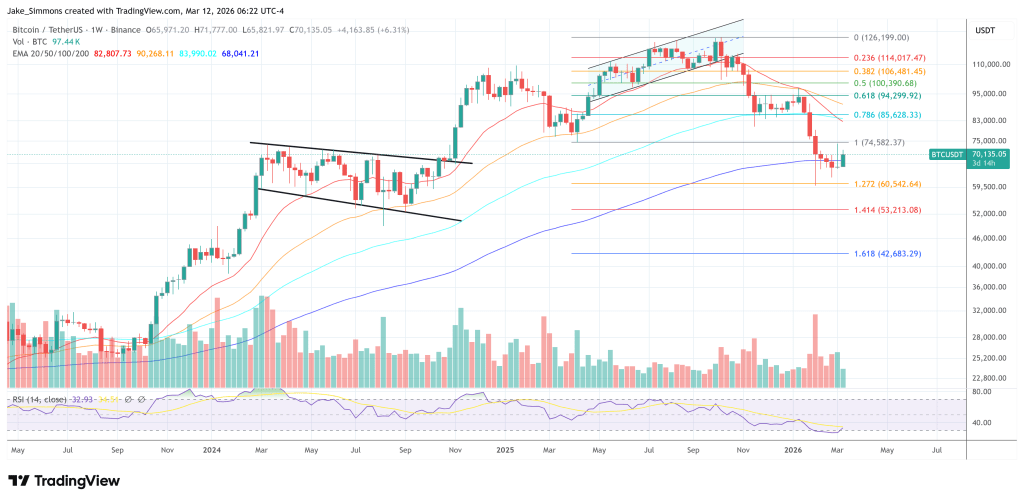
BTC faces the 1.0 Fib level, 1-week chart | Source: BTCUSDT on TradingView.com

Preguntas relacionadas

QWhat are the two new subsidiaries established by Metaplanet as part of its expanded strategy?

AMetaplanet established Metaplanet Ventures, focused on Japan's domestic Bitcoin ecosystem, and Metaplanet Asset Management, a Miami-based digital credit and Bitcoin capital markets business linking Asian and Western markets.

QHow much does Metaplanet Ventures plan to invest in Japan's Bitcoin infrastructure, and what areas will it focus on?

AMetaplanet Ventures plans to invest ¥4 billion into firms building Bitcoin financial infrastructure in Japan, spanning lending, payments, custody, stablecoins, derivatives, and compliance.

QWhy does Metaplanet believe Japan is ready for Bitcoin infrastructure development, according to CEO Simon Gerovich?

ACEO Simon Gerovich stated that Japan has built the best regulatory framework in the world for digital assets and now needs the companies, builders, and infrastructure to match, indicating that regulation is no longer a bottleneck.

QWhat is the significance of Metaplanet's investment in JPYC, and how does it relate to institutional adoption?

AMetaplanet's investment of up to ¥400 million in JPYC, Japan's first licensed yen stablecoin, is tied to the institutionalization of markets, as every Bitcoin transaction requires a currency side, which goes digital as the market institutionalizes.

QHow does Dylan LeClair, Director of Bitcoin Strategy at Metaplanet, describe the company's broader ambition?

ADylan LeClair described Metaplanet as a 'perpetual Bitcoin accumulation machine' with an unwavering mandate to utilize every capital markets tool available to acquire BTC relentlessly and at scale, aiming for vertical integration across the ecosystem in Japan.

Lecturas Relacionadas

From Banning Doubao to Embracing Honor: Why Did WeChat Suddenly 'Change Its Face'?

The article explores the sudden shift in WeChat's strategy towards AI assistants from mobile phone manufacturers, transitioning from strict opposition to active collaboration. For over a year, WeChat fiercely resisted attempts by phone AI assistants (like ByteDance's Doubao in late 2025) to control its features via GUI automation ("simulated clicking"), citing security and data control concerns. This stance created a significant barrier for system-level AI integration. Now, Tencent has initiated A2A (Agent-to-Agent) partnerships with major phone brands like Honor, Xiaomi, OPPO, and vivo. This model allows a phone's system AI (e.g., Honor's YOYO) to parse a user's voice command and send a structured request directly to WeChat's own internal AI agent via secure APIs. WeChat then executes the action (e.g., sending a message) and returns the result. The article attributes Tencent's "change of face" to strategic pressure. While leading in social app usage, Tencent trails rivals like ByteDance and Alibaba in standalone AI app popularity. WeChat, with its vast mini-program ecosystem, is Tencent's key asset for an AI comeback. The upcoming WeChat AI agent aims to handle tasks like booking and payments within the app. However, phone system assistants remain the primary AI entry point for most users. The A2A collaboration allows Tencent to extend WeChat's AI reach to this crucial system layer while maintaining control over its core functions and data. For phone manufacturers, embracing A2A is a pragmatic move. The GUI route proved unviable due to WeChat's blocks. A2A offers a compliant path to integrate a vital service, enhancing their AI assistants' usefulness. It allows them to focus on developing their own AI ecosystems for other services while cooperating on WeChat access. The collaboration is framed as a mutual, strategic necessity: Tencent gains a distribution channel, and manufacturers gain a key functionality. The partnership relies on a "dual authorization" mechanism for security, requiring both user and app consent for each action. While questions about long-term data privacy practices remain, experts note A2A is more secure and compliant than GUI automation. Ultimately, this cooperation is seen as a tentative, calculated truce. Tencent's long-term goal is to make WeChat an AI-powered "service OS." Phone manufacturers aim to make their system AI the central user interface. Their paths may converge or clash in the future, but for now, the A2A deal represents the opening chapter in the battle for the AI-era user入口, driven by necessity and strategic calculus on both sides.

marsbitHace 18 min(s)

From Banning Doubao to Embracing Honor: Why Did WeChat Suddenly 'Change Its Face'?

marsbitHace 18 min(s)

On-Chain Figures on the Eve of Kickoff: 1.6 Billion Traded Before the World Cup Even Begins

"On-Chain Numbers on the Eve of the World Cup: $1.6 Billion Traded Before Kick-off" Analysis of on-chain markets before the 2026 FIFA World Cup reveals significant crypto integration into football. The most striking figure is the approximately **$1.6 billion** in total trading volume on the single "World Cup Winner" contract on the Polymarket prediction market platform, accumulated before a single match was played. This represents explosive growth for a sector whose annual volume surged from ~$16B in 2024 to ~$64B in 2025. The ecosystem is maturing beyond speculation. Key developments include: 1) **Infrastructure upgrades** like Polymarket's migration to native, regulated USDC stablecoin for settlements; 2) **Reliable data oracles**, such as Chainlink, being used to resolve real-world match outcomes on-chain; and 3) **Official recognition**, with FIFA appointing its first-ever "Prediction Markets" partner. Over 100 contracts now cover everything from the outright winner to individual match results and even non-sporting risks like venue relocation. This evolution marks a fundamental shift. While crypto firms are absent from FIFA's top-tier sponsor list, the technology has deeply penetrated the tournament's financial and predictive infrastructure through regulated stablecoin settlements, decentralized oracles, and new official partnership categories. The regulatory landscape remains complex and varies by jurisdiction, but on-chain markets for the World Cup are already a multi-billion-dollar reality.

marsbitHace 1 hora(s)

On-Chain Figures on the Eve of Kickoff: 1.6 Billion Traded Before the World Cup Even Begins

marsbitHace 1 hora(s)

From SpaceX's IPO to the Future of Crypto: Which Crypto Sectors Will Host the Trillion-Dollar Narrative?

From the SpaceX IPO, which targets a $750 billion raise at a $1.77 trillion valuation, we can extrapolate capital flow trends relevant to crypto. The focus shifts from speculative narratives to foundational infrastructure and real-world asset (RWA) integration. Key crypto sectors poised to benefit include: 1. **AI Infrastructure**: The narrative is moving from consumer-facing AI applications to underlying, scarce resources like compute power and decentralized GPU networks (e.g., TAO, RENDER, AKT, IO). These protocols are positioning as the essential "picks and shovels" providers for the AI economy. 2. **Real-World Assets (RWA)**: Beyond tokenized treasury bonds, RWA's future lies in on-chain equity and pre-IPO assets like SpaceX. This could democratize access to high-growth assets and reshape global capital flows, benefiting infrastructure projects like ONDO, LINK, and Plume that facilitate issuance, data, and liquidity. 3. **Core Financial Infrastructure**: Stablecoins, payment networks, and DePIN (Decentralized Physical Infrastructure Networks) are critical for settling the future on-chain economy. Their role expands from internal trading tools to foundational layers for global finance, AI systems, and real-world asset networks, leading to potential value reassessment. In summary, the next cycle may prioritize long-term infrastructure value—AI compute, asset tokenization networks, and settlement layers—over short-lived application hype, mirroring the broader market's shift towards funding the foundational systems of the future.

marsbitHace 1 hora(s)

From SpaceX's IPO to the Future of Crypto: Which Crypto Sectors Will Host the Trillion-Dollar Narrative?

marsbitHace 1 hora(s)

Trading

Spot
Futuros

Artículos destacados

Cómo comprar PUSH

¡Bienvenido a HTX.com! Hemos hecho que comprar Push Protocol (PUSH) sea simple y conveniente. Sigue nuestra guía paso a paso para iniciar tu viaje de criptos.Paso 1: crea tu cuenta HTXUtiliza tu correo electrónico o número de teléfono para registrarte y obtener una cuenta gratuita en HTX. Experimenta un proceso de registro sin complicaciones y desbloquea todas las funciones.Obtener mi cuentaPaso 2: ve a Comprar cripto y elige tu método de pagoTarjeta de crédito/débito: usa tu Visa o Mastercard para comprar Push Protocol (PUSH) al instante.Saldo: utiliza fondos del saldo de tu cuenta HTX para tradear sin problemas.Terceros: hemos agregado métodos de pago populares como Google Pay y Apple Pay para mejorar la comodidad.P2P: tradear directamente con otros usuarios en HTX.Over-the-Counter (OTC): ofrecemos servicios personalizados y tipos de cambio competitivos para los traders.Paso 3: guarda tu Push Protocol (PUSH)Después de comprar tu Push Protocol (PUSH), guárdalo en tu cuenta HTX. Alternativamente, puedes enviarlo a otro lugar mediante transferencia blockchain o utilizarlo para tradear otras criptomonedas.Paso 4: tradear Push Protocol (PUSH)Tradear fácilmente con Push Protocol (PUSH) en HTX's mercado spot. Simplemente accede a tu cuenta, selecciona tu par de trading, ejecuta tus trades y monitorea en tiempo real. Ofrecemos una experiencia fácil de usar tanto para principiantes como para traders experimentados.

212 Vistas totalesPublicado en 2024.12.13Actualizado en 2026.06.02

Cómo comprar PUSH

Discusiones

Bienvenido a la comunidad de HTX. Aquí puedes mantenerte informado sobre los últimos desarrollos de la plataforma y acceder a análisis profesionales del mercado. A continuación se presentan las opiniones de los usuarios sobre el precio de PUSH (PUSH).

活动图片













