Meme Wrapped Contracts: Is alt.fun Real Innovation or Pseudo-Demand?

Odaily星球日报Publicado a 2026-05-18Actualizado a 2026-05-18

Resumen

"Last week, the new Meme token launch platform alt.fun on Hyperliquid gained significant attention. Its flagship token ALT reached a peak market cap of $8.8 million. The platform's novelty lies in combining the mechanics of Pump.fun with leveraged trading on Hyperliquid. When a user creates a Meme token on alt.fun, they must also open a leveraged long/short position (2x, 3x, or 5x) on an underlying asset like HYPE. The platform then mints a corresponding leveraged token (LT) on BounceTech, which represents that perpetual contract position. Essentially, users are trading a tokenized derivative. This creates a dual price driver: the token's value is influenced both by market buying/selling via a bonding curve and by the performance of its underlying leveraged position. Hence the slogan: 'Your token pumps even when nobody's buying.' Tokens 'graduate' to a liquidity pool when their market cap (effectively the LT's value) reaches $9,000, achievable through either mechanism. However, this model faces key challenges. Gains are amplified only in strong, one-directional markets for the underlying asset. In volatile conditions, the mandatory 'rebalancing' of LTs leads to value decay. More fundamentally, alt.fun struggles to foster the community consensus vital for Meme tokens. Investment is driven primarily by price speculation on the underlying asset, not by narrative or cultural appeal. With limited underlying assets, token differentiation is low. The article concludes that while m...

Original | Odaily Planet Daily (@OdailyChina)

Author | Golem (@web3_golem)
Last week, a new Meme launch platform on the Hyperliquid ecosystem called alt.fun attracted significant attention from Meme players. Within just one week of launch, its leading token ALT reached a peak market cap of $8.8 million. Its price has since retraced, with the market cap currently hovering around $6.7 million.

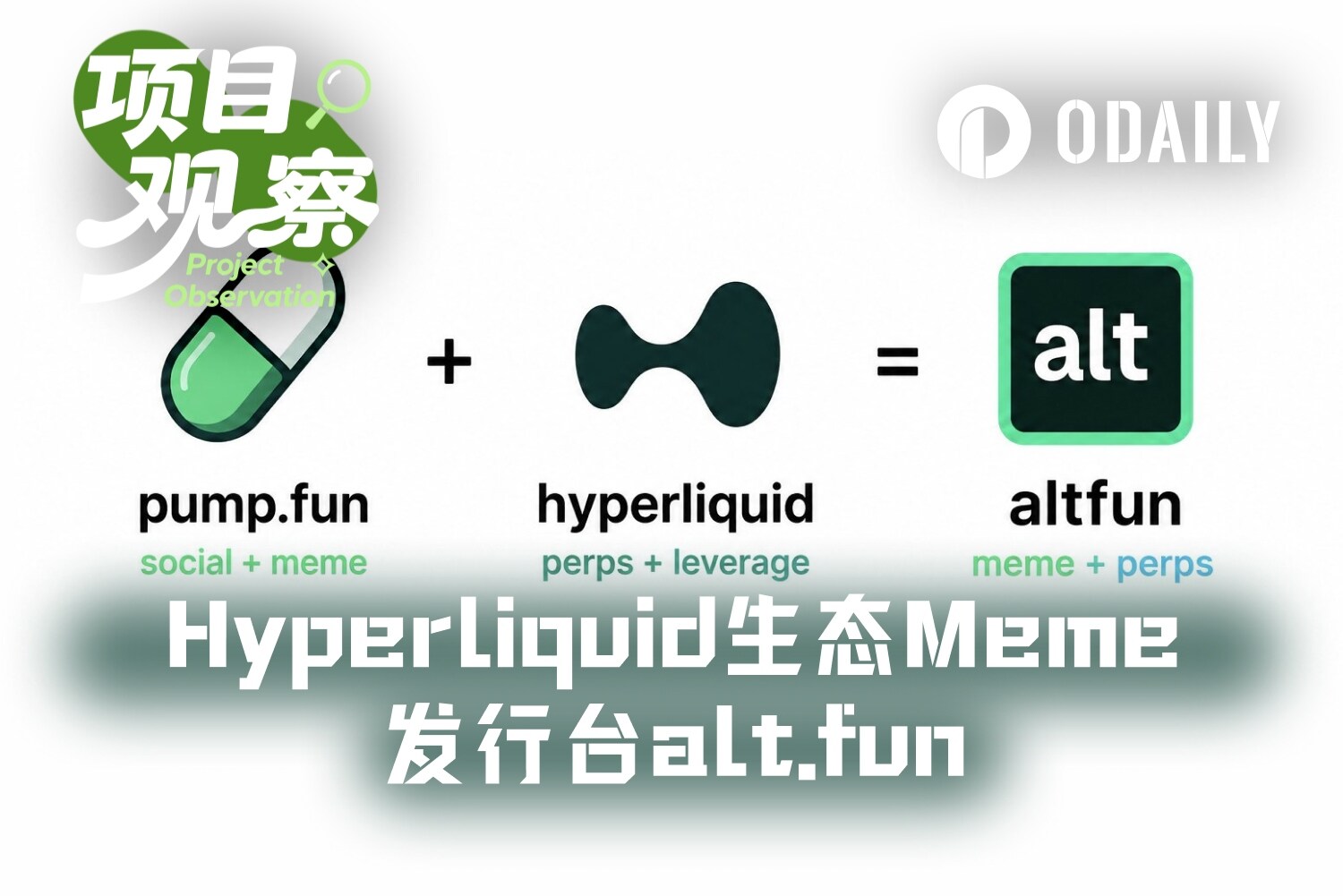
The novelty of alt.fun can be understood as a combination of Pump.fun and Hyperliquid, allowing users on this platform to experience the dual thrill of playing with Memes and opening leveraged contracts simultaneously.

Introduction to the alt.fun Platform Mechanism

Specifically, each Meme token launched on alt.fun has a corresponding contract position on Hyperliquid as its underlying asset.

Similar to Pump.fun, any user can launch a Meme coin on HyperEVM with one click via the alt.fun platform. The token price is still influenced by a bonding curve. The total supply of a created Meme coin is 1 billion tokens. When 75% of the tokens are sold, the token successfully "graduates" and is migrated to the HyperSwap V2 liquidity pool.

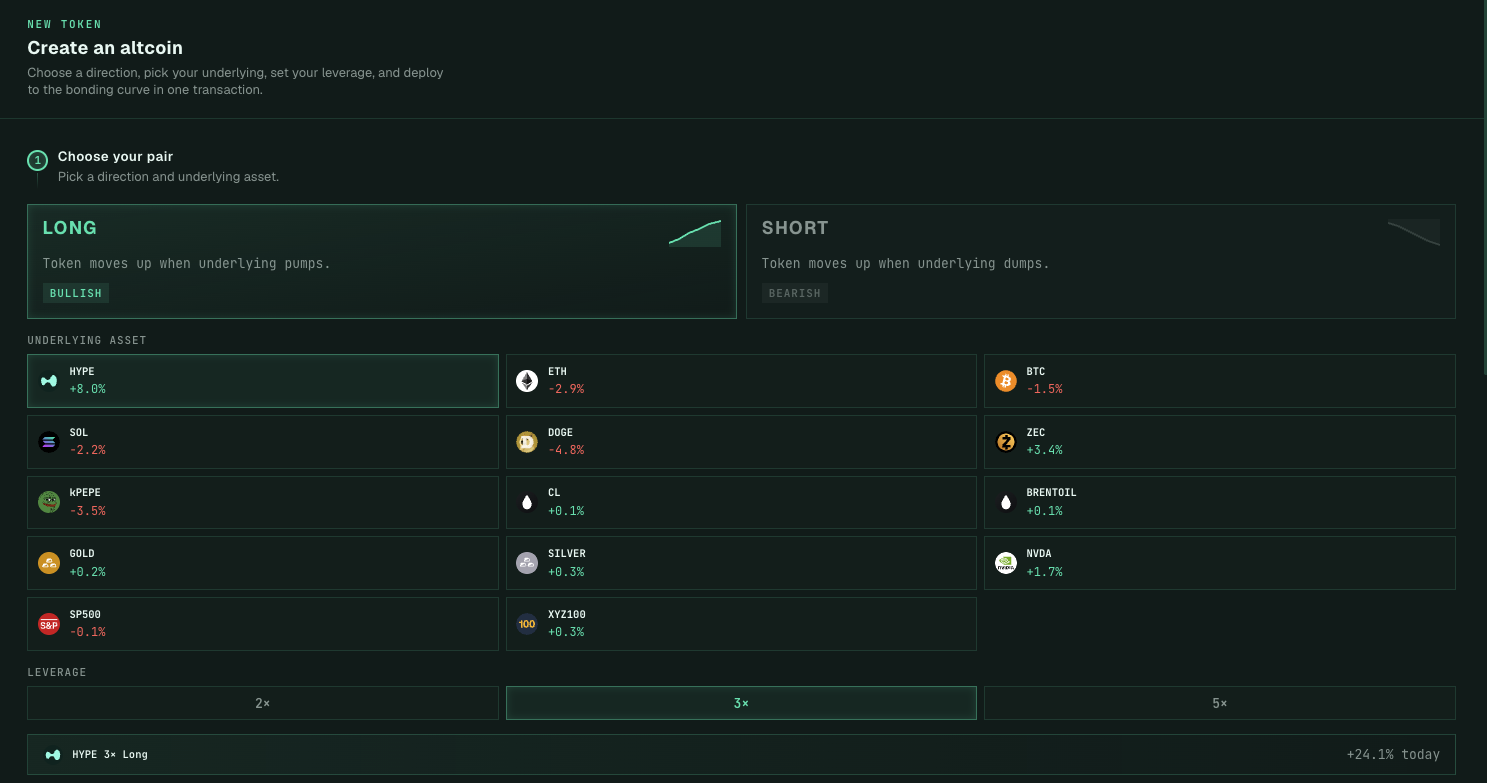
The difference from Pump.fun is that when creating a token on alt.fun, the user also needs to select an underlying asset and specify a leverage level (2x/3x/5x) for a short/long position. At the exact moment of token creation, the platform mints a corresponding amount of Leveraged Tokens (LT) on BounceTech(Odaily note: a permissionless leveraged token platform on Hyperliquid) and sends them to the user. These leveraged tokens represent perpetual contract positions on Hyperliquid. For example, if a user chooses to create a token based on a 3x long HYPE position, what they receive is essentially a leveraged token tracking the returns of a 3x long HYPE position.

As shown in the figure below, currently on alt.fun, users can choose from 14 underlying assets when creating a token. Similarly, when a player buys a Meme coin on this platform, the platform also mints the corresponding leveraged tokens on BounceTech. If a player sells, this process is reversed—the leveraged tokens are redeemed, and the user receives the corresponding USDC.
This model of packaging leveraged tokens as underlying assets and then selling them is similar to the securitization of specific risk exposures like futures and options in traditional finance, such as 3x short Nasdaq ETF, 5x short crude oil products, etc. In this process, the alt.fun platform acts as a role similar to an asset management company, managing the long-term positions behind the leveraged tokens for users.

The core price of such financial products follows the net asset value. However, because the token price on the alt.fun platform is also simultaneously influenced by the Meme coin bonding curve mechanism, the graduation model and price drivers for tokens on this platform are not singular.

Dual Graduation Modes and Price Driving Factors

This also means that token prices on the alt.fun platform are influenced by two factors: first, by market sentiment from buying and selling; second, by the performance of the underlying asset. So now you might understand the meaning of alt.fun's slogan, "Your token pumps even when nobody's buying."

For example, if a user creates a token based on a 3x long HYPE position with an initial investment of $20 (the platform's minimum buy-in size), and subsequently HYPE rises by 10%, then even if no one else buys the token, the user's holding value increases by 30% to $26.

Based on this dual price driver, the graduation model for tokens on the alt.fun platform is also not limited to one method. Specifically, the graduation condition for its tokens is reaching a market cap of $9,000. This essentially calculates the value of the leveraged token. Besides achieving graduation through token purchases, if the token's own value driven by the underlying asset's rise reaches a $9,000 market cap, it can also graduate smoothly. Therefore, whether a token reaches the graduation threshold is often a combined result of both price mechanisms.

Of course, ideally, the underlying asset's rise drives the leveraged token's increase, which, combined with the emotional catalyst from the Meme market, might cause the token's price to spiral upward rapidly. However, once the underlying asset falls, the leveraged token's value continues to shrink, potentially causing market panic and a sell-off, leading to the token's price crashing instantly.

Therefore, although alt.fun's mechanism can effectively leverage amplification effects, this only works in one-directional market trends and requires users to accurately catch the trend. If encountering volatile market conditions for the underlying asset, users must also bear the decay loss from leverage. This is because when the underlying asset price fluctuates, the platform needs to perform "rebalancing" to manage positions to avoid liquidation. This means that even if the underlying asset falls and then recovers to its original price, the leveraged token will suffer losses and gradually depreciate due to forced position reductions during the dip.

Furthermore, in cases of sudden price spikes or flash crashes, the platform might fail to react in time, potentially leading the leveraged token's value to zero.

Meme or not Meme

The alt.fun platform currently has a total of 41 graduated tokens. Only two have a market cap exceeding one million: ALT (based on 5x long HYPE) and STONKS (based on 5x long S&P 500). The total number of users is around just over 1,000. Although alt.fun is still in its early stages, we can already identify its current development bottlenecks.

First, the platform has too few underlying assets. With the current 14 underlying assets, there can be at most 84 different combinations of leveraged tokens. alt.fun has already seen leveraged tokens with the same leverage level (short/long) on the same underlying asset. For instance, the current top token ALT is based on 5x long HYPE, while another token, ATH, with a certain market cap, is also based on 5x long HYPE. Apart from the token name and creation time, there is no difference between them. In that case, why wouldn't an investor buy the lower-market-cap ATH?

Although alt.fun may support more underlying assets in the future, its core pain point is its inability to foster Meme coin community consensus.

The essential reason investors choose to buy leveraged tokens on the alt.fun platform instead of opening leveraged positions directly on Hyperliquid is to obtain greater price leverage and, because the platform manages position rebalancing on the backend, individual users can act as "hands-off managers," not worrying about individual liquidation risks.

But this is also the issue. Investors buying an alt.fun token are essentially doing so based on future price expectations for its underlying asset, not based on narrative, market games, attention—these "meaningless things" that ironically are the core value supporting Memes. A Meme's ability to rise or gain market recognition often isn't due to any actual value backing or financial design behind it; what's more important is its community propagation attribute.

As a Meme player, it's difficult for me to develop a love for a leveraged token similar to the passion for a particular Meme community's culture. If someone truly has faith in the underlying asset of a leveraged token, they might as well issue their own leveraged token rather than buying an existing one and bearing unnecessary premiums.

Therefore, the mechanism of the alt.fun platform appears novel, but in my view, it's merely a mechanical innovation. If alt.fun focuses on developing towards a DeFi platform in the future, there might be an opportunity. However, if it insists on forcing its way into the Meme launch platform track, it is destined to be a flash in the pan.


Preguntas relacionadas

QAccording to the article, what is the core innovation of the alt.fun platform and which two platforms does it combine?

AThe core innovation of the alt.fun platform is that it packages leveraged tokens as underlying assets and sells them as meme coins, combining the meme coin launch mechanism of Pump.fun with the perpetual contract (leveraged trading) functionality of Hyperliquid.

QWhat are the two main factors that drive the price of a meme coin on the alt.fun platform?

AThe price of a meme coin on the alt.fun platform is driven by two main factors: 1) Market sentiment and buying/selling pressure on the meme coin itself (via the bonding curve). 2) The performance of the underlying asset that the coin's leveraged token is tracking (e.g., if the coin is based on a 5x long position on HYPE, its value is affected by HYPE's price movement).

QWhat is one of the key risks or disadvantages mentioned regarding the alt.fun leveraged token model, especially in volatile market conditions?

AA key risk is the potential for "leverage decay." In volatile or choppy market conditions where the underlying asset price fluctuates up and down, the platform must perform "rebalancing" to manage the leveraged position. This process can cause the leveraged token to slowly lose value over time, even if the underlying asset's price eventually returns to its original level.

QWhat is identified in the article as the core dilemma or fundamental weakness of alt.fun's approach to being a meme coin platform?

AThe core weakness is that alt.fun's model lacks the ability to build true meme coin community consensus. Investors buy these tokens primarily based on price expectations for the underlying financial asset, not for the narrative, cultural elements, or community hype that are essential to sustaining a successful meme coin. It's more of a packaged financial product than a true community-driven meme.

QWhat are the two conditions under which a meme coin on alt.fun can 'graduate' (be successfully launched into a liquidity pool)?

AA meme coin on alt.fun graduates when its market capitalization reaches $9,000. This can happen in two ways: 1) Through purchases on the bonding curve, which increases the token's price and market cap. 2) Through the increase in value of the underlying leveraged token itself, driven by favorable price movement of the underlying asset, even without new buyers on the bonding curve.

Lecturas Relacionadas

BNB Chain Releases Research Report, Exploring Post-Quantum Cryptography Migration Path for BSC

BNB Chain, a leading Layer-1 blockchain ecosystem, has released a research report exploring the potential migration path for BNB Smart Chain (BSC) to post-quantum cryptography. The study evaluates replacing traditional cryptographic systems with quantum-resistant alternatives, specifically examining the use of ML-DSA-44 for transaction signing and pqSTARK for aggregating validator consensus signatures. While quantum computers are not currently a practical threat to existing blockchain cryptography, the research represents a proactive effort to ensure long-term network security and infrastructure resilience. The report assessed several core areas of the BSC tech stack, including post-quantum transaction signing, validator signature aggregation, transaction validation, public key storage, and network performance under increased data loads. A key finding is that achieving post-quantum readiness is technically feasible today but requires significant trade-offs in scalability. Test data indicates: • Transaction size would increase from ~110 bytes to ~2.5 kilobytes. • Block size would grow from ~110 kilobytes to ~2 megabytes. • Native transfer TPS would decrease from 4,973 to 2,997. The primary performance bottleneck is not signature verification itself, but the increased network transmission overhead caused by larger transaction and block sizes. Conversely, the pqSTARK aggregation technology proved highly efficient, compressing validator signatures by an approximately 43:1 ratio, which helps manage consensus-layer overhead. The report notes that post-quantum alternatives for areas like P2P handshakes and KZG commitments were not within the scope of this evaluation and require further research and broader ecosystem coordination. BNB Chain emphasizes this work is a research-oriented exploration and not a response to any imminent security threat.

marsbitHace 13 min(s)

BNB Chain Releases Research Report, Exploring Post-Quantum Cryptography Migration Path for BSC

marsbitHace 13 min(s)

After Developer Numbers Halved: Crypto Isn't Dead, It's Just Giving Up Talent to AI

The title "After a 50% Drop in Developer Count: Crypto Isn't Dead, It's Just Ceding Talent to AI" suggests a shift, not an end. The article analyzes GitHub data showing a significant drop in overall Crypto developer activity from a peak of 45K monthly active developers in 2022 to about 23K in 2026. However, this masks a deeper trend of "talent deleveraging." The exodus consists mainly of newcomers who entered during the bull market for hype-driven roles (e.g., NFT contracts, forked DeFi protocols), with over 50% of developers with less than one year of experience leaving. In contrast, established developers (2+ years of experience) have hit record highs, contributing roughly 70% of the code. They are consolidating in ecosystems with real users and revenue, like Bitcoin and Solana. These experienced builders possess unique skills forged in Crypto's "code is law" environment: the ability to build trust and functional systems from scratch in the absence of external authority or rules, with zero tolerance for error. The article argues that AI's scaling faces structurally similar trust, coordination, and verification problems—particularly regarding compute aggregation, multi-agent incentive alignment, and autonomous payments. Crypto builders are already applying these skills in AI. Examples include CoreWeave (mining to AI compute), OpenRouter (NFT marketplace routing to AI model routing), and projects like Hyperbolic (using crypto-native mechanisms for decentralized compute verification) and EigenLayer (applying restaking logic to AI agent governance). Stablecoin infrastructure is becoming critical for AI agent micro-payments (e.g., x402 protocol). The role of these builders is evolving from writing smart contracts to "designing trusted mechanisms for autonomous AI systems." This shift is reflected in new hiring trends at major exchanges and significant venture capital flowing into the crypto-AI convergence (e.g., funds from Paradigm, Haun Ventures). The article concludes that while developer numbers have halved, the core density of talent has increased, and their uniquely cultivated skills are finding a new, larger stage in the AI era.

marsbitHace 23 min(s)

After Developer Numbers Halved: Crypto Isn't Dead, It's Just Giving Up Talent to AI

marsbitHace 23 min(s)

After the Developer Count Halved: Crypto Is Not Dead, It's Just Ceding Talent to AI

Following a significant decline in the total number of open-source crypto developers, from a peak of 45K in 2022 to approximately 23K by 2026, this article argues the industry is undergoing a "talent deleveraging" rather than a collapse. The exodus primarily consists of newcomers who entered during the bull market, while the core of experienced developers (2+ years) has grown to a record high, contributing around 70% of code. These established builders are concentrating in ecosystems with real users and revenue, like Bitcoin and Solana. The article posits that crypto has cultivated a unique skill set in building trustless, autonomous systems with near-zero tolerance for error—a capability now finding high demand in the AI era. As AI scales, it faces structural gaps in decentralized compute aggregation, multi-agent coordination/incentive alignment, and autonomous payment infrastructure. Crypto builders are transitioning their expertise to address these exact problems. Examples include CoreWeave (mining to AI compute), Hyperbolic (decentralized compute verification), EigenLayer (extending restaking mechanisms to AI agent governance), and the x402 protocol (enabling AI agent micro-payments via stablecoins). The role of the crypto builder is evolving from writing smart contracts to designing the rule-based, trust-minimized frameworks necessary for AI-native systems. Venture capital is increasingly funding this convergence, viewing it as a structural opportunity rather than a narrative shift. The core talent and systemic design principles from crypto are not disappearing but being re-priced and applied to the foundational challenges of scalable AI.

链捕手Hace 27 min(s)

After the Developer Count Halved: Crypto Is Not Dead, It's Just Ceding Talent to AI

链捕手Hace 27 min(s)

A Quick Look at the Latest Moves of the 24-Year-Old 'AI Stock God': Sixty Percent of the Portfolio Hedging Against Semiconductor Downturn

24-year-old AI investing prodigy Leopold Aschenbrenner's fund, Situational Awareness LP, has disclosed its Q1 2026 13F holdings. The fund's total portfolio nominal value surged 148% to $13.7 billion, driven by both investment gains and significant new capital inflows. The most striking move was the establishment of massive short-term hedges against potential volatility in the AI semiconductor sector. Over 60% of the fund's nominal exposure is now in put options (bets on declines) targeting major AI hardware stocks like NVIDIA (NVDA), VanEck Semiconductor ETF (SMH), Broadcom (AVGO), and AMD. Notably, the fund also holds call options (bets on rises) on some names like Micron (MU) and TSMC, indicating it expects extreme price swings in these stocks. Alongside these hedges, the fund remains a long-term bull on AI infrastructure. It significantly increased its equity stakes in companies like GPU cloud provider CoreWeave (CRWV) and added to positions in power/energy infrastructure firms like Bloom Energy (BE), albeit after taking substantial profits on the latter. The fund also exited positions in optical communication hardware (LITE, COHR) and reduced leverage by clearing out large call option positions on Intel and CoreWeave. In essence, the portfolio reflects a dual strategy: cautious on near-term semiconductor valuations and potential over-extension, while maintaining a conviction that the true long-term bottlenecks and value will be in the underlying infrastructure powering the AI revolution—such as energy, data centers, and compute availability.

marsbitHace 33 min(s)

A Quick Look at the Latest Moves of the 24-Year-Old 'AI Stock God': Sixty Percent of the Portfolio Hedging Against Semiconductor Downturn

marsbitHace 33 min(s)

Trading

Spot
Futuros

Artículos destacados

Qué es MEME 2.0

Memecoin 2.0: El Ascenso de $MEME 2.0 en el Mundo de las Criptomonedas Introducción En el panorama siempre cambiante de las criptomonedas, ha surgido un nuevo contendiente. Memecoin 2.0, simbolizada como $MEME 2.0, lleva el concepto de las monedas meme a un emocionante nuevo nivel. Como un subproducto del Memecoin original, este proyecto ha capturado la atención de la comunidad cripto al cambiar el enfoque de los incentivos financieros típicos a una experiencia comprometida y entretenida. Operando en la blockchain de Ethereum, Memecoin 2.0 redefine audazmente la participación de la comunidad en la esfera cripto. ¿Qué es Memecoin 2.0, $MEME 2.0? En su núcleo, Memecoin 2.0 es un proyecto de criptomoneda que prioriza el espíritu comunitario y la diversión asociada con la cultura meme. A diferencia de las criptomonedas convencionales, que se concentran en casos de uso prácticos y beneficios tangibles, Memecoin 2.0 se distingue al abrazar el lado más liviano de la moneda digital. El proyecto existe sin promesas de utilidad, un mapa estructurado o retornos financieros, enfocándose en cambio en fomentar una comunidad vibrante centrada en memes y en el disfrute compartido. Al hacerlo, aprovecha la creciente tendencia de la cultura meme en el espacio en línea, convirtiéndose en un jugador único en el mundo de los activos digitales. Creador de Memecoin 2.0, $MEME 2.0 A pesar de la extensa investigación sobre los orígenes de Memecoin 2.0, la identidad explícita de su creador sigue siendo desconocida. Esta anonimidad no es inusual en la comunidad cripto, donde muchos proyectos son liderados por individuos o grupos que prefieren permanecer en las sombras. La falta de información disponible públicamente sobre el creador podría verse como un movimiento estratégico, poniendo el foco en la participación comunitaria en lugar de la notoriedad individual dentro del espacio. Inversores de Memecoin 2.0, $MEME 2.0 La información sobre los inversores o el respaldo financiero de Memecoin 2.0 es escasa. Esta ausencia de detalles puede sugerir que el proyecto es autofinanciado o que su enfoque en la comunidad en lugar de las estructuras de inversión tradicionales ha atraído a un tipo diferente de apoyo. Dado que el mundo de las monedas meme generalmente involucra una participación más de base en lugar de inversión institucional, este enfoque está alineado con la ética de los proyectos impulsados por la comunidad. ¿Cómo Funciona Memecoin 2.0, $MEME 2.0? Memecoin 2.0 opera completamente en la blockchain de Ethereum, capitalizando sus robustas características de seguridad y escalabilidad. Al aprovechar las fortalezas de Ethereum, Memecoin 2.0 puede ofrecer un entorno seguro para las interacciones de los usuarios, asegurando que las transacciones sean tanto eficientes como rentables. Uno de los atributos únicos de Memecoin 2.0 radica en su estructura impulsada por la comunidad. El valor y la popularidad del token $MEME 2.0 derivan de la participación activa de sus usuarios, en vez de de una utilidad inherente. Este diseño refuerza el enfoque del proyecto en el aspecto de entretenimiento de las criptomonedas, lo que implica que la risa y la participación comunitaria son las verdaderas monedas que impulsan su éxito. Además, el proyecto encaja dentro del ecosistema más amplio de las monedas meme, donde el valor de cada moneda meme oscila basado en la cultura, tendencias y la participación de la comunidad, en lugar de principios económicos tradicionales. Cronología de Memecoin 2.0, $MEME 2.0 Para entender mejor la evolución y los hitos de Memecoin 2.0, aquí hay una cronología que destaca eventos significativos en su historia: 2024: Se reconoce la creación de Memecoin 2.0 como una ramificación del Memecoin original, estableciéndose dentro del contexto próspero de las monedas meme mientras opera en la blockchain de Ethereum. 13 de julio de 2024: Memecoin 2.0 se posiciona oficialmente como una moneda meme centrada en la comunidad en la red de Ethereum, enfatizando su enfoque centrado en el entretenimiento que invita a los usuarios a participar y crecer. Puntos Clave Sobre Memecoin 2.0, $MEME 2.0 Varios rasgos críticos definen a Memecoin 2.0: Enfoque Centrado en la Comunidad: La misión principal de Memecoin 2.0 es crear una experiencia comunitaria divertida y atractiva, capitalizando en el disfrute colectivo derivado de la cultura memética. Construido sobre Ethereum: Operar en la blockchain de Ethereum proporciona al proyecto una infraestructura esencial que garantiza seguridad y escalabilidad. Falta de Utilidad o Hoja de Ruta: En un notable desvío de las criptomonedas tradicionales, Memecoin 2.0 no promete características utilitarias ni retornos financieros, reafirmando su compromiso con la participación comunitaria y el compromiso social. Enfoque en la Cultura Memética: Al abrazar los aspectos humorísticos y culturales del fenómeno meme, Memecoin 2.0 proporciona una plataforma para que los usuarios interactúen con cripto tanto fuera de línea como en línea. Contexto Adicional: La Importancia de las Monedas Meme Las monedas meme han surgido como una clase distinta de criptomonedas, a menudo impulsadas por el humor y un enfoque desenfadado para el comercio. Estas monedas generalmente carecen de una utilidad significativa o hojas de ruta de desarrollo, atrayendo a los usuarios con la promesa de diversión, interacción comunitaria y relevancia cultural. En el panorama del ecosistema cripto más amplio, las monedas meme reviven la importancia de la participación comunitaria, revirtiendo enfoques únicamente motivados por el lucro. Proyectos como Memecoin 2.0 inauguran una era donde el entretenimiento puede armonizar con las aspiraciones financieras, convirtiendo la blockchain en un parque de diversiones para la creatividad y la interacción social. Conclusión Memecoin 2.0, o $MEME 2.0, encarna una nueva ola de criptomonedas que prioriza la participación comunitaria sobre estructuras financieras rígidas. Con un enfoque en el humor y la interacción social, capitaliza sobre la fascinación que rodea la cultura meme. Al operar en la blockchain de Ethereum, Memecoin 2.0 aprovecha las capacidades de la tecnología mientras se mantiene firme en su compromiso con el valor de entretenimiento de la moneda digital. A medida que el espacio alrededor de las criptomonedas continúa evolucionando, Memecoin 2.0 sirve como un testimonio de la noción de que el futuro de los activos digitales podría depender, en gran medida, de experiencias compartidas, risas y sólidas conexiones comunitarias. En el mundo impredecible de las criptomonedas, quizás la alegría pueda ser tan valiosa como la ganancia financiera tradicional.

95 Vistas totalesPublicado en 2024.04.04Actualizado en 2024.12.03

Qué es MEME 2.0

Cómo comprar MEME

¡Bienvenido a HTX.com! Hemos hecho que comprar Memeland (MEME) sea simple y conveniente. Sigue nuestra guía paso a paso para iniciar tu viaje de criptos.Paso 1: crea tu cuenta HTXUtiliza tu correo electrónico o número de teléfono para registrarte y obtener una cuenta gratuita en HTX. Experimenta un proceso de registro sin complicaciones y desbloquea todas las funciones.Obtener mi cuentaPaso 2: ve a Comprar cripto y elige tu método de pagoTarjeta de crédito/débito: usa tu Visa o Mastercard para comprar Memeland (MEME) al instante.Saldo: utiliza fondos del saldo de tu cuenta HTX para tradear sin problemas.Terceros: hemos agregado métodos de pago populares como Google Pay y Apple Pay para mejorar la comodidad.P2P: tradear directamente con otros usuarios en HTX.Over-the-Counter (OTC): ofrecemos servicios personalizados y tipos de cambio competitivos para los traders.Paso 3: guarda tu Memeland (MEME)Después de comprar tu Memeland (MEME), guárdalo en tu cuenta HTX. Alternativamente, puedes enviarlo a otro lugar mediante transferencia blockchain o utilizarlo para tradear otras criptomonedas.Paso 4: tradear Memeland (MEME)Tradear fácilmente con Memeland (MEME) en HTX's mercado spot. Simplemente accede a tu cuenta, selecciona tu par de trading, ejecuta tus trades y monitorea en tiempo real. Ofrecemos una experiencia fácil de usar tanto para principiantes como para traders experimentados.

196 Vistas totalesPublicado en 2024.12.12Actualizado en 2025.03.21

Cómo comprar MEME

Discusiones

Bienvenido a la comunidad de HTX. Aquí puedes mantenerte informado sobre los últimos desarrollos de la plataforma y acceder a análisis profesionales del mercado. A continuación se presentan las opiniones de los usuarios sobre el precio de MEME (MEME).

活动图片