Macro Black Swans and On-Chain Selling Pressure: A Guide to Navigating Crypto Market Risks Next Week

marsbitPublicado a 2026-01-26Actualizado a 2026-01-26

Resumen

Hotcoin Research's Market Analysis: Crypto Market Downturn and Key Events (Jan 26 - Feb 1, 2026) The cryptocurrency market is experiencing significant volatility, with a market cap of $3.1T. BTC (-6.87% weekly and ETH (-11.6%) led a broad downturn, though assets like AXS saw gains (+122.1%). Key metrics show a neutral RSI (44.24) and a Fear & Greed Index of 25. Core trading ranges are identified: BTC ($88K-$92K), ETH ($2.9K-$3.3K), and SOL ($124-$137). Macro events are heavily influencing sentiment. A market "flash crash" occurred on Jan 19. US Bitcoin spot ETFs saw a net outflow of $1.32B, with GBTC outflows totaling $25.539B to date. US economic data, including lower-than-expected unemployment claims, is being watched closely. The probability of a Fed rate cut in January remains low at 5.7%. Political statements from Donald Trump have caused immediate market reactions. Looking ahead, the report highlights several key events for the coming week: * **Macro Events:** The US Fed and Canadian central bank interest rate decisions on Jan 29 and Jan 28, respectively. * **Token Unlocks:** Significant unlocks are scheduled for JUP ($10.53M), TREE ($8.5M), OP ($9.88M), and SUI ($65.29M), which could create selling pressure. * **Project Updates:** The closure of the Defiance Ethereum ETF (Jan 26), the Infinex TGE (Jan 30), and the shutdown of Ready Player Me after its acquisition by Netflix (Jan 31). * **Regulation:** New South Korean restrictions on unregistered overseas cr...

Author: Hotcoin Research

Crypto Market Performance

Currently, the total cryptocurrency market capitalization is $3.1 trillion, with BTC accounting for 59.2%, at $1.83 trillion. The stablecoin market cap is $308.1 billion, decreasing by 0.75% in the last 7 days, with USDT making up 60.57%.

Among the top 200 projects on CoinMarketCap, most declined while a few rose, including: BTC down 6.87% in 7 days, ETH down 11.6% in 7 days, SOL down 11.2% in 7 days, AXS up 122.1% in 7 days, ZRO up 34.8% in 7 days.

This week, US Bitcoin spot ETFs saw a net outflow of $1.32 billion; US Ethereum spot ETFs saw a net outflow of $600 million.

Market Forecast (January 26 - February 1):

The current RSI index is 44.24 (neutral zone), the Fear & Greed Index is 25 (re-entering fear zone), and the Altcoin Season Index is 39 (neutral, higher than last week).

BTC core range: $88,000-92,000, short-term bias is towards high volatility.

ETH core range: $2,900-3,300, awaiting directional selection.

SOL core range: $124-137, technical signals are mixed, waiting for new catalysts. Solana's "Alpenglow" network upgrade, expected in Q1 2026, could be a significant price catalyst.

The cryptocurrency market is currently highly volatile, with short-term trends very sensitive to news. Pay special attention to Trump's foreign tariff policies and signals from the Federal Reserve's monetary policy, as these will impact the overall risk appetite of the crypto market.

Understanding the Present

Review of the Week's Major Events

  1. On January 19, the cryptocurrency market experienced a "flash crash" on Monday morning, with Bitcoin dropping up to 3.79% in nearly an hour, falling from around $95,500 to $91,900, now recovering to around $92,800;
  2. On January 18, Sonic stated, "As planned, through fully permissionless smart contract execution, successfully burned 16,027,929.41 S tokens, which were unclaimed airdrop allocations from Season 1;";
  3. On January 18, according to Defillama data, Meteora's revenue in the past 24 hours reached $1.33 million, surpassing Pump.fun's $1.16 million revenue in the past 24 hours, second only to Tether ($16.45 million) and Circle ($6.60 million);
  4. On January 19, according to an update on Paradex's official status page, its blockchain status resumed operation at 20:13;
  5. On January 20, Japan's 40-year government bond yield rose 5.5 basis points to 4% on Tuesday, hitting its highest level since its issuance in 2007, and marking the first time in over thirty years that a Japanese government bond yield has reached this level. This signifies the first time since December 1995 (when the 20-year yield touched 4%) that Japanese government bond yields have climbed above the 4% mark;
  6. On January 21, according to Bitget market data, spot gold surged 10% in 20 days, breaking through $4,800/ounce for the first time, with a year-to-date increase of over $480;
  7. On January 21, the crypto wallet Rainbow announced that the RNBW token airdrop snapshot will take place on January 26 at 16:20 EST, with the official airdrop occurring on February 5;
  8. On January 22, Trump stated he would not impose tariffs on Greenland, causing cryptocurrencies to rebound briefly in response;
  9. On January 22, North Korean hackers returned, attacking over 3,100 IP addresses using fake job interviews;
  10. On January 23, according to the Financial Times, Musk's rocket company SpaceX is seeking Wall Street investment banks for a "super" IPO, expected to be one of the largest IPOs in history;
  11. On January 22, cryptocurrency custody service provider BitGo (BTGO.US) officially listed on the NYSE, marking the first crypto IPO of the year.

Macroeconomics

  1. On January 22, US initial jobless claims for the week ending January 17 were 200,000, against an expectation of 210,000, with the previous figure revised from 198,000 to 199,000;
  2. On January 23 at 23:00, the US released the January University of Michigan Consumer Sentiment Index at 56.4, against a forecast of 54, previous 54.
  3. On January 23, according to CME "FedWatch" data, the probability of a 25 basis point Fed rate cut in January is 5.7%, and the probability of maintaining rates is 94.3%.

ETFs
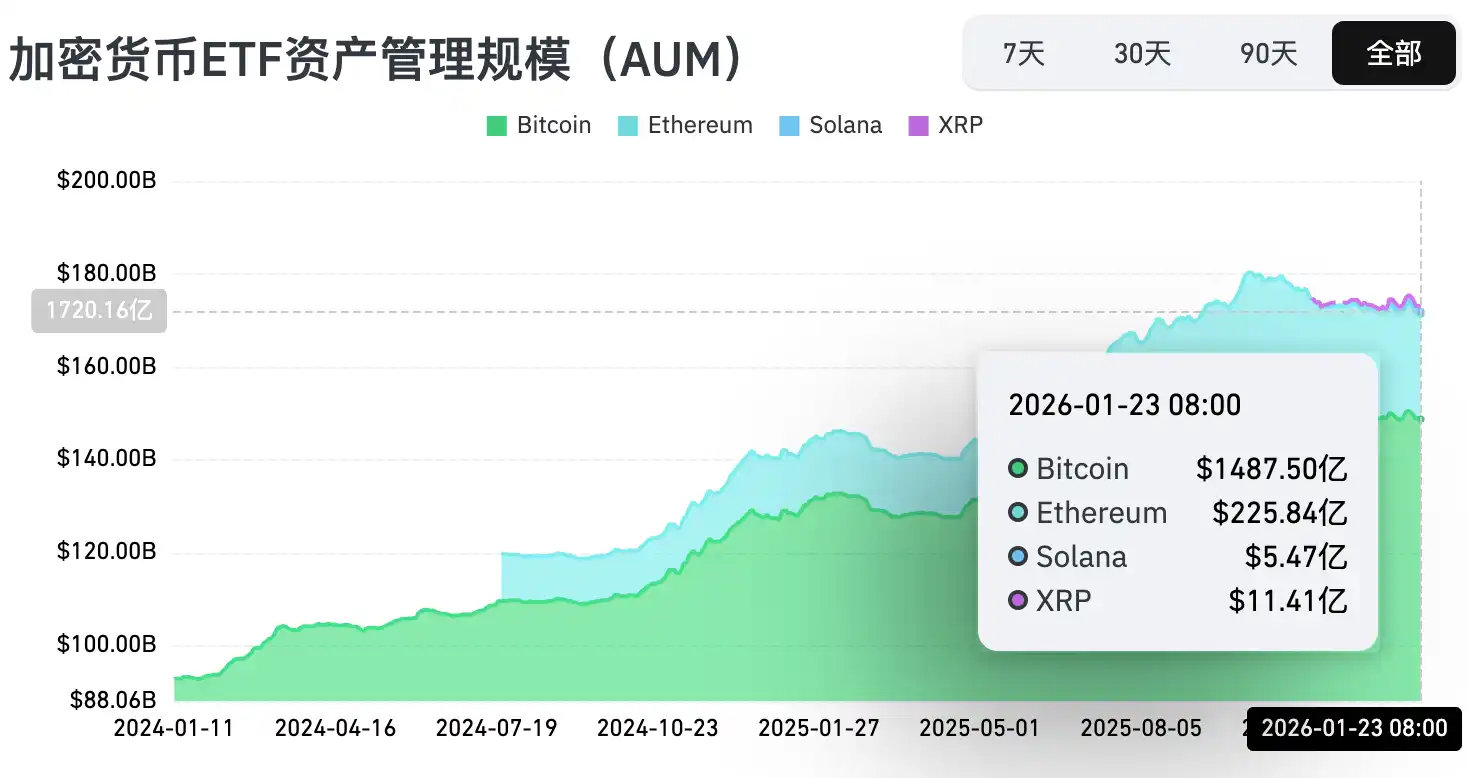
According to statistics, during January 19-24, US Bitcoin spot ETFs saw a net outflow of $1.32 billion; as of January 24, GBTC (Grayscale) has seen a total outflow of $25.539 billion and currently holds $14.414 billion, while IBIT (BlackRock) currently holds $69.721 billion. The total market capitalization of US Bitcoin spot ETFs is $120.315 billion.

US Ethereum spot ETFs saw a net outflow of $600 million.

Foreseeing the Future

Industry Conferences

  1. Consensus Hong Kong 2026 will be held in Hong Kong, China, from February 11 to 12;
  2. ETHDenver 2026 will be held in Denver, USA, from February 17 to 21;
  3. EthCC 9 will be held in Cannes, France, from March 30 to April 2, 2026. The Ethereum Community Conference (EthCC) is one of Europe's largest and longest-running annual Ethereum gatherings, focusing on technology and community development.

Project Developments

  1. Defiance will close its Nasdaq-listed Ethereum ETF: Defiance Leveraged Long and Yield Ethereum ETF (ETHI) on January 26;
  2. The first batch unlock claim deadline for Base network Perp DEX protocol RollX is January 26. The genesis airdrop totals 180 million tokens, eligible addresses include Trade & LP points holders and contributors from activities like Binance Wallet, Bitlayer, Galxe, etc.;
  3. The Aster Phase 4 airdrop claim window opens on January 28, 2026;
  4. The TON ecosystem project Catizen game Pixel Ninja will be taken offline on January 29, 2026;
  5. The cross-chain aggregation DeFi platform Infinex TGE is scheduled for January 30. The public sale had 868 participants, raising 7.214 million USDC, allocating approximately $5 million (5% of INX supply), and refunding about $2.21 million;
  6. Coinbase suspends services in Argentina. Starting January 31, 2026, Coinbase will no longer support buying or selling USDC with Argentine Pesos, but deposit and withdrawal functions will remain unaffected;
  7. The metaverse avatar platform Ready Player Me, acquired by Netflix, will cease services on January 31, 2026, with the entire team joining Netflix.

Important Events

  1. South Korea's FIU will restrict unregistered overseas crypto exchanges and wallets from listing on Google Play starting January 28. Application requirements include an anti-money laundering (AML) system and an Information Security Management System (ISMS) certification from the Korea Internet & Security Agency (KISA). Apps not complying with the policy will be blocked in South Korea from January 28, preventing new installations, and existing users may face usability issues due to inability to update;
  2. On January 28 at 22:45, Canada will announce its bank rate decision for January 28;
  3. On January 29 at 03:00, the US will announce the Federal Reserve interest rate decision (upper limit) for January 28;
  4. On January 29 at 21:30, the US will announce initial jobless claims for the week ending January 24 (in thousands).

Token Unlocks

  1. Jupiter (JUP) will unlock 53.45 million tokens on January 28, worth approximately $10.53 million, 1.7% of circulating supply;
  2. TreeHouse (TREE) will unlock 85.85 million tokens on January 29, worth approximately $8.5 million, 39.41% of circulating supply;
  3. Zora (ZORA) will unlock 168 million tokens on January 30, worth approximately $5.23 million, 4% of circulating supply;
  4. Kamino (KMNO) will unlock 228 million tokens on January 30, worth approximately $11.22 million, 3.68% of circulating supply;
  5. Optimism (OP) will unlock 31.34 million tokens on January 31, worth approximately $9.88 million, 1.62% of circulating supply;
  6. Sui (SUI) will unlock 43.52 million tokens on February 1, worth approximately $65.29 million, 1.15% of circulating supply;
  7. EigenCloud (EIGEN) will unlock 36.82 million tokens on February 1, worth approximately $12.53 million, 8.88% of circulating supply.

About Us

Hotcoin Research, as the core research arm of Hotcoin Exchange, is dedicated to transforming professional analysis into your practical tool. We dissect market trends through "Weekly Insights" and "In-Depth Reports"; with our exclusive column "Hotcoin Selection" (dual screening by AI + experts), we help you identify potential assets and reduce trial costs. Every week, our researchers also engage with you face-to-face through live streams, interpreting hot topics and forecasting trends. We believe that warm companionship and professional guidance can help more investors navigate cycles and seize the value opportunities of Web3.


Preguntas relacionadas

QWhat is the current total market capitalization and Bitcoin's dominance, according to the article?

AThe current total cryptocurrency market capitalization is $3.1 trillion, with Bitcoin's dominance at 59.2%, equivalent to $1.83 trillion.

QWhat were the 7-day price performances of BTC, ETH, and SOL mentioned in the report?

ABTC had a 7-day decline of 6.87%, ETH fell 11.6%, and SOL decreased by 11.2%.

QWhat significant macroeconomic event is scheduled for January 29th that could impact the market?

AThe US Federal Reserve's interest rate decision (upper limit) is scheduled for 03:00 on January 29th.

QWhich token has the largest value unlock scheduled for the upcoming week, and what is its value?

ASui (SUI) has the largest value unlock scheduled for February 1st, with 43.52 million tokens worth approximately $65.29 million.

QAccording to the article, what two external factors should traders pay special attention to as they highly influence short-term market sentiment?

ATraders should pay special attention to former President Trump's foreign tariff policies and signals regarding the Federal Reserve's monetary policy, as they significantly impact the crypto market's risk appetite.

Lecturas Relacionadas

7 Months After the Collapse of Huiwang, Southeast Asia's Escrow Platforms Undergo a Major Reshuffle

Following the collapse of Huione Pay—dubbed the "Alipay of Southeast Asia"—seven months ago, the region's underground financial guarantee platform sector is undergoing a significant reshuffle. This power vacuum has been swiftly filled by emerging platforms such as XinBi, Tiger/Navigator, JinBei (renamed JinBo), Dali/Tiancheng, and FullyLight. These platforms, operating largely via Telegram and offering services like escrow for illicit transactions, have absorbed the vast user base and markets left behind by Huione. While positioning themselves as "trust intermediaries," their primary clientele consists of networks involved in online scams, money laundering, illegal gambling, and even human trafficking. For instance, the Tiger/Navigator platform explicitly provides "escrow" services for kidnapping-for-ransom operations ("强押车交易"). Data underscores the immense scale: Huione alone processed over $103 billion in cryptocurrency payments and facilitated over $31 billion through its escrow market before its downfall, linking it to Cambodia's notorious Prince Group. Since its collapse, competitors have seen explosive growth. For example, the XinBi platform has accumulated over $1.6 billion in total USDT revenue, while platforms like NewPay, OkPay (under Dali), and FullyLight Wallet collectively processed over $4.8 billion in USDT in a single year. This ecosystem thrives in regions like Cambodia and Myanmar, where regulatory gaps allow these platforms to act as critical financial infrastructure for sprawling cybercrime industries, from scam compounds to online casinos. The article concludes that the moniker "Southeast Asian Alipay" is a misnomer, obscuring the platforms' fundamental role in enabling serious criminal enterprises rather than representing legitimate financial innovation.

Odaily星球日报Hace 39 min(s)

7 Months After the Collapse of Huiwang, Southeast Asia's Escrow Platforms Undergo a Major Reshuffle

Odaily星球日报Hace 39 min(s)

The Changing Landscape: What Are Crypto VCs Experiencing?

Title: The Shifting Landscape of Crypto Venture Capital The era of dedicated crypto venture capital funds is undergoing a significant transformation. Once essential for navigating the sector's complexity and high risk, these specialized funds are now facing an identity crisis as the market matures. This shift mirrors historical patterns in other specialized investment classes like cleantech and SPACs, where initial information advantages dissipate as technologies become mainstream and integrated into existing industry frameworks. The article argues that crypto is reaching a critical inflection point, transitioning from a "building phase" to an "integration phase." Major players like Stripe, BlackRock, and Visa now engage with crypto not for its novel mechanics but as a foundational financial infrastructure. Their needs—regulatory compliance, banking partnerships, distribution channels—align with traditional fintech, a domain easily understood by large, generalist funds like Sequoia and Founders Fund. This evolution creates a "barbell effect" within the VC landscape. On one end are massive, diversified platforms that can incorporate crypto as one vertical among many. On the other are small, nimble funds focused on niche, experimental projects. The middle ground—medium-sized dedicated crypto funds—is being squeezed out. Their typical fund size makes it impossible to generate sufficient returns solely from early-stage crypto bets, yet they cannot compete with giants for later-stage deals. Consequently, leading crypto-native firms like Paradigm and Framework Ventures are expanding into AI, robotics, and other sectors, driven partly by LP pressure for better returns amid a broader VC DPI crisis. Others, like Dragonfly and a16z, have narrowed their crypto focus predominantly to financial infrastructure like stablecoins, reframing the sector's core narrative. For crypto entrepreneurs, this consolidation presents challenges. While generalist funds offer larger checks and broader resources, crypto projects now compete fiercely with AI for attention and capital within these firms. Furthermore, the long-term, non-commercial foundational work that built the ecosystem—funded by dedicated crypto VCs—is less likely to attract generalist capital focused on direct returns. The conclusion is that "crypto investor" as a standalone category is becoming obsolete, akin to "internet investor." Crypto is becoming a baseline infrastructure layer. The future will see a barbell structure: large-scale growth financing handled by generalist funds, while pioneering, speculative projects are funded by small, specialized vehicles. The dedicated crypto funds of the 2017-2021 boom, which incubated core infrastructure, are giving way to this new, bifurcated reality.

Foresight NewsHace 57 min(s)

The Changing Landscape: What Are Crypto VCs Experiencing?

Foresight NewsHace 57 min(s)

As Consensus Accelerates, What Are Young Investors Betting On?

Title: As Consensus Forms Faster, What Are Young Investors Betting On? In the rapid evolution of tech investment, a new generation of young investors is navigating a landscape where AI, robotics, commercial aerospace, and quantum computing are advancing simultaneously. Traditional investment logic based on financial models is giving way to a need for deep technical understanding and the ability to act before industry consensus forms. An analysis of trends from the "WAIC FUTURE TECH" list of young investment leaders reveals key shifts in focus. The first major trend is the movement of AI from the digital screen into the physical world. Investment is shifting from large language models and chatbots towards embodied AI, robotics, AI hardware, and edge computing. While demonstrations generate excitement, the real challenge lies in achieving scalable, reliable, and cost-effective delivery in complex real-world environments like factories and logistics. Success depends not just on algorithms but on the integration of sensors, actuators, and control systems. Second, the competitive focus for large models is moving beyond raw capability toward building an "intelligence flywheel." The goal is to create self-reinforcing systems where user interaction generates data, improving the model, which in turn enhances the user experience and attracts more engagement. Companies that successfully embed AI into workflows to create these closed-loop systems can build lasting value that isn't easily erased by the next model upgrade. Third, facing a potential bottleneck in high-quality human-generated data, investors are looking at new underlying technologies. Reinforcement learning and self-play, as demonstrated by AlphaGo Zero, offer paths for AI to generate its own experience. Scientific foundation models, which aim to build general AI capabilities for fields like life sciences and materials discovery, represent a non-consensus direction that could unlock new frontiers of knowledge and data. Finally, in deep-tech areas like quantum computing, commercial aerospace, and space-based infrastructure, patient capital is essential. These fields have long, uncertain development and validation cycles involving complex engineering, supply chains, and regulations. Investment here requires a long-term view, focusing on foundational team capabilities and the eventual emergence of market demand, even if commercial returns are distant. Collectively, these trends illustrate how young investors are adapting to a new era. They are learning to make earlier, technically-informed judgments, balance hype with real-world viability, and provide the patient capital needed to build the deep-tech foundations of the future.

marsbitHace 1 hora(s)

As Consensus Accelerates, What Are Young Investors Betting On?

marsbitHace 1 hora(s)

Trading

Spot
活动图片




