LayerZero Gathers Wall Street Old Money in a Day, as the Cross-Chain Leader Begins to Tell the Story of a 'Wall Street Public Chain'

marsbitPublicado a 2026-02-11Actualizado a 2026-02-11

Resumen

LayerZero, known for its cross-chain protocol, has announced a new Layer 1 blockchain called "Zero," positioning itself as a decentralized multi-core world computer designed for institutional financial markets. The project has garnered significant backing from major Wall Street players, including Citadel Securities, which made an unusual strategic investment in the ZRO token. Other supporters include ARK Invest, Tether, DTCC, ICE, and Google Cloud, all exploring applications in clearing, exchange operations, and cloud infrastructure. Zero features a unique architecture with multiple independent zones optimized for different use cases: a general-purpose EVM-compatible environment, a private payment system, and a dedicated trading zone. This structure aims to address Wall Street's need for high throughput, privacy, and scalability, with claims of supporting up to 2 million TPS. The move signals a strategic pivot from cross-chain bridging to capturing institutional demand for tokenized assets and high-frequency trading. While Ethereum remains a key player in tokenization, Zero is positioned as a potential alternative for production-level financial activity. For the ZRO token, the narrative shifts from cross-chain governance to potentially capturing value from institutional-scale asset flows. However, 80% of ZRO tokens remain locked, with unlocks extending to 2027, and a fee mechanism proposal failed in December, with another vote scheduled for June. The partnerships, while si...

Author: Deep Tide TechFlow

On February 10, LayerZero launched Zero in New York.

This is a self-developed Layer 1 public chain aimed at hosting institutional-grade financial market trading and clearing.

LayerZero calls it a "decentralized multi-core world computer." Let me translate that for you: a chain specifically for Wall Street.

At the same time, various Wall Street institutions began openly endorsing it, with some responses directly involving financial investment.

Among them, Citadel Securities made a strategic investment in the ZRO token.

This company handles approximately one-third of U.S. retail stock orders. CoinDesk specifically noted in its report on the matter that directly purchasing crypto tokens is not a conventional move for traditional Wall Street financial institutions like Citadel.
ARK Invest also purchased equity and tokens in LayerZero, with Cathie Wood (Cathie Wood) directly joining the project's advisory board; Tether announced a strategic investment in LayerZero Labs on the same day, though the amount was not disclosed.

Beyond token purchases and equity investments, there is a quieter signal.

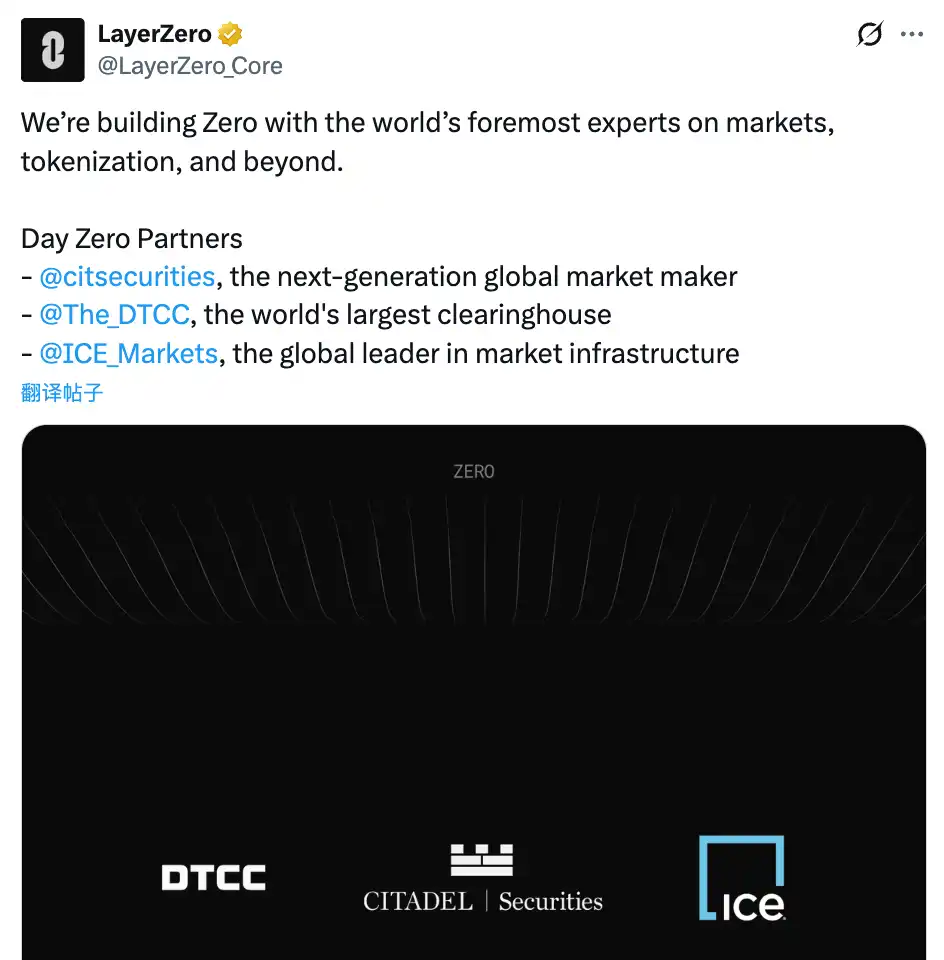
DTCC (the central clearing agency for U.S. stock trading), ICE (the parent company of the New York Stock Exchange), and Google Cloud also signed joint exploration agreements with LayerZero.

So, a cross-chain bridge project, in its transformation, has simultaneously secured collective endorsement from the entire industry chain including clearing, exchanges, market makers, asset management, stablecoins, and cloud computing.

Traditional institutions are adding another move in their layout of on-chain financial pipelines.

After the news was announced, ZRO's price surged over 20% that day, currently hovering around $2.3.

No Longer a Bridge, but a Pipeline?

What LayerZero has done over the past three years is not complicated:

Moving tokens from one chain to another. Its cross-chain protocol currently connects over 165 blockchains. USDt0 (the cross-chain version of Tether's stablecoin) launched less than a year ago and has handled over $70 billion in cross-chain transfers.

This is a mature business, but the ceiling is visible.

Cross-chain bridges are essentially tools—users choose the one that is cheaper and faster. However, as the entire crypto market shrinks and trading volume declines, cross-chain functionality has become a pseudo-demand. It's understandable that LayerZero is choosing to switch tracks.

Moreover, it has the capital to do so. a16z and Sequoia have led funding rounds for the project, with total financing exceeding $300 million and a previous valuation once reaching $3 billion.

The investment portfolios of these two capital firms are essentially Wall Street's contact list. The fact that Citadel and DTCC are now willing to sit at the table to endorse LayerZero might have a lot to do with who is standing behind it.

Returning to the new L1 launched by LayerZero, Zero, it clearly isn't designed for DeFi players or meme traders.

Zero's architecture is different from existing public chains. Most chains are like a single road running all vehicles; Zero splits the chain into multiple independently operating partitions, which LayerZero calls Zones.

Each Zone can be individually optimized for different scenarios without interference.

At launch, three Zones were opened: a general-purpose environment compatible with Ethereum smart contracts, a private payment system, and a dedicated trading matching environment.
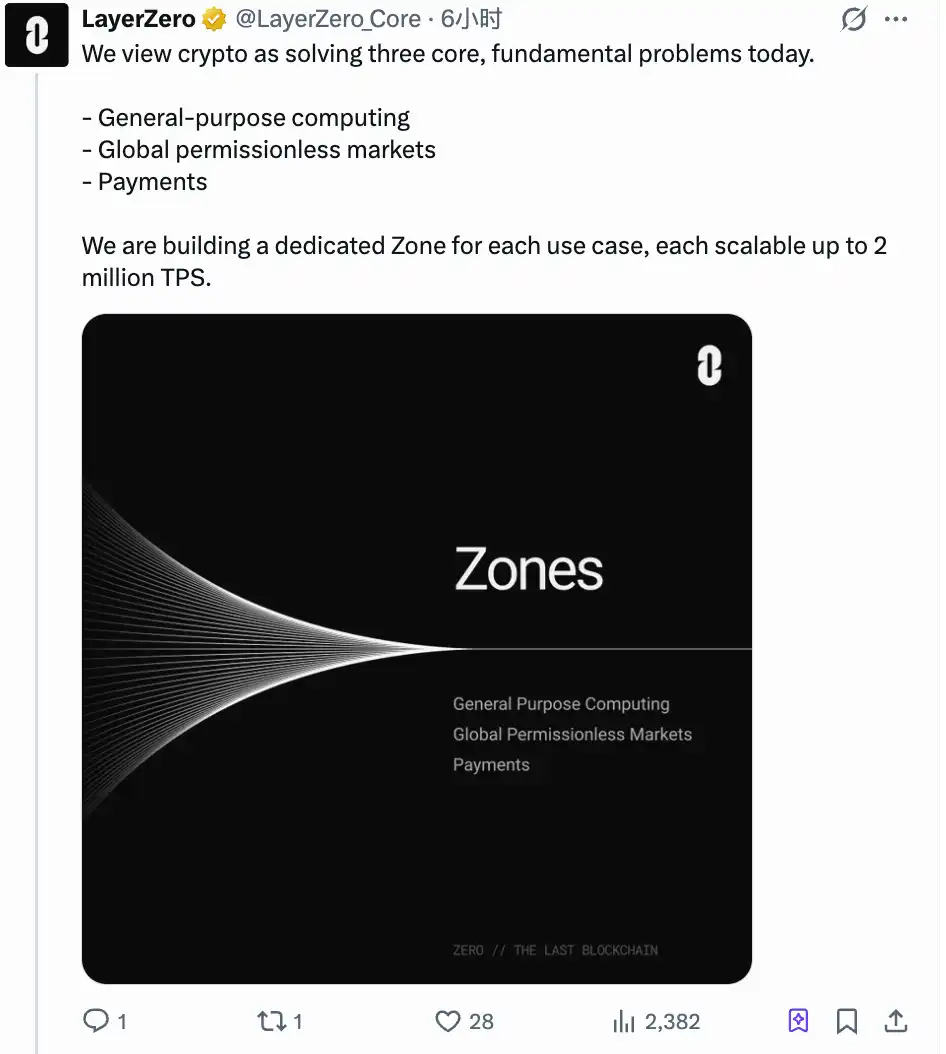
These three Zones target three types of customers.

The general EVM environment retains existing crypto developers with low migration costs. The private payment system solves an old problem for institutions: trading on Ethereum allows counterparties to see your positions and strategies, and large funds are unwilling to swim naked.

The trading-specific Zone aims more directly at solving the matching and settlement of tokenized securities.

Looking back at the list of attendees makes it understandable. DTCC clears securities transactions worth millions of billions of dollars and wants to know if clearing can be faster. ICE operates the NYSE, where the stock market is only open on weekdays, and it wants to experiment with 24/7 trading. Citadel handles massive order flows, and every step faster in the post-trade process means money.

So, looking at it together, these are not the needs of the crypto industry; they are Wall Street's own pain points.

LayerZero CEO Bryan Pellegrino was quite blunt in a public interview:

"It's not that the existing things aren't good enough; it's that the scenarios truly requiring 2 million transactions per second belong to the future global economy."

Incidentally, this new Zero chain claims to achieve 2 million TPS in test environments, which could indeed meet traditional finance production-level demands. But the performance narrative of public chains has long been played out; no matter how high the performance, the author feels it's not surprising.

The story can remain the same, but the audience can change once—this time, it's the turn of the old money.

Wall Street Wants to Move Trading On-Chain, but Ethereum Can't Handle It

The background of institutions flocking to LayerZero is not the crypto bull market but Wall Street's own push for tokenization.

BlackRock's BUIDL fund was issued on Ethereum last year, with a scale exceeding $500 million. JPMorgan's Onyx platform runs on Ethereum technology and has already handled trillions in repo transactions.

Wall Street has used Ethereum for proof-of-concept, proving that tokenization is feasible. The next step is to find a place that can handle production loads.

Zero's three Zones are aimed precisely at this gap. EVM compatibility means assets and contracts can migrate from Ethereum.
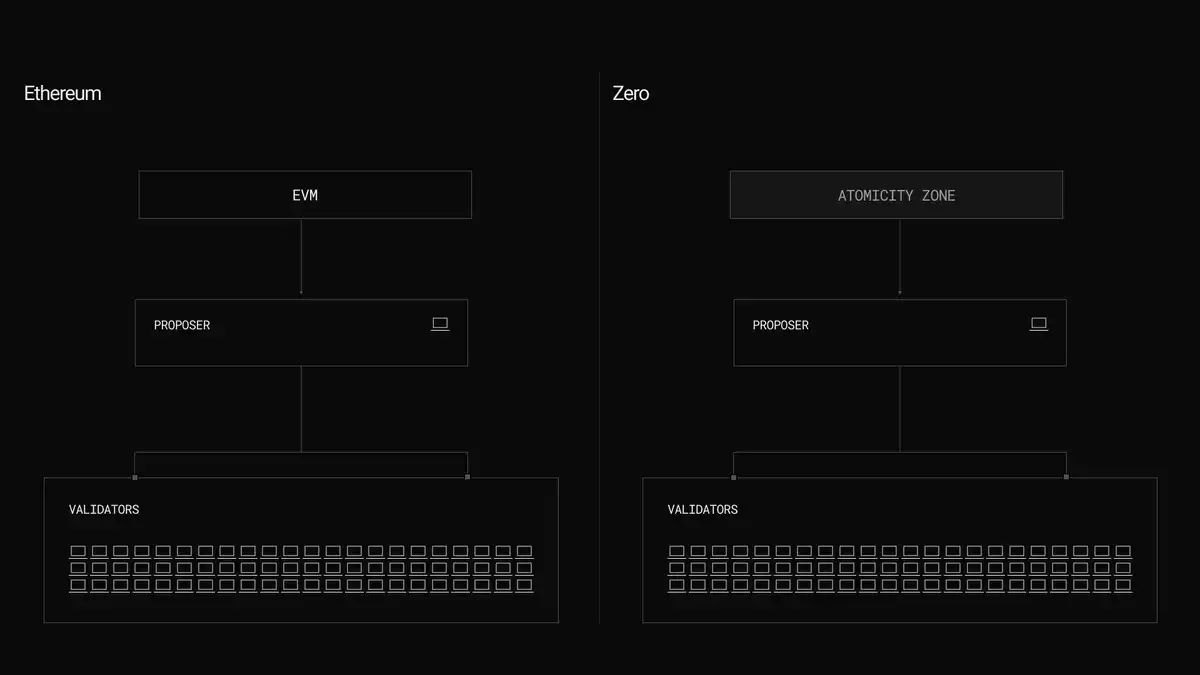
This might be the real divide between LayerZero and Ethereum.

Ethereum is currently using standards like ERC-8004 to fight for definition rights, issuing on-chain IDs for AI Agents, setting rules for the future on-chain economy...

LayerZero's current move is to ignore definitions and directly build pipelines, telling institutions that their trades can run here.

One is writing the rulebook; the other is laying the pipes. They are betting on different things.

Ethereum is betting on its irreplaceability as a trust layer, backed by TVL scale, security audit ecosystems, and institutional recognition. LayerZero is betting on the replacement demand for the execution layer: Wall Street needs speed, privacy, and throughput, and will use whoever provides it first.

Whether these two paths will eventually cross is unclear now. But the flow of capital has already given a directional signal.

What Does This Mean for $ZRO?

ZRO's previous positioning was simple: the governance token for the LayerZero cross-chain protocol. Total supply is 1 billion tokens, used for voting and staking, nothing more.

After the launch of Zero, the story of this token has changed.

ZRO is the native token of the Zero chain, anchoring network governance and security. If Zero truly becomes institutional-grade financial infrastructure, ZRO's valuation logic will no longer be "how much trading volume does the cross-chain bridge have" but "how many assets are running on this chain."

You all understand the difference between these two valuation anchors—the ceiling differs by several orders of magnitude. But narrative aside, several hard variables will determine ZRO's future trend.

Supply Side: 80% of the tokens are not yet unlocked.

ZRO's current circulating supply is approximately 200 million tokens, just over 20% of the total supply. According to CoinGecko data, on February 20, approximately 25.71 million ZRO will be unlocked, worth about $50 million, accounting for 2.6% of the total supply, allocated to core contributors and strategic partners. The entire unlock cycle continues until 2027.

This unlock on February 20 is the first supply shock after the announcement; whether the market can absorb it is a litmus test for short-term sentiment.

Demand Side: The fee switch hasn't been turned on yet.

Currently, ZRO has no direct value capture mechanism. There was a governance vote last December proposing to charge a fee for each cross-chain message, with the revenue used to buy back and burn ZRO, but it failed due to insufficient voter turnout. The next vote is scheduled for June this year.

If passed, ZRO will have a burning mechanism similar to ETH, reducing circulation with each transaction. If it fails again, the token's "governance right" will remain just voting rights, without cash flow support.

So overall, players interested in ZRO can watch three key dates:
1. June, the second fee switch vote. Passing or not will directly determine whether ZRO has endogenous demand.

2. This autumn, the Zero mainnet launch.

3. ZRO tokens will not be fully unlocked until 2027. Before that, each round of unlocking will bring pressure,叠加 the current crypto bear market. News-driven positive sentiment may not necessarily drive ZRO's price up.

Finally, LayerZero calls Zero a "decentralized multi-core world computer," which is clearly对标 Ethereum's concept of a world computer, attempting to play a more important role in the settlement layer, especially the financial settlement layer, while transitioning and cutting away from the thin narrative of a cross-chain bridge.

However, the official statements from several partners are worth pondering.

Citadel calls its participation an "evaluation of how the architecture can support high-throughput workflows"; DTCC says it is "exploring scalability in tokenization and collateral."

Translation: we think this thing might be useful, but we haven't made a final decision yet.

Wall Street's money is smart—smart enough to place many small bets simultaneously to see which one pays off first. Therefore, when a project receives endorsements from various star institutions, it does not mean a complete强绑定, but rather更像 a short-term positive catalyst.

What LayerZero has obtained might be an entry ticket, or it might just be an interview opportunity.


Preguntas relacionadas

QWhat is Zero, the new product launched by LayerZero, and what is its primary target?

AZero is a self-developed Layer 1 blockchain by LayerZero, designed to host institutional-grade financial market trading and clearing. Its primary target is to serve as a dedicated blockchain for Wall Street.

QWhich major Wall Street institutions have publicly endorsed or invested in LayerZero's new initiative?

AMajor institutions include Citadel Securities (strategic investment in ZRO token), ARK Invest (purchased equity and tokens), Tether (strategic investment), along with partnership exploration agreements with DTCC, ICE, and Google Cloud.

QHow does the architecture of the new Zero blockchain differ from traditional blockchains?

AZero's architecture is divided into multiple independently operating partitions called 'Zones,' each optimized for different scenarios. Initially, three Zones were launched: a general-purpose EVM-compatible environment, a private payment system, and a dedicated trading matching environment.

QWhat are the key factors that could impact the price and valuation of the ZRO token in the future?

AKey factors include the unlocking of 80% of the total ZRO supply (with a significant unlock on February 20th), the outcome of the fee switch vote in June (which could introduce a token burn mechanism), the mainnet launch in autumn, and overall market conditions.

QWhat is the fundamental strategic shift in LayerZero's narrative with the launch of Zero?

ALayerZero is shifting from being a cross-chain bridge protocol to building a financial infrastructure pipeline for Wall Street, targeting institutional needs for high throughput, privacy, and scalability, rather than focusing solely on-chain DeFi or retail crypto users.

Lecturas Relacionadas

7 Months After the Collapse of Huiwang, Southeast Asia's Escrow Platforms Undergo a Major Reshuffle

Following the collapse of Huione Pay—dubbed the "Alipay of Southeast Asia"—seven months ago, the region's underground financial guarantee platform sector is undergoing a significant reshuffle. This power vacuum has been swiftly filled by emerging platforms such as XinBi, Tiger/Navigator, JinBei (renamed JinBo), Dali/Tiancheng, and FullyLight. These platforms, operating largely via Telegram and offering services like escrow for illicit transactions, have absorbed the vast user base and markets left behind by Huione. While positioning themselves as "trust intermediaries," their primary clientele consists of networks involved in online scams, money laundering, illegal gambling, and even human trafficking. For instance, the Tiger/Navigator platform explicitly provides "escrow" services for kidnapping-for-ransom operations ("强押车交易"). Data underscores the immense scale: Huione alone processed over $103 billion in cryptocurrency payments and facilitated over $31 billion through its escrow market before its downfall, linking it to Cambodia's notorious Prince Group. Since its collapse, competitors have seen explosive growth. For example, the XinBi platform has accumulated over $1.6 billion in total USDT revenue, while platforms like NewPay, OkPay (under Dali), and FullyLight Wallet collectively processed over $4.8 billion in USDT in a single year. This ecosystem thrives in regions like Cambodia and Myanmar, where regulatory gaps allow these platforms to act as critical financial infrastructure for sprawling cybercrime industries, from scam compounds to online casinos. The article concludes that the moniker "Southeast Asian Alipay" is a misnomer, obscuring the platforms' fundamental role in enabling serious criminal enterprises rather than representing legitimate financial innovation.

Odaily星球日报Hace 37 min(s)

7 Months After the Collapse of Huiwang, Southeast Asia's Escrow Platforms Undergo a Major Reshuffle

Odaily星球日报Hace 37 min(s)

The Changing Landscape: What Are Crypto VCs Experiencing?

Title: The Shifting Landscape of Crypto Venture Capital The era of dedicated crypto venture capital funds is undergoing a significant transformation. Once essential for navigating the sector's complexity and high risk, these specialized funds are now facing an identity crisis as the market matures. This shift mirrors historical patterns in other specialized investment classes like cleantech and SPACs, where initial information advantages dissipate as technologies become mainstream and integrated into existing industry frameworks. The article argues that crypto is reaching a critical inflection point, transitioning from a "building phase" to an "integration phase." Major players like Stripe, BlackRock, and Visa now engage with crypto not for its novel mechanics but as a foundational financial infrastructure. Their needs—regulatory compliance, banking partnerships, distribution channels—align with traditional fintech, a domain easily understood by large, generalist funds like Sequoia and Founders Fund. This evolution creates a "barbell effect" within the VC landscape. On one end are massive, diversified platforms that can incorporate crypto as one vertical among many. On the other are small, nimble funds focused on niche, experimental projects. The middle ground—medium-sized dedicated crypto funds—is being squeezed out. Their typical fund size makes it impossible to generate sufficient returns solely from early-stage crypto bets, yet they cannot compete with giants for later-stage deals. Consequently, leading crypto-native firms like Paradigm and Framework Ventures are expanding into AI, robotics, and other sectors, driven partly by LP pressure for better returns amid a broader VC DPI crisis. Others, like Dragonfly and a16z, have narrowed their crypto focus predominantly to financial infrastructure like stablecoins, reframing the sector's core narrative. For crypto entrepreneurs, this consolidation presents challenges. While generalist funds offer larger checks and broader resources, crypto projects now compete fiercely with AI for attention and capital within these firms. Furthermore, the long-term, non-commercial foundational work that built the ecosystem—funded by dedicated crypto VCs—is less likely to attract generalist capital focused on direct returns. The conclusion is that "crypto investor" as a standalone category is becoming obsolete, akin to "internet investor." Crypto is becoming a baseline infrastructure layer. The future will see a barbell structure: large-scale growth financing handled by generalist funds, while pioneering, speculative projects are funded by small, specialized vehicles. The dedicated crypto funds of the 2017-2021 boom, which incubated core infrastructure, are giving way to this new, bifurcated reality.

Foresight NewsHace 55 min(s)

The Changing Landscape: What Are Crypto VCs Experiencing?

Foresight NewsHace 55 min(s)

As Consensus Accelerates, What Are Young Investors Betting On?

Title: As Consensus Forms Faster, What Are Young Investors Betting On? In the rapid evolution of tech investment, a new generation of young investors is navigating a landscape where AI, robotics, commercial aerospace, and quantum computing are advancing simultaneously. Traditional investment logic based on financial models is giving way to a need for deep technical understanding and the ability to act before industry consensus forms. An analysis of trends from the "WAIC FUTURE TECH" list of young investment leaders reveals key shifts in focus. The first major trend is the movement of AI from the digital screen into the physical world. Investment is shifting from large language models and chatbots towards embodied AI, robotics, AI hardware, and edge computing. While demonstrations generate excitement, the real challenge lies in achieving scalable, reliable, and cost-effective delivery in complex real-world environments like factories and logistics. Success depends not just on algorithms but on the integration of sensors, actuators, and control systems. Second, the competitive focus for large models is moving beyond raw capability toward building an "intelligence flywheel." The goal is to create self-reinforcing systems where user interaction generates data, improving the model, which in turn enhances the user experience and attracts more engagement. Companies that successfully embed AI into workflows to create these closed-loop systems can build lasting value that isn't easily erased by the next model upgrade. Third, facing a potential bottleneck in high-quality human-generated data, investors are looking at new underlying technologies. Reinforcement learning and self-play, as demonstrated by AlphaGo Zero, offer paths for AI to generate its own experience. Scientific foundation models, which aim to build general AI capabilities for fields like life sciences and materials discovery, represent a non-consensus direction that could unlock new frontiers of knowledge and data. Finally, in deep-tech areas like quantum computing, commercial aerospace, and space-based infrastructure, patient capital is essential. These fields have long, uncertain development and validation cycles involving complex engineering, supply chains, and regulations. Investment here requires a long-term view, focusing on foundational team capabilities and the eventual emergence of market demand, even if commercial returns are distant. Collectively, these trends illustrate how young investors are adapting to a new era. They are learning to make earlier, technically-informed judgments, balance hype with real-world viability, and provide the patient capital needed to build the deep-tech foundations of the future.

marsbitHace 1 hora(s)

As Consensus Accelerates, What Are Young Investors Betting On?

marsbitHace 1 hora(s)

Trading

Spot
活动图片




