Keeta rallies 36% in a day – Should KTA holders take profits now?

ambcryptoPublicado a 2026-04-01Actualizado a 2026-04-01

Resumen

Keeta (KTA), an altcoin with a $109 million market cap, surged 36.7% in 24 hours, accompanied by a 400% increase in daily trading volume. This rally occurred amid broader market uncertainty, with Bitcoin facing rejection near $76k and retesting $66k as support. The 1-day chart showed KTA reclaiming the $0.20 resistance level, with the Chaikin Money Flow (CMF) indicating strong buying pressure and the RSI suggesting sustainable upward momentum. However, the 1-hour chart revealed a potential short-term pullback toward $0.176, supported by a bearish RSI divergence and a declining CMF. Traders are advised to consider taking profits, as the longer-term structure remains bearish, and further losses may follow.

The $109 million market cap altcoin Keeta [KTA] experienced a 36.7% rally in the past 24 hours, at press time. CoinMarketCap data showed that it had a 400% surge in daily trading volume as traders and investors raced to capture some gains the altcoin was posting.

These gains came at a time of wider market uncertainty and drawdown. Bitcoin [BTC] faced rejection from the $76k level in the past two weeks and retested the $66k level as support on Tuesday, the 31st of March.

Can KTA keep its rally going, or is this rally one for holders to sell?

Right time to take profits?
Source: KTA/USDT on TradingView

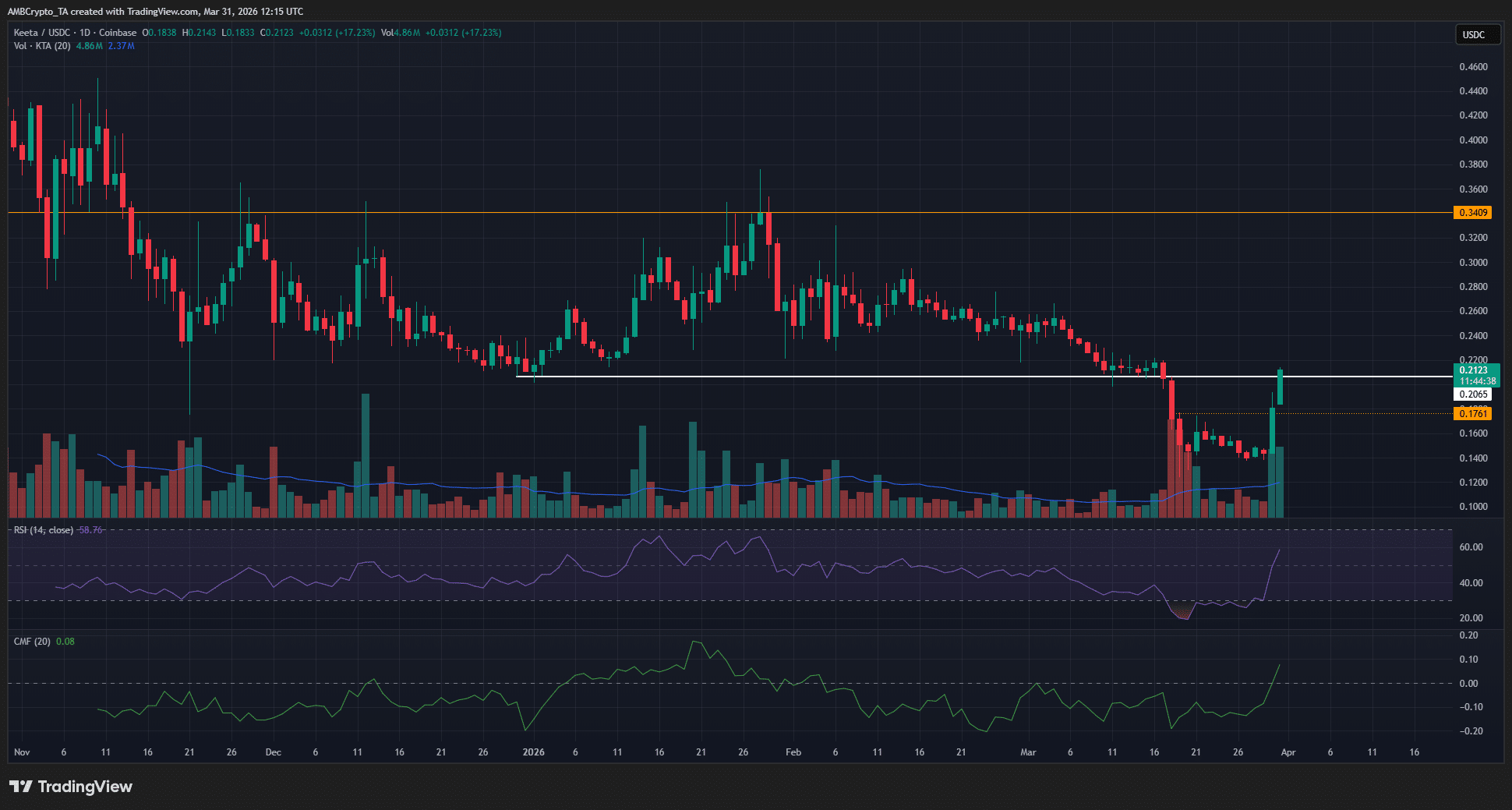
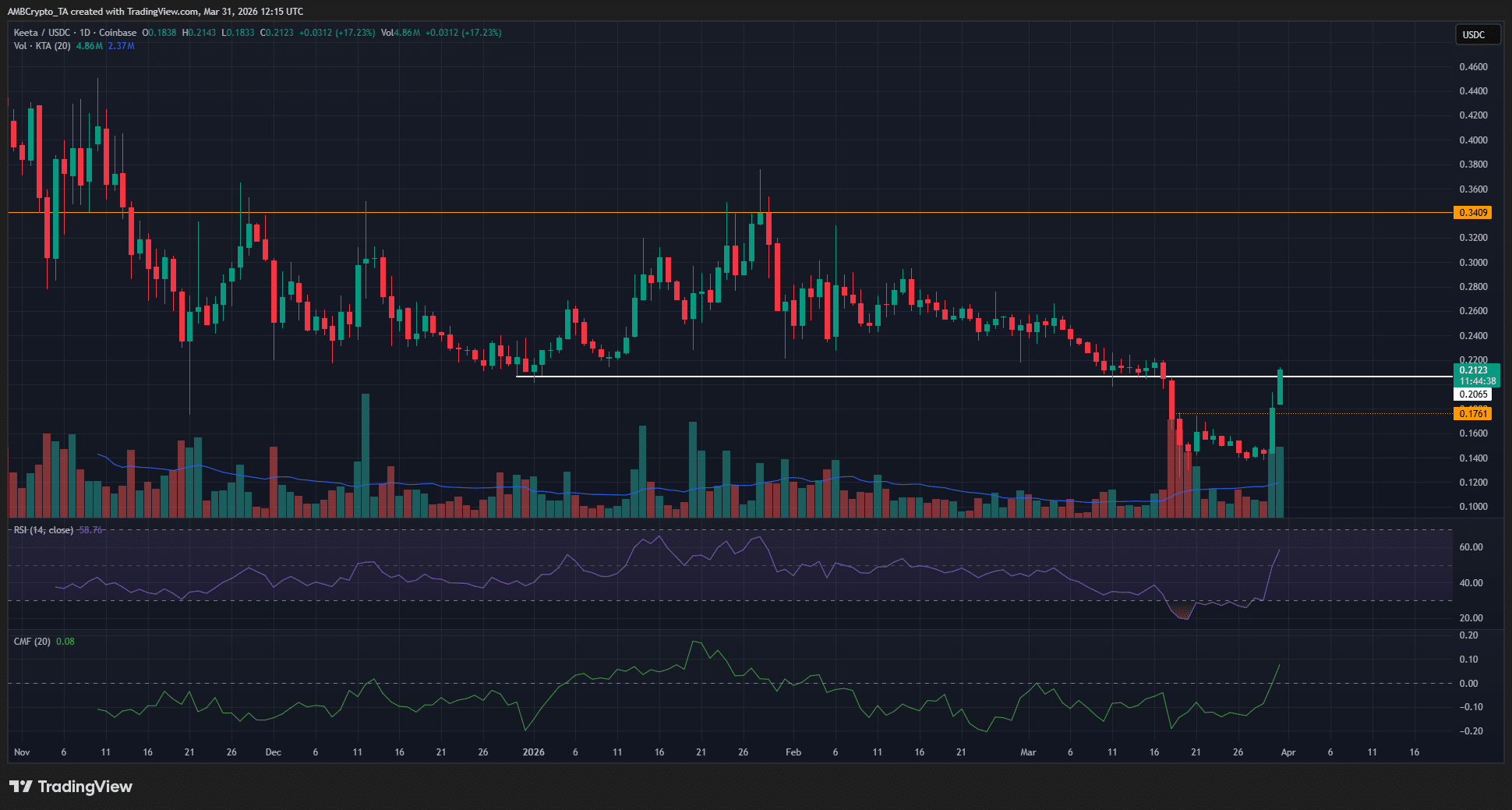
The 1-day chart of the altcoin showed the breakdown below the $0.2 support zone in mid-March. The trading volume on Wednesday, the 18th of March, was the highest single-day volume since Friday, the 12th of December 2025.

The high-volume breakdown below a support level that has held throughout 2026 was significant.

Yet, at the time of writing, KTA was poking its head back above the same resistance zone, which coincides with a psychological round number resistance.

The CMF climbed to +0.08 to indicate heavy buying pressure and sizeable capital inflows. It must be noted that the daily CMF has been negative since the market crash in the first week of February.

Meanwhile, the daily RSI has also recovered to push past neutral 50. This indicated sustainable upward momentum.

Traders’ call to action: Sell!
Source: KTA/USDT on TradingView

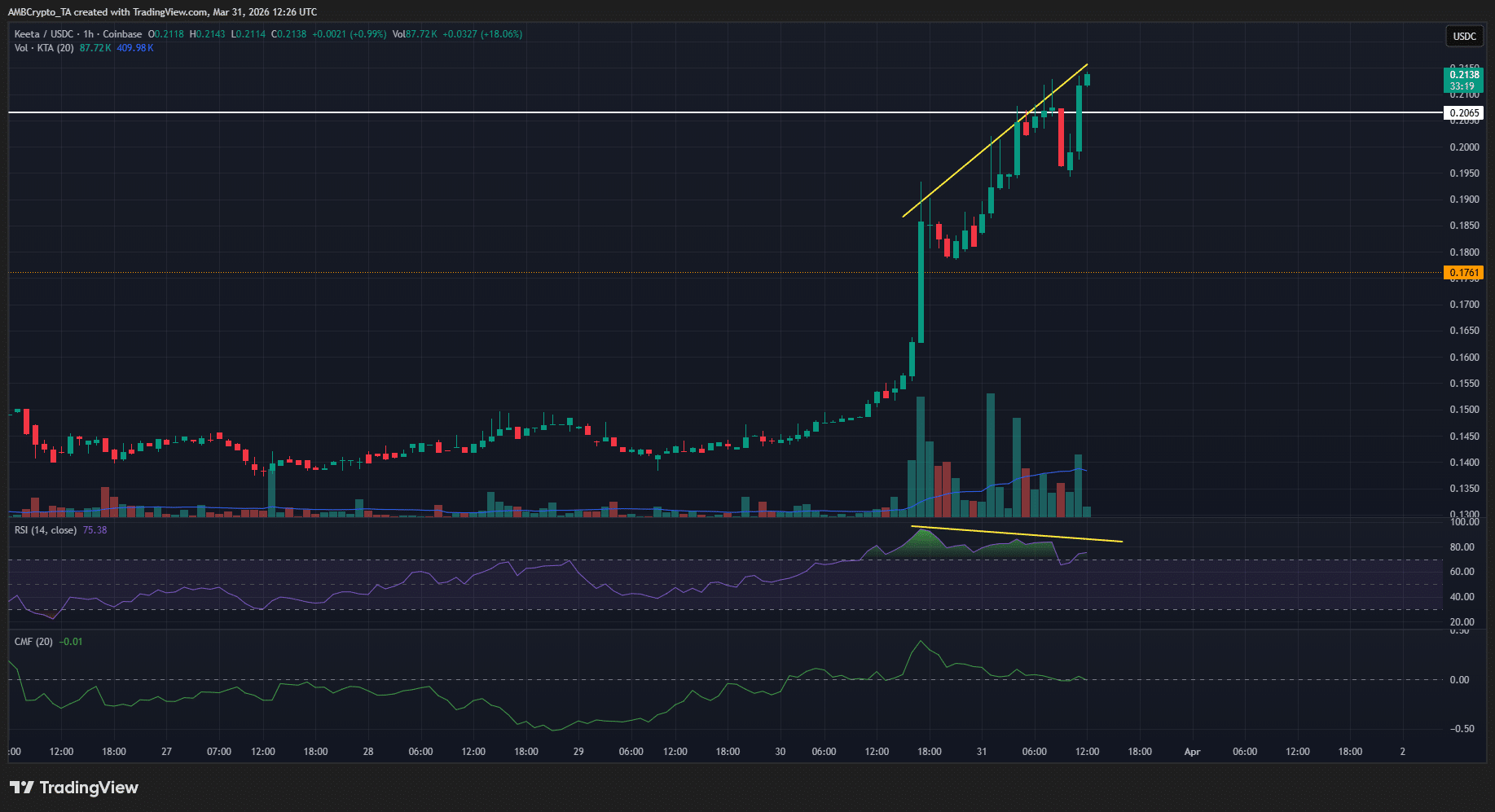
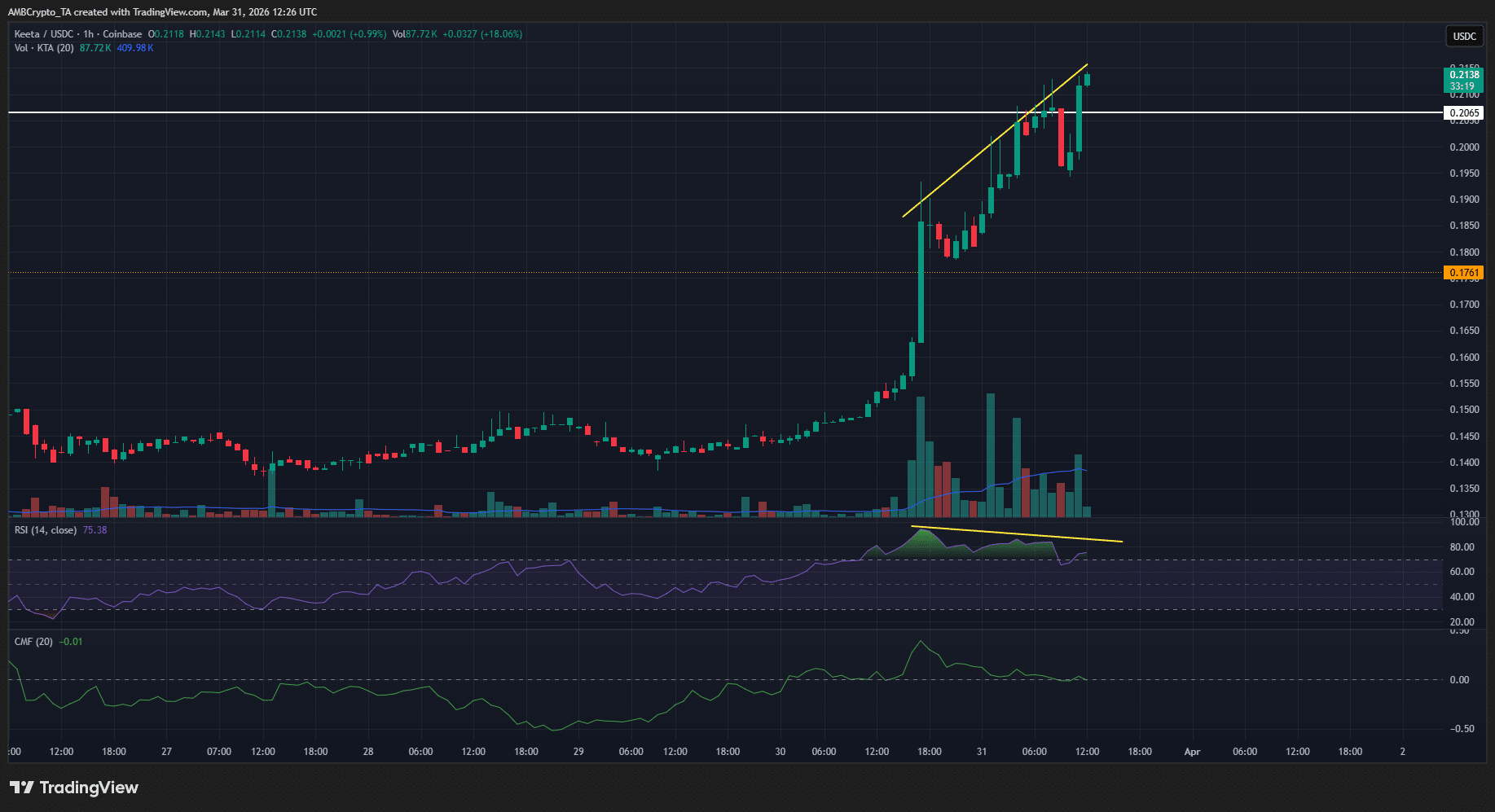
The 1-hour chart showed bullish volume and momentum indicators, but the run could be ending. While the 1-day chart stressed a bearish long-term structure, the 1-hour chart hinted at a pullback toward the $0.176 level, a support from earlier in March.

The CMF was back below +0.05 and, more importantly, the RSI was making a bearish divergence.

This was a clear sign that short-term holders should consider taking profits. As things stand, the longer-term bias means that they should be wary of buying a pullback and expect further losses instead.


Final Summary

  • Keeta saw a 36% rally in the past 24 hours and was back above a support level it lost to the bulls in mid-March.
  • The lower timeframe price chart showed that a pullback is likely, and there was a clear momentum divergence in progress.


Preguntas relacionadas

QWhat was the percentage increase in Keeta's value in the past 24 hours?

AKeeta experienced a 36.7% rally in the past 24 hours.

QAccording to the article, what is a clear sign that short-term holders should consider taking profits?

AA clear sign is the bearish divergence on the RSI (Relative Strength Index) on the 1-hour chart.

QWhat key support level did KTA break down below in mid-March?

AKTA broke down below the $0.2 support zone in mid-March.

QWhat did the Chaikin Money Flow (CMF) indicator climbing to +0.08 signify?

AThe CMF climbing to +0.08 indicated heavy buying pressure and sizeable capital inflows into KTA.

QDespite the recent rally, what is the longer-term bias for KTA according to the analysis?

AThe longer-term bias is bearish, and the analysis suggests traders should be wary of buying a pullback and expect further losses instead.

Lecturas Relacionadas

In Jinjiang, Fujian, a Storage Super Unicorn Lies Quiet

In Fujian's Jinjiang, a city known for sportswear, lies a quiet semiconductor giant: Fujian Jinhua Integrated Circuit Co. (JHICC). Once a promising domestic DRAM manufacturer alongside Yangtze Memory and ChangXin Memory Technologies (CXMT), its journey was derailed in 2018 when the U.S. placed it on an Entity List and filed criminal charges for alleged trade secret theft. This halted production for years. A turning point came in February 2024 when a U.S. federal court found JHICC not guilty. However, it had lost crucial time. While CXMT soared to become a top-valued A-share company in 2024, JHICC, with an estimated valuation of 80 billion RMB, was just restarting. Its current output is primarily customized DDR4 chips, not the advanced DDR5/HBM demanded for AI, but it still benefits from the broader memory chip upcycle. JHICC's story is tied to Chen Zhengkun, a veteran engineer who left Micron to lead the venture. Founded in 2016 with state-backed funding, JHICC partnered with Taiwan's UMC to develop DRAM technology. Rapid progress was cut short by the U.S. actions, which Micron initiated, partly due to its heavy reliance on the Chinese market. Post-sanctions, Chen's team worked to rebuild the production line with reduced reliance on U.S. technology. According to its records, JHICC achieved small-scale production and revenue growth under immense pressure. It now focuses on the stable "niche" DRAM market (e.g., TVs, routers) with a monthly capacity of ~40,000 wafers, aiming for 60,000 by 2026. It holds over 1,000 patents but remains on the Entity List. For Jinjiang, investing in JHICC was a bold industrial leap. The local government provided unwavering financial and logistical support during the crisis, helping the company survive. JHICC has become the anchor for a growing local semiconductor cluster. Though its scale lags behind domestic peers, JHICC's persistence symbolizes a hard-won foothold in a global market long dominated by Samsung, SK Hynix, and Micron. Having missed one boom, it seeks a place in the new AI-driven memory supercycle.

marsbitHace 1 hora(s)

In Jinjiang, Fujian, a Storage Super Unicorn Lies Quiet

marsbitHace 1 hora(s)

Trading

Spot
活动图片